My Charter School in Canada

February 4, 2018

Image result for my girlfriend who lives in canadaImage result for my girlfriend who lives in canada

Matt Ladner and Max Eden have observed that the National Alliance for Public Charter Schools (NAPCS) as well as the National Association of Charter School Authorizers (NACSA) give their highest ratings to states that barely have any charter schools.  As Max noted of the NAPCS rating: “Half the states in the top ten have fewer than 10 charter schools.” He added: “three of your top 10 states have produced 20 schools in 20 years.”

It’s bad enough that there is no evidence to support the criteria that NAPCS and NACSA use to rate state charter laws, but it’s intolerable that their ratings seem to praise policies that are associated with slowing the spread of charter schools — the exact opposite of what these groups are supposed to be advocating for.

It’s nice that Robin Lake is noticing that charter growth has stalled and that Portfolio Management is beginning to block more charter schools in Denver, but somehow neither she nor Paul Hill, nor any of the other charter intelligentsia, seem to be able to connect the dots and trace the problem to the types of burdensome regulatory schemes that they all prefer.  These folks back burdensome regulations with the claim that they help promote charter quality and forestall political problems, even though there is no evidence that they accomplish either of these goals.  But the evidence is becoming quite clear that what these burdensome regulatory schemes accomplish is the creation of very few charter schools and even fewer led by minority members of local communities.

It’s as if the charter intelligentsia thinks that the best charter school is the one that isn’t there.  This reminds me of the Girlfriend in Canada trope.  The best girlfriend (charter school) is the one who isn’t there.  She’s really great and I wish you could meet her, but she lives far away. Avenue Q captured this trope nicely, so I’ve modified the lyrics a bit:

I wish you could go to my charter school
My charter school that’s placed in Canada
The scores couldn’t be higher, I swear I’m not a liar
My charter school that’s placed in Canada
Its leadership is Ivy League, too bad they’re all lily-white
Competitors are not in sight, no one can put up a fight
They test kids every single day, just to make sure that everything’s okay
It’s a pity the school’s so far away in Canada
Last year we reported the highest grad rate
Too bad it’s because we chose to inflate
It’s so sad, that doesn’t mean we’re not great
Our discipline’s progressive and our politics transgressive
I wish you could go to my charter school
But you can’t because it’s in Canada
I know I’m persistent, even if it’s non-existent
That’s why I favor district schools… er, I mean charter schools
Darn, I really want district schools to create more charter schools
It’s the best charter school, my wonderful charter school
Yes, I have a charter school that’s placed in Canada
And I can’t wait to give kids more choices


Sad and Lonely is a Bad Look-Even More Than Usual When You Lead in Gains

January 30, 2018

(Guest Post by Matthew Ladner)

Arizona Republic columnist Bob Robb turned in a gem recently on the improvement in Arizona academic achievement:

The furious reaction to an ad campaign by some Arizona business organizations raises a question that deserves more than a superficial ponder: Why is there such resistance, hostility even, to good news in Arizona, particularly about K-12 education?

Arizona schools are seriously underfunded compared to other states. Legions have made the leap, based upon this indisputable fact, that Arizona children are getting a lousy education compared to the kids in other states.

That has never really been the case.

According to the 2009 results from the National Assessment of Educational Progress test, the most reliable cross-state measure of student learning, Arizona kids, considered as a whole, did lag behind the national average.

But that was mostly a function of demography. When the data was disaggregated, Arizona was right around the national average. White students in Arizona did as well as white students elsewhere. And Latino students in Arizona did as well as Latino students in other states.

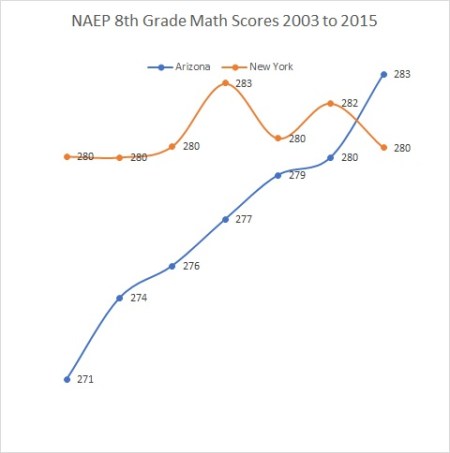
When the 2015 NAEP results came out, Matt Ladner, senior research fellow at the Charles Koch Institute, made a startling discovery. Arizona students led the country in gains between 2009 and 2015.

According to the NAEP administrators, who work for the federal government, Arizona results for students as a whole in 8th grade reading and math were now “not significantly different” from the national average. Arizona white students now score above the national average for white students. As do Arizona Latinos compared to Latino students elsewhere.

This should be very big news. It should have catalyzed an intense discussion and inquiry about what was happening in Arizona classrooms that yielded such astonishing results, particularly during a period when the schools were on starvation rations when it came to resources.

 Instead, these remarkable results have created barely a ripple in the discussion of K-12 education in Arizona.

Robb gives yours truly too much credit as there were others who noticed the Arizona gains earlier than me. I simply dug into the details and subgroups trends. In any case, Robb does an admirable job of describing the climate in Arizona. The dedication in some quarters to what seems to be an entirely self-defeating and irrational strategy is truly astounding.

The strategy strikes many of us as follows: how many entrepreneurs attempting to raise investment capital would make the argument that even vaguely sounds like “our product is HORRIBLE and you should be ASHAMED unless you give us more money. Buy our stock or you are a bad person!” How do we imagine such a strategy would work out?

“Everything is HORRIBLE!!!!” is a whip-up the base type strategy, but contributes to skepticism and ultimately defeat by poisoning the well with the public. In 2012, the districts put a tax measure on the ballot to support education, which failed almost 2-1 on election day. Then, as now, people were touting polls allegedly showing that the public supported the measure, but on election day the voters rejected it overwhelmingly. Proponents still grouse about the no campaign, but the no campaign won for a reason and in fact people on the yes side of the effort swear up and down that the support for the measure had begun falling before opponents launched their campaign.

The reason is simple: the public lacks confidence that increased spending will see the inside of a classroom. In other words they fear (rationally) that the money will simply be wasted. A non-stop narrative of “Everything is HORRRIBLE!!!!” is like the soundtrack to building public skepticism regarding sending good money after bad in AZ K-12.

Robb notes in his column that district supporters fear that drawing attention to Arizona’s nation leading gains may undermine the case for additional revenue, allowing some to make the case that current funding levels are “good enough.” I however believe that the opposite is true- instead of the self-defeating misguided pitch above, what if the pitch became “Arizona has the fastest improving public education achievement scores in the nation. We are asking for your increased support in order to accelerate our momentum in providing our students the knowledge, skills and character necessary for success in life.” Imo:

I’m content to let this whole democracy thing work itself out on the question of funding. Arizona has lots of old people and large average family sizes. The states just above and below us on the funding rankings are Idaho and Utah, respectively. Hmmm…what do those states have in common? Here’s one:

Arizona (and Idaho and Utah) have large average family sizes and we should not want or expect this to change. Arizona has lots of retirees living on fixed incomes anxious to vote every election- and this is increasing. Arizona has no oil gushers or hedge fund billionaire clusters paying sky high income taxes. Add on top of that a self-defeating trash-my-own product fundraising strategy reinforcing a notion on the part of the public that Arizona schools could not find their posterior with both hands and a map. Call me nuts, but disabusing the people of this latter notion, rather than reinforcing it, is helpful rather than harmful to the case for increased funding.

Arizona is never, and I mean EVER going to win a spending per pupil contest, but some cards could be played much better. Instead of winning a spending contest, we have been winning a bang for the education buck contest and leading the nation in academic gains. I’ll eventually once again become one of the millions of voters on a statewide funding vote. So far I am batting a thousand as far as landing on the winning side, but my vote is very unlikely to be decisive. If funding were driving results, we would not be seeing trends like this:

So cheer up Arizona- we’ll eventually put the 2018 elections behind us and while the capacity of the school crowd to pull defeat from the jaws of victory is strong, at least the Arizona business community seems to have embraced a positive path forward. Oh and also there is a whole lot to be happy about in improving faster than any state, especially if we can keep it up.


Pass the Popcorn: Words and Deeds

January 24, 2018

darkest-hour_de5745f86cac1e5c466d8d21ac667752

(Guest post by Greg Forster)

Okay, depending on where you live, maybe maybe maybe it’s not too late for you to head out and see Darkest Hour on the big screen. As the surprise standout in Oscar nominations, the movie may find itself on a few extra screens. (Theaters screening Mary and the Witch’s Flower get a dispensation, all others are on notice.)

This is a visually stunning movie and it well deserves a big-screen screening. I especially appreciate the filmmakers’ having lavished so much effort on the cinematography of a movie that isn’t about superheroes or spaceships, and for that matter doesn’t even have that much to work with in terms of war machines.

Yes, part of it is the effort put into the bombing scenes. But it’s also recreating the cramped quarters of the underground bunker, the vast chamber of Parliament, and the dingy makeshift bedroom in which the king made his decision to back the war.

Oh, and whoever it is playing Churchill does a pretty okay job, too.

(I’m proceeding with full spoilers because, duh, history.)

958d9676bd9168931e63dd43f538cc5a0a40aacf

This movie begins as a character study of Churchill. But any character study of Churchill must ask the question: What is it that makes a man refuse to agree to surrender his nation (for that is what “negotiations” with Hitler would have meant) even in the face of certain destruction? And that is not really a question about the man. It is a question about the nation. For, as it is the burden of this movie to show, Churchill could not have stood firm if the nation had not been willing to stand firm.

Yes, part of the story is that Churchill’s leadership brought the nation to choose resistance unto death. But leaders must have something to work with. The nation itself has to have moral resources for making right but hard choices.

This is why I cannot join those who are upset that this movie emphasizes Churchill’s temporary willingness to broach negotiations. It looks to me like the movie did not deviate from the historical record as far as some suggest. Perhaps it would have been better to show a little more of the cunning that lay behind Churchill’s decision to speak to the outer cabinet; Churchill did manufacture their pressure upon him to change course and forbid negotiations. But the point of this movie is that Churchill was almost boxed in. The professional political class did not provide the moral resources needed to sustain a stand against Hitler. Churchill had to go find them elsewhere.

So this movie transitions from a character study of Churchill to a character study of Great Britain. It asks: What are the moral resources of a nation?

The answer is words – but not words.

Words cannot produce the needed force by themselves, because the needed force is moral, and it transcends mere words. That is the abracadabra fallacy. But words rightly used are needed to transform moral truth into moral action.

Persuasion is not an autonomous power. Persuasion exists to connect people to truth.

darkest-hour-still

The first big turning point of the movie is when Churchill lies to the nation about the severity of the situation in France. As he says to his wife, for years he has been the only person with the guts to tell the people the truth. But now he believes he has to lie to them.

This, the movie makes clear, was a wrong move – the abracadabra fallacy.

Halifax, demanding Churchill negotiate, tells him that with the British army facing certain destruction, he has nothing to fight Hitler with but “words, words, words!”

Yet that same Halifax, at the end of the movie, declares that Churchill has won with words. “What just happened?” someone asks Halifax after Churchill wins over Chamberlain’s faction to support the war effort.

“He mobilized the English language and sent it into war,” replies Halifax.

And what is the bridge between words and moral reality? History.

darkest-hour-ben-mendelsohn

History brings us into contact with two things that give words moral reality: kings and books.

Our nations and their institutions and traditions are a mess. They really are. They’ve done much wrong and are shaped by many irrational forces. And they are not an absolute authority, for there are authorities in whose light they too can be judged (we will come back to that in a moment).

But they embody moral truths, because human beings are moral creatures and we cannot organize our lives in any kind of sustainable way except around moral truth. And so the institution of the monarchy may be irrational, but it exists to embody something. When the monarch chooses to carry out this function rather than neglect it, he has extraordinary power. The same can be said to some extent of all political institutions and traditions (including those in republics).

The makers of this movie thought a lot about how to portray George VI. It is clearly in dialogue with another outstanding movie that reflects on the tensions between aristocracy and democracy in light of World War II, The King’s Speech. For one thing, Darkest Hour really wants to make sure you know that Churchill stupidly opposed Edward’s abdication and George’s ascension, despite what you may have seen in that other movie.

It falls to George, who hates Churchill and has every good reason to do so, to make the decision to back Churchill at the crucial moment. When the short-sighted political class all go one way, the king goes the other – because that is his job.

And it is through words, used rightly, that George helps Churchill understand the moral ground he has been lacking. Go to the people, he says, draw from their moral strength and give them “the truth unvarnished.”

Yet this call to go to the people suggests that kings (and by extension political institutions and traditions generally) are not the highest authority.

We find the highest authority in another part of history, in the world of ideas – literature, religion, philosophy – that comes to us from the great minds, through their books.

DH4

Yes, the subway scene is odd, and ahistorial, and if the filmmakers had asked me I probably would have told them to find another way to accomplish what they’re doing here. But what they’re doing here is the right thing.

Some have interpreted the scene as an attempt to tear down quasi-aristocratic leaders like Churchill, establishing that they’re not allowed to lead us but we must lead them. That’s not how I read it, and I think Steven Hayward has made that case well, so I don’t have to.

Churchill is going to the nation to find out what they’re made of, how far they’re willing to go. It is right for political leaders to lead with full awareness of how much they can ask of their people.

And what does Churchill find among the people? The words of Macaulay – the same words, if I remember rightly, that he found in his library in an earlier scene:

Then out spake brave Horatius, captain of the gate:

“To every man upon this earth death cometh soon or late.

And how can man die better than facing fearful odds,

For the ashes of his fathers and the temples of his gods?”

And so we are led back to political institutions and traditions (the ashes of his fathers), but now in light of what is higher (the temples of his gods) and also what is lower (Londoners on the tube).

For the words of great books are democratizing; they make the lowest highest. They arm ordinary people – even a black man in 1940 Britain – with the moral strength to stand in judgment of a Chamberlain, a Churchill or a George.

And so, in the end, having drawn strength from the words of his national traditions (by way of the king) and the words of the greatest of the wise (by way of the people), Churchill uses his enormous gift with words to rally the nation, giving form and force to their moral resources and saving the world.

His gifts really were extraordinary, but the point of this movie is that his gift with words was less important than his willingness to deploy them for moral truth.

As Chamberlain said: “He was right about Hitler.”


Failure Up Close

January 23, 2018

It’s finally out!  Run, don’t walk, to the Amazon or the Rowman and Littlefield web sites to buy your copy.

The book was a fascinating exercise that produced some really useful results.  Mike McShane and I asked 9 very smart and experienced education scholars each to identify a failure in education reform and reflect on why that failure occurred and what could be learned from it.  We didn’t pickwhat policies were failures, we let the authors do that.  The only thing we did was encourage people to engage in some useful self-criticism and try to focus on policies with which they were sympathetic.

Be sure to check out the chapters by Rick Hess and Paige Willey, Larry Cuban, Dan Willingham, Marty West, Ashley Jochim, Matthew DiCarlo, Anna Egalite, Matt Ladner, and Megan Tompkins-Stange.  And in the intro and concluding chapters Mike McShane and I try to identify common themes and lessons across these contributions.

Rather than blaming others, this book is about the honest mistakes we all make in trying to improve education policy and how we might avoid similar mistakes in the future.  There is nothing inherently wrong with failure.  The problem is our unwillingness to acknowledge and learn from failure.  If we can’t do that we tend to repeat the same policy failures over and over.  I would rather that we “fail better.”

Or as Samuel Beckett put it:

“All of old. Nothing else ever. Ever tried. Ever failed. No matter. Try again. Fail again. Fail better.”


Remain Calm. All is Well!

January 22, 2018

Paul Peterson has an excellent interview of Mo Fiorina on Education Next regarding Mo’s new book.  This new book, like several earlier works by Fiorina, makes the case that America is not coming apart at the seams, despite appearances.  Based on a careful analysis of public opinion polls and his extensive knowledge of American politics, Fiorina argues that Americans are no more divided on political issues now than they have been for many decades.  Most Americans remain moderate in their politics and rarely embrace extremist views or movements.

The reason things feel more divided is that political parties have become more homogenous internally and more distinct from each other.  Gone are the Southern, conservative Democrats, like George Wallace or even Sam Nunn, and the liberal, Northeast Republicans, like Nelson Rockefeller and Edward Brooke.  The Voting Rights Act ended one-party rule in the South and other regional issues have given way to parties with uniform, national agendas.  Parties have also become more responsive to national donors, who fund campaigns and drive the agenda in local races throughout the country.  This has made the country more partisan, but not more divided, since people have just been sorted more clearly into distinct parties.

Paul asks Mo an excellent question: how come one of the parties hasn’t moved its positions closer to the middle to capture all of those moderate voters and ensure greater electoral success?  Mo answers that parties are no longer primarily about winning elections.  They are primarily concerned with articulating and promoting the more extreme views of their donor and activist bases.  Paul and Mo were my graduate advisors and I served as a teaching and research assistant for both, so I am always inclined to believe them.  Despite my prejudices, however, I think Mo makes a persuasive case that has implications for the ed reform movement.

What if ed reform foundations and organizations are not, for the most part, really concerned with winning?  What if, like political parties, they are just trying to articulate and promote the worldviews of their donors and activist bases?  Thinking about ed reform foundations and organizations like Fiorina thinks about political parties would explain a lot.  It could explain why foundations and the organizations they fund have pursued a series of reforms whose failures were easily predictable, from Measuring Effective Teachers to Common Core to Portfolio Management to reforms that focus narrowly on the most disadvantaged.  It could also help explain why people at foundations and reform organizations almost never experience consequences when the ideas they back fail.  Ed reformers are so far removed from accountability that Tom Vander Ark was even pushed out of Gates for backing a strategy that succeeded.

Maybe many ed reform foundations and organizations are not actually about reforming education as much as they are about appearing earnest in support of things elites consider to be good.  This would help explain the disproportionate amount of energy devoted to posturing on social media and making speeches to each other at conferences.

Of course, it’s easy to become too cynical about ed reform, just as it is too easy to despair about the nation’s political divides.  But Mo offers a parsimonious theory that not only explains why parties have not moved more to the middle but also why ed reform appears stuck with a string of political failures.


Organizations Can’t Disrupt Themselves

January 17, 2018

(Guest Post by Matthew Ladner)

I’ve been hearing through the grapevine for a long time that Denver’s much ballyhooed portfolio strategy was in deep trouble. Robin Lake calls it out today in Denver’s Storied Portfolio District is Starting to Act Like Just Another City School System.

It might be more useful to think of this as: the Denver district has acted like just another city school system for almost its entire history, flirted with the idea of being something different, but then yielded to political gravity in an entirely predictable fashion.

Clayton Christensen explained years ago that organizations don’t disrupt themselves. Mainframe computer manufacturers did not deftly transition to making personal computers rather than die- they just died. Every other brand in General Motors took every opportunity to slip their knives into Saturn’s back- sure enough GM eventually squandered an enormous amount of public goodwill for Saturn before it eventually died. School districts don’t willingly hand over empty buildings to outside operators. All of this falls somewhere on the water is wet, objects fall to the ground, you don’t fight a land war in Asia spectrum of the self-evident.

Jay noted years ago that you can call your district Superintendent a “harbor master” but in the end it is a tomatO tomAto exercise, especially if they are still hired and fired by boards elected in single digit turnout elections dominated by incumbent interests. Building new rather than attempting to reform the old remains the best strategy.


New Faculty in the Department of Education Reform

January 16, 2018

I am pleased to announce that the Department of Education Reform at the University of Arkansas will have two new faculty members.  Both Jonathan Wai and Albert Cheng will be joining us in August 2018 as Assistant Professors in Education Policy.  Jonathan Wai will also hold the title of Endowed Chair in Education Policy.  The current holder of that endowed chair, Gary Ritter, will be leaving in August to become the Dean of the School of Education at St. Louis University.

Jonathan received his B.A. in Psychology and Mathematics from Claremont McKenna College followed by an M.A. in Psychology and Evaluation from Claremont Graduate University.  He then earned his Ph.D. in Psychology from Vanderbilt University.  Following that, Jonathan was a post-doc at Duke University and remained there as a Research Scientist affiliated with Duke’s Talent Identification Program (TIP), which strives to identify and offer enriching opportunities to gifted students, especially those from disadvantaged backgrounds.  Jonathan’s research covers a variety of topics, such as gifted programs and the role of intelligence in educational success, and has been widely cited.

Image result for albert cheng harvard

Albert received his B.A. in Mathematics from the University of California at Berkeley followed by an M.A. in Education from Biola University.  He taught math in a school in California before enrolling in and completing his Ph.D. in Education Policy from the University of Arkansas.  Following that, Albert was a post-doc at Harvard University in the Program on Education Policy and Governance.  Albert’s research covers a variety of topics, including path-breaking ways of measuring non-cognitive or character skills and the role of mission in school success.

We are sad to bid farewell to Gary Ritter but extremely excited about these new additions to our faculty.


The Houston Almond Dome?

January 16, 2018

(Guest Post by Matthew Ladner)

California’s drought riddled Central Valley produces 80% of the world’s almonds, but each nut takes a gallon of water to produce. Hmmm.

By spraying mineralized water on plant roots, vertical farming techniques have succeeded in reducing agricultural water use by 91% in some crops. You need enclosed climate controlled space, and the price of real estate is a key consideration.

Now comes word that scientists have succeeded in increasing crop yields by keeping plants under lights 24/7.

Which leads us to…the Astrodome.

The so-called “8th Wonder of the World” when it was built became antiquated. The Houston Oilers moved away to become the Tennessee Titans in search of a modern stadium, and the Astros eventually moved to their own space as well. When the NFL put an expansion team in Houston, a new stadium was the price of poker. The Houston Texans modern stadium sits right next to the Astrodome.

There was a city referendum on turning the old dome into some sort of park. It failed. It was said that they would tear the thing down if it didn’t pass, but perhaps because of the expense of hauling away the rubble it is still sitting there.

So…anyone see where I am going with this? Houston would be better off selling the dome for a dollar than spending millions to demolish it and haul away the remains. Especially if you could, you know, steal another California industry in the process. The Astrodome is dead, long live the Almond Dome!


Metric Fixation

January 14, 2018

Image result for metrics

Jerry Muller has a piece in the Wall Street Journal that should be required reading for foundation staff and ed reformers who are obsessed with metrics.  Here is a snippet:

Metric fixation consists of a set of interconnected beliefs. The first is that it is possible and desirable to replace judgment with numerical indicators of comparative performance based on standardized data. The second is that making such metrics public (transparency) assures that institutions are actually carrying out their purposes (accountability). Finally, there is the belief that people are best motivated by attaching rewards and penalties to their measured performance, rewards that are either monetary (pay for performance) or reputational (rankings).

But not everything that is important is measurable, and much that is measurable is unimportant. Most organizations have multiple purposes, and that which is measured and rewarded tends to become the focus of attention, at the expense of other essential goals. Similarly, many jobs have multiple facets, and measuring only a few of them creates incentives to neglect the rest. Almost inevitably, people become adept at manipulating performance indicators. They fudge the data. They deal only with cases that will improve performance indicators. In extreme cases, they fabricate the evidence.

It’s not that measurement is useless or intrinsically pernicious. The challenge is to specify when performance metrics are genuinely useful—that is, how to have metrics without the malady of metric fixation….

Tools of measurement are most useful for internal analysis by practitioners rather than for external evaluation by the public, which may fail to understand their limits. Such measurement can be used to inform practitioners of their performance relative to their peers, offering recognition to those who have excelled and offering assistance to those who have fallen behind. To the extent that they are used to determine continuing employment and pay, they will be subject to gaming the statistics or outright fraud….

Just because performance measures often have some negative outcomes doesn’t mean that they should be abandoned. They may still be worth using, despite their anticipatable problems. It’s a matter of trade-offs, and that too is a matter of judgment.

With measurement as with everything else, recognizing limits is often the beginning of wisdom. Not all problems are soluble, and even fewer are soluble by metrics. It’s not true, as too many people now believe, that everything can be improved by measurement, or that everything that can be measured can be improved.


The Lives of Others

January 12, 2018

Image result for behavioral economics

In education reform, like other policy areas, analysts are busy trying to identify how to channel people’s behavior in directions that we believe will improve their lives.  If we think people should eat less, we devise interventions to encourage them to cut back.  If we think too few students go to college, we nudge them to enroll.  If we think people save too little, we arrange systems to increase retirement contributions.  In what is imagined to be a kinder, gentler approach to these problems, we “nudge” people toward desired outcomes rather than mandating them.  Mandating can seem too harsh and produce backlash, but nudges allow social scientists to influence behavior without feeling like they are infringing on the autonomy and liberty of the people whose behavior they are shaping.  Most people behave irrationally and lack impulse control, but the priestly class of social scientists can detect and correct these problems for other people.

A central problem with this approach is that we know too little about the lives of others to know with confidence what is good for them or how our nudges will affect their entire lives.  We may think we are helping people, but absent the same contextual information that individuals possess about themselves we are liable to push (excuse me, nudge) people in ways that actually harm them.

A recent NBER study on a plan to increase retirement savings helps illustrate the challenges associated with managing other people’s lives.  That study examined a natural experiment in which civilian employees of the military were automatically enrolled in contributing 3% of their income toward a retirement plan that would be matched by employer contributions.  Previously, employees had to opt-into this retirement plan, but the policy changed so that employees would have to opt-out if they did not wish to contribute.  Already employed workers were exempted from the change, so researchers could compare those hired just before the policy was implemented to those hired just after to identify the causal effect of the switch toward automatic contributions.

As intended, the plan increases retirement savings: “At 43-48 months of tenure, automatic enrollment increases cumulative employer plus employee contributions since hire by 5.8% of first-year annualized salary.”  While the plan succeeded in increasing retirement savings, employees did not appear to decrease their consumption.  Instead, they increased their borrowing, particularly for cars and homes, by an amount that exceeded the amount by which their retirement savings increased.  Even if we exclude the mortgage borrowing, which has a more ambiguous affect on long-term wealth given that house prices may appreciate by more than interest and depreciation, even just the auto loan increases exceeded the amount by which employees increased their savings.  If we include the employer match, increased retirement wealth was close to the increase in auto loan amount.  Overall, it is unclear if the policy increases the total wealth of the employees.  Excluding the employer match, employee wealth is likely decreased. So the only clear effect of the automatic savings policy is a transfer of wealth from whoever pays for the employer match to employees, but no overall benefit to society.

As this study reveals, shaping other people’s behavior is complicated.  People may not contribute to retirement plans because they want to consume things now.  Pushing (er, I mean, nudging) them to save anyway may just cause them to increase their borrowing in a way that has no net benefit or even a net harm.  We don’t know enough about other people’s lives to manage them optimally.

But retirement savings is usually considered one of the clear success stories for nudges.  I suspect that is because people typically judge those interventions by the extent to which they change the narrow behavior on which we are focused rather than overall well-being. That is, we nudge people to contribute more to retirement savings and sure enough they do.  Mission accomplished.  But we really need to look at their total consumption and borrowing behavior to see how this policy affects folks.  When we step back to see the bigger picture, the benefits disappear or even become harms.

The same is true for educational nudges.  We have a number of studies that look at short-term and narrow effects of nudges to get students into college.  Sure enough, if we push (I mean, nudge) people to enroll in college, they tend to do that.  All that shows is that people believe we are experts and are willing to substitute our expert advice for them (even though we know almost nothing about them) for their own, better informed judgement about what they should do.  The real proof of college-going nudges is not whether people listen to us, but whether that helps them long-term.  Those long-term results have not yet been published, but those results exist and I believe based on leaked drafts that the short-term benefits go away or even turn into harms after a few more years.   That is, students who didn’t think they were ready for college but were pushed into attending may have difficulty finishing and other students who enroll later may be better prepared at that point to succeed, causing the overall effect of these nudges to be null or even negative.  One has to wonder about the ethics of researchers touting short -term positive results if they know that longer-term effects tend to go away or turn negative.  Are they nudging us to accept the idea of nudge interventions, so it is really for our own good to only hear about positive short-term results?

(H/T Bob Costrell for alerting me to the retirement study.)