ALELR Wraps Up the NEA Convention

July 15, 2009

Han & Chewie Cantina

Are you union boys having some kind of local trouble?

(Guest post by Greg Forster, with profuse apologies for the pun in the caption above.)

ALELR just sent out the first new Communique in three weeks, and it’s a treasure trove of hidden gems from the recently concluded NEA national convention. Here are a few choice tidbits to convince you to go dig deeper:

1) ALELR shares Matt’s interest in the increasing level of comfort and frankness at NEA about the fact that they have changed from a professional organization to a labor union. He offers a delightful digest of that Chanin speech Matt linked to last week (“Whatever you think of Chanin, he is to be applauded for his clarity in an age where obfuscation is the norm in politics. We shall not see his like again”) and draws attention to this fascinating reflection from notorious NEA double agent Hans Moleman on the longtime internal conflict at the organization between unionists and social radicals.

2) In addition to noting that the . . . uh . . . unpleasantness in Indiana was completely hushed up at the convention, he also relates this exclusive story:

I’m reliably informed that at the NEA board of directors meeting immediately preceding the representative assembly in San Diego, the Indiana contingent was given a standing ovation.

Let’s see: They’ve driven the union into a multi-million dollar debt, failed to notice their insurance trust was being bled dry, fell under national trusteeship, threatened to kick 650 disabled teachers into the street, laid off one-quarter of the staff, put their headquarters building up for sale, watched charter school caps lifted, and failed to block a tuition tax credit for private school students.

Way to go! If only California and New Jersey would follow your lead.

3) He provides highlights from NEA coverage by Rich Gibson of the ed school at San Diego State, a radical-left critic of the unions. Quoting Gibson on Linda Darling-Hammond: She “noted that California prisons spend more per capita than the schools do. She did not say that the guards are members of the AFL-CIO.”

4) As every year, he derives endless amusement from the NBIs (“new business items”) introduced by delegates, which run the gamut from cranky to obnoxious to certifiable. “NBI 38 – a complaint that the Labor Department’s ‘Dictionary of Occupational Titles’ defines teaching as ‘light’ work. A little research shows the term refers only to strength, and how much force one exerts in a typical day. If you are exerting 20 to 50 pounds of force on the kids, you should seek another profession.”

5) Finally, I really must quibble with this – an item from before the NEA convention, but it’s included in the new Communique – making the case that union organizing will not undermine the charter school movement. Now, I prefer having charters over not having them, and I offer no predictions as to whether they are politically viable in the long term, or whether union organizing will subvert them. But the argument ALELR makes here is not sound; maybe his position is right, but his reasoning (or at least one part of it) doesn’t adequately support it.

Responding to a post by Andrew Coulson arguing that government-owned schools must eventually succumb to unionization as the charter sector grows to a larger scale, ALELR writes:

As long as charters stay true to their roots, treat their employees well and weed out failing schools, they’ll be able to resist union and bureaucratic pressures.

In other words, as long as charters don’t succumb to unionism, charters won’ t succumb to unionism!

ObiWanCantina

Let’s just say we’d like to avoid any . . . imperial entanglements.

Han Cantina

Well . . . that’s the real trick, isn’t it?

ALELR thinks you can resist “bureaucratic pressures” even while growing into a huge bureaucracy, as long as you “stay true to your roots.” The mistake here is to think that resisting “bureaucratic pressures” is exogenous from “staying true to your roots,” when in fact those are just two different ways of framing the same issue.  As the charter sector transitions from being a small, scrappy, cottage industry to being a giant, bureaucratically organized political force, whether it can continue to resist bureaucratic pressures and whether it will remain true to its roots are the same thing.

So it’s certainly true that charters will be able to resist unionization as long as they stay true to their roots. But that’s the real trick, isn’t it?


What Do You Really Think Bob?

July 9, 2009

(Guest Post by Matthew Ladner)

W*O*W


GreenDot UFT Bargain

June 26, 2009

(Guest Post by Matthew Ladner)

In Shakespeare’s Richard III there is a scene where Richard makes an offer to Elizabeth, widow of the former King Edward. Allow me to marry your daughter and you will continue to live a life of royal luxury. If you refuse, you die.

Elizabeth asks Richard “Shall I be tempted by the Devil then?”

Richard replies “Yes, if the Devil tempt you to do good.

Needless to say, the Devil is not in the business of tempting anyone into doing good. People with far more expertise than I possess will be required to evaluate GreenDot’s own deal with the proverbial devil in the form of a collective bargaining agreement with the United Federation of Teachers. Needless to say, there is a potential for a win-win on both sides here, but as always, the devil is in the details. Here is one devilish detail that I certainly would have refused:

Article 10

Student-Teacher Ratio, Class Size and Teacher Load


The School shall maintain a school-wide staffing ratio of no more than twenty (20) students to one (1) full-time classroom teacher. Unless otherwise approved by the Calendar Committee and ratified by a majority of Bargaining Unit Members and the Board, an individual class may not exceed thirty (30) students. Moreover, there must be a total of no more than one hundred thirty (130) students in all of a teacher’s classes excluding advisory.

Translated: “There shall be an arbitrary and unsupportable cap on the total productivity of any individual teacher imposed on these schools. This cap will have the added benefit to the union of limiting the possibilities for differentiated pay, or attracting and keeping talented teachers in the classroom. Oh and by the way this will happily hamstring any hope of bringing Green Dot to a widespread scale.  Thanks for playing sucker– this mole has now been successfully whacked.  HURTCHA!!!!”

These standards may very well fit comfortably into GreenDot’s current practices. GreenDot’s current practices, however, are for a niche player and are not at scale. These terms of course could be renegotiated in the future, but good luck changing them once they are in place.

Teacher unions are rational actors. Their rational incentive is to maximize employment for dues paying members. If this happens to mean that we wind up throwing legions of all-to-often-ill-suited-and-ill-prepared-bottom-of-the barrell-students into the teaching profession at great expense and to castastrophic effect, them’s the breaks.  Things would be better if we spent (even more) money!

This agreement is almost certainly an improvement over what NYC’s rubber room contract, but that does not mean it will prove to be worthwhile.


Teacher Unions = The Tobacco Institute

June 22, 2009

I want to add a little to my post the other day about how the teacher unions lie and so should not be treated as credible players in policy discussions. 

The unions don’t have to lie.  The NEA didn’t have to falsely claim that the DC voucher program “yielded no evidence of positive impact on student achievement.”  They could have said something about the effects not being large or that there are other harms to vouchers that are greater than the benefits.  A pattern of lying fundamentally undermines the credibility of the teacher unions so that they will increasingly be shunned in policy discussions and lose in policy debates.

You may think that the unions are so powerful that they can just lie and get away with it, but you’d be wrong.  Remember the fate of the tobacco industry.  They created the Tobacco Institute, which produced “research” claiming to be unable to find links between smoking and cancer. 

The tobacco companies didn’t have to do this.  They could have just said that people should be free to choose whether they smoke or not regardless of health risks.  They didn’t have to lie about health effects, they could have just said that it was none of the public’s business whether people chose to smoke or not.

At the time it was conventional political wisdom that the Tobacco Institute could get away with lying because the tobacco lobby was so powerful and rich that they could do almost anything.  But eventually lying destroys one’s credibility in a way that no amount of money can restore.  And the teacher unions may suffer the same fate as the Tobacco Institute.  They may seem all-powerful right now, but over time it is hard to sustain dumb ideas, especially when lying.


No News — NEA Lies

June 20, 2009

You read it here on JPGB first.  The NEA sent a letter to members of Congress containing bald-faced lies about the DC voucher program.  Now the WSJ has picked up the story.  The WSJ wrote:

Public school teachers are supposed to teach kids to read, so it would be nice if their unions could master the same skill. In a recent letter to Senators, the National Education Association claims Washington, D.C.’s Opportunity Scholarships aren’t working, ignoring a recent evaluation showing the opposite.

“The DC voucher pilot program, which is set to expire this year, has been a failure,” the NEA’s letter fibs. “Over its five year span, the pilot program has yielded no evidence of positive impact on student achievement.”

That must be news to the voucher students who are reading almost a half-grade level ahead of their peers. Or to the study’s earliest participants, who are 19 months ahead after three years. Parents were also more satisfied with their children’s schools and more confident about their safety. Those were among the findings of the Department of Education’s own Institute of Education Sciences, which used rigorous standards to measure statistically significant improvement.

It should be no news that the NEA lies.  They do not have a commitment to the truth; their only commitment is to the interests of their members and leadership.  If that requires lying, they show no restraint.

The only news is that people, including the news media, public intellectuals, and policymakers, continue to treat the teacher unions as if they were credible actors in education policy discussions.  It is a mystery to me why they are ever contacted for comment by reporters or invited to serve on panels.  People who feel obliged to lie should be shunned and their opinions should never be solicited because their opinion can never be trusted as serving the truth.

I understand that the teacher unions have a right to exist, to represent their members in negotiations, and to attempt to influence policy.  But I don’t know why anyone should help them influence policy since they have shown such a callous disregard for truth and obsessive concern with self-interest.

Now I know that Leo Casey or one of his sock puppets might accuse me of being untrustworthy.  Here’s the difference:  While I might be mistaken, I am unlike the union folks in that my continued employment is not dependent on my holding particular opinions.  If I woke up tomorrow and decided that vouchers made no sense, I would be perfectly free to do so without penalty.  My position as a tenured professor does not depend at all on my believing that something  is true.

The same cannot be said for Leo Casey or other unions flacks.  If they woke up one morning and decided that vouchers were the key to improving the education system, they could not say so and expect to continue to be employed.  If they cannot change their mind without severe penalty, why would we believe that they are telling us their honest opinion now?  And if we can’t be sure that they are telling us their honest opinions, why would we ever ask them for their opinions?

I also know that some might accuse Matt or Greg of lacking the freedom to change their minds since they don’t have tenure like I do.  Actually, there is a remarkable amount of latitude at think tanks for people to say what they really think.  If you don’t believe that, think about Sol Stern or Diane Ravtich.  Besides, if Matt or Greg suddenly changed their minds they could pretty easily find work at another think tank that held a different view.  Where would all of the union people work if they changed their minds?

I say what I say because I believe it is the truth.  The teacher unions say what they say because they want something.


The Lie Seems to Be Spreading

June 15, 2009

Pinnochio

(Guest post by Greg Forster)

Here on JPGB we’ve been tracking the progress of Dick Durbin’s lie that the DC voucher program didn’t show academic gains – which is all true except for the part where it says that the program didn’t show academic gains. (We’ve also had some fun passing along the AP’s reprot that Durbin tried to help Rod Blagojevich make a deal for Barack Obama’s vacant Senate seat.) Now it would appear that we’ve made our way back upstream to the source.

A little bird told me the NEA has mailed out the following letter to all U.S. Senators. Note the line I’ve highlighted.

June 11, 2009

Dear Senator:

On behalf of the National Education Association’s (NEA) 3.2 million members, we would like to express our strong opposition to proposals reportedly under consideration in the Armed Services Committee to provide private school vouchers for military families.

Vouchers are not real education reform.  Pulling children out of the public school system doesn’t solve problems – it ignores them.  Real reform will put a qualified teacher in every classroom, keep their skills up to date with continuing education, and raise pay to attract and retain the best teachers.

Proponents of a military family voucher program have cited the District of Columbia voucher program as a model.  However, the DC voucher pilot program, which is set to expire this year, has been a failure.  In fact, over its five year span, the pilot program has yielded no evidence of positive impact on student achievement.

Vouchers are clearly not the right solution to ensure every student the highest quality education.  Voucher schools are permitted to maintain their admissions standards and can reject any public school student they choose.  They can reject students based on prior academic achievement and on the basis of gender.  Students with special needs often cannot find a private school that can serve them.  In contrast, public schools serve all students who come through their doors.

Providing vouchers for 750,000 students in military families stationed in the United States would be a huge expense.  These resources would be much better spent on to ensure ALL children the highest quality education.  The U.S. Department of Education has created the What Works Clearinghouse (WWC) clearinghouse to help school districts, educators, parents, and other stakeholders choose programs that have been proven effective.  A brief review of their database revealed dozens of programs that have been scientifically proven effective at improving student achievement in reading and math, at increasing the likelihood of students staying in school and completing their education, and at improving the language and achievement of English language learners.  We have attached examples of these programs for your information.

Again, we urge your opposition to any proposals to create a private school voucher program for military families.

Sincerely,

Diane Shust
Director of Government Relations

Randall Moody
Manager of Federal Advocacy

Of course, the whole letter is shot through with dishonesty – but it’s the sort of dishonesty that’s routine in politics. (E.g. The empirical evidence consistently shows that vouchers do in fact “solve problems,” not only by helping the students who use them but by improving public schools.)

The highlighted sentence, on the other hand, represents the kind of thing you normally can’t get away with. No matter how many Senators you buy.

Hey, here’s a question (and not just for Leo): If vouchers are really so bad, why do their opponents have to lie about them all the time?


Synchronize Your Watches…

June 8, 2009

(Guest Post by Matthew Ladner)

James Sherk and Dan Lips point out that the Obama administration is lowering the amount of transparency for unions even as the Indiana swindle unfolds.

Meanwhile the NEA seems to have shifted its position from “we will take care of this” to “it sucks to be you disabled teachers” back to “we will take care of this.”

Synchronize your watches for 15 minutes and we will see what they say next.


Did a “Massachusetts Miracle” actually happen?

June 2, 2009

(Guest Post by Matthew Ladner)

There was fierce posting last week here and at Flypaper on the Massachusetts Miracle and what role the unions did or did not do in thwarting said miracle. The question I’ll raise: does MA’s improvement deserve the title of miracle?

MA has the highest NAEP scores in the country, and they’ve improved in recent years, so they don’t have anything to be ashamed of when it comes to education reform. Superficially, they outshine everyone.

However, MA is also a very wealthy and fairly homogenous state.  NAEP lists their free and reduced lunch eligible students at 28.9% (which is low) and their percentage of Anglo children at 72.9% which is pretty high. Spending per pupil is listed at over $12,000 per pupil.

My favorite education reform state, Florida, spends less and has a far more demographically challenging K-12 demographic profile. And…they’ve made much more progress with difficult to educate students.

FL MA 1

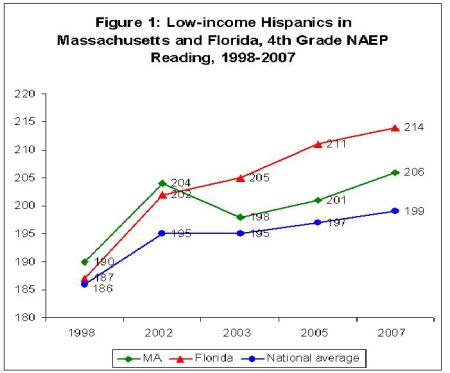
Looking at progress among the most difficult to educate students gives us a good view of which state has made the most progress. This effectively controls for MA being wealthy and pale. Figures 1 and 2 present data from the 4th grade reading exam.

Among free and reduced lunch eligible Hispanics, Florida has made a great deal more progress than MA- 16 point improvement in MA, a 27 point improvement in Florida. 

MA outperforms the national average, but by a mere three points. Florida doubled the improvement of the national average.

The same is true among free and reduced lunch eligible African American students. MA improved by nine points, the national average improved by ten points, and Florida improved by twenty four points.


FL MA 2Again, MA doesn’t have anything to be ashamed of given their highest scores. There are other wealthy and homogenous states that spend a great deal on their public schools- and MA clobbers them. For me, however, when it comes to education reform


Liberating Learning

June 1, 2009

Liberating Learning by Terry M. Moe: Book Cover

Two decades after writing Politics, Markets, and America’s Schools, Terry Moe and John Chubb have done it again.  With Liberating Learning they’ve written a a compelling account of what is blocking significant improvement in public education and provided strategies for overcoming those obstacles. 

The main obstacle has remained the same across the two books: teachers unions.  Organized special interests in education as in other sectors of public policy shape the policies that are made.  In the case of education the special interests are so large, well-organized, and well-funded that their influence has distorted policy significantly to the benefit of the adults working in schools and against the interests of students and their families.

In their earlier book the solution to union dominance was choice and competition.  Interest groups can control policy but they can’t easily control markets.  But in the new book Moe and Chubb (they flipped the order of the names) acknowledge that unions have been generally successful at using politics to block the creation of effective markets.  Something has to loosen the union stranglehold to allow the markets to develop and prosper.

In Liberating Learning they’ve found what they think will break that logjam: technology.  The increasing use of technology in education will transform the operation of schools and the role of teachers in education.  In general, it will reduce the need for teachers by replacing (at least to some extent) labor with capital.  It will generate tons of data, improving the transparency of schools to the public and policymakers.  And it will decentralize the education workplace, making it harder for unions to organize and control the workforce.

There are clear echoes of Clayton Christensen’s work on disruptive technologies in this new book.  But unlike Christensen, Moe and Chubb focus on the politics of public organizations rather than technology per se.  In fact, if you are looking for detailed descriptions of how technology should be used in education or hard proof of its effectiveness, you won’t find it in Moe and Chubb’s new book.  They are not trying to prove that these technologies are educationally effective or describe best practices, although it is clear that they have some ideas on these topics.  They are trying to describe the political logic of the current stagnation in education and how it might be altered.

The clear writing and tight argument will make Liberating Learning a pleasure to read for education reformers.  We might still wonder whether unions will be able to use politics to block the transformative effect of technology, but the book is sure to provoke a lot of productive discussion and thinking.

(edited for typos)


The Last Word on Unions and Reform

May 26, 2009

building_unions

(Guest post by Greg Forster)

In the great Flypaper debate over whether unions are an obstacle to reform, Robert Costrell has what can only be considered the last word on the subject. Little Ramona started the argument by asserting that Massachusetts has strong unions and yet it accomplished some reforms, therefore unions are not an obstacle to reform, QED. (I paraphrase, but not by much.)

Costrell offers a very striking post on his real-world experience in Massachusetts. Excerpt:

It is indisputable that the Massachusetts Teachers Association (MTA) was the largest obstacle to implementing key elements of the reforms, most notably the MCAS exit exams, which were the main driver of Massachusetts’ success. Diane seems to minimize “the current effort to show that teachers’ unions were no help to education reform in Massachusetts,” as if this were some sort of recent revisionist history. But the “current” effort simply reiterates the well-documented history that was established at the time.  The fight against MCAS featured lawsuits, boycotts, demonstrations, and, most famously, the MTA’s $600,000 fear-mongering ad campaign (the ads showed a ticking clock with nervous students, despite the fact that the exams were untimed).

Here’s the game changer:

My own contribution to this history was solicited by Diane for her last annual Brookings conference….At the time, Diane thought my piece was “great.” So I was surprised to read that the lesson Diane now draws from Massachusetts is that “unions do not block academic improvement.” Well, it was certainly not for lack of trying.

Back in the early 1990s, we videogamers used to call that a “finishing move.”

In other news, sock puppet and Sith apprentice Leo Casey continues to offer his insights. Question for Leo: How deep do you intend to let the hole get before you stop digging?