Akili Smith with Tenure

December 18, 2008

(Guest Post by Matthew Ladner)

Malcolm Gladwell weighs in on teacher quality, certification and value-added analysis in a must read article drawing attention to the similarities between teaching and the NFL draft.

Now, lots of people like to bust on the San Diego Chargers for drafting Ryan Leaf with the second overall pick in 1998 (one pick behind the great Peyton Manning btw).

Personally, I think the Bengals taking Akili Smith with a similar high pick the next year represents an even more tremendous screw up, and the Bengals turned down the Ricky Williams deal from the Saints to draft a guy who threw 5 touchdowns and 13 picks before getting cut. Instead, the could have had the Saints entire 1999 draft and a couple of high 2000 picks just to move down a few spots.

But I digress. Gladwell’s point is an excellent one: no one can figure out which college QB will translate into the pros, and no one can seem to figure out who will make an excellent teacher. Get them in the classroom and figure it out, but don’t give Akili Smith tenure.


Teacher Certification: Ineffective, Counterproductive and Possibly Racist…

December 17, 2008

(Guest Post by Matthew Ladner)

…but other than that, it’s swell!

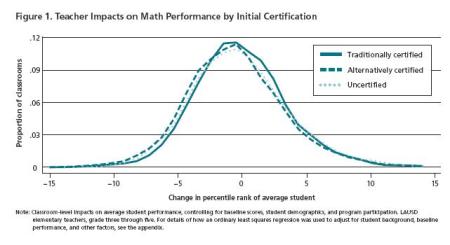
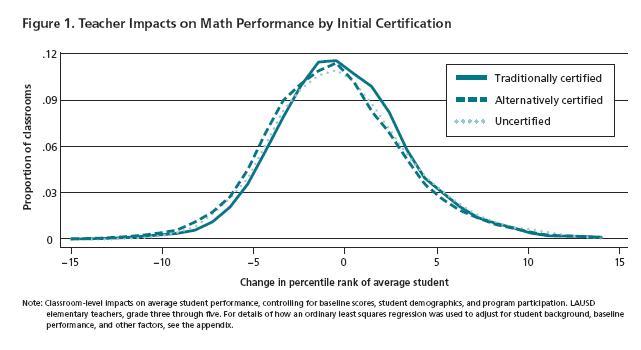
Let’s start with ineffective. Super chart! below from the Brookings Institute, you will recall, shows average gain scores in mathematics for three different groups of teachers: traditionally certified, uncertified and alternatively certified:

gordon-1-7398851

The differences between the three groups are far, far, far, far smaller than differences within each of the three groups. Schools keeping out the uncertified and alternative certified teachers on the right side of the curve are doing a grave diservice to their students.

Next, let’s look at evidence from Paul Peterson and Daniel Nadler’s recent Education Next piece on certification.

ednext_20091_70_table1

There is some suggestive evidence that alternative certification programs help state teaching forces look more like the ethnic composition of their states. Another way to put this might be to say that requiring people to take 30 hours of course work for no apparent reason (see Super Chart! above) may have a disproportionate impact on minority students. Or, put another way, genuine alternative certification seems to provide more opportunity for minorities to enter the teaching profession.

Now “racist” is a tricky term. Some argue that the SAT exam is racist, as it has a disproportionate impact on minorities. From what I understand, the SAT does successfully predict college success to a large degree, while teacher certfication does not predict student gains (see Super Chart! above).  If so, by my way of thinking, the SAT is not racist, while teacher certification may be, de facto.

Let’s put it another way: if SAT scores don’t predict college success any better than certfication predicts successful teaching, I’ll happily join the chorus calling to eliminate the exam.

Finally, Peterson and Nadler show that the 21 states who have done more than symbolic alternative teacher certfication have made larger than average gains on NAEP.

ednext_20091_70_fig3

This of course does not prove that alternative certification caused the faster gains, but they certainly didn’t prevent these gains. Florida, a leader in alternative certfication, has about half of their new teachers coming from alternative routes. As you can see, it doesn’t seem to be hurting their academic achievement.

florida-arizonaAs the figure below shows, Florida’s free and reduced lunch eligible students now outperform the statewide average in my home state of Arizona.
As one of Jay’s neighbors once said, it’s time for a change in how we train, recruit and compensate teachers.


Super Chart!

December 4, 2008

(Guest Post by Matthew Ladner)

gordon-1-739885

This chart from Brookings is one of the most important education charts I’ve seen in several years. Rather than me going on about why I think that is, super edu-nerd bonus points for you if you do so in the comments section. We are all about community here a JPGB!

Hint: there is more than one reason.


PJM on Candidates’ Education Flip-Flops

November 3, 2008

(Guest post by Greg Forster)

Over the weekend Pajamas Media carried my column on how Obama and Palin have flip-flopped on education:

Suppose I told you Candidate A has supported rigorous academic standards, has stood up to the teachers’ unions — even been booed by them at their convention — and proclaimed the free-market principles that schools should compete for students and better teachers should get higher salaries. On the other hand, Candidate B says that competition hurts schools, that kids should be taught a radical left-wing civics curriculum, that we should throw more money at teachers’ unions — excuse me, at schools — and that rigorous academic standards should be replaced with the unions’ old lower-the-bar favorite, “portfolio assessment.”

Candidate A is Barack Obama. So is Candidate B.

Meanwhile, Candidate C has made an alliance with the teachers’ unions, opposed school choice, thrown money at the unions — excuse me, at schools — and even helped undermine a badly needed reform of bloated union pensions. On the other hand, Candidate D has broken with the teachers’ unions, demanded that schools should have to compete for students, and endorsed the most radical federal education reform agenda ever proposed by a national candidate, including a national school choice program for all disabled students.

Candidate C is Sarah Palin. So is Candidate D.

Important disclaimer:

None of this implies anything about the overall merits of any of these candidates. One can love a candidate overall while hating his or her stand on education, and vice versa.


Paying the Pension Piper

October 27, 2008

According to an analysis of public (including teacher) pensions by Northern Trust reported in the Washington Post, those pensions lost 14.8% of their value for the year ended September 30.  They have almost certainly lost more during October in line with the continuing drop in stock prices. 

The decline only compounds a serious problem.  Even before this year’s market fall many teacher pension plans were under-funded.  According to the Post, the GAO concluded that 27 out of 65 large public pensions were inadequately funded as of 2006.

The problem, according to pension administrators cited in the article, stems in part from “an increase in pension benefits.”  That is, when the market is doing great and pension funds are flush, state policymakers are tempted to accede to teacher demands to raise benefits.  But when the market drops, the pension benefits cannot be cut.  It’s a one-way street.  Pension benefits may be increased but it is illegal to decrease them.

So, guess who is going to have to pay the pension piper?  Taxpayers.

UPDATE:  Teacher pensions also distort the labor market for teachers by having “spikes” and “valleys” in benefits.  That is, teachers leave a large amount of money on the table if they leave their positions too early and they actually begin to lose pension benefits if they remain in their job too long.  The net effect is to keep some teachers who have lost their fire for teaching in the profession too long and to drive effective and experienced teachers out of the profession too early.  See a great piece on this by my colleagues Bob Costrell and Mike Podgursky in Education Next.


Buildings Don’t Teach Kids, People Do

October 23, 2008

Matt wrote about black-market private schools in the third world housed in open-air shacks on the same day that newspapers reported that my local school board in Fayetteville, AR wants to re-build the high school so that we have a “21st Century” facility

While it is better not to have schools in open-air shacks, I can’t understand why people think we need educational palaces to teach our children.  Buildings don’t teach kids.  People do. 

We should invest much more in ensuring that we attract, retain, and motivate the best people as teachers rather than in “21st Century” facilities (whatever that blather means).  The systematic evidence overwhelmingly shows that the quality of school facilities in the United States has no relationship to student achievement, while the quality of teachers is very strongly related.  In the Handbook of the Economics of Education, Eric Hanushek reviews all of the research meeting minimal quality standards regarding the relationship between school facilities and student performance.  He identifies 91 analyses on the issue in the U.S. and finds that 86% of them show no statistically significant relationship.  Of the remaining 14% of analyses that did show significant effects, 9% were positive and 5% were negative. 

Research from developing countries told a different story.  Of the 34 analyses he identified on the relationship between school facilities and student performance in developing countries 65% showed significantly positive effects, 9% significantly negative, and 26% not statistically significant.  Clearly there is some level of building quality below which student achievement suffers.  But school buildings in the United States are nowhere near that threshold where the facility makes a significant difference.  The kids in the open-air shacks would probably benefit from an environment that screened out noise and dust more effectively, but almost all kids in the U.S. are in buildings that meet the minimum requirements for student learning even if they are not all luxurious.

But I suspect that is the problem in Fayetteville.  Just up the highway in Springdale, they recently built a Taj Mahal of a high school, called Har-Ber.  The marble-floored interior is pictured above.  Here is the giant-columned exterior: (Web site with photos was taken down, but you can still view pictures of the school here: http://www.wddarchitects.com/ )

Har-Ber was built for about $37 million, or about $93 per square foot.  People in Fayetteville had been talking about building a new school for more than twice that amount.  In our version of keeping up with the Joneses, some folks in town fear that the superior academic reputation of Fayetteville High School could be eclipsed if we don’t top the Har-Ber building.

Yes, Fayetteville High School is half a century old.  Yes, its cafeteria and auditorium are too small.  But there are smarter and less costly ways of addressing those problems than temporarily housing students elsewhere while we spend tens of millions to build a new one.  How about if we just build a new cafeteria and auditorium?  The recently completed appraisal of the facility said that it was in “excellent condition,” so why do we have to tear it all down and build a shinier new one? 

And how about if we take some of the money that we were willing to spend on a shiny new building and invest it intelligently in recruiting, retaining, and motivating the best teachers?

As a separate matter, someone needs to look into why exactly school buildings cost so much.  The average cost for housing construction in the area is $55.10 per square foot compared to $93 at Har-Ber and who knows what at the potential new Fayetteville High School.  My guess is that school construction firms have effective lobbies that insert all sorts of gold-plating and burdensome requirements into school building codes.  Doing so limits possible bidders who could meet all of those requirements while it drives up the construction profit.  And I imagine that most of those requirements have nothing to do with educational necessity or realistic student health and safety.

(edited for typos and pictures currently unavailable from source site but can be viewed here: http://www.wddarchitects.com/)


Policymaking By Anecdote

October 7, 2008

Is it good policy to reduce barriers to firing sub-par teachers?

According to Jennifer Jennings, the blogger formerly known as Eduwonkette, the answer is no.  We need to preserve teacher tenure, she argues, because she has found an example of a really great teacher, Art Siebens, who was fired when his DC school was reconstituted.  His case is “haunting for the glimpse it offers into the brave new world of unchecked principal autonomy.”

Well, Siebens wasn’t actually fired.  He wasn’t re-hired at the same school and was instead offered a job teaching a different science course at a different DC public school.  Don’t fret ye of weak hearts — continued employment for teachers is still essentially guaranteed even if not in the school and class of their choosing.

It’s puzzling why Siebens wasn’t re-hired given that he was an award winning teacher with what appears to be a strong record of excellent work.  But the fact that he wasn’t is hardly evidence against DC superintendent Michelle Rhee’s proposal to offer teachers significant pay increases if they give up tenure.  Perhaps there is more to Siebens’ story than is publicly known.  

More importantly, the case of Art Siebens is not evidence against abandoning tenure because it is a single case.  The plural of anecdote is not data.  We shouldn’t make policy by referencing anecdotes.  Instead, we should look “through the lens of social science,” as a wise person once wrote, and consider systematic evidence when formulating education policy. 

The remarkable investigative reporting by Scott Reeder has powerfully documented the problems with teacher tenure.  After filing 1,500 Illinois Freedom of Information Act requests with the state board and all 876 Illinois school districts, Reeder uncovered the following:

1) “Of an estimated 95,500 tenured educators now employed in the state [of Illinois] an average of only seven have their dismissals approved each year by a state hearing officer. Of those seven, only two on average are fired for poor job performance. The remainder is dismissed for issues of misconduct.”

2) “Of Illinois’ 876 school districts only 61, or 7 percent, have ever attempted to fire a tenured faculty member since the teacher evaluation reforms were imposed 18 years ago.”

3) “Of those 61 school districts, only 38 were successful in actually firing a teacher.”

4) “Not only is it exceedingly rare to fire a tenured teacher in Illinois, but it also is extraordinarily expensive. In fact, Illinois school districts that have hired outside lawyers in these cases have spent an average of more than $219,000 in legal fees during the last five years.”

5) “In the last 10 years, about 477,000 evaluations of Illinois tenured teachers have been performed, but only 513 received unsatisfactory evaluations… In other words, only 1 out 930 evaluations result in a tenured teacher receiving an ‘unsatisfactory’ rating.” Conducting those evaluations consumed 2.5 million administrative hours.

OK, so it is next to impossible to fire tenured teachers.  And we also know from systematic evidence that the quality of the teacher is the single most important factor within school control to influence student academic improvement. (See for example the research referenced here.)

Unless we believed that all but .007% of tenured teachers are doing a solid job, the current system is clearly keeping incompetent teachers in the classroom.  Any meaningful reform strategy has to involve getting rid of dud teachers and attracting better teachers as replacements.  Rhee’s proposal to increase pay in exchange for greater flexibility in terminating sub-par teachers seems like a promising idea to do just that.  The higher pay might attract better new people into teaching and the flexibility on termination could remove bad teachers from the classroom. 

Of course, the blogger formerly known as Eduwonkette makes a fair point when she asks, “Why are you confident that principals will always – or even often – pick the ‘best teachers?'”  For a system with reduced tenure protections to work, principals would also have to be properly motivated to distinguish between effective and ineffective teachers.  But this could be done either through meaningful merit evaluation and rewards for principals or through market accountability in choice programs.  If continued employment or pay raises for principals depended upon identifying effective and ineffective teachers, they are unlikely to let talented teachers like Art Siebens go and are likely to get rid of duds.

But we should all accept that any system of hiring and firing teachers will have its injustices.  The status quo tenure system has the injustice of protecting bad teachers in their jobs.  And if cuts have to be made it is newer teachers who have to be let go, even if they are better teachers than their senior colleagues.  A system like Rhee proposes will occasionally mistakenly let go of a good teacher.  But with well-designed incentives for the principals this should be the exception and not the rule.

Besides, we have to ask ourselves:  how many kids do you want to condemn to an ineffective teacher to avoid the possibility of unjustly terminating a good teacher?  If we care more about the kids than the adults in schools, then the injustice to the students should matter much more to us than the possible injustice to a few teachers.


A Few Comments

September 9, 2008

It must be the back to school season because there are a lot of interesting education pieces on the web.  I thought I’d just mention and briefly comment on some:

  • On Matt Ladner’s Little Ramona’s Gone Hillbilly Nuts about Diane Ravtich’s new-found enthusiasm for teacher unions and hostility to charter schools and merit pay — I posted this comment on his piece: “I liked Left Back, Language Police, and much of her historical work. That’s why it’s so disappointing to read what she is writing these days. From her earlier work one would never have guessed that she would accuse people who favor merit pay, reduction in teacher tenure rights, and charter schools of plotting to destroy public education.  And for someone whose past work relied on rigorous scholarship, it is shocking to see these new claims made without any evidence that merit pay, weaker tenure, and charter schools harm public education, let alone destroy it.  Other than the fact that Bloomberg and Klein support these policies, it is not clear why Diane Ravitch opposes them.”
  • Marcus Winters has a great piece on National Review Online about how reforming the teacher compensation system is the key to improving teacher quality and, in turn, student achievement.
  • Thomas Hibbs has a not-so-great piece on National review Online about how “the true teacher cannot simply be an instrument of the wishes of the student’s family.”  He’s right that parents can sometimes try to shield their children from burdens by lowering academic expectations and that teachers need to strive for excellence regardless.  But it’s unrealistic to expect that we can build an educational system based on “the teacher’s love.”  Parents, whatever their shortcomings, are more likely to be effective advocates for a child’s progress than even well-intentioned and well-trained teachers because the parents have a love for children that we cannot realistically expect from teachers. 
  • I don’t have time to comment on them, but you should also check out the rest of the National Review Online pieces, including those by Checker Finn, Neal McCluskey, Mike Petrilli and Amber Winkler, and Susan Konig.

PJM on Merit Pay in D.C.

September 8, 2008

(Guest post by Greg Forster)

Today, Pajamas Media carries my column on Michelle Rhee’s push for a limited, voluntary merit pay system in Washington D.C.:

To see how much has changed, just consider the amazing fact that about one out of every three public-school students in D.C. attends a charter school — government-owned but non-unionized, privately operated, and (most important of all) chosen by parents — instead of a regular public school. “We lost 6,000 students last year,” says Parker, referring to the number of students who moved from regular schools to charters. Six thousand students is over 13% of the city’s remaining enrollment in regular public schools — in one year.

Rhee isn’t the force behind charter schools or vouchers in D.C. She’s in charge of the regular public system. But the same widespread mandate for reform that made charters and vouchers successful have allowed Rhee to succeed with reforms like closing schools that were only there to create patronage jobs, introducing curriculum innovation, and taking on the unbelievable amount of bureaucratic waste in the system. And as vouchers and charters have sent a message that the system can’t take students for granted any more, the pressure for reform has only increased — strengthening Rhee’s hand.

By coincidence, the Washington Post‘s Marc Fisher has a column today emphasizing how the explosion of charter schools in D.C. was decisive in bringing the unions to the bargaining table, even on the issue of reforming the structure of teacher pay. Just as competition from globalization forced the private sector unions to start the long, slow process of giving up the ridiculous extravegances that they won from management in the 1960s and 1970s, thus rescuing the American economy from disaster, now competition in schooling is forcing the teachers’ unions to start the same process of giving up their own ridiculous extravegances – the biggest of all being a system of hiring, firing and pay that bears no serious relationship to job performance.


Teacher Pay: Size Isn’t the Issue

August 12, 2008

(Guest post by Greg Forster)

On NRO yesterday, David Freddoso, author of The Case Against Barack Obama, launched a broadside against Obama as a faux education reformer. I have no interest in dissecting the details of Obama’s record on education, but Freddoso’s line of attack on the subject of teacher pay seems to me to miss the point.

Freddoso begins by quoting Obama asserting that schools in a Chicago neighborhood were closing early because the district couldn’t afford to pay teachers for a full day. Freddoso notes that teachers in that neighborhood are paid an average of $83,000; more than a quarter of them make over $100,000. (These figures don’t include administrators, who make even more.) Somehow, Obama managed not to mention this when bemoaning the district’s inability to pay for a full school day.

Freddoso may well be right about what’s happening that particular district; I don’t know. However, he goes on to build a more general case that Chicago teachers citywide are making big bucks while the system destroys children’s lives, and therefore Obama’s close alliance with the Chicago teachers’ union is similar in kind to his alliances with Tony Rezko, the Chicago machine, and other practitioners of “systemic corruption.”

I certainly agree with Freddoso that the government school monopoly, in Chicago as everywhere else, consumes large quantities of taxpayer money while destroying children’s lives. I’ll also agree that the teachers’ unions bear a lot of the blame. But is the size of teacher salaries a serious problem?

Freddoso says the entry level salary for a Chicago teacher is $43,702 plus $3,059 in pension contributions. Is that really so much, considering that 1) Chicago is an urban area, where the cost of living will be high, and 2) teachers have to have a college degree and specialized training in order to enter the profession?

Freddoso goes on to note that once these starting Chicago teachers gain four years’ experience, they’ll make $60,000, not including increases for additional education credentials. Since the large majority of teachers do pursue (educationally worthless) additional credentials in order to get these “pay for paper” salary increases, it would be good to know how much those salary increases are worth in Chicago. But setting aside that question, given that the empirical evidence suggests teachers get significantly more effective in their first few years, a bump up to $60,000 doesn’t seem all that bad (remembering again that we’re in an urban area).

In short, while teachers in Chicago – like teachers nationwide – are certainly paid well, they aren’t benefitting from “systemic corruption” a la Tony Rezko or the disgraced management of Fannie Mae and Freddie Mac or the “Friends of Angelo” at Countrywide, all of whom are connected to Obama.

Yet Freddoso writes about teacher pay as though being a teacher is some sort of scam. “Chicago teachers have terriffic pay and hours, and summer vacations,” and we should ask whether Obama’s link to the Chicago teachers’ union is “corrupting,” since this link is “part of a much braoder pattern that characterizes his political career, as with his backing of Chicago’s machine bosses, his sponsorship of legislation and earmarks to help such donors as Tony Rezko, and his support for special-interest subsidies in Washington.”

Freddoso is right that in addition to salary, teachers enjoy extremely strong job protection and shorter work hours, and this should be factored in when we consider whether or not they are “underpaid.” Still, it’s hardly fair to lump them in with Tony Rezko. Moreover, if the issue is not per se whether teachers are well paid, but accountability for the use of taxpayer funds (as the “corruption” meme suggests), then teachers’ job security and summer vacations don’t seem very relevant.

The real problem with teacher pay is not size, but technique. That is, it’s not primarily how much we pay, but how we pay. Teachers in the U.S. aren’t paid like professionals, they’re paid on a factory worker scale, with ability and performance totally unrelated to compensation. (Even calling this a “factory worker” scale is unfair to factory workers, since many factories have now adopted some reforms to the old pre-globalization pay system.) And it’s this pay structure, not the amount we pay, that’s the real problem. The system is designed to attract the lowest performers – since high performers can always earn more elsewhere while low performers always earn more by becoming teachers.

Freddoso mentions the subject of merit pay in passing, but only so he can assert that, on account of his alliance with the union, Obama’s merit pay plan is a toothless tiger. Whether it is or it isn’t, merit pay is a much more important issue than pay levels. If pay were tied to performance, high teacher salaries would be good – in fact, given the large role that teacher quality has been shown to play in student outcomes, if pay (and hiring) were linked to performance I would say the current pay levels would be too low.

Having said I would steer clear of evaluating his record as a whole, I will note that Obama’s openly supporting merit pay represents real progress, even if we agree with Freddoso that this support is only for show. It’s more of a show than any previous Democratic nominee has made, if I’m not mistaken (though I don’t trust my memory too far on this). Obama was actually booed by the NEA when he mentioned his views on differential pay during his speech accepting their endorsement. He didn’t have to mention teacher pay reform in his endorsement acceptance, but he did. That counts for something.

It’s also worth mentioning that the unions benefit far more than individual teachers from the direction the system has been moving in. Over the past few decades, while teacher salaries have stagnated, the number of teachers hired by the system has soared. That’s a mixed bag for teachers – it presumably means less work for each teacher, but it also exerts downard pressure on salaries. However, it puts big bucks in the unions’ pockets, with no real downside for them.

If I had to guess, I’d say Freddoso is overreacting against the widespread claim that teachers are “underpaid.” Since teachers are in fact well paid, this myth certainly does grate on anyone who knows the facts – especially so since this myth is even more obviously at odds with the facts than most education myths, and yet (or perhaps I should say “and therefore”) challenging it tends to produce an especially nasty and vicious response.

But let’s not get drawn into the opposite error. As Martin Luther is said to have said, if a man falls off his horse on the left side, the next time he rides he’ll fall off on the right side. Teachers aren’t paid too little or too much – they’re paid the wrong way. The problem here isn’t teachers, it’s unions.