One More Brummett Update

July 16, 2009

Arkansas columnist John Brummett responds to my most recent blog post.  (See also yesterday’s related post here)

 Unfortunately, he continues to change the subject.  The issue is not whether a summer literacy program in Fayetteville is a good program or not.  As I’ve said before, I’m willing to believe that it is.

The issue is whether doubling (or tripling) teacher pay for that program was a good use of additional stimulus dollars.  If it really is a great program, wouldn’t it be better to use those funds to double the number of students who could participate and hire twice as many teachers?  Or how about making the program run twice as long?

Only right-wing zealots would favor halving the number of students or halving the number of days for a beneficial program. 

And one small point — name-calling can be done with adjectives.  Ugly and smelly are adjectives.


Brummett Update

July 16, 2009

As I warned yesterday, Arkansas columnist John Brummett was preparing another attack on me.  Sure enough, Brummett threw his tantrum.  He opens with name-calling: “He’s right-wing and quite the zealous advocate of many education reform notions.”  

Then he assigns to me responsibility for all sorts of things that aren’t actually attributable to me.  For example, he says (dripping with sarcasm): “He gives [teachers] summers off and calculates their hours of actual classroom instruction and concludes that he knows people in other professional fields who aren’t doing as well or significantly better.” 

I didn’t do any of those things.  Teacher contracts with schools give them the summers off.  The U.S. Bureau of Labor Statistics (BLS) calculates their hourly and weekly pay.  The BLS reports that teachers, on average, make more than other white collar and professional workers on both an hourly and weekly basis.  I just repeated what the BLS reported.

He continues falsely attributing to me claims that were not invented by me: “He faulted [Fayetteville schools] for spending federal stimulus dollars not to stimulate the economy, but to pay teachers what he assumes to be twice their usual hourly rate for something they would have been doing anyway, and for much less, without the stimulus.”  (emphasis added) 

I didn’t assume that teacher pay was doubled with the stimulus dollars.  The Northwest Arkansas Times reported that fact and I, again, just repeated it.

Finally, he makes the case for this use of stimulus dollars: “This is a new and different program that wouldn’t have been undertaken without the extra Title 1 money from the stimulus, [district officials] say. This will be high-intensity summer session with innovative techniques and individualized instruction and counseling, they say.”

I never disputed that the program might be a beneficial one.  As I wrote in my initial post on this topic: ”The Leap Ahead program may well be a good one.”  My objection is to paying teachers twice their normal rate (as reported by the NWAT) and three times what teachers in neighboring Springdale are being paid for the same program.  Nothing in Brummett’s column justifies that.  And he conveniently neglects to mention how Springdale teachers are being paid 1/3 as much for the same thing.

It’s clear that John Brummett uses his column to prosecute his own personal, political agenda.  That’s acceptable for a columnist, but normally they have to be constrained by facts and logic in doing so.  He can’t falsely attribute to me claims that are not my own.  And he can’t switch the issue from doubling (or tripling) teacher pay for a program to the desirability of that program.  At least, his newspaper shouldn’t let him do these things with their paper. 

Who exactly is the zealot here — the person repeating the factual claims of the BLS and the Northwest Arkansas Times or the person omitting crucial facts, falsely attributing claims, and changing the subject?

(This material is also contained in an update to yesterday’s post.  See also a more recent post on the same issue here.)


Brummett About to Throw Another Tantrum

July 15, 2009

John Brummett, a columnist in a local paper in Northwest Arkansas called the Morning News, posted on his blog that he is going to write another column attacking me.  At least he gives fair warning.

In 2007 he wrote an angry column in response to a report I co-wrote with Marcus Winters about teacher pay.  The column concluded:

What’s inherently nonsensical — no, breathtakingly offensive — is for someone interested in those very reforms to be so politically lead-footed as to write an article saying teachers are paid plenty already, and do so while he pulls down $160,000 or more in a public education faculty position himself, and while he is underwritten by a foundation created by wealthy heirs of a fortune gleaned in part from low employee wages and sparse employee benefits.

At the time I hadn’t started this blog, so I didn’t think there was a reasonable forum to address his piece.  But now that the blog is pulling in a daily readership that is not too far off the daily readership of his column in the Northwest Arkansas Morning News (daily circulation 33,582), I’ll respond to the old column and anticipate his new one.

Other than being angry himself and asserting that I had said “something crazy that makes every school teacher in Arkansas throw an eraser across the classroom,” it is not clear what substantive objection Brummett has to what I wrote.  He never disputed the accuracy of the facts I presented on teacher pay, nor could he.  The numbers I presented were taken directly from the U.S. government’s Bureau of Labor Statistics (BLS). 

I suppose one could object to how the BLS calculates hourly pay, based on the argument that it fails to fully capture teacher hours worked outside of school more than it fails to capture hours worked outside of the office by other professionals and white collar workers.  But we addressed that concern in the report by comparing teacher wages to those of other white collar and professional workers on a weekly basis.  Teachers still earn more than other white collar and professional workers.  Teachers do earn less on an annual basis, as we said, but having breaks during the Winter, Spring, and Summer is worth money.  If you don’t think it is, how do you think teachers would feel if we asked them to work all year for the same annual pay they get now?

In addition, I never said that teachers are overpaid, despite Brummett’s suggestion to the contrary by describing my view incorrectly as “teachers get paid plenty already.”  In fact, in the report we explicitly stated: “we offer no opinions on the proper level of pay for public school teachers. We are simply offering facts, almost entirely obtained from an agency of the federal government, that we believe ought to be included in any policy discussion about teacher pay.”  Instead, our point, other than providing descriptive information, was to suggest that teacher pay was roughly comparable on an hourly or weekly basis to that of other white collar and professional workers. 

We did provide an exploratory regression analysis showing no relationship between the level of teacher pay and student outcomes, controlling for observed demographics.  And we did suggest that higher pay might yield better student achievement if it were more explicitly connected to achievement via a merit pay system.  But these arguments do not suggest that teachers are paid too much, only that we should explore paying them differently.

What’s even stranger about Brummett (and others) being offended by my report, is that it is not clear what would be bad about saying that teachers are reasonably well-compensated.  In business schools they routinely brag about how well-paid their graduates are.  Doing so helps them attract more and higher quality applicants.  Why wouldn’t we want to do the same in Education colleges?  I understand that some teachers and their unions may nurse the false grievance of being paid significantly less than other professionals in order to gain leverage in seeking pay increases in the future.  But why should researchers, journalists, and Education college officials suppress accurate and truthful information to assist them in that effort?

Brummett may get angry again tomorrow.  He may throw his column across the room.  He may talk about how much I get paid.  He may offer more political advice, as if researchers should tailor their reporting of the facts to suit political interests.  He may say I’m controlled by the Waltons or Keyser Soze

But he can’t change the facts.  The BLS numbers are what they are.  He can try to distract his readers from that evidence, but he can’t make a substantive argument against what I’ve reported.

UPDATE —Sure enough, Brummett threw his tantrum.  He opens with name-calling: “He’s right-wing and quite the zealous advocate of many education reform notions.”  

Then he assigns to me responsibility for all sorts of things that aren’t actually attributable to me.  For example, he says (dripping with sarcasm): “He gives [teachers] summers off and calculates their hours of actual classroom instruction and concludes that he knows people in other professional fields who aren’t doing as well or significantly better.” 

I didn’t do any of those things.  Teacher contracts with schools give them the summers off.  The U.S. Bureau of Labor Statistics (BLS) calculates their hourly and weekly pay.  The BLS reports that teachers, on average, make more than other white collar and professional workers on both an hourly and weekly basis.  I just repeated what the BLS reported.

He continues falsely attributing to me claims that were not invented by me: “He faulted [Fayetteville schools] for spending federal stimulus dollars not to stimulate the economy, but to pay teachers what he assumes to be twice their usual hourly rate for something they would have been doing anyway, and for much less, without the stimulus.”  (emphasis added)  I didn’t assume that teacher pay was doubled with the stimulus dollars.  The Northwest Arkansas Times reported that fact and I, again, just repeated it.

Finally, he makes the case for this use of stimulus dollars: “This is a new and different program that wouldn’t have been undertaken without the extra Title 1 money from the stimulus, [district officials] say. This will be high-intensity summer session with innovative techniques and individualized instruction and counseling, they say.”

I never disputed that the program might be a beneficial one.  As I wrote in my initial post on this topic: “The Leap Ahead program may well be a good one.”  My objection is to paying teachers twice their normal rate (as reported by the NWAT) and three times what teachers in neighboring Springdale are being paid for the same program.  Nothing in Brummett’s column justifies that.  And he conveniently neglects to mention how Springdale teachers are being paid 1/3 as much for the same thing.

It’s clear that John Brummett uses his column to prosecute his own personal, political agenda.  That’s acceptable for a columnist, but normally they have to be constrained by facts and logic in doing so.  He can’t falsely attribute to me claims that are not my own.  And he can’t switch the issue from doubling (or tripling) teacher pay for a program to the desirability of that program.  At least, his newspaper shouldn’t let him do these things with their paper. 

Who exactly is the zealot here — the person repeating the factual claims of the BLS and the Northwest Arkansas Times or the person omitting crucial facts, falsely attributing claims, and changing the subject?

(Edited for typos.  See a follow-up post here.)


Your Stimulus Money at Work

July 12, 2009

If you want to get a feeling for how education stimulus dollars are being used, check out this story from the Northwest Arkansas Times.  We learn that the Fayetteville School District is using stimulus dollars to double the regular pay of teachers working in a summer literacy program. 

That’s right.  The money is not being used to save teacher jobs that would have otherwise been cut.  The money isn’t being used to offer a new program that otherwise wouldn’t have been offered.  The money is simply being used to pay teachers more for the same thing that they would have been doing anyway.  The only thing that is “racing to the top” about this use of funds is teacher pay.  As the NWAT reports:

Fayetteville School District is using part of its federal stimulus funding to pay teachers in the Leap Ahead summer literacy program at Owl Creek School about double their regular pay.

Teachers in this program that targets at-risk students who have completed kindergarten through second grades will bank $8,000 for 12 days of classroom instruction and three days of preparation at the school.

That’s about $533 per day for working from 8:30 a.m. to 3:30 p.m. This does not include any extra time that school officials say teachers will be required to develop lesson plans and meet with parents.

Springdale Public Schools pays its summer school teachers $25 per hour, per district policy, said Rick Schaefer, the district’s public information officer.

For those of you without a calculator, that works out to paying Fayetteville teachers $76 per hour of scheduled work (excluding benefits) to do something that teachers in neighboring Springdale are doing for $25 per hour.  And it is apparently double what the same Fayetteville teachers are normally paid.

The Leap Ahead program may well be a good one.  But it isn’t clear how simply paying the same people more to do the same thing that would have been done in the absence of stimulus money helps anyone other than the people getting paid more. 

This is essentially a transfer of wealth from taxpayers (who on average earn less) to this group of teachers (who on average earn more).  And we wonder why the stimulus isn’t stimulating the economy.


Rock star teacher pay for Rock Star teachers: Part 4

June 11, 2009

(Guest Post by Matthew Ladner)

How do you get rock star teachers? Offer rock star wages of course! I coauthored a study for the Goldwater Institute laying out a model of achieving $100,000 teacher salaries based on Arizona charter school funding. You can read the previous posts on this here, here and here.

The New York Times features a new charter school that apparently had a similar idea: they are offering teacher salaries of $125k and merit bonuses of up to $25k.

What do you get for that? Well for starters, Kobe Bryant’s former personal trainer as your gym teacher.  “Developed Kobe from 185 lbs. to 225 lbs. of pure muscle over eight years,” his resume says.

The school, named the Equity Project, is located in a rough part of town and will have class sizes of 30 to pay for those rock star teacher salaries.

I don’t know whether the school will be tracking value-added learning gains over time as we recommend in our study.  I hope they will. I for one will be watching with great interest to see how they do over time.


Rick Hess on Recruiting the Teachers of the Future

May 22, 2009

(Guest Post by Matthew Ladner)

The new edition of Education Next is online, and Rick Hess has a very interesting article on modernizing the teaching profession. Rick notes that we need to update bedrock assumptions-such as assuming that the dominant model of teaching recruitment should rest on recruiting 20 year olds into colleges of education and then expecting them to teach for the next 30 or 40 years. Lots of interesting suggestions on technology, compensation and alternative certification.

Great article, well worth reading.


Rock Star Pay for Rock Star Teachers Part Trois

May 7, 2009

(Guest Post by Matthew Ladner)

A few months ago I got an angry email from an Arizona teacher claiming that her school had been terribly underfunded, and that she had 32 students in her classroom. I wrote to her:

If you have 32 children in your classroom, my first question is what is your school district doing with all of that revenue?

The JLBC put the statewide spending per pupil in Arizona at $9,399. A classroom of 32 at the statewide average would mean $300,768 in revenue from the students in your class.

Her response:

1-teacher, 1ELL teacher, 1 Special ED teacher, reading specialist, principal, janitor, secretaries, music, art, PE, computer teacher, Cafeteria workers, Para-educators, paper, textbooks, hands on science materials, Computers (this is the 21st century learning) building up keep, electricity, water, tables, chairs , etc…..

She forgot to mention administrative salaries from central command. There is one tiny little problem with all of this. According to the 2007 NAEP, 44 percent of Arizona 4th Graders scored BELOW BASIC in reading.

In other words, as Dr. Phil likes to say, how’s that hiring your average teacher from the bottom third of university students and supplementing them with crowds of others working out for you?

Shape up people!

The sad reality of American public education is that our schools have become revenue and employment maximizers that all too often are profoundly unfocused on the bottom line: student learning.  Public schools ought not to be jobs programs, but focused on their mission of equipping students with the academic skills necessary for success in life.

So, if you’ve got $300,000 in revenue from a classroom (many states have more) call me crazy, but I think you’ve got $100,000 for what research shows to be going away the most important factor for student learning gains: a high quality teacher. When I say a high quality teacher, I mean a verified high quality teacher whose student learning gains are being tracked over time by both administrators and parents on a continuous basis.

The best platforms for ongoing value added assessment are web-based data products that allow teachers to develop common assessment items based on state standards. If there are state standards for a subject, you can do value added analysis on it. When schools really get going on this, they give monthly assessments. This gives ongoing assessment data that greatly drops the amount of error (using only state tests, some of the pioneering value added models require 3 years worth of data).

Overall, it isn’t very hard to imagine a system that would improve upon the status-quo in these practices. We can no longer in good conscience socially organize our efforts to teach children to read along the lines of: let’s hire an army of people who want job security and summers off , do absolutely nothing to reward merit, and hope for the best.

This must change, and it will change.


Merit Pay Smackdown

May 1, 2009

My colleague, Gary Ritter, and NEA boss, Dennis Van Roekel debated merit pay on the PBS NOW web site.

At the bottom you can vote for who you think won the debate.  Gary currently has 67% of the vote.  Bam!


Rock Star Pay for Rock Star Teachers Part Deux

April 29, 2009

(Guest Post by Matthew Ladner)

Last year I was reading the comments section of a newstory online, and came across a comment from a public elementary school teacher. She was complaining that she had 34 students in her classroom.

So let’s do the math. The statewide average spending per pupil in the state: $11,000. Total revenue generated by this classroom = $374,000. Let’s assume the teacher gets a total compensation package of $60,000 including benefits. The question becomes- what did they do with the other $314,000?

Ah, that was what the teacher was really angry about. Her elementary school had 8 teachers in “non-classroom assignments.”

I don’t have a problem with 30 some odd kids in a classroom. It’s been done, and is being done. Remember?


Many insist that the period depicted by this photo constituted the “good ole days” of education. Jay and Greg have felt compelled to dispel the myth of the lost golden age of public education, back in the good ole days, when public schools were far more effective than they are today. The truth, of course, is that NAEP scores for 17 year olds are flat as far back as you can take them.

What has not been flat- public school spending- adjusted for inflation per pupil has steadily increased even while test scores have stagnated, even while Americans have become wealthier and poverty has declined.

Of course, there is no single explanation for this trend, but certainly the national obsession with lowering average class sizes must be viewed to have been an enormously expensive academic failure. Consider the international evidence:


class-size-11

Really big classes in Asia, really small in the United States. However, when it comes to achievement:

class-size-2

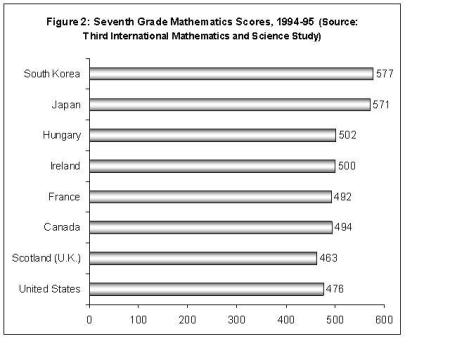
The average South Korean seventh-grader scores 21 percent higher than the average American on seventh-grade mathematics, despite having much larger average class sizes. While a variety of factors contribute to the relative deficiency of American public schools, many scholars are beginning to suspect the main factor is the relatively inferior average quality of American teachers.

In How the World’s Best Performing Schools Come Out on Top, the international management consulting firm McKinsey & Company point squarely at teacher quality as a key variable in explaining variation in international academic achievement. In its findings, McKinsey quoted a South Korean policymaker who noted, “The quality of an education system cannot exceed the quality of its teachers.”


McKinsey found that the top-performing school systems around the world recruit their teachers from the top third of each graduating cohort. Moreover, South Korean schools draw from the top 5 percent of college graduates. Larger class sizes create the resources to pay South Korean instructors much higher salaries.


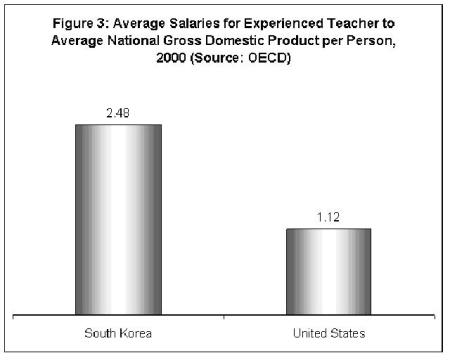
The Organisation of Economic Co-operation and Development measures relative teacher pay by comparing the average salaries of teachers with 15 years of experience with a nation’s gross domestic product (GDP) per capita. A high salary compared with per capita GDP suggests that a country invests more of its financial resources in teachers and suggests a relative prestige of the profession. By definition, the average person in each of these countries will earn a ratio of 1. Figure 3 compares teacher-salary-to-per-capita GDP for the United States and South Korea.

teacher-pay-korea

An experienced South Korean schoolteacher makes a relatively impressive wage compared with teachers in the rest of the world. In South Korea, teaching is an honored profession—not just rhetorically but in compensation as well. In the United States, meanwhile, a teacher with a college degree and 15 years of experience makes a salary relatively close to the average GDP per person. Not surprisingly, there are many qualified applicants for each open teaching position in South Korea.


McKinsey quotes the New Commission on the Skills of the American Workforce to contrast the United States with those countries having more successful education systems: “We are now recruiting our teachers from the bottom third of high-school students going to college…. [I]t is simply not possible for students to graduate [with the skills they will need] unless their teachers have the knowledge and skills we want our children to have.”


Rock Star Pay for Rock Star Teachers!

April 28, 2009

(Guest Post by Matthew Ladner)

The Goldwater Institute released a new study today titled New Millennium Schools: Delivering Six-Figure Teacher Salaries in Return for Outstanding Student Learning Gains. In this report, my coauthors Mark Francis, Greg Stone and I argue that the United States has made a tragic error in emphasizing teacher quantity (through efforts to limit average class size) rather than teacher quality. The growing literature on student learning gains clearly demonstrate that teacher quality trumps the impact of class size variation by a wide margin.

The value added literature has revealed stunning equity issues. We don’t attract enough high ability teachers into the profession, we quickly lose many of those we do to frustration or administration, and we distribute most of the remainder to the leafy suburbs. I don’t have a problem with incentive “combat pay” but let’s face it: it is not enough to simply redistribute the limited number of high quality teachers. We need to attract many more of them.

After exploring foreign and domestic examples of systems that make the opposite choice, we propose a solution: a school model which not only employs value added assessment to identify high achieving teachers, but also splits the additional revenue for students after the 20th with the teacher. We propose a 2/3 teacher, 1/3 school split for the 21st student and beyond. This works out to a $5,200 bonus per child.

With this split, our school delivers a six figure teacher salary at 32 students based upon Arizona’s relatively modest funding for charter schools. A class size of 32 students is hardly outside of the historical practice for American public schools, or even the current practice entirely.

There are many practical issues to consider, and variations on the basic model, so please read the study. I’ll write more about the study in the coming days, but the most important point is this: there is plenty of money in the public school system to treat teachers like true professionals and reward them for excellence.

UPDATE: Education Week’s Stephen Sawchuck points out that principals already covertly increase class sizes for additional pay.