Greg Goes Heisman in 2011 Reform Blowout

July 1, 2011

(Guest Post by Matthew Ladner)

In 1916, legendary Georgia Tech coach John Heisman had a score to settle with Cumberland College. His engineers led 126-0 at halftime, inspiring Heisman to tell his players “We’re ahead, but you just can’t tell what those Cumberland players have up their sleeves. They may spring a surprise. Be alert, men.”

The final score: Georgia Tech 222, Cumberland College 0. The Atlanta Journal reported, “As a general rule, the only thing necessary for a touchdown was to give a Tech back the ball and holler, ‘Here he comes’ and ‘There he goes.’ ”

Greg has followed Heisman’s example by scoring 4 more times in the Mathews bet. Ohio dramatically expanded their Ed Choice voucher program, their Cleveland program, and upgraded their autism voucher bill to a full fledged special needs voucher. In addition, North Carolina became the first state to enact a tuition tax credit for special needs children.

Let’s see if I can recall them all:

Utah (1) Carson Smith expansion

Arizona (1) Education Savings Accounts

Colorado (1) New voucher program

DC (1) Opportunity Scholarships reenacted, expanded

Florida (2) McKay Scholarship expansion, Step Up for Students Tax Credit Expansion

Georgia (1) Tax credit expansion

Oklahoma (1) New tax credit, (major fix of special need voucher)

Indiana (3) New statewide voucher, expansion of tax credit, new tax deduction

Louisiana (1) Tax deduction expansion

Wisconsin (2) Milwaukee Expansion, New Racine Program

Iowa (1) Tax credit expansion

North Carolina (1) New special needs tax credit

Ohio (3) Cleveland expansion, Ed Choice expansion, Autism to Special needs expansion

Most legislative sessions are winding down this year, but we could see some additions to the list. There are too many great stories to cover here, from the heroic struggle to save the DC Opportunity Scholarship Program, to Colorado’s turning a court defeat based upon “local control” on its head, and Wisconsin emerging from years of toil and struggle to enact an amazing expansion, to Arizona lawmakers embarking on an experiment in liberty to give parents control down of the education of their child down to the last penny.

Lots of important reforms outside of private choice as well- major tenure reforms, charter caps lifted, some pathbreaking expansions of digital learning. It will take time for the smoke to clear just to see what actually passed, much more before we will have any clue about results.

A few states have taken what I would describe as deep reform dives-embracing a broad set of reforms making truly historic changes. Florida of course has long been in the lead here, and Florida had a fantastic education reform session this year, reforming tenure, expanding digital learning and passing a truly amazing law to expand high quality charter schools.

Indiana however may be the pupil that has exceeded the master.

Indiana adopted critical Florida reforms, like grading schools A-F and social promotion curtailment, last session. During this session, Indiana’s reformers went far beyond enacting the most far reaching choice programs.  Go and read the transcript from Governor Daniels speech at AEI. After detailing Indiana’s far reaching collective bargaining, teacher quality and parental choice reforms, Daniels sort of casually mentions:

And here’s another little calendar quirk that we just moved the school board elections from the spring to the fall. So test from the fall to the spring, elections from the spring to the fall, what’s up with that, you want to know? Well, spring is when we have primaries, nobody votes. It’s a lot easier to dominate, for a small or for an interest group to dominate the outcome and elect a friendly school board in the sparsely attended primary elections. And so now they will have more of the public at least eligible or at least on hand to take part in those elections, we’ll see if it makes a difference.

Now this, ladies and gentlemen, is comprehensive education reform: grading schools A-F based on student proficiency and gains, curtailing social promotion, tenure reform including the mandated use of student performance as a part of formula, throwing out the 900 page collective bargaining agreements, and what will be the nation’s largest system of parental choice. Oh, and by the way, we are going to take a shot at massively increasing democratic participation in school districts while we are at it, just for fun.

Govenor Daniels described these reforms as “mutually reinforcing” in his AEI speech. When I heard that line, I literally gasped and thought to myself: he really gets it!

Indiana lawmakers have not however suspended the law of unintended consequences. Many challenges known and unknown attend such profound change, and the hardest work lies ahead. Among the known challenges: Indiana has term limits, and these far reaching reforms come in the twighlight rather than the dawn of the Daniels terms of office. Seeing this business through will be an enormous challenge for the next crop of Indiana policymakers, if they choose to accept it.

Ok, enough of the grim warrior business. If you can’t pause to celebrate victory, you won’t last the season. This has easily been the best year for K-12 reform, and the best is yet to come.


Iowa Legislature Lines Up Another Enactment

June 30, 2011

(Guest post by Greg Forster)

Last night, Iowa’s House and Senate passed a budget that expands funding for the state’s tax-credit scholarship program. If the governor signs, as expected, that will bring us to fifteen school choice enactments and officially put us not just at, but over the benchmark for Matt’s “double down challenge”  in my bet with Jay Mathews.

And from what I hear, the next question isn’t whether we’ll get to sixteen. The question is, which state will get to fifteen first, and which will have to settle for sixteen – or seventeen, or eighteen . . .


Louisiana Doubles Down

June 28, 2011

Sorry, I couldn’t find “Louisiana Hold ‘Em”

(Guest post by Greg Forster)

Two Wisconsin enactments while I was travelling a week ago – expanding Milwaukee vouchers and creating a new voucher program in Racine – brought my ongoing humiliation of Jay Mathews to a total of 13 school choice enactments (new programs or expansions of existing programs). And that’s not even counting Oklahoma’s “expansion” of its special ed voucher program (the program was “expanded” to include students who were eligible to participate but were being illegally denied access by rogue school districts).

Governor Jindal just doubled us down by signing into law Lousiana’s expansion of its educational tax deduction, bringing us to 14 enactments on a bet that we wouldn’t reach seven.

Here’s the tally so far:

  1. UT Carson Smith expansion
  2. Douglas County, CO new voucher
  3. AZ new ESA
  4. DC voucher expansion
  5. IN new voucher
  6. IN new tax deduction
  7. IN tax-credit scholarship expansion
  8. OK new tax-credit scholarship
  9. FL tax-credit scholarship expansion
  10. FL McKay voucher expansion
  11. GA tax-credit scholarship expansion
  12. WI Milwaukee voucher expansion
  13. WI new Racine vouchers
  14. LA tax deduction expansion

Matt wants to know if there’s a mercy rule for wonk bets. As Ned Flanders once said, “Mercy is for the weak!”


Greg Continues to Run Up the Score on Jay Mathews

June 16, 2011

(Guest Post by Matthew Ladner)

Another day, another couple of style points for Greg. North Carolina’s legislature passed a tax credit for special needs students with an overwhelming bipartisan majority in each chamber. Down in Louisiana, lawmakers expanded the tax deduction for private school students, also by an overwhelming bipartisan margin.

Jay’s suffering is not done yet. Wisconsin is very near to expanding the size and scope of the Milwaukee program, and creating a new program in Racine, and there is more game to be played in Big-10 country.


Why America Needs School Choice — Pre-Order Now

June 8, 2011

I have a mini-book making the case for school choice coming out on June 28.  You can pre-order it now at Amazon.


Freedom and School Choice

June 7, 2011

(Guest post by Greg Forster)

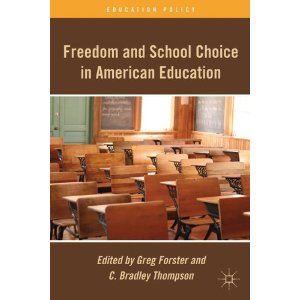
Today is the release of Freedom and School Choice in American Education, a new collection of essays on the purpose and direction of the school choice movement. Your JPGB favorites – Jay, Matt and myself – along with Andrew Coulson, George Clowes, Sheldon Richman, Pauline Dixon & James Tooley, and Brad Thompson lay out our diverse viewpoints on what we think the guiding vision for educational freedom in America ought to be, and what the school choice movement ought to do as a consequence. Paul Peterson provides the foreword.

What’s particularly valuable about this book, I think, is how it gives expression to the very different paths by which people come to hold educational freedom as an aspiration, and then connects those aspirational paths to the practical issues that face the movement in the short term. Jay comes to educational freedom with an emphasis on accountability and control; against the Amy Gutmanns of the world who want to set up educational professionals as authority figures to whom parents must defer, Jay wants to put parents back in charge of education. Matt comes to educational freedom with an emphasis on alleviating unjustified inequalities; against the aristocrats and social Darwinists of the world who aren’t bothered by the existence of unjustified inequalities, Matt wants social systems to maximize the growth of opportunities for those least likely to have access to them. And I come to educational freedom with an emphasis on the historical process of expanding human capacities, especially as embodied in America’s entrepreneurial culture; agaisnt all forms of complacency, I want America to continue leading the world in inventing ever better ways of flourishing the full capacities of humanity. And each of the other contributors has his or her own aspirational path.

This leads to an interesting constellation of agreements and disagreements about short-term tactics. Matt and I both emphasize the role of school choice in empowering entrepreneurs to invent new models. Matt emphasizes this because he knows it’s the only way to deliver better services to underserved populations; for me it’s about inventing the future for the nation as a whole. Matt wants to deliver a better education to kids now sitting in educational warehouses in Compton because he’s outraged at the injustice of a system that keeps kids in educational warehouses; my strongest motive for delivering a better education to those kids is because I want to unlock their potential to make a productive contribution to everyone.

Of course I share Matt’s outrage at injustice, and I’m sure he shares my aspiration to unlock the constructive potential of kids in Compton. Yet in important ways we end up coming down differently on tactics because we give primacy to different motives. Matt wants the school choice movement to focus on models targeted to underserved populations; he argues this is not only more just, but also has the greatest potential to demonstrate to a watching world how school choice can transform seemingly hopeless situations. But I argue agaisnt moving in that direction, preferring instead to push for more universal programs, because I’m worried school choice is getting trapped in a tiny niche that will, in the long run, undermine its ability to serve the larger goal of helping everyone flourish – not only because the programs end up being poorly designed, but because it isolates them from the mainstream of American culture.

On the other hand, Jay shares my orientation toward universal vouchers as the desirable model; he doesn’t seem to see anything special in targeted vouchers the way Matt does. Yet Jay strongly dissents from my desire to move forcefully toward universal vouchers in the short term; tactically, Jay is with Matt in that he wants to stick with narrow programs. That’s because Jay is a gradualist; he’s worried that trying to win too much too fast will do more harm than good. At the risk of some interpretive strech, I think this is ultimately because, as I’ve noted above, Jay is fundamentally worried about power. He wants to overthrow the Gutmann dictatorship, but he knows that overthrowing it rapidly would require us to become (or to make common cause with) revolutionaries. And revolutionaries are notoriously difficult to constrain. Jay doesn’t want to overthrow the Gutmann dictatorship by setting up a Forster dictatorship in its place. (Yeah, I know, it’s bizarre – but hey, it takes all kinds to make a world.)

Special thanks to the Foundation for Educational Choice and the Clemson Institute for the Study of Capitalism for co-sponsoring the conference that led to the book, and to Brad, who runs the Clemson Institute and co-edited the book with me.

If you’re going to be in Seattle for the Aug. 23-26 meeting of the State Policy Network, join us on Aug. 23 before the SPN meeting starts for a special event featuring Paul Peterson and the Freedom and School Choice contributors. It promises to be a lively time and well worth your attendance – and not just for the free food:

Kick off your SPN experience with the leading national figures in this year’s most successful policy movement – school choice and parental control of education. The Foundation for Educational Choice invites you to a half-day event on Aug. 23, with lunch provided. Featured speaker Paul Peterson of Harvard University will equip you with the latest research findings, and our panel of experts will provide up-to-the-minute discussion of political trends, innovative policy approaches, and the strategic and tactical issues every school choice advocate needs to know about. Plus, get a peek at the groundbreaking new book from Palgrave, Freedom and School Choice in American Education, co-sponsored by the Foundation for Educational Choice and the Clemson Institute for the Study of Capitalism.

The event is free – and hey, did I mention there’ll be food? (Don’t ask me how an organization founded by Milton Friedman ended up serving people a free lunch; it’s the mystery of market economics.)

The event will start at 12:00 so you have plenty of time to fly in beforehand, and we’ll be done with plenty of time to get over to SPN to register before it starts. To register for the pre-SPN event, contact Keri Hunter at keri@edchoice.org.


Running Up the Score: Choice Goes to Eleven

May 20, 2011

(Guest post by Greg Forster)

Matt Ladner’s awesomeness goes to eleven! And so does school choice with the expansion of Georgia’s tax-credit scholarship program making eleven school choice “enactments” this year.

Jay Mathews bet me we wouldn’t have seven enactments, and we now have eleven. Where do you think he’ll buy me dinner?


Running Up the Score: Make That Ten

May 20, 2011

Thou shalt not dismiss the viability of school choice!

(Guest post by Greg Forster)

Earlier this week I celebrated the Oklahoma Eight Ball, the first school choice program passed after the Indiana Triple Play gave me the seven enactments (new or expanded programs) needed to win my bet with Jay Mathews.

Or so I thought! Somehow I missed the Florida Twofer. Florida expanded funds available for its tax-credit scholarship program and made a larger population of students eligible for the McKay voucher program for special needs students(thus expanding the total size of the program because McKay has no cap on total participation).

That puts my score at ten out of seven.

At least six states are still in play according to my sources: Pennsylvania, Ohio, Wisconsin, Iowa, New Jersey, and South Carolina.


Time to Run Up the Score

May 17, 2011

(Guest post by Greg Forster)

The Indiana Triple Play put me over the top for a total of seven school choice “enactments” this year, winning my bet with Jay Mathews on whether school choice is politically viable. So what comes next?

Now is the time on Jay P. Greene’s Blog when we run up the score!

Ladies and gentlemen, say hello to the Oklahoma Eight Ball:

Oklahoma Gov. Mary Fallin today signed into law the Oklahoma Equal Opportunity Education Scholarship Act, which will provide tax credits to individuals and businesses that donate to nonprofits that distribute private-school scholarships to eligible families.

“This legislation is another victory in a year of nationwide progress toward the goal of giving families access to effective educational options for their children,” Robert Enlow, president and CEO of the Foundation for Educational Choice, said. “More parents now will have the power to choose the best education for their children. Most importantly, more children will have the chance to receive an education that prepares them for success in life.”

Nine more states – nine! – remain in play for possible enactments this year.

Will Jay be spared the embarrassment of even more enactments? Ask the magic Oklahoma Eight Ball:


OMG, Fordham on Vouchers Has Me ROTFLOL

May 6, 2011

Twitter must be infecting the brains of Washington and NY education policy “analysts.”  I say this because I can’t figure out what else could explain the short and inexplicable missives emanating from Fordham these days.  For example, The Education Gadfly declares with Twitter-length analysis: “While Gadfly supports the expansion of school choice to families in higher income brackets, he can’t help but wonder if the Year of the Funding Cliff is the right time for this idea to come of age.”  That’s it.  No other explanation, justification, or analysis is provided.

Uhm, don’t the folks at Fordham know that the voucher and tax-credit-funded scholarship plans being adopted during the current legislative session save states money?  They have generally set the voucher or scholarship amount less than per pupil spending in traditional public schools precisely so that states would save money given the Funding Cliff that states are facing.  That is an important part of the appeal of these programs to some state policymakers.

Another example of a Fordham analysis with all of the depth of a “Tweet” can be seen in  Michael Petrilli’s email response to Don Boudreaux’s op-ed in the Wall Street Journal.  Boudreaux critiques public education monopolies by asking: “What if groceries were paid for by taxes, and you were assigned a store based on where you live?.”  He continues the analogy to how we provide public education by answering: “Being largely protected from consumer choice, almost all public supermarkets would be worse than private ones. In poor counties the quality of public supermarkets would be downright abysmal. Poor people—entitled in principle to excellent supermarkets—would in fact suffer unusually poor supermarket quality.”

Mike’s complete and penetrating analysis in his email response to this piece is: “Clearly Don Boudreaux hasn’t visited a Safeway or a Giant in an inner-city neighborhood, or else he wouldn’t have gone with this analogy. ”

It’s short enough for Twitter, but does it make any sense?  Yes, urban grocery stores tend to be less nice, but there is no doubt that they are better than if they were operated as local government monopolies.  There is ample evidence that markets help deliver better services at lower cost even for the very poor.

Why would someone as smart and nice as Mike make this stupid, one-line retort?  Why does Fordham’s Gadfly dismiss expanded vouchers with the mistaken and one-line claim that they cost more money and so would not be affordable with tight state budgets?

I fear that the brains of the people at Fordham have been shrunk by over-use of Twitter.  Everything is a one-line quip.  No need for facts, evidence, analysis, etc… Everything is a catty little fight.

Diane Ravitch is now tweeting about 60 times per day, but Mike Petrilli is not far behind at about 30-40 per day.  And their tweets are some of the dumbest, ill-conceived things I’ve ever seen from such intelligent people.  Seeing how Tweeting is rotting their brains makes me worried about whether I should give up blogging before I become similarly shallow.