(Guest Post by Lindsey Burke)
In the most recent administration of the Florida Comprehensive Assessment Test (FCAT) – the state’s criterion-referenced assessment of student achievement – Florida students were asked to pay a little more attention to punctuation, grammar, and spelling in order to get a passing grade on the writing assessment. FCAT cut scores were to reflect that, with proficiency status awarded to those students who could meet the requirements of the new grammar-sensitive assessment.
This rather trivial change has set off a firestorm in the Sunshine State, which just released this year’s FCAT scores, graded under the more rigorous standards.
In 2011, a whopping 81 percent of Florida’s fourth graders scored a 4 or better on the writing portion of the FCAT. Just 27 percent of the youngsters scored proficient under the more rigorous standards this year. Eighth and tenth graders saw similar declines.
The dramatic drop prodded the state board of education to revise the cut scores downward, temporarily dropping the passing mark from 4 to 3 (out of a possible 6 points).
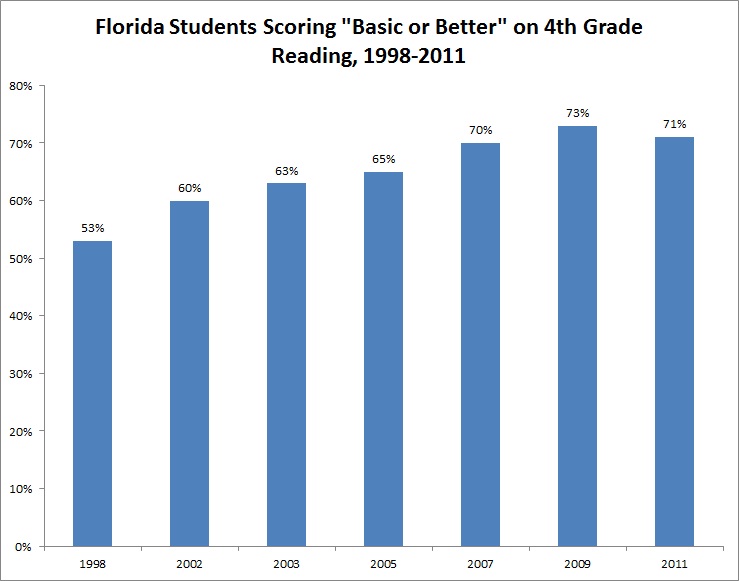
Over the past decade, Florida has made dramatic gains in academic achievement. Florida skyrocketed from 5th worst in reading performance on the NAEP in 1998 to 8th best by 2007, significantly increased the number of students who take and pass AP exams, and began to narrow the achievement gap between white and minority students (Black and Hispanic students in Florida had twice the reading gains of the national average from 1998 to 2009). But evidence suggests that progress the Sunshine State had begun to taper out, with students plateauing on recent assessments.
Keen to ensure student achievement continued apace, Florida proactively raised the rigor of the FCAT – something they’ve done every other year or so since Gov. Jeb Bush’s A-PLUS plan was implemented. According to Commissioner Gerard Robinson, the board of education “asked scorers to grade essays more strictly, with an eye to punctuation, grammar and the quality of word choice and relevance.”
As Florida reels under the draconian requirements of – gasp! – punctuation awareness in a writing assessment, there’s a lesson to be learned for federal and state policymakers eager to adopt national standards and tests.
The backlash against Florida’s efforts to improve the rigor of the FCAT begs the question: what is the correct level of rigor for the 46 states that have adopted Common Core national standards that will not elicit similar reactions? We have yet to learn where the Common Core central planners will set their cut scores, or how they plan to go about setting passing marks on which both Alabama and Massachusetts will agree.
It is a cautionary tale for national standards proponents. Much of Florida’s success over the past decade can be attributed to the state continuously improving its standards and tests. With rigid national standards in place, that flexibility would be lost. And if mistakes are made in the standards, they’re here to stay.
Florida will likely succeed, as it has over the past few years, at striking the right balance on the FCAT. But being able to define what Florida students should know and be able to do, and crafting standards and tests to reflect that, will be lost if the state goes through with Common Core adoption.
Florida strengthened state tests to make sure kids could spell, apply punctuation, and grasp other grammar concepts. These are nuances the state will no longer be able to enjoy come 2014, when national standards and tests are to be fully implemented. The Sunshine State wants to continue its march to the top of the NAEP, and has been working to strengthen standards to achieve that goal. But that ability will soon be lost, which is the ultimate lesson that should be gleaned from the FCAT controversy.
(edited to fix a typo)


 Posted by Jay P. Greene







 Jay P. Greene's Blog