It’s Not Easy Being Greene

June 14, 2010

(Guest post by Greg Forster)

Jim Geraghty, sorting through the various theories that have been offered to explain the mysterious landslide victory of unknown candidate Al Greene in the South Carolina Democratic senatorial primary:

Shortly after the election, Robert Ford, an African-American South Carolina state senator who ran for governor, offered the theory that voters could tell Greene was black by his last name: “No white folks have an ‘e’ on the end of Green. The blacks after they left the plantation couldn’t spell, and they threw an ‘e’ on the end.” This is an intriguing and possible theory, except that the world is full of people with the last name Greene who aren’t black (such as Florida Senate candidate Jeff Greene, author Graham Greene, and actress Michelle Greene) and plenty of African Americans with the last name “Green.”

Bad news, Jay – apparently you’re only the fourth most famous non-black Greene.


Random Pop Culture Apocalypse: Olympic Ceremonies by DANNY BOYLE?

June 11, 2010

(Guest post by Greg Forster)

The British want their 2012 Olympic opening ceremonies directed by DANNY BOYLE?

Which of Boyle’s previous landmark works do you think will serve as the model?

The movie that takes us on an unsparing journey into the most horrible depths of heroin addiction, and then ends by mocking bourgeois suburbia as a shallow and superficial life?

The zombie movie whose central lesson is that the only thing more thoroughly evil than rabid remorseless flesh-eating zombies is people?

Or the cute and cuddly story of a little boy who tries to charitably give away a duffel bag full of cash, only to discover that we’re all so evil that every grownup he approaches about it tries to take the cash for himself?

It’s a tossup!

My vote? Wenlock eats Mandeville’s eye out, then Mandeville rips Wenlock’s limbs off. For the opening act.


Separated at Birth? Carl Newman and Mark Steyn

May 2, 2010

Which one is the cool Canadian indie-rocker and which one is the cool Canadian columnist?


Random Pop Culture Apocalypse: Video Mix Tape

April 3, 2010

(Guest Post by Matthew Ladner)

So Mrs. Ladner once again took the Ladner children to visit their relatives in New Mexico, and once again, rather than pile up pizza boxes and watch a bunch of college basketball, I have taken off to hang out in NoZo at the Raven Cafe in Prescott.  When this happened last year, a mocha overdose resulted in the first Random Pop Culture Apocalypse post on cover songs.

As my blood caffeine level once again reaches dangerous levels, I’ve decided to make a tradition of this. This year’s model: mix tapes.

Just to begin with a “in my day we had to walk to school 5 miles in the snow uphill both ways” story, it used to be difficult to make a mixtape. Back when they were actually tapes, that is. I remember going to libraries to check out cds, raiding the collections of my friends, buying used cds, recording the one song I wanted and then selling it back at a loss, etc. etc. etc.

Ah, and then Napster came along. The great thing about Napster was that they had all kinds of random stuff that you couldn’t buy, like Sammie Davis Jr. singing the theme song to Shaft (I love Sammie, but it sounds like a SNL spoof) or Ozzy Osbourne goofing around in the studio and covering the Bee Gees Staying Alive with Dweezil Zappa. Now the mashup artists are doing cool stuff.

High Fidelity memorably included a discussion of the dos and don’ts of mixtaping. In my opinion, the key to a good mixtape is awkward transitions between songs. Often this can be achieved by juxtaposing songs from completely different genres, but this is not always the case. For instance, I had the following two songs on a mixtape from the mid 1990s:

Followed by:

Ah Rednex, it’s so hard to find a good Swedish electronica/hillbilly band these days! But I digress. Electronic music that takes itself seriously followed by purposely absurd electronic music = awkward mixtape transistion, a delight to be savored.

Mixtapes can tell stories by matching particular songs. I found an old mixtape I made back around 1998, which contained two songs which spoke to a certain political scandal of that era. First the desperately pathetic intern begs for affection:

The male, a practiced liar with an air of menace, responds:

For some reason I used to like to pair Rancid:

with ABBA:

Well, it made sense to me at the time. Still does. Here’s another awkward pairing  of the beautifully elegant Stacey Kent:

with the delightfully inelegant Joan Jett:

So you get the idea, now it is your turn. Post your favorite video mixtape pairings in the comment section, and tell me why it works for you. Person submitting the best pairing wins a JPGB No-Prize.


Cory in the House!

January 13, 2010

This Examiner article from Jan. 5 has just been brought to my attention:

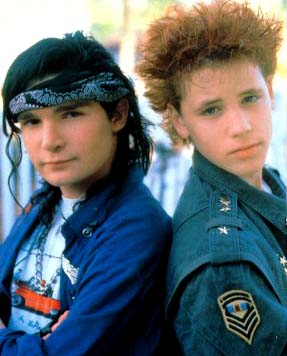
Another concern is that private schools work against segregation and decrease tolerance. On the contrary, in a study by Cory Forster of The Friedman Foundation who compared segregated levels in private voucher schools and public schools, less segregation was found in the private schools.

In my time I have been cited in newspapers as Greg Forester, Greg Foster, and other spellings. But I have never had the honor and privilege of being a Cory.

I’ll try not to let it go to my head.


Worst. Decade. Ever.

December 29, 2009

At least since the 90s, so says Reason TV.  It’s not nearly the erudite conversation we had assessing this decade, but it’s still pretty, darn funny.  Enjoy.

[HT: Patrick Gibbons]


Pass the Clicker — Stories in 60 Seconds

December 25, 2009

Some ads are pure genius.  In 30 or 60 seconds they can tell stories that capture the human experience more beautifully than many 2 hour movies (certainly better than Avatar does in 3 hours).

Check out the ad above for Coke and Wal-Mart.  Yes, it’s sappy.  But so are many movies.  What’s great is the way this ad captures certain relationships with little more than a gesture and a look in a few seconds.  I particularly like meeting his best friend and the on-line date.  Notice how the best-friend puts his arm around the date and she reacts uncomfortably and then relaxes, just like someone would on a first date. 

I also think the protagonist’s declaration of love for the first girl he ever kissed is just brilliant.  Notice how she is clearly there with her boyfriend and they are both shocked by his declaration.  She is then flattered and the boyfriend is diminished.

These are essential parts of the human experience and they are captured in just seconds.  Think about how many takes they probably had to do to get it just right.  Think about the acting skill involved.  This is art.


Recommended Reading

December 22, 2009

(Guest post by Jonathan Butcher)

Enemies of the People: My family’s journey to America, by Kati Marton (2009).

George Orwell’s 1984 is an epoch of dystopian storytelling.  Dozens of books and movies have tried since to recreate the idea of an oppressive, conspiratorial state and the overmatched citizens who attempt to free themselves.  From similar novels, such as Man in the High Castle, to recent films such as The Matrix and V for Vendetta, plotlines have morphed over the years, but the general concept is the same.

Nothing is recycled about Kati Marton’s life, however, and Hungarian oppression was real; she lived 1984.  Enemies of the People is her family’s biography of living, being hunted and captured, and, finally, escaping the brutal yet vulnerable totalitarian regime of post-World War II Hungary.  While the country’s leadership was feared by Hungarians, we are told a complex tale of how international pressures and varying levels of Soviet influence kept leaders looking over their shoulders in an attempt to gain political advantage, either from the West or the East.

The Marton’s knew every detail.  Kati’s parents were correspondents for the Associated Press and UP (what would become UPI) and had more access than any other reporters to both the American presence in Budapest and national leadership.  In fact, shortly before his arrest, Endre Marton, Kati’s father, had a memorable face-to-face confrontation with “Stalinist stooge” Matyas Rakosi, then in power.  Rakosi was well aware of the Martons’ reputation for keeping the West appraised of the oppression in Hungary: “Why should I talk to you?  You won’t write the truth anyway.”  Not Rakosi’s truth, certainly.  Endre and his wife, Ilona, were valuable assets for Western press outlets and well-known in press rooms.  The New York Times’s front-page articles on the Marton’s imprisonment were embarrassing to the Rakosi regime and critical to the pair’s release.  The Marton’s would be recognized for their courageous reporting after the Soviet resurgence in Hungary with the George Polk Memorial Award in 1957.

There are some distractions from the spy games in Enemies.  Kati is honest about her parents’ flaws, but she is also warmly candid on the way in which imprisonment strengthened—and even may have saved—Endre and Ilona’s marriage.  What happened to Kati and her sister, Julia, while their parents were in prison is told with a cold stare; she is not bitter, but the pain is almost too much to describe with any emotion.

Three plot elements kept me turning pages in Enemies: first, Kati knew almost nothing of the espionage going on during her childhood, and Enemies allows one to re-live Kati’s childhood along with her as she uncovers the AVO (secret police) files on her family.  She was blissfully ignorant of the grim details surrounding her parents’ knowledge of and attempts to avoid AVO surveillance and capture.  Second, the events of her parents’ separate arrests, their release one year later, and their daring escape with their daughters in the middle of the night, dodging Soviet tanks along the way, makes for gripping reading.

Third, and most importantly, Enemies of the People is a reminder that the United States is unique.  Freedom is a gift, and people recognize when they do not have it and so will chase it.  The Marton’s story is a sophisticated one, involving betrayal and espionage but also periods of calm and hopeful expectation of a better life.  Yet amidst the details, Kati Marton cannot help but emphasize that her parents knew the American way of life was free of the fear and despondency in Hungary.  Freedom of thought, speech and responsible action were absolutely vital to the Marton’s, and for as long as they could, they practiced these things in Hungary until they had no choice but to flee.

Throughout the book there is a hopeful thought that persists with the reader but goes unspoken by the Marton’s: there is always America.  If things become unbearable (which they did), or if Endre and Ilona are ever released (they finally were), they could always turn to their contacts in America and try to escape.  And when they reached America, they would be safe—the Marton’s were convinced of this.  As long as there was America, there was hope.


A Colbert State of Mind

December 20, 2009

(Guest Post by Matthew Ladner)

Colbert raps with Alicia Keyes. Colbert keeps it real- really suburban.


The State of Happiness

December 18, 2009

The news is filled with stories about a new study published today in Science Magazine ranking states by how happy people are.  The study is based on huge national survey that asks “In general, how satisfied are you with your life?  Subjects can answer very satisfied, satisfied, dissatisfied, or very dissatisfied, creating a 4 point scale.  The researchers controlled for personal factors, such as income, age, marital status, race, and employment status to identify which states had the highest regression-adjusted self-reported happiness.

The study also references earlier research by Gabriel, et al (2003) that develops an objective measure of happiness (or more accurately — quality of life).  They identified a long list of amenities that might be appealing to people, including weather, access to ocean or inland coast, state or national parks, crime, pollution, cost of living, commute times, etc…  They then predicted housing prices based on all of those variables.  This would allow them to know, for example, how much more people would be willing to pay for a house (all else equal) for each sunny day on average per year.  Essentially, these researchers can empirically derive the price for each of the long list of amenities they identified.  The average aggregate price of all of those amenities in each state allows them to develop an objective measure of happiness for each state.

Interestingly, states with higher median household income tend to be less happy.  However, it is important to note that the regression with dummies for each state shows positive coefficients for income, so money does contribute to happiness as long as it is only more money relative to my neighbors and not relative to the national average.

It is also interesting that blue states seem to be especially unhappy.  I calculated that there is a correlation of .48 between the percentage of voters in a state that voted for Bush in 2000 and the state’s happiness rank, using the objective measure.  The objective and subjective measure are also strongly correlated to each other, which is reassuring.

I would also note that Matt and I seem to live in happy states, while poor Greg is in a relatively unhappy state.  And pity Marcus and all of those other New Yorkers, with NY ranking at the bottom in terms of happiness on both measures.

  Obj. Sub.
AL 26  
AK 23 12
AZ 20 6
AR 3 17
CA 42 45
CO 34 2
CT 32 49
DE 30 22
DC N/A 36
FL 10 4
GA 36 19
HI 38 3
ID 5 16
IL 48 44
IN 44 47
IA 15 30
KS 19 31
KY 24 34
LA 8 1
ME 9 10
MD 45 39
MA 27 43
MI 49 48
MN 46 25
MS 7 9
MO 40 37
MT 4 8
NE 16 33
NV 29 38
NH 43 26
NJ 47 46
NM 14 23
NY 50 50
NC 17 13
ND 6 24
OH 33 42
OK 21 21
OR 22 29
PA 35 40
RI 12 41
SC 18 7
SD 2 14
TN 28 5
TX 25 15
UT 39 20
VT 13 18
VA 31 27
WA 41 35
WV 11 32
WI 37 28
WY 1 11