Reporter in Bed with School Official, Literally

September 27, 2008

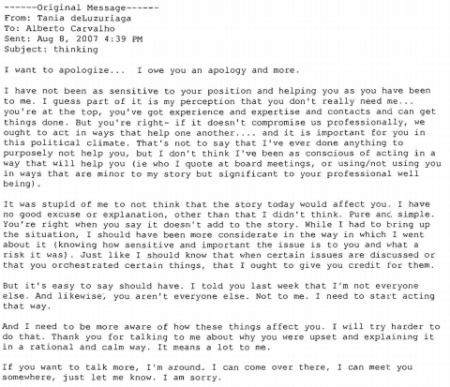
A series of e-mails between reporter, Tania deLuzuriaga, and a senor Miami-Dade school official, Alberto Carvalho, suggest an affair between the two while deLuzuriaga covered Miami schools for the Miami Herald.  deLuzuriaga has resigned from her job at the Boston Globe, where she moved last fall.  And Carvalho’s  selection as the new superintendent of Miami-Dade schools is in jeopardy.

The most alarming part of this story is not the affair itself, but how the affair distorted news coverage.  In addition to documenting the relationship, the emails detail how deLuzuriaga attempted to shape her reporting to preserve her relationship with Carvalho and how he bullied her about it.  In this exchange we see that Carvalho argued with deLuzuriaga about her coverage and she apologizes, asking for “understanding” about not quoting him more and giving him more credit:Carvalho

And in this e-mail deLuzuriaga explicitly apologizes for not helping Carvalho more and pledges that “we ought to act in ways that help one another”

Carvalho2Unfortunately, too many education reporters, especially outside of major cities, are in bed with school officials — figuratively.  They depend upon those officials for access and treat their pronouncements and views as accepted facts when they should be much more skeptical. 

If you want to see some examples of the rare investigative education reporter, check out Scott Reeder or Mike Antonucci.


The Denominator Law

September 16, 2008

Education policy debates should have a law.  No one should be allowed to highlight numerators without also presenting denominators.  That is, it is often misleading to describe a big number without putting that number in perspective.  In almost every education policy issue we see debates distorted by large numbers (the numerators) without the benefit of perspective that comes from also mentioning the denominator.

For example, the placement of disabled students in private schools is a regular sore spot for school districts and the topic of numerous alarming articles in the media.  New York City complained as part of its lawsuit in the Tom F. case that private placements initiated by parent request were costing NYC schools $49.3 million in a single school year.

Wow, that sounds like a huge burden — it’s millions of dollars!  But that is just the numerator.  If we add the denominator to the discussion, private placements no longer seem like a large financial burden.  NYC has a total annual budget of about $17 billion.  Once we add the denominator we see that private placement consists of about .3% of the NYC budget.  And if we consider that disabled students would have to be educated in the public schools if they were not placed in private schools, the additional cost of private placement is less than .1% of the total NYC budget.  See what a difference a denominator can make?

Articles in the New York Times, Time Magazine, the San Francisco Chronicle, Boston Globe, etc… lament the crushing burden of private placements.  One would think from all of these articles that private placements happen all of the time.  In fact, there are 57,708 disabled students using public funds to be educated in private schools at parental request.

Wow, that’s tens of thousands of students.  But wait.  There are more than 6 million disabled students and almost 49 million total students in K-12 education.  So privately placed students represent less than 1% of all disabled students and about one-tenth of one percent of all students.  Enforcing the denominator law would have a huge effect on news coverage of this issue.

The presentation of numerators without denominators also distorts the “boy crisis” debate.  In a recent report issued by the American Association of University Women, they argue that boys are doing fine since the number of men graduating college has increased over time: “More men are earning college degrees today in the United States than at any time in history. During the past 35 years, the college educated population has greatly expanded: The number of bachelor’s degrees awarded annually rose 82 percent, from 792,316 in 1969–70 to 1,439,264 in 2004–05.” It’s true that the number of women enrolled in college has increased even faster, they claim, but as long as college enrollment is rising for both men and women, there is no cause for alarm.

But there are also more people in the United States over time.  How do things look when we add a denominator to the discussion?  In 2006 25.3% of men between the ages of 25 and 29 had a BA or higher.  If we look at the cohort of men three decades earlier (ages 55-59) 34.7% have a BA or higher.  Educational attainment is declining for men once we add the denominator.  The same comparisons for women show an increase from 27.4% holding a BA or higher among those ages 55-59, rising to 31.6% among women ages 25-29.

The Denominator Law is important because the number of people and dollars involved in education is so huge that everything seems big without the benefit of the perspective that denominators bring.


Yet Another Study Finds Vouchers Improve Public Schools

August 21, 2008

(Guest post by Greg Forster)

The Friedman Foundation has just released my new study showing that Ohio’s EdChoice voucher program had a positive impact on academic outcomes in public schools. I’m told that it has generated a number of news hits, though the only reporter to interview me so far was the author of this piece in the Columbus Dispatch. When she interviewed me I thought she was hostile, because her questions put me a little off balance, but the article is perfectly fair. I guess if the reporter is doing her job right, the interviewees ought to feel like they were being challenged. The final product is what counts.

The positive results that I found from the EdChoice program were substantial but not revolutionary. That’s not surprising, given that 1) failing-schools vouchers aren’t the optimum way to structure voucher programs in the first place, and 2) the data were from the program’s first year, when it was smaller and more restricted than it is now.

It’s too early to be sure, but among the large body of empirical studies consistently showing that vouchers improve public schools, a pattern seems to be emerging that voucher programs have a bigger impact on public schools when they’re larger, more universal, and have fewer obstacles to parental participation. That’s worth watching and studying further as opportunities arise.


Arkansas Blogs Increase 200%

August 6, 2008

Well, not really.  But I’ve come across two relatively new Arkansas-based blogs (at least they are new to me).  One is The Arkansas Project, written by David Kinkade, Freeman Hunt, and Dan Greenberg.  Greenberg is a state representative who shares my interest in the naming of public buildings.  The other is the eponymous blog, Freeman Hunt.  And speaking of the symbolic power of names, Freeman Hunt appears to be her real name. 

They join the extremely high quality blog written by Stuart Buck at The Buck Stops Here.


Where Did You Get That Marvelous Datum?

July 31, 2008

(Guest post by Greg Forster)

NRO blogger Jim Geraghty has a good post today about Obama and school choice. But what I particularly want to point out is this, which he notes in passing:

These numbers from the Department of Education’s National Center for Education Statistics for the 2003-2004 school year put average tuition paid by private elementary school students at $5,049

It looks to me like the word “these” was supposed to have a link, but there’s no link. I wasn’t aware NCES had collected any private school tuition data since 1999. And that figure looks a whole lot like the figure NCES was reporting back in 1999. Did Geraghty find the tuition number and assume it came from the most recent iteration of the Private School Universe Survey? (Actually the PSS has just released its 2005 data, but we’ll overlook that for the moment.) Or does NCES still collect private school tuition data, and somehow I missed it?

I’m not sure which outcome to root for.


Being Misquoted

July 17, 2008

Dean Millot has a new post attacking me on the peer review issue that Eduwonkette promotes on her own site.

But Dean Millot is being fundamentally dishonest in that he misquotes me. He says that I argue: “In short, I see no problem with research becoming public with little or no review.”

In fact I wrote: “In short, I see no problem with research initially becoming public with little or no review.” (See here )

The absence of the word “initially” makes quite a difference and sets up the straw man that Millot wishes to knock down. The issue is not whether research can benefit from peer review, but whether it is inappropriate to make it publicly available INITIALLY, before it has received peer review.

Readers may want to wonder about the credibility of Millot’s claim that “One of the reasons I do my best to quote the very words of people I write about in edbizbuzz is that I prefer to fight fair.”

And so much for Eduwonkette’s praise of Millot’s “measured, careful, and thoughtful analysis.”

I’m waiting for the correction and apology from both of them.


Educating Journalists about Education Science

July 16, 2008

(Guest post by Greg Forster)

Don’t worry, this post is definitely not a continuation of the recent big dustup about 1) whether it’s naughty for scholars to provide journalists with accurate information about their work; and 2) whether it’s naughty for anonymous bloggers to argue that scholars’ motives are relelvant to their credibility, but bloggers’ motives aren’t relevant to theirs (which reminds me of Pat Moynihan’s quip about the Supreme Court cases, since overturned, holding that government can’t subsidize private school books but can subsidize classroom equipment such as maps; Moynihan asked, “What about atlases?” – books of maps? What about scholars who are bloggers? Or bloggers who write about scholarly studies? Once you start legitimizing ad hominem arguments, where do you stop?).

But I would like to expand on a comment that Eduwonk made during said dustup, which deserves more attention and has significance well beyond the issues that were at stake in that squabble. The comment got lost in the exchange because it was somewhat tangential to the main points of contention.

He wrote:

Not infrequently newspapers get snookered on research and most consumers of this information lack the technical skills to evaluate much of the work for themselves.   As education research has become more quantitative — a good thing — it’s also become less accessible and there is, I’d argue, more an asymmetry to the information market out there than a fully functioning marketplace of ideas right now.  In terms of remedies there is no substitute for smart consumption of information and research, but we’re not there yet as a field.

We are living in the first golden age of education research, brought on by the advent of systematic data collection, which every other field of human endeavor began undertaking a long time ago but which education is only getting around to now because it has been shielded from pressure to improve thanks to its protected government monopoly. Given the explosion of new information that’s becoming available, educating journalists about quantitative research is a huge problem. Jay is right that there is a marketplace of ideas. There really can’t help but be one; the idea some people seem to have that we can forbid people who own information from spreading it around as much as they want is silly. But just because there’s a market doesn’t mean there’s a perfect market, and Eduwonk is right that markets require informed consumers to function well. The current state of methodological ignorance among journalists does hinder the market of ideas from functioning as well as it should. (I’ll bet Jay would agree.)

As it happens, the same subject came up this morning in a completely different context, as my co-workers and I struggled to figure out the best way to present the findings of an empirical study we’re coming out with so that journalists will be able to follow them. And I wasn’t there, but I hear this topic also came up at a bloggers’ panel at the recent conference of the Education Writers’ Association.

Here at the Friedman Foundation, this has been a topic of great importance to us for some time, since exposing the bad and even bogus research that’s used to justify the status quo is one of our perennial challenges. We took a stab at composing a journalist’s guide to research methods. It went over well when we first distributed it (at last year’s EWA, if memory serves). But it’s necessarily very basic stuff.

Eduwonk is also right about journalists having been snookered by lousy research, and I think that has had both good and bad effects. The good news is that I’ve noticed a clear trend toward greater care in reporting the results of studies (not at propaganda factories like the New York Times, of course, but at serious newspapers). In particular, we’re seeing journalists talk about studies in the context of previous studies that have looked at the same question. Of course, we have a long way to go. But we’re on the way up.

On the bad side, however, I have also noticed a greater reluctance to cover studies at all. Part of that is no doubt due to the increase in volume. I’m young, but even I can remember the heady days of 2003 when any serious empirical study on the effects of a controversial education policy (vouchers, charters, high-stakes testing) would get at least some coverage. Now it’s different, and (to echo Eduwonk) that’s a good thing. But I think it’s extremely unlikely that this is the only factor at work. Junk science has poisoned the well for serious research. No doubt that was part of its intended purpose (although of course the motives of those who produce it have no relevance to its scientific merts or lack thereof).

My hope is that journalists will soon realize they’re getting left behind if they don’t learn how to cover the research accurately. Their job is to go where the news is. If the news is in quantitative research – and that is in fact where a lot of it is – they’ll have to learn how to get there.

Also, the changing media landscape will help. The old idea that journalists must be neutral stenographers with Olympian detachment from all the issues they cover is an artifact of the mid-20th-century role of the media as oligarchic gatekeeper, and is rapidly dying out. As “news” increasingly includes coverage by people who are actively engaged in a field, even as advocates, we can expect the news to be increasingly provided by people with greater amounts of specialized knowledge. (By the way, the old idea of the scholar as detached Olympian stenographer is equally an artifact of vanished circumstances, and will probably be the next thing to go; see the Our Challenge to You statement on the inside cover of any empirical study published by the Friedman Foundation for our views on the relationship between advocacy and scholarship.)

An optimistic view, yes – but since my optimism on other subjects has been triumphantly vindicated over the past year, even when the conventional wisdom said to head for the hills, I think I’ll let it ride.


It Never Ends

July 14, 2008

I thought that the exchange with Eduwonkette over the appropriateness of releasing research without peer review had run its course with my last post.  But it seems that it will never end.  Here is her latest post and here is the reply that I posted in her comment section:

Eduwonkette is attempting to change the subject. I’ve never disputed that peer review can help provide additional assurances to readers about quality.  The issue is whether research ought to be available to the public even if it has not been peer reviewed.  In attacking the release of my most recent study Eduwonkette seems to be arguing that it is inappropriate to release research without peer review, at least under certain conditions that she only applies to research whose findings she does not like.  If she were going to be consistent, she would have to criticize anyone who releases working papers of their research, which would be almost everyone doing serious research.


What’s more, she is still trapped in a contradiction: she can’t say that we should analyze the motives of people who release research directly to the public when assessing whether it is appropriate, while she prevents analysis of her own motives because she blogs anonymously.  As I have now said several times, either she drops the suggestion that we analyze motives or she drops her role as an anonymous blogger.  If she refuses to resolve this contradiction, Ed Week should stop lending her their reputation by hosting her blog.  Let her be inconsistent in blogging at the expense of her own anonymous persona and not drain the respectability of Ed Week.


Lastly, the comparison of the market for education policy information and the market for cars comes from my most recent post in our exchange, but she oddly does not credit me here. (See https://jaypgreene.com/2008/07/12/see-were-in-italy/ )  Her position seems to be that we ought to forbid (or at least shun) the sale of used cars without warranties (translation: research without peer review).  My argument is that used cars without warranties come at a risk but there are compensating benefits.  Similarly, non-peer-reviewed research has its risks but also its benefits.


UPDATE — My exchange with Eduwonkette continues although it seems increasingly pointless.  Here is my (slightly edited) last comment on her site:

“Let’s make this very concrete. Was it inappropriate for Marcus Winters and I to release our social promotion findings in 2004 without peer review, or should we have waited until it had been peer-reviewed and published (in various forms) in 2006, 2007, and again in 2008? If the appropriate thing is to wait, would interest groups, editorial boards, and bloggers similarly hold their tongues until the additional evidence came in?  Would policymakers hold off on decisions that might have come out differently if they had the suppressed information?

Would it have been OK to release in 2004 as long as we tried to make it obscure enough so that people were less likely to find it? What if interest groups, bloggers, etc… found our obscure finding and promoted them (as has happened with Jesse Rothstein’s paper)?

And in saying ‘working papers and thinktank reports are released for entirely different functions’ you are repeating your call for an analysis of motives. You’ve said that think tanks want to influence policy (bad motive) while academics are trying to advance knowledge with each other (good motive). But if academics are serving the public good, shouldn’t they ultimately want to influence policy? I am an academic who also releases working papers through a think tank. Does that make my motives good or bad? I think all of this analysis of motives is silly when the real issue is the truth of claims, not why people are making those claims. Calling for an analysis of motives is especially silly for someone who is trying to influence people anonymously. The fact that you are trying to influence people through a blog does not give you a free pass from having to be consistent on this.”


See, we’re in Italy…

July 12, 2008

Stripes

“See, we’re in Italy.  The guy on the top bunk has gotta make the guy on the bottom’s bed all the time.  It’s in the regulations.  If we were in Germany I would have to make yours.  But we’re in Italy, so you’ve
gotta make mine. It’s regulations.”

This is more or less Eduwonkette’s response to my complaint that she can’t argue that the source of information is important in assessing the truth of claims while blogging anonymously.  Her answer is that it’s different for bloggers (in Italy) than for researchers (in Germany).  It’s regulations.

She goes on to describe some differences between different types of information in education policy debates, but it’s not clear why any of those differences would be relevant to whether assessing the source is important for one and not for another.  The closest she comes to explaining why things are meaningfully different is when she says, “And let’s be realistic: an anonymous blogger isn’t shaping public policy.”  So, if information will have no bearing on policy debates, then its source is unimportant.

This would be a consistent argument if she really believed that bloggers had NO influence.  But of course they have at least some influence.  Why else would she and the rest of us be bothering with this?  And if bloggers have some influence, then the same basic principles should apply: either we should analyze the motives of sources of information to assess the truth of claims or we shouldn’t.  I’m in favor of not analyzing motives for anyone since I think that the truth of claims is independent of the motives of the source.  Even bad people can make true arguments.

At the risk of belaboring this issue, maybe I can clarify things by describing the market of ideas in policy debates as being like the market for cars.  We have different levels of confidence in cars that have gone through different processes before being made available for sale.  We could buy a used car from the corner used car dealer with no warranty.  That would be like reading blogs.  We don’t really know whether we are getting a lemon or not, since almost no assurances have been made about quality.  Or we could buy a used car from a larger chain with at least some warranty.  That would be like getting information from newspapers or magazines.  There has been some review and assurance of quality, but we still don’t quite know what we’ll get.  Or we could buy a new car from a major dealer and buy the extended warranty.  That would be like getting information from a peer-reviewed journal.  It may still be a lemon, but we’ve received a lot of assurances that it is not.  And I suppose reading an anonymous blogger is like buying a used car from someone you don’t know in the want ads.  There are trade-offs in getting cars with these different level of assurances about quality, just as there are trade-offs in getting information that has gone through different processes to assure quality. 

Eduwonkette’s argument is essentially that the same rules regarding these trade-offs don’t apply to the market for cars without warranties that do apply to the market for cars with warranties.  My view is that there are only differences in degree, not kind.  Even bad people can sell cars that are good values.

I’ve also noticed that Marc Dean Millot has weighed in on this issue.  He’s just knocking down a straw man.  It is not my position that research doesn’t benefit from peer review.  He can check out my cv to see that I have two dozen peer-reviewed publications, many of which were earlier released directly to the public without review.

I’ve been arguing that the public benefits from seeing research even before it has received peer review because it gets more information faster.  Without the assurances of peer review people will tend to have lower confidence in that research, and their confidence may increase as the research receives those additional assurances.  Millot seems to want to embargo information from the public until it receives peer review.  If he really believes that, then he should criticize every researcher with working papers on the web.  That’s almost everyone doing serious research.

And on his points about ideology tainting research I would suggest that people read Greg Forster’s excellent earlier post on Vouchers: Evidence and Ideology.


Eduresponses to Edubloggers

July 10, 2008

My recent posts on the release of our new study on the effects of high-stakes testing in Florida and posts here and here on the appropriateness of releasing it before it has appeared in a scholarly journal, have produced a number of reactions.  Let me briefly note and respond to some of those reactions.

First, Eduwonkette, who started this all, has oddly not responded.  This is strange because I caught her in a glaring contradiction: she asserts that the credibility of the source of information is an important part of assessing the truth of a claim yet her anonymity prevents everyone from assessing her credibility.  I prefer that she resolve this contradiction by agreeing with my earlier defense of her anonymity that the truth of a claim is not dependent on who makes it.  But she has to resolve this one way or another — either she ends her anonymity or she drops the argument that we should assess the source when determining truth.

But apparently she doesn’t have to do anything.  Whose reputation suffers if she refuses to be consistent?  Her anonymity is producing just the sort of irresponsibility that Andy Rotherham warned about in the NY Sun and that I acknowledged even as I defended her.  The only reputation that is getting soiled is that of Education Week for agreeing to host her blog anonymously.  If she doesn’t resolve her double-standard by either revising her argument or dropping her anonymity, Education Week should stop hosting her.  They shouldn’t lend their reputation to someone who will tarnish it.

Mike Petrilli over at Flypaper praises our new study on high stakes testing but takes issue with referencing comments by Chester Finn and Diane Ravitch about how high stakes is narrowing the curriculum in the “pre-release spin.”  I agree with him that this study is not “the last word on the ‘narrowing of the curriculum.’”  But to the extent that it shows that another part of the curriculum (science) benefits when stakes are applied only to math and reading, it alleviates the concerns Checker and Diane have expressed. 

As we fully acknowledge in the study, we don’t have evidence on what happens to history, art, or other parts of the curriculum.  And we only have evidence from Florida, so we don’t know if there are different effects in other states.  But the evidence that high stakes in math and reading contribute to learning in science should make us less convinced that all low stakes subjects are harmed.  Perhaps school-wide reforms that flow from high stakes in math and reading produce improvements across the curriculum.  Perhaps improved basic skills in literacy and numeracy have spill-over benefits in history, art, and everything else as students can more effectively read their art texts and analyze data in history.

Andy Rotherham at Eduwonk laments that what I describe as our “caveat emptor market of ideas” doesn’t work very well.  I agree with him that people make plenty of mistakes.  But I also agree with him that “in terms of remedies there is no substitute for smart consumption of information and research…”  There is no Truth Committee that will figure everything out for us.  And any process of reviewing claims before release will make its own errors and will come at some expense of delay.  Think Tank West has added some useful points on this issue.

Sherman Dorn, who rarely has a kind word for me, says: “Jay Greene (one of the Manhattan Institute report’s authors and a key part of the think tank’s stable of writers) replied with probably the best argument against eduwonkette(or any blogger) in favor of using PR firms for unvetted research: as with blogs, publicizing unvetted reports involves a tradeoff between review and publishing speed, a tradeoff that reporters and other readers are aware of.”  He goes on to have a very lengthy discussion of the issue, but I was hypnotized by his rare praise, so I haven’t yet had a chance to take in everything else he said.