What Does Florida Tell Us About Broader/Bolder?

September 4, 2008

(Guest Post by Matthew Ladner)

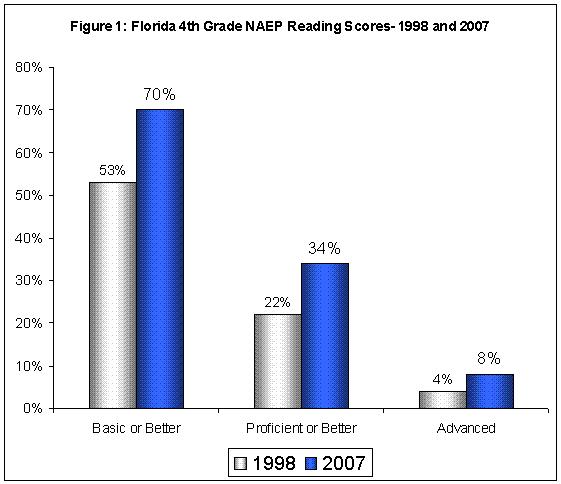
I have several times noted the vast improvement in Florida’s 4th Grade Reading NAEP scores on this blog. Figure 1 below demonstrates just how large that improvement has been between 1998 and 2007. For those who don’t have an excel spreadsheet open, that is  a 32% increase in students scoring Basic or above, a 54% increase in those scoring Proficient or better, and a 100% increase in the percent scoring at the advanced level.

These results make the so-called “Broader and Bolder” approach seem all the more absurd. There hasn’t been any outbreak of “Socialism for the Children” in Republican dominated Florida, but there has been substantial improvement in the percentage of children learning to read.


Lucky thing too, as state budgets are being consumed by out of control Medicaid spending that it taking an increasingly large bite. Society has several other priorities besides K-12 education, such as criminal justice, higher education, transportation and social welfare. Bottom line: there isn’t the money for the Broader and Bolder approach anyway. This is just as well, as the track record on spending increases fueling academic gains stands as a dismal failure.


Given that we can’t spend our way out of our K-12 problems (and it wouldn’t work if we tried) we should instead seek ways to improve the bang we get for our existing bucks. Fortunately, Florida shows that it can be done.


Demography Is Not Destiny

August 22, 2008

(Guest Post by Matthew Ladner)

The Pacific Research Institute has put out a new study co-authored by PRI Senior Fellow Vicki Murray and some guy from Arizona comparing trends in academic achievement in California to those in Florida. Among the findings: Florida’s Hispanic students outscore the statewide average for all students in California on NAEP’s 4th Grade Reading Exam. Also, Florida’s Free and Reduced lunch eligible Hispanics outscore the statewide average for all students in California. After a decade of strong improvement in Florida, Florida’s African-American students are within striking distance of the statewide average for all students in California, and have already exceeded the statewide averages for all students in Louisiana and Mississippi.

Oh, and Florida’s free or reduced lunch eligible students attending inner city schools outscore the statewide average for all California students.

The point of all of this is not to bash California public schools, but instead to show just how much entirely plausible room for improvement exists. The question isn’t whether disadvantaged kids can learn. Yes they can! The question is whether we adults can get our acts together for the kids.


Should You Redshirt Your Kindergartener?

July 31, 2008

(Guest Post by Matthew Ladner)

“Redshirting” children (having children start school at an older age) has become a fad. Some parents have held children back from entering kindergarten with the idea that their child will benefit academically from being older and/or more mature. According to research by Sandra E. Black, Paul Devereux and Kjell G. Salvanes at Vox (an interesting hybrid between a blog and an academic journal for economists) this fad is like many previous education fads: intuitively plausible but actually worthless.

The researchers were able to isolate the impact of late school starting from those of mere age by comparing Norwegian military IQ tests of students born on December 31 to those born on January 1st :

The administrative rule in Norway is that children must start school the year they turn seven. Children born on 31 December start school a year earlier than those born on 1 January – even though they are almost exactly the same age. This provides an exogenous separation between age and school-starting age.

Result: age matters but not school-starting age. Would-be redshirt parents can relax, or more likely, seek an edge some other way.


Dan Lips Interviews the Chef

July 22, 2008


(Guest Post by Matthew Ladner)

Dan Lips interviews Jeb Bush about education reform on National Review Online today.


I Love It When a Plan Comes Together

July 15, 2008

(Guest Post by Matthew Ladner)

Recently I wrote about Arizona’s system of testing having jumped the shark. The cut scores for the AIMS had been dropped severely, and the state’s version of the Terra Nova exam spun a tale of Arizona students scoring above the national average in every grade and subject tested. Arizonans were asked to believe this, despite having a very difficult to educate K-12 population and NAEP scores below the national average in every test given since the early 1990s.

I am pleased to say that the Arizona legislature, acting in a bipartisan fashion, took corrective action. Essentially they limited the current testing contracts to a single year, and appointed a commission to design a new testing system, specifying the use of a college readiness exam as a graduation exam along the lines of the Michigan model with the ACT.

The challenge now will be for the commission to create a challenging, consistent system of testing providing proper transparency for parents, teachers, administrators and policymakers. The first step was to admit that there was a problem, which the Arizona legislature has now done emphatically.


Learn to Swim by Drowning

July 10, 2008

(Guest post by Greg Forster)

So far I’ve kept largely out of the hubbub over Reading First, but I can’t resist a comment on Stephen Krashen’s “opposing view” editorial in yesterday’s USA Today.

On the merits of Reading First I offer no opinion, but Krashen’s proposal for what we should be doing instead of Reading First is a good illustration of how little the program’s opponents are offering by way of promising alternatives.

Krashen argues that we should increase literacy by spending more money on libraries. Apparently the mere physical presence of books will help people learn how to read – by osmosis, presumably.

Actually, Krashen’s real argument is that we don’t have a problem with literacy anyway. He asserts that 99 percent of U.S. adults can read and write “on a basic level.” Thus, we should be focused on increasing people’s ability to read at a higher level – in which respect he asserts that the main obstacle is a lack of access to reading material among low-income populations.

His source for the 99 percent literacy datum is the CIA World Factbook. Insert your own joke about the CIA’s “slam dunk” intelligence on Saddam’s WMD program here.

In fact, the CIA includes all persons 15 years and older in this statistic, so we’re not just talking about “adults.” The CIA is actually claiming that 99 percent of U.S. adults and teenagers can read and write.

Clearly the CIA is defining “literacy” at such a low level as to be meaningless for evaluating the need for programs like Reading First. If the CIA considers 99 percent of U.S. adults and teenagers to be literate, then it must be counting the ability to read a stop sign as literacy. Reading First is intended to address literacy problems on a slightly more serious level.

As for the idea of spending more money on libraries, if the unspecified “studies” that Krashen asserts show literacy benefits from libraries involve scientifically valid analysis of systematically collected empirical data, then by all means let’s spare a little more money for the libraries. (In Krashen’s defense on that last point, USA Today doesn’t really offer a lot of space for specifics on what studies you’re referring to and what methods they used.)

But the alleged need for more libraries really ought to be considered separately from fights over pedagogy. The relevant question for evaluating the merits of Reading First is how we ought to be teaching reading in our schools. Unless Krashen wants to quit teaching reading in schools and just lock the kids in the library until they figure out how to read, his argument for more libraries really doesn’t speak to the question at hand. He might as well argue that since Reading First allegedly doesn’t work, we should be spending the money on hospitals instead.

All of this, of course, is separate from the question of whether spending more money on libraries really would improve literacy. In response to Krashen’s editorial, I recieved an e-mail that was circulated by Martin Kozloff of the education school at the University of North Carolina-Wilmington, who gave me permission to post it here:

This [proposal to spend more on libraries] has been Krashen’s refrain for the past 20+ years. It’s hard to argue with investment in libraries, but it feels like a bait and switch argument rather than addressing instructional needs of students.

Yes, we CAN eliminate drowning simply by building more swimming pools and then immersing the kids in water-rich environments.

“Here, ya go, Billy.” [SPLASH]

“HAAALLLLP!”

“It’s alright, Billy, you are an emergent swimmer.”

Kozloff takes quotes from critics of phonics-based instruction and substitutes swimming for reading:

“Children must develop [swimming] strategies by and for themselves.”

“Saying that we are determined to teach every child to [swim] does not mean that we will teach every child to [swim]…The best we can do … is … to ensure that, if not every child [survives a rip tide], there is a minimum of guilt and anguish on the part of teachers, students, and parents.”

“We might offer students some [floating] hints at an appropriate moment when they are [drowning] and aren’t sure how to [stay afloat].”

“[Swimming] learning proceeds naturally if the environment supports young children’s experimentation with [rip currents].”

“In my view, [swimming] is not a matter of [stroking with your arms and kicking with your legs] but of bringing meaning to [drowning].”

“Early in our miscue research, we concluded.That [the middle of an ocean] is easier to [swim in] than a [raging river], a [raging river] easier to [swim in] than a [lake] , a [lake] easier than a [pool], a [pool] easier than a [bath tub], and a [bath tub] easier than a [kitchen sink]. Our research continues to support this conclusion and we believe it to be true.”

“The worst [swimmers] are those who try to [paddle and kick] according to the rules of [physics and common sense].””In my view, [swimming] is not a matter of [stroking with your arms and kicking with your legs] but of bringing meaning to [drowning].”

“Early in our miscue research, we concluded.That [the middle of an ocean] is easier to [swim in] than a [raging river], a [raging river] easier to [swim in] than a [lake] , a [lake] easier than a [pool], a [pool] easier than a [bath tub], and a [bath tub] easier than a [kitchen sink]. Our research continues to support this conclusion and we believe it to be true.”

“The worst [swimmers] are those who try to [paddle and kick] according to the rules of [physics and common sense].” 

Kozloff is, of course, a harsh critic of whole language instruction. I have no desire to step into the phonics/whole language debate as such.

But Kozloff clearly has a point when he observes that offering libraries as an alternative to Reading First is like offering swimming pools as an alternative to a program of swimming lessons. Even if the lessons in the Swimming First program aren’t effective, it’s simply a distraction to respond by talking about the need for more swimming pools.

And quite a lot of the noise about Reading First has this quality about it – by which I mean what Kozloff calls a “bait and switch” quality. No one in the national spotlight seems to be championing whole language the way they were, say, ten years ago. If the critics think whole language is the way we should go, let them say so. If not, what are their alternative models for good pedagogy?

Fortune Favors the Bold

July 2, 2008

(Guest Post by Matthew Ladner)

The Goldwater Institute released a new study today co-authored by yours truly titled Fortune Favors the Bold: Reforms for Results in K-12 Education.

The study makes the case for robust education reforms rather than incremental tinkering with a fundamentally broken system. Here in Arizona, for example, inflation adjusted spending per capita in the K-12 schools has tripled since 1960, and 44% of our 4th graders in public schools score “below basic” on the NAEP 2007 4th grade reading exam.

The kids are running around with their hair on fire, while we adults wonder whether to use a cup or a bucket of water to put out the flames. It’s time to use the fire hose.

The four reforms proposed:

  • A universal system of choice, either through vouchers or a universal tax credit. Despite having among the nation’s most robust system of private and public school choice, choice programs have simply absorbed about of the third of the increase in the public school population since the charter law passed in 1994. Arizona could enjoy substantial academic and financial benefits from passing a far bolder choice program than anything currently on the books, and we would still be building new public schools.
  • Reforming Public School Governance. Charter schools make up nine out of the top 10 high schools in the greater Phoenix area, and the 10th is a magnet school. Not a single district school cracks the top 10, with charters enormously overrepresented. The lesson is clear: good schools need a district bureaucracy like a fish needs a bicycle. Schools can and should govern themselves, freeing resources for instructional use.
  • Reform of Testing. Standardized testing has jumped the shark in Arizona and elsewhere. We put forward a proposal on how to preserve the transparency and diagnostic value of testing even when states respond to pressure to dummy down their tests.
  • Measure Teacher Effectiveness on a Value Added Basis. William Sanders’ path-breaking work on value added assessment shows that students learn 50% more over a three year period with highly effective teachers compared to those stuck in classes with the bottom 20%. Dr. Sanders finds that variation attributable to teacher performance is 10 to 20 times greater than that associated with class size. Further, high-quality teachers are too rare and clustered in the leafy suburbs. Value-added measurement serves as a pre-requisite for rational and just treatment of teachers as professionals and improving learning for children.
  • Jeb Bush put in what seemed like a radical set of reforms in Florida in 1999, and they have paid huge dividends. The time has come not only for other states to emulate Florida, but to reach further, and do more. Fortune favors the bold and American education reform dithers between being misguided, pointless, and too timid.


Have You Heard About the Latest Thing in Education? Fads!

July 2, 2008

(Guest post by Greg Forster)

In a number of recent discussions, we’ve tangentially touched on the subject of educational fads: some new idea will quickly gather a huge following, tons of money will pour in to support it, and then a few years later everyone will forget about it – not because anyone actually bothered to measure whether the hot idea worked, but because a new fad will come along, and the cycle will start over. As a result, the demand for improvement that ought to be producing political capital for real reforms instead gets dissipated in the mad rush for fad after fad. Meanwhile, as educators see fads come and go, they become less receptive to all proposed ideas – even ideas that would accomplish real reform and/or have solid science showing they work. It seems to be pretty widely agreed upon that this has been one of the major problems in education over the past century.

I’m tempted to say that complaining about the problem of fads has become a hot fad among reformers. But fads are things that don’t last! Complaints about the fad problem, by contrast, are perennial. Recently I’ve noticed a couple more contributions to the genre: Roger Frank Bass of Carthage College provided a sharp-edged overview of the educational fad phenomenon in the Milwaukee Journal Sentinel on Sunday. Meanwhile, last Monday America’s last education labor reporter noted the juxtoposition of two headlines – “The Next Big Thing: Small Schools” in Baltimore, and “Small School Experiment Doesn’t Live Up to Hopes” in Seattle. “Maybe they were just on the wrong coast,” quips Antonucci. (Come to think of it, I was shocked back in May to see Newsweek pimping small schools on the front cover – this, not months but years after the failure of the Gates Foundation’s extraordinary investment in small schools had become clear even to the Gates Foundation. There’s nothing sadder than people who desperately want to be cool but are always wearing last year’s outfit.)

What I don’t see very often, though, is reformers asking why we have this problem. There are no other socially urgent functions (from law and emergency services to the production and sale of consumer goods) that have remained basically unchanged and unimproved for a century because they’re crippled by an inability to 1) stick with one idea long enough to 2) objectively measure whether it works and 3) make a deliberate decision on whether to keep it. Only education spins its wheels this way; everywhere else in society, “fads” are either the province of children and adolescents (for whom they are probably beneficial, since they harmlessly dissipate dangerous youthful energies) or else are shunted off into the realm of “fashions,” which are not supposed to accomplish anything serious and thus do nobody any harm if they constantly change.

So what’s different about education? Well, if you’ve read your homework assignment, or if you’ve spent any time here on Jay P. Greene’s Blog (or “JPGB,” as all the kids are calling it when they text each other about it), you already know the answer: accountability for results. Educational decisionmaking exists in an “outcome vaccuum” to a greater extent than decisionmaking in just about any other field.

Of course the vast majority of people in the system are well-intentioned, but we all know where the road paved with good intentions leads. Flitting from one promising idea to the next promising idea is precisely the kind of thing well intentioned people can end up doing when they lack the disciplining force imposed by firm outcome-based incentives.

“Incentives again? What, are you proposing a unified field theorem of educational problems, where everything that’s wrong with our schools traces back to this single cause?” Well, maybe not – but if there’s an alternative explanation for the unique prevalence of the fad problem in education, I’d be open to hearing it.


How Well Aligned Is Kazakhstan to NAEP Standards?

June 25, 2008

(Guest Post by Matthew Ladner)

Recently I appeared on the Horizon public affairs program together with Arizona Superintendent of Public Instruction Tom Horne, to discuss the No Child Left Behind law and our state AIMS test. Superintendent Horne and I have a public disagreement about the relative reliability of NAEP compared to that of the state’s own version of the Terra Nova exam. NAEP finds Arizona consistently below the national average in all subjects and grade levels, while the state’s Terra Nova finds us above the national average in all subjects tested and grade levels. One of these sets of finds is much more consistent with the socio-economic profile of the K-12 population than the other, given that Arizona ranked second to the bottom on Jay and Greg’s Teachability Index study.

During the discussion, Superintendent Horne said the main reason Arizona students perform poorly on the national NAEP test, also known as the Nation’s Report Card, is due to a non-alignment of standards. If, for example, Arizona does not teach the math concepts in fourth grade that appear on the fourth grade math NAEP, one could expect lower average grades.

The explanation seems quite plausible, and doubtlessly there are some states that have better aligned their standards to NAEP than others. But how big a deal is this, in terms of Arizona’s performance? A study by the American Institute of Research shows probably not much.

The study compared international science scores for eighth graders to eighth grade NAEP science scores through an equating proceedure. Singapore came in first, with 55 percent of students ranked as “proficient” or above. Massachusetts was the highest-performing U.S. state, with 41 percent proficient. Just 20 percent of Arizona eighth grades ranked proficient.

Alignment error ought to be much greater between nations than between American states. Perhaps, for example, Norway chooses not to teach science until 9th grade. One would be hard pressed to buy into the notion that countries such as Singapore, Korea, Estonia, Hungary, and Slovakia simply have national standards more closely aligned to the American NAEP test than Arizona.

When we get clobbered in science proficiency by countries like Estonia, we have problems that go much deeper than standards alignment. I could start looking up GDP per capita in Estonia, but that would be cruel. We need to be willing to think outside the box and figure out what other countries are doing right.

Nation (or State) 8th Grade Science Scores

Percent Scoring “Proficient” or Above

Nation (or State) 8th Grade Science Scores

Percent Scoring “Proficient” or Above

Singapore

55

Lithuania

25

Taipei

52

Slovenia

24

South Korea

45

Russia

24

Hong Kong

44

Scotland

24

Japan

42

Belgium

22

Estonia

41

Latvia

21

Massachusetts

41

Malaysia

20

England

38

Arizona

20

Hungary

38

Israel

18

Netherlands

31

Bulgaria

17

Australia

30

Italy

17

Sweden

28

Norway

15

New Zealand

26

Romania

14

Slovakia

26

Serbia

12


Baked Alaska

June 25, 2008

I just returned from vacation in sunny Alaska to see how well the blog has been doing in my absence.  Thanks to Jonathan Butcher for being my substitute blogger and to Greg Forster and Matthew Ladner for keeping everything running smoothly.  Thanks also to Reid Lyon, Dan Lips, and Larry Bernstein for their guest posts.  Looks like I missed a lot of interesting discussions.

The most striking thing about Alaska, other than the amazing natural beauty, is how remote living there must be.  The state capital, Juneau, can only be reached by boat or plane.  There are communities sprinkled throughout the state whose link to the outside world is regularly cut by snow, rain, fog, rock-slides, or high winds. 

I kept wondering, how in the world do they offer kids in all of these communities a public education?  By necessity, they don’t restrict their vision of public schools to students riding in yellow school buses to government built and operated school buildings.  In Alaska a significant portion of public education is provided by distance learning technology, just as Matt Ladner has suggested in his post The Shape of Things to Come

The Alyeska Central School is a statewide virtual school than began operating in 1939, when distance learning technology was the mail service.  Until recently it was run by the state department of education but has recently shifted to being a charter school.  In addition, about one-fifth of the districts offer their own distance-learning programs.  In total, more than 10,000 students out of a public school enrollment of 133,000 receive their public education in their own homes via distance education technology. Many more are home-schooled with the assistance of distance learning technology but are not enrolled as public school students.  Another 4,800 students are enrolled in charter schools, many of which rely heavily on distance learning.  In total, well more than 10% of all students in Alaska are educated in their own homes with distance learning.

It’s hard to judge the quality of these distance learning programs without a carefully designed evaluation, but it is clear that distance learning makes it possible to offer public education to all Alaskan children at a reasonable cost.  Keep in mind that almost everything has to be brought into Alaska since they grow almost no crop, have virtually no farm animals, and manufacture very little.  The cost of shipping in difficult to reach environments has to be factored into almost everything.  Their schools are more expensive to build, their teachers and staff have to be (and in fact are) paid more given the higher cost of living, and transportation of students is much more expensive. 

Distance learning certainly helps Alaska control costs.  With distance learning there is less need to build schools, lower cost for transportation, and the pupil-teacher ratios can be much higher.  In the Alyeska Central School the ratio is 50 students for each teacher.

To be sure, distance learning isn’t for everybody, but if states want to offer make courses available to more students at lower costs, they should pursue distance learning.  The student living in Manhattan or suburban Chicago may not be as remote as those in Haines, Alaska, but both may benefit from options other than taking a yellow bus to a brick and mortar school.