Those concerned about new-fangled math instruction should be aware that new math isn’t so new. Here’s a classic Tom Lehrer song on the topic — from 1965!
New Math
December 9, 2008
 5 Comments |
  instructional reform | Tagged: Jay Greene. Tom Lehrer, Jay P. Greene, New Math |
  Permalink
 Posted by Jay P. Greene
Reading First Final Report
November 19, 2008The final report of the U.S. Department of Education commissioned evaluation of Reading First was released yesterday. According to Russ Whitehurst, the USDOE’s director of the Institute for Education Sciences: “I don’t think anyone should be celebrating that the federal government has spent $6 billion on a reading program that has had no impact on reading comprehension.”
For more perspective on Reading First, people may want to check out Reid Lyon’s posts on the program on this blog, including this one. I also have commentary here.
1 Comment | instructional reform | Tagged: Jay Greene, Jay P. Greene, Reading First, Reid Lyon | Permalink
Posted by Jay P. Greene
More Quantification of Greatness
November 12, 2008(Guest post by Greg Forster)
I was so excited by my effort at quantifying greatness yesterday – well, okay, I was testing Alex Beam’s assertion that Great Books tend to be prohibitively long – anyway, I was so excited I couldn’t resist counting the pages in the Great Books I had at home to add to the data set I acquired in my office yesterday.
I had thought that the books at home would be shorter since I keep some of them there for regular reading, and the ones I read regularly tend to be shorter (for obvious reasons). I forgot, however, that some of them I keep there simply because I don’t read them very often at all, and those books tend to be longer (for obvious reasons). The books in my office represent the middle of the spectrum in terms of how often I read them.
Anyway, here’s what I came up with at home. Remember, our test case is Beam’s book, a history of the Great Books movement that claims Great Books are too long to be easily accessible and that clocks in at 245 pages:
Machiavelli, The Prince: 78 pages
Havel, The Power of the Powerless: 87 pages
Lewis, Mere Christianity: 113 pages
Mill, On Liberty: 113 pages
Bunyan, The Pilgrim’s Progress*: 154 pages
Orwell, 1984: 240 pages
Chesteron, The Everlasting Man: 254 pages
Aristotle, Rhetoric: 257 pages
Dante, Inferno: 260 pages
Swift, Gulliver’s Travels: 293 pages
Augustine, Confessions: 305 pages
Pascal, Reflections: 329 pages
Marsilius of Padua, Defender of the Peace: 432 pages
Kant, Critique of Pure Reason: 628 pages
Smith, The Wealth of Nations: 1,028 pages
*I include only the original Pilgrim’s Progress, not the “second part” that he wrote years later.
Again, Beam is clearly on the shorter side of the halfway mark, but the original finding is confirmed: the broad generalization that Great Books are prohibitively long has been falsified.
Moreover, the distribution of page lengths isn’t a bell curve. It’s clustered – and Beam’s book is right smack dab in the biggest cluster:

Coming next: a comprehensive set of metrics that quantifies all the qualities that make a book “great,” thus allowing greatness to be expressed mathematically – just like Dr. J. Evans Prichard, Ph.D. did for poetry in Dead Poets Society.
5 Comments | civic values, instructional reform | Tagged: Alex Beam, great books, Greg Forster | Permalink
Posted by Greg Forster
The Misunderstood Greatness of “Great” Books
November 11, 2008
(Guest post by Greg Forster)
Yesterday’s Wall Street Journal carried a review of Alex Beam’s new history of the great books movement, A Great Idea at the Time. The reviewer, Robert Landers, approvingly quotes Beam’s statement that he wanted his history of the GB movement to be “brief, engaging, and undidactic . . . as different from the ponderous and forbidding Great Books as it could be.”
The GB movement has touched all levels of post-primary education – secondary, collegiate, and “continuing” – and it has come in for a lot of criticism, some of it justified, particularly as regards the pomposity and the (really surprising) intellectual vacuity of Mortimer Adler. Much that was written about the Great Books by some of their most prominent self-appointed champions was indeed prolix, unengaging, and didactic.
With some shame, I confess that in my excitement about great ideas during my intellectual youth, I was suckered into paying $50 for Adler’s useless cinder block of a book, the “syntopicon.” Adler’s ambition was to create a reference that would point you to everything that the great thinkers had ever thought about each of a hundred “great ideas.” Alas, the real content of the Great Books failed to line up with Adler’s preconcieved notions about what constitues a great idea, and Adler failed to realize this; consequently the book is as useless as it is long. Fortunately, thanks to the miracle of the Internet, I was able to find another sucker willing to pay me $50 to take the embarrassing thing off my hands.
But anyone who thinks the Great Books themselves are prolix, unengaging, and didactic has obviously never read one – or if he has, all the more shame on him that he didn’t pay attention to what he read.
Indeed, the greatness of Great Books consists precisely in the authors’ gift for communicating large ideas in a clear, easily understood, engaging, and undidactic way so that everyone – everyone – can benefit from them. People think that the greatness of Great Books consists in the greatness of the ideas, but this is false. Any fool can write a book about great ideas, as Mortimer Adler proved so conclusively. What takes greatness is to write a book about a great idea that makes those ideas accissible and exciting to all readers.
The issue here really goes to the heart of how we understand education when it comes to ideas as opposed to skills (like reading and math). What is the best way for people who are not themselves great philosophers to learn about great ideas? For a long time the nation’s educators have set themselves up as a parasitical priesthood class, arguing that the ordinary person lacks the capacity to recieve these things directly from the sources; they need priests to interpret for them. The GB movement argued that the great philosophers themselves were much better teachers of ordinary people than the educational priests – that is precisely what makes them so great.
C.S. Lewis – who wrote extensively about the purpose, methods, and philosophy of education – put it very concisely in an introductory essay he wrote to be included in a new edition of an old book (Athanasius’s On the Incarnation), which was subsequently published separately under the title “On the Reading of Old Books”:
I have found as a tutor in English Literature that if the average student wants to find out something about Platonism, the very last thing he thinks of doing is to take a translation of Plato off the library shelf and read the Symposium. He would rather read some dreary modern book ten times as long, all about “isms” and influences and only once in twelve pages telling him what Plato actually said. The error is rather an amiable one, for it springs from humility. The student is half afraid to meet one of the great philosophers face to face. He feels himself inadequate and thinks he will not understand him.
But if he only knew, the great man, just because of his greatness, is much more intelligible than his modern commentator. The simplest student will be able to understand, if not all, yet a very great deal of what Plato said; but hardly anyone can understand some modern books on Platonism.
It has always therefore been one of my main endeavours as a teacher to persuade the young that firsthand knowledge is not only more worth acquiring than secondhand knowledge, but is usually much easier and more delightful to acquire.
The whole essay is well worth reading for anyone who wants to think about how great ideas are communicated to ordinary people who want to know about them.
And for those of a more quantitative bent, I can’t resist examining the one quantitative claim implied by Beam’s comment – that his book, unlike the Great Books, is “brief.”
The Journal lists Beam’s book at 245 pages. I went to my office shelf and took down all the books that could be considered Great, and checked the page numbers – excluding introductions, interpretive essays, appendixes and the like (some of which occupy hundreds of pages in the volumes I have). Where I had multiple editions I picked the edition that I used regularly. I suspect the selection may be biased toward longer works because the books I keep at work as opposed to what I keep at home for regular reading are probably longer. One could argue that the selection is biased in the other direction because some books are so long that I don’t even bother to own a hard copy, and access them electronically (e.g. Aquinas’s Summa Theologica and Calvin’s Institutes). But I would argue that those longer works are not really Great Books at all, but reference works. Aquinas and Calvin never meant for anyone to sit down and read their works cover to cover; the idea was to provide a useful reference so that if you need help with some specific problem, you know where to look it up. (They’re kind of like Adler’s syntopicon that way, except they’re actually useful.)
Here’s what I came up with:
Plato, Apology of Socrates: 21 pages
Locke, A Letter Concerning Toleration: 49 pages
Rousseau, Discourse on the Origin of Inequality: 97 pages
Rousseau, The Social Contract: 144 pages
Locke, The Reasonableness of Christianity: 195 pages
Locke, Two Treatises of Government: 240 pages
Treatment case: Alex Beam, A Great Idea at the Time: 245 pages
Aristotle, Ethics: 276 pages
Niebuhr, Moral Man and Immoral Society: 285 pages
Burke, Reflections on the Revolution in France: 292 pages
Plato, Republic: 300 pages
Aristotle, Politics: 425 pages
Rousseau, Emile or On Education: 447 pages
Hobbes, Leviathan: 482 pages
Hamilton, Madison & Jay, The Federalist Papers: 494 pages
Locke, Essay Concerning Human Understanding: 678 pages
Tocqueville, Democracy in America: 705 pages
Montesquieu, The Spirit of the Laws: 722 pages
Augustine, The City of God: 1,086 pages
So it does seem fair to say that Beam’s book is on the shorter end of the distribution – but the generalization that Great Books are not “brief” is patently false. And that’s before we even get into the qualitative dimension; the Apology is more or less the Original Great Book (the educational equivalent of an OG, if you will) and in length it barely rises to the level of a pamphlet.
Bottom line: before you complain about the GB movement, try picking up a Great Book and reading it.
UPDATE: See additional data and discussion in my follow-up post.
6 Comments | civic values, instructional reform | Tagged: Alex Beam, Best of Greg, great books, Greg Forster, Mortimer Adler, Robert Landers, Wall Street Journal | Permalink
Posted by Greg Forster
The Infinte Regress
October 29, 2008
There is no problem to which more education is not the proposed solution. Teachers aren’t as effective as they should be? Increase professional development. Professional development isn’t as effective as it should be? Increase training for providers of professional development. Wash. Rinse. Repeat.
So, when Mathematica found that intensive mentoring for first year teachers had no effect on those teachers’ practices or their students’ academic achievement, what did folks have to say? Improve the training of the mentors.
Similarly, when Mathematica evaluated a broad range of education technology in schools they found: “Test scores were not significantly higher in classrooms using selected reading and mathematics software products. Test scores in treatment classrooms that were randomly assigned to use products did not differ from test scores in control classrooms by statistically significant margins.” But, critics of the study said that it “didn’t take into account the critical factors of proper implementation and curriculum integration, professional development for teachers, planning, or infrastructure issues, among others. ” That is, the results would be better if only we provided more education to teachers and administrators to implement the technology appropriately. Wash. Rinse. Repeat.
And again when the Department of Education’s evaluation of Reading First showed no advantage for students’ reading achievement, others responded that the schools studied had not properly implemented the program or trained their teachers.
The problem with offering more education as the solution to each failure is that it assumes that the only thing educators are lacking is knowledge of the right thing to do. If only we bother to tell them, educators are hungry to learn the right thing and implement it well. But as I’ve argued in the past, educators are also lacking the motivation to learn these techniques and implement them well.
All of these interventions — mentoring, technology, and increased reliance on phonics — may very well be desirable. But unless we address the incentives that educators have to identify effective practices, learn them, and use them well, no amount of additional education will solve the problem.
18 Comments | instructional reform | Tagged: Jay Greene, Jay P. Greene, Mathematica, Reading First | Permalink
Posted by Jay P. Greene
Illiterocracy?
October 24, 2008
(Guest Post by Matthew Ladner)
Idiocracy is a silly Mike Judge movie about an average Joe who finds himself shot into the future, where the world has suffered a catastrophic decline in mental ability over time. The protagantist, played by Luke Wilson, finds himself to be a relative super-genius, as the denizens of the future can barely speak a sentence and sit around all day watching mindless television programs. Our hero overcomes adversity to become President.
Every once in awhile, I see something that brings that movie to mind.
I’ve written about Arizona’s lowering of AIMS cut scores in order to game school accountability. AIMS however has four levels of achievement: Below Standard, Approaches Standard, Meets Standard and Exceeds Standard. The “Meets” category of course has been the focus of lowering cut scores.
Let’s take a look, however, at the more stable category of “Exceeds Standard.” Cut scores have been much more stable at the top. Figure 1 below presents data from the Tucson Unified School District Reading AIMS. The figure presents the percentage of TUSD 3rd and 6th grade scoring “Exceeds Standard” on the Reading AIMS for the Class of 2012.

For those without an abacus on hand, that’s an 88% decline in the percentage of children scoring at the advanced level between 3rd and 6th grade. Strangely, TUSD finds enough money to spend on a “Raza Studies” program in the midst of such catastrophic failure.

Any interest in running for Governor of Arizona?
Figure 2 presents the statewide figures for all public schools in Arizona for the Class of 2012 for the same grades and years.
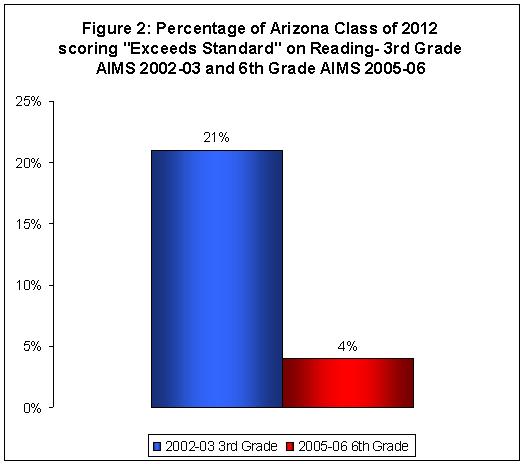
Figure 2 presents an 80% statewide decline. Attendance in a typical Arizona public school seems injurious to the ability to perform high-level reading at grade level, at least according to the state’s own standards and measures.
8 Comments | instructional reform | Tagged: Idiocracy, Luke Wilson, Tucson Unified School District | Permalink
Posted by matthewladner
The One Florida Program
October 2, 2008
(Guest Post by Matthew Ladner)
Public school officials have come to resemble the kids at college football games holding up the sign “Hi Mom! Send More Money!” Public school officials constantly call for additional resources, a call that lawmakers have answered. Nationally, inflation adjusted spending per pupil nearly quadrupled between 1959 and 2004. Unfortunately, there was very little evidence of increased student learning during that period- NAEP scores have been largely flat since the late 1960s despite the increase in funding.
One state, however, has figured out how to utilize the insatiable appetite of schools for additional funding as a carrot to improving student performance.
Florida education reforms not only have improved early childhood literacy, but have also prepared a higher percentage of minority children for college work. Governor Jeb Bush pushed a One Florida Initiative, which sought to replace race based affirmative action with more effective instruction: better preparation rather than lower standards. The results have been impressive.
Working in partnership with the College Board beginning in the year 2000, the One Florida plan sought to increase the academic achievement of Florida’s students, particularly underrepresented in universities. The comprehensive plan included professional development for teachers and counselors and free PSAT exams for students. Florida officials created AP Potential – a web-based tool to identify promising students for AP coursework.
The program relied heavily on incentives, creating an AP Teacher Bonus – $50 for every passing score, up to $2,000. The program also created an incentive for the school, paying the school an additional bonus of $650 per student passing an Advanced Placement exam. Florida officials carefully wrote this bonus into the funding formula so that it went to the school, not to the school district.
The reformers didn’t stop there, however. Florida’s A-Plus reform plan assigns letter grades to schools based upon student performance. The One Florida plan provided an additional school bonus of $500 per student passing an AP exam for schools rated “D” or “F.” The idea was to set high expectations and to reward success.
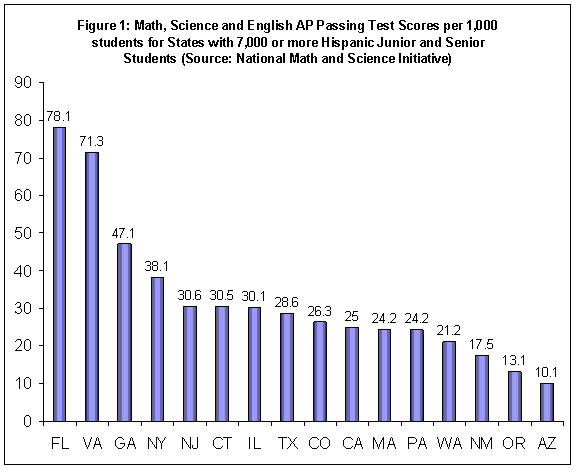
The National Math and Science Initiative recently collected data on the number of students passing AP exams, broken down by ethnicity. Figure 1 presents the number of Hispanic students having passed an AP exam per 1,000 junior and senior Hispanic students. Florida not only leads the nation in Hispanics passing AP exams, they do so at a rate nearly 8 times greater than that of my home state of Arizona.
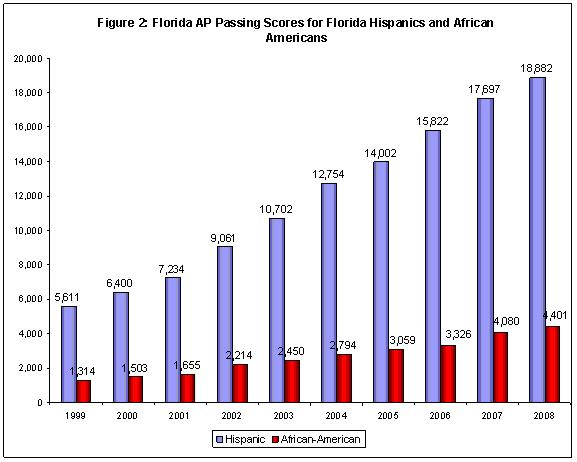
Do schools respond to incentives? Judge for yourself: between 1999 and 2007, the number of Florida students passing AP tests increased by 154%. Figure 3 below shows that the number of Florida Hispanic and African American students passing an AP exam more than tripled between 1999 and 2007.
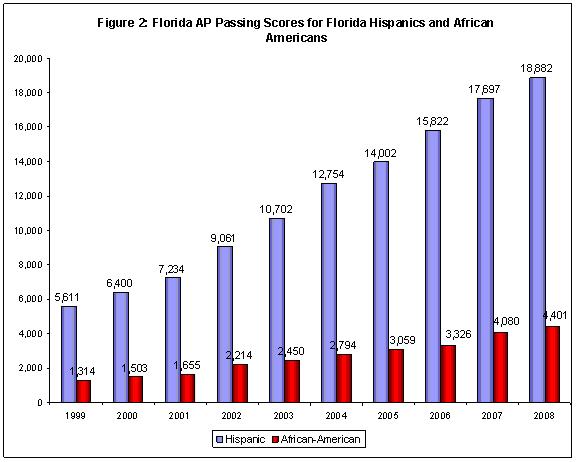
Florida’s education reformers achieved these results for what ultimately amounts to a tiny portion of the Florida K-12 budget. Floridians should not be satisfied with these results, but should be proud of this level of progress- and work to extend it.
The next time the public school establishment calls for additional resources in your state, the question should not only be whether they should get them or not. The question should also be “in return for what?” Pay for performance is an excellent idea for education funding.
In Florida, high-schools get more money the old fashioned way- they earn it.
8 Comments | instructional reform | Tagged: Florida education reform | Permalink
Posted by matthewladner
Progress in Delaware
September 22, 2008
(Guest Post by Matthew Ladner)
Both Eduwonk and Charlie Barone are ga-ga for Delaware’s education reform results, and with good reason. Delaware has high-scoring minority students on NAEP, and have an admirable system of student testing that other states should study carefully.
I decided to run Delaware’s numbers against my favorite reform state, Florida, by comparing progress by low-income children on NAEP’s 4th grade reading exam.
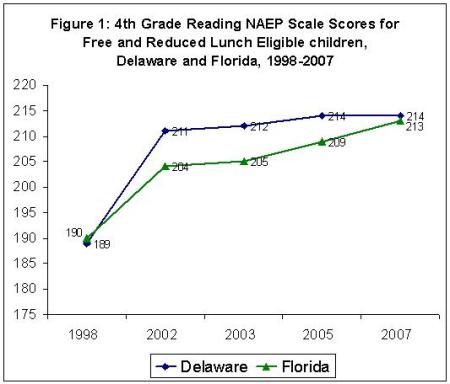
And down the stretch they come! It’s Delaware by a nose!
Now, Delaware spends $11,633 per pupil in the public schools in 2006, while Florida was only at $7,759, which is 49% higher. However, these days, you don’t look the progress gift-horse in the mouth, even if it comes at a hefty price.
One could argue that Delaware shows that with the right kind of investment and commitment to standards, that you can improve student achievement without any of that messy school choice business.
Not so fast my friend!
It turns out that Delaware is discretely a haven for parental choice. Delaware has the nation’s 7th ranked charter school law according to the Center for Education Reform, and active inter and intra district choice programs. Add all of those up, and 15.5% of all K-12 students in Delaware are exercising choice through public options.
Delaware also has a large number of students attending private schools, and a little less than 2% home-schooling. Combine those, and you get over 20 percent of students exercising private choice.
If you add it all together, 35.7% of Delaware students are attending schools other than their assigned district school.
It just goes to show- standards and parental choice are two great tastes that taste great together.
4 Comments | competitive effects, instructional reform | Tagged: Delaware education reform, Lee Corso, Longhorns vs. Razorbacks | Permalink
Posted by matthewladner
Does Joel Klein Matter?
September 18, 2008
(Guest Post by Matthew Ladner)
Literature contains any number examples of the “magic child” myth- the one with mystical abilities that will become a great leader. Paul Atreides, Luke Skywalker and Thomas “Neo” Anderson are recent examples from science fiction, but there are many others.
For some reason, we tend to buy into the messianic myth with school leaders as well.
The oddest thing (to me) about the back and forth we’ve had here and elsewhere about instructional versus incentive based reform seems to center around Joel Klein’s tenure in NYC. I think Klein will ultimately be seen as a fairly inconsequential figure.
Let me hasten to say that I briefly met Klein at a conference a few months ago, and he seemed like a good guy, so this is nothing personal. He seems to have good intentions. Some have lauded his reforms; others have indicted him for making poor instructional choices. It seems perfectly plausible to me that Klein deserves praise for some things and criticism for others.
In my book, however, there are usually only two types of urban superintendents: those that have failed, and those that will fail. Rick Hess’ Spinning Wheels made this case convincingly- school systems cycle through superintendents as pseudo-messiahs as a method for kicking the can down the road. New savior arrives, tries to implement reforms, and receives a pink slip about three years later.
The new-new savior finds a group of half implemented reforms lying around, discards them to put in his or her own new program. Repeat process indefinitely. Longtime teachers learn to ignore the flailing at the top, knowing that “this too shall pass.”
Klein obviously departs from this model. He has a legal rather than an education background, and assumed control under the auspices of Mayor Bloomberg taking over the schools. His tenure has already lasted far longer than average.
It has never been a tenet of those of us in the choice movement that a gigantic schooling system would substantially improve if only they had the right superintendent. We emphasize market mechanisms, not benevolent dictatorships. In fact, we’ve seen some celebrity superintendents in the past: Roy Roemer in Los Angeles, Mike Moses (former state Education Commissioner) in Dallas.
No revolutionary improvement there, either.
Don’t get me wrong: I’m hoping for the best with people like Rhee and Klein. One might think that, for instance, that it shouldn’t be inconceivable for Rhee to improve the governance of the DCPS, but the track record here is not awe-inspiring.
If the critique of Klein is that he received a huge windfall of money but has failed so far to produce big results, what can one say other than: why would you expect anything else? Surely hope cannot have so completely triumphed over experience.
We should be persuaded by the evidence that instructional choices are very important. Incentive based reforms are also important. If a NYC chancellor does a little bit of one and none of the other, the results are likely to be underwhelming.
In other words-this too shall pass. Wake me up if and when Klein does anything truly radical- like a Jack Welch program for firing the bottom 10% of teachers and bureaucrats each year or widespread parental choice. Until then, I’ll hope for the best but not expect too much.
2 Comments | competitive effects, instructional reform | Tagged: Joel Klein, Rick Hess, Sol Stern | Permalink
Posted by matthewladner
Bruce Fuller Knows Better
September 11, 2008(Guest Post by Matthew Ladner)
In the New York Times campaign blog, Cal-Berkley education professor Bruce Fuller makes some wildly inaccurate assertions.
Fuller asserts:
Yet only three publicly financed voucher programs — Cleveland, Milwaukee and Washington — have survived since the early 1990s.
Fuller needs to check his facts. There are three voucher programs in Ohio alone. Two more in Arizona. Oh, and then there are voucher programs in Utah, Georgia and Louisiana. Oh, and Maine and Vermont. Also Florida. And of course this ignores the nation’s tax credit programs.
Worse still, Fuller writes:
On early education, Republican leaders have been silent, even though quality preschools pack a strong punch in boosting young children’s learning.
This is an artfully written sentence indeed. The phrase “boosting young children’s learning” deftly avoids the question as to whether these gains are ultimately sustained. Fuller himself however wrote the following in opposing Hillary Clinton’s preschool plan:
Three recent studies, conducted with national data on more than 22,000 young children, have shown significant benefits from preschool for poor students, especially those who find their way into higher quality elementary schools. But cognitive gains from preschool quickly fade out for middle-class children; social development slows for those spending long days in centers.
I am reading Fuller’s book Standardized Childhood and must say I’m finding him more credible as a scholar than as a proponent of the Obama campaign.
1 Comment | instructional reform, politics, vouchers | Tagged: Bruce Fuller, New York Times campaign blog, preschool | Permalink
Posted by matthewladner

 Jay P. Greene's Blog