(Guest Post by Matthew Ladner)
Kotkin: Who Killed California?
July 7, 2009
 1 Comment |
  economics, politics | Tagged: California economy, Joel Kotkin |
  Permalink
 Posted by matthewladner
GI: Hold the Phone on Higher Taxes
June 26, 2009(Guest Post by Matthew Ladner)
Arizona has one of the worst budget deficit problems in the country (live by the property bubble…) written about here and here. New governor Jan Brewer has called for a “temporary” sales tax increase to prevent the sort of belt-tightening of the Arizona budget already having been done by most Arizona families.
We at the Goldwater Institute strongly disagree, and put out the following humorous video today to explain why:
1 Comment | economics | Tagged: Goldwater Institute, Jan Brewer | Permalink
Posted by matthewladner
A Different Kind of WaPo Gold
May 14, 2009
(Guest post by Greg Forster)
In other Washington Post news, those who have been following our coverage of the resurgence of socialism will not want to miss George Will’s column today:
The administration’s central activity — the political allocation of wealth and opportunity — is not merely susceptible to corruption, it is corruption.
HT Jim Geraghty
Leave a Comment » | economics | Tagged: George Will, Greg Forster | Permalink
Posted by Greg Forster
Union Busting — Good for the NYT, Bad for Everyone Else
May 4, 2009The NYT has threatened to shutter its Boston Globe subsidiary in 60 days if its unions don’t agree to various cuts. According to the Times’ own coverage:
Hmmm…. What would the New York Times say if someone else, like let’s say Walmart, threatened to close down its units because unions would drive costs too high. Oh, wait, they did write an editorial about that on August 16, 2008. It begins:
I guess it is hardly news that the New York Times would engage in the same practices that they find deplorable if allegedly done by others.
And who could forget this gem of an editorial by the Times on December 28, 2008? Just a few months ago the Times seemed to think that expanding union power was great because it would raise wages, which was necessary for economic recovery:
Come on NYT! Can’t you follow your own advice? Do your part for the economy and raise those Boston Globe wages higher rather than slashing them.
(edited for typos)
5 Comments | economics, politics | Tagged: Boston Globe, New York Times, Walmart | Permalink
Posted by Jay P. Greene
Charles Murray responds to Greg
April 22, 2009(Guest Post by Matthew Ladner)
Charles Murray responds to Greg’s critique of his Kristol lecture on NRO. Murray writes:
Good Public Discourse [Charles Murray]
Here’s a novel experience. Kathryn Lopez called my attention to Greg Forster’s critique of my Kristol lecture here, wondering if I might want to respond. So I read it. And then read it again. And then thought about it some more. And here’s the novel part: I have nothing to say except, “Well, okay, I take your point.” What he pointed out as weaknesses were weaknesses. On his most important objection, that I failed to mention that activities don’t provide deep satisfactions if they’re morally wrong, he even correctly anticipates my response: I took it for granted. But I shouldn’t have.
Why am I even bothering to post about it? Because we really, really need a change in tone when we’re discussing difficult issues (and need it every bit as much on the Right as on the Left). Forster’s essay is a model: Based on a minutely close reading of the thing-being-critiqued, refusing to personalize the argument in any way, and, dammit, acute.
Leave a Comment » | economics | Tagged: Charles Murray, Greg Forster | Permalink
Posted by matthewladner
The Larger Case Against Socialism
April 21, 2009
(Guest post by Greg Forster)
Readers of JPGB who have followed our occasional coverage of the resurgence of socialism in America may be interested in this column of mine that just went up on The Public Discourse. It addresses Charles Murray’s lecture last month that makes what might be called the “larger” case against socialism – beyond its economic and demographic unsustainability, socialism also undermines all the social structures that provide higher meaning in human life, and would thus be undesirable even if it were sustainable. The lecture got a lot of attention among conservatives. I argue that Murray’s analysis is correct and very valuable as far as it goes, but that it’s missing a crucial element that’s needed to make the case complete.
8 Comments | economics | Tagged: Charles Murray, Greg Forster, Irving Kristol lecture | Permalink
Posted by Greg Forster
Truth in Advertising on the Newspaper Bailout
April 8, 2009
(Guest post by Greg Forster)
You may have heard that Sen. Benjamin Cardin is proposing a government bailout of the newspaper industry.
Some enterprising legislator who loves free speech should propose an amendment to the bill stating that any newspaper accepting its terms shall be required to change its name to PRAVDA. Truth in advertising!
Actually, “bailout” may not be technically the right term. Cardin swears his plan involves “no infusion of federal taxpayer money.”
Note the word “federal.”
Instead of handing out cash, which would make government the de facto owner of America’s newspapers (as the examples of GM and AIG show all too clearly), Cardin would allow newspapers to reorganize as nonprofit “educational” institutions. But since the law already allows nonprofits to publish and distribute their own newspapers if they want to, the only possible rationale for Sen. Cardin’s proposal is that it allows newspapers to continue charging money to cover their costs while also recieving tax-free subsidies.
And who would be doing the subsidizing? Even if government (at the state and local level) doesn’t do it directly, it’ll do it indirectly. Politicians have lots of wealthy friends who would love to have their own pet newspapers.
In fact, Cardin’s proposal is actually worse than a direct government subsidy. At least a direct subsidy would be on the books and subject to disclosure, oversight, and some level of accountability.
Cardin invokes the old Jeffersonian saw that it would be better to have newspapers without government rather than government without newspapers. Yes – but either of those would be better than having government newspapers.
Even though the proposal is obviously going to go nowhere because it fails the laugh test, you’ll still get a lot out of reading Michael Kinsley’s deconstruction of it:
Few industries in this country have been as coddled as newspapers. The government doesn’t actually write them checks, as it does to farmers and now to banks, insurance companies and automobile manufacturers. But politicians routinely pay court to local newspapers the way other industries pay court to politicians. Until very recently, most newspapers were monopolies, with a special antitrust exemption to help them stay that way. The attorney general has said he is open to additional antitrust exemptions to lift the industry out of today’s predicament. The Constitution itself protects the newspaper industry’s business from government interference, and the Supreme Court says that includes almost total immunity from lawsuits over its mistakes, like the lawsuits that plague other industries.
Kinsley notes that just as capitalism built newspapers, it’s now destroying them in order to build something better:
But will there be a Baghdad bureau? Will there be resources to expose a future Watergate? Will you be able to get your news straight and not in an ideological fog of blogs? Yes, why not — if there are customers for these things. There used to be enough customers in each of half a dozen American cities to support networks of bureaus around the world. Now the customers can come from around the world as well.
There’s a good Michael Kinsley who writes about issues and an evil twin Michael Kinsley who smears his opponents with reckless disregard for truth; this column is about as good as the good Kinsley gets.
Leave a Comment » | economics, journalism, politics | Tagged: Benjamin Cardin, Greg Forster, Michael Kinsley, newspaper bailout | Permalink
Posted by Greg Forster
Obama’s Courage, and “Courage,” on GM
April 1, 2009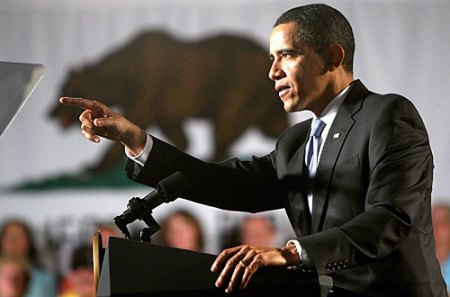
(Guest post by Greg Forster)
On Monday, Jay praised the president’s “courage” because the media were reporting that the administration was talking about bankruptcy for GM. I posted a comment to the effect that the media reports cited unnamed sources, and nobody should be praised for “courage” until somebody stood up and said “bankruptcy” in front of TV cameras.
Right after that, what does the president do but get up and say “bankruptcy” in front of TV cameras?
So, credit where it’s due. It was a bold move.
But there are two kinds of courage: the courage of the man who is resolved to do a hard thing because it’s right, and the courage of the man who is resolved to do a hard thing because it’s necessary to save his own skin.
We’ve yet to see which kind of courage this is. In today’s Journal, the indispensable Holman Jenkins makes the case that the president is bluffing because he needs to create the impression that he’s serious about bankruptcy.
Whatever else we may say about the president, he knows one thing the Clintons don’t: even if the only thing you care about is your own survival, you still have to take risks periodically. If you always do the “safe” thing, you’ll end up less safe.
Leave a Comment » | economics | Tagged: Barack Obama, GM, Greg Forster, Holman Jenkins | Permalink
Posted by Greg Forster
Obama Gets It Right
March 30, 2009
It’s a dramatic reversal over statements last month, but I am glad to see that the Obama Administration seems to be learning. Bankruptcy is not collapse. It is an acknowledgement of failure with a plan to improve.
As the WSJ puts it: “The Obama’s administration’s leading plan to fix General MotorsCorp. and Chrysler LLC would use bankruptcy filings to purge the ailing companies of their biggest problems, including bondholder debt and retiree health-care costs, according to people familiar with the matter.”
Now only if he will exhibit similar bravery in taking on teacher unions, with their large retiree costs and structural inefficiencies.
3 Comments | economics | Permalink
Posted by Jay P. Greene
So You Want More Regulation?
March 27, 2009
Folks advocating more regulation of the economy, education, healthy life-styles, etc… should read this great piece in the Wall Street Journal. It describes the efforts of Washington state’s Department of Licensing to regulate Seatle Semi-Pro Wrestling, which is a spoof of professional wrestling performed in Seattle bars as entertainment. Above you can see a photo of one of the spoof characters, Rondle McFondle.
But the Washington state officials say that this spoof is a professional sport and all professional sports have to be licensed by the state. They need to have medical staff on the premises and post a $10,000 bond, among other burdensome regulations.
As the WSJ describes the issue: “The Seattle league calls itself “fight cabaret” — in essence, theater with singlets, suplexes and sweat, as unworthy of regulation as a Shakespeare play. “It’s a bunch of grown men and women in costumes pretending to be professional wrestlers,” says David Osgood, the league’s lawyer. “It is to wrestling as ‘West Side Story’ is to actual gang relations.”
4 Comments | economics | Permalink
Posted by Jay P. Greene

 Jay P. Greene's Blog