PJM Column on Milwaukee Study

March 30, 2009

(Guest post by Greg Forster)

This morning, Pajamas Media carries my column on the results of the new Milwaukee studies released last week by the School Choice Demonstration Project:

It’s bad enough that everyone seems to be ignoring the program’s positive impact on public schools. About four-fifths of the students are still in public schools. Why look only at the results for the voucher students, only one-fifth of the total? If you had a medical treatment that would help four-fifths of all patients suffering from some horrible disease — and what else can you call the present state of our education system but a horrible disease? — that would be considered a fantastic result.

But it gets worse. These results don’t just show that the program improves education for students in public schools. They also indicate that the program improves education for the students who are using vouchers.


Andy’s Just Plain Wrong

March 5, 2009

Andy Rotherham is a great guy.  And he’s often right.  But I’m afraid that on vouchers he’s just plain wrong.

Andy responded to my post, which was a response to an earlier post he wrote on vouchers.  Let me just run through his arguments:

First, Andy wants to argue that vouchers have stalled politically.  I pointed out that there are now 24 voucher or tax-credit programs in 15 states serving more than 100,000 students.  And two new programs were adopted last year and a third significantly expanded. 

No fair, Andy cries, including tax-credit programs “creates a false sense of scale for intentional choice plans.”  What’s false about counting tax credit programs, like the one in Florida which functions as the largest voucher program in the country?  The program gives vouchers — excuse me — “scholarships” to students from organizations that are funded with dollar for dollar tax credit donations from corporations.  This is virtually identical in financing and effect as the state simply giving vouchers to students.  The only difference is that the tax credit is treated better by the courts (don’t ask why) because the money never enters the state treasury before going right back out the door as a voucher.

But let’s say we grant Andy his odd position that tax-credit programs don’t count.  We still have 13 voucher programs in 10 states serving about 50,000 students.  And the two new programs adopted last year were both voucher programs.  Wish as he might, Andy still can’t show that vouchers have stalled politically.

Second, Andy rightly says, “Reasonable people can review the cumulative literature about choice plans and disagree on how substantively significant or transformative these effects are (or could be at scale) and what that means for vouchers as a policy. ”  While reasonable folks could disagree about the magnitude of the effect of expanded school choice on public school performance, no reasonable person could disagree with the observation that the research literature supports at least some positive impact.  Given how hard it is to find any policy intervention that raises student achievement, consistently finding a positive impact from the systemic effect of vouchers should be treated as a big deal.  It isn’t to Andy. 

Third, Andy concedes that the more frightening prospect of vouchers helped spread charters, at least in the early stages of the charter movement.  But now that charters have reached critical mass, they may well do just fine without the viable threat of new and expanded voucher programs.  Folks who are really sincere about charters shouldn’t get so comfortable.  Just look at the unionization of the KIPP charter in NY or the constant effort to regulate charters to death in many states.  Dropping vouchers from your arsenal would be like confronting a resurgent Russia after dismantling all of your nuclear weapons.  You may think your conventional forces are up to the task, but ask the Poles how they would feel about it.

I’ve never understood why people would support charters but oppose vouchers.  The theory that expanded choice is good for the participating student and helps spur improvement in traditional public schools is required for both reforms.  Yes, charters are more easily subject to regulation than private schools receiving vouchers, but healthy charter programs require light regulation and states have not been shy about applying similar light regulation to voucher programs. 

The only reason I can imagine that folks would support charters but oppose vouchers is for political gain since the theory and evidence for both are essentially the same.  And I understand why politicians invent these false distinctions to prove their moderation and good sense by opposing the one they artificially dub as radical.  But we aren’t politicians.  We don’t have to lie or invent false distinctions to please constituencies.  Universities, think tanks, and the blogosphere should be refuges for reasoned inquiry and dispute, not rhetoric for political advantage.  As it says on the great seal — Veritas.

UPDATE — Andy’s a nice guy.  I tried to make my post as hyperbolic as possible and he responds kindly and reasonably.  Damn, he’s good.

UPDATE TO UPDATE — Just to be clear, I still think Andy is just plain wrong.  The fig leaf that Andy uses to be pro-charter while anti-voucher is the concern that vouchers sever “the connection between avenues of democratic input into schooling decisions and those decisions.   In other words, for some people the issue isn’t choice, rather it’s accountability in a broad sense.”  The reality is that there is as much opportunity for democrat input in the  design and operation of voucher programs as charter schools or traditional public schools for that matter.  The public can place whatever regulations it deems necessary on voucher schools as a condition of receiving those funds, just as it does with charter and traditional public schools.  Of course, all of these systems would operate best with minimal regulation.  If regulation were the answer to school effectiveness our public schools would already be fantastic.


Beltway Confusion

March 3, 2009

(Beltway edu-analysts discuss the world over brandy and cigars.  Note where they are headed.)

I feel sorry for my education colleagues within the DC Beltway.  I don’t know if it’s all those wine and cheese receptions or box lunch lectures that addle their brains, but they are clearly confused.  They confuse political analysis for research.  And they confuse their political preferences for political analysis. 

Look, for example, at the recent post by my friend Andy Rotherham at Eduwonk on vouchers, which states:

“Now, paradoxically, the school choice experience since the early 1990s has lessened the allure of vouchers as a scalable education reform but at the same time made these smaller “pilot” type initiatives like the one in D.C. seem less toxic and more harmless among an increasing number of players.   Opponents don’t even really have a slippery slope to point to in any of the early adopter sites for vouchers.  There’s not one in D.C.  There it’s the public charters not the vouchers that are taking over and not in the other cities/states, even Milwaukee, where vouchers have been tried and the effects have been modest.  In other words, vouchers are not destroying the public schools.  Rather, systemically, they’re not really doing much of anything at all.”

Andy concludes that “systemically” vouchers aren’t “much of anything at all” because they aren’t expanding very rapidly.  This is a political analysis on the appeal of larger voucher programs, not a summary of research on the effects of vouchers on public school achievement.  If Andy had wanted to talk about the research on the systemic effects of vouchers he would have referenced this literature, which clearly shows that expanding choice and competition through vouchers improves public school performance.  So, Andy substitutes political analysis for research.

But he also substitutes his political preferences for political analysis because he ignores the steady growth in vouchers over the last two decades.  There are now 24 voucher or tax-credit programs in 15 states serving over 100,000 students.  Just last year two new programs were adopted, in Georgia and Louisiana, and the tax credit program in Florida was significantly expanded.  Andy may wish the voucher movement to be stalled, but a clear political analysis would reveal that vouchers continue to move forward.

Now, it’s true that there have been setbacks in the voucher movement.  And it’s true that each new program encounters a blizzard of opposition, making each step forward seem inordinately difficult.  But vouchers are just the spearhead of a broader choice movement that includes the more rapidly expanding charter movement.  If not for the viability of voucher programs, charters would have been the target of this onslaught of opposition. 

Vouchers have made the world safe for charters.  And the moment that vouchers really do stall, the enemies of school choice will redirect their fire at charters, strangling them with regulation and repealing charter gains.  To say that vouchers haven’t really done much of anything politically because charters are really where the action is ignores how much charters owe their political strength to the credible threat of new and expanded voucher programs.

It may be fashionable at Beltway receptions to dismiss vouchers as everyone is eager to be seen as championing the latest DC fad proposal.  But real analysis of research and politics show that the expansion of school choice, led by vouchers, will have a greater impact on education reform than building new school buildings, expanding pre-school, adopting a 21st century curriculum or whatever folks there are now talking about.

(edited for typos)


Evidence Shows Vouchers Are a Win-Win Solution

February 23, 2009

win-win-study-large

(Guest post by Greg Forster)

On Friday, the Friedman Foundation released my new report, “A Win-Win Solution: The Empirical Evidence on How Vouchers Affect Public Schools.” It goes over all the available empirical evidence on . . . well, on how vouchers affect public schools.

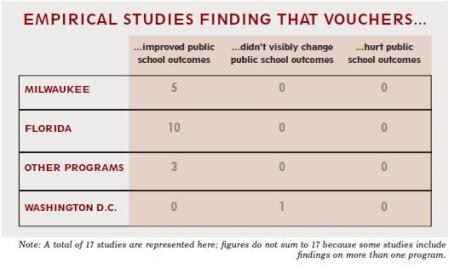
Here’s the supercool graphic:

win-win-study-chart1

Worth a thousand words, isn’t it? I mean, at what point are we allowed to say that people are either lying, or have been hoodwinked by other people’s lies, when they say that the research doesn’t support a positive impact from vouchers on public schools?

There’s always room for more research. What would we all do with our time if there weren’t? But on the question of what the research we now have says, the verdict is not in dispute.

Here’s the executive summary of the report:

This report collects the results of all available empirical studies on how vouchers affect academic achievement in public schools. Contrary to the widespread claim that vouchers hurt public schools, it finds that the empirical evidence consistently supports the conclusion that vouchers improve public schools. No empirical study has ever found that vouchers had a negative impact on public schools.

There are a variety of explanations for why vouchers might improve public schools, the most important being that competition from vouchers introduces healthy incentives for public schools to improve.

The report also considers several alternative explanations, besides the vouchers themselves, that might explain why public schools improve where vouchers are offered to their students. It concludes that none of these alternatives is consistent with the available evidence. Where these claims have been directly tested, the evidence has not borne them out. The only consistent explanation that accounts for all the data is that vouchers improve public schools.

Key findings include:

  • A total of 17 empirical studies have examined how vouchers affect academic achievement in public schools. Of these studies, 16 find that vouchers improved public schools and one finds no visible impact. No empirical studies find that vouchers harm public schools.
  • Vouchers can have a significant positive impact on public schools without necessarily producing visible changes in the overall performance of a large city’s schools. The overall performance of a large school system is subject to countless different influences, and only careful study using sound scientific methods can isolate the impact of vouchers from all other factors so it can be accurately measured. Thus, the absence of dramatic “miracle” results in cities with voucher programs has no bearing on the question of whether vouchers have improved public schools; only scientific analysis can answer that question.
  • Every empirical study ever conducted in Milwaukee, Florida, Ohio, Texas, Maine and Vermont finds that voucher programs in those places improved public schools.
  • The single study conducted in Washington D.C. is the only study that found no visible impact from vouchers. This is not surprising, since the D.C. voucher program is the only one designed to shield public schools from the impact of competition. Thus, the D.C. study does not detract from the research consensus in favor of a positive effect from voucher competition.
  • Alternative explanations such as “stigma effect” and “regression to the mean” do not account for the positive effects identified in these studies. When these alternative explanations have been evaluated empirically, the evidence has not supported them.

Charters Work, Unions Don’t

January 7, 2009

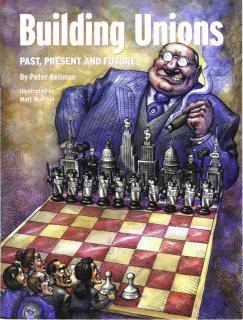
building_unions

(Guest post by Greg Forster)

On Monday the Boston Foundation released a study by researchers from Harvard, MIT and Duke, examining Boston’s charter schools and “pilot” schools using a random assignment method (HT Joanne Jacobs).

Pilot schools were created in Massachusetts in 1995 as a union-sponsored alternative to charter schools, which came to the state a year earlier. Pilot schools are owned and operated by the school district. Like charter schools, pilot schools serve students who choose to be there (though it’s easier to get into a charter school than a pilot school; see below). Like charter schools, pilot schools have some autonomy over budget, staffing, governance, curriculum, assessment, and calendar. Like charter schools, pilot schools are regularly reviewed and can be shut down for poor performance.

There are two main differences between charter schools and pilot schools. First, the teachers’ unions. Pilot schools have them, and all the shackles on effective school management that come with them. Charter schools don’t.

Second, some pilot schools are only nominally schools of choice, not real schools of choice like charter schools. Elementary and middle pilot schools – which make up a slender majority of the total – participate in the city’s so-called “choice” program for public schools, and thus have an attendance zone where students are guaranteed admission, and admit by lottery for the spaces left over.  So while on paper everyone who goes to a pilot school “chooses” to be there, some of them will be there only because the city’s so-called “choice” system has frozen them out of other schools. The students compared in the study are all lottery applicants and are thus genuinely “choice students” – they are really there by choice, not because they had no practical alternatives elsewhere. However, the elementary and middle pilot schools are not “choice schools.” (Pilot high schools do not have guaranteed attendance zones and are thus real schools of choice.)

The Boston Foundation examined two treatment groups: students who were admitted by lottery to charter schools and students who were admitted by lottery to pilot schools. The control groups are made up of students who applied to the same schools in the same lotteries, but did not recieve admission and returned to traditional public schools.

As readers of Jay P. Greene’s Blog probably know already, random assignment is the gold standard for empirical research because it ensures that the treatment and control groups are very similar. The impact of the treatment (in this case, charter and pilot schools) is isolated from unobserved variables like family background.

The results? Charter schools produce bigger academic gains than regular public schools, pilot schools don’t.

The two perennial fatal flaws of “public school choice” would both seem to be at work here. First, public school choice is always a choice among schools that all partake of the same systemic deficiencies (read: unions). Choice is not choice if it doesn’t include a real variety of options. And second, public school choice typically offers a theoretical choice but makes it impossible to exercise that choice in practice. In this particular case, if each school has a guaranteed-admission attendance zone, the practical result will be fewer open slots in each school available for choice. (Other kinds of public school choice have other ways of blocking parents from effectively using choice, such as giving districts a veto over transfers.)

Charter schools are only an imperfect improvement on “public school choice” in both of these respects. Charters have more autonomy and thus can offer more variety of choice, but not nearly as much as real freedom of choice would provide. And with charters, as with public school choice, government controls and limits the admissions process.

But charters are an improvement over the status quo, even if only a modest one, as a large body of research has consistently shown.

There are some limitations to the Boston Foundation study, as with all studies. Pilot high schools are not required to admit by lottery if they are oversubscribed, while charter schools are. (Funny how the union-sponsored alternative gets this special treatment – random admission is apparently demanded by the conscience of the community when independent operators are involved, but not for the unions.) Of the city’s pilot high schools, two admit by lottery, five do not, and one admits by lottery for some students but not others. Thus, the lottery comparison doesn’t include five of the pilot high schools. It does include three high schools and all of the elementary and middle schools.

As always, we shouldn’t allow the limitations to negate the evidence we do have. Insofar as we have evidence to address the question, more freedom consistently produces better results, and more unionization consistently doesn’t.


School Voucher Mythbusters

December 17, 2008

mythbusters_collection3

(Guest post by Greg Forster)

A while back, I posted this to help people find comprehensive lists of the research on various subjects related to school vouchers. It’s a list of lists – in case you’re looking for a list of all the available research on whether vouchers improve education for the kids who use them, or whether they improve public schools, and so forth. Some of the lists are more scholarly and contain a lot of technical information, while some are presented in a more easily accessible format.

Well, here’s a big update on the list-of-lists front: the Friedman Foundation has released a set of “myth buster” guides to the research on the six most common school choice myths. For each myth they’ve provided a brief, handy reference sheet and a slightly longer, more detailed guide to the research. Even the detailed version of each myth buster is still less technical than the other lists on my “meta-list” page, compiled by Jay and other scholars, but it does go over the most important technical issues (how do we distinguish the impact of vouchers from the impact of other factors like family influence?) and provides the references you’ll need to dig further if you wish.


Myth: Vouchers hurt public schools and take the best and brightest.

Research: Short version, detailed version.


Myth: Private schools aren’t really better than public schools.

Research: Short version, detailed version.


Myth: Vouchers will lead to increased segregation.

Research: Short version, detailed version.


Myth: Private schools are hostile to tolerance and democratic values.

Research: Short version, detailed version.


Myth: Vouchers are costly and drain money from public schools.

Research: Short version, detailed version.


Myth: Private schools exclude difficult students.

Research: Short version, detailed version.


Take note that these are true comprehensive lists, including all high-quality studies on each of these questions. I’ve noticed that it’s always voucher supporters who are willing to discuss all the evidence, while voucher opponents typically cherry-pick the evidence, mischaracterize the evidence they’ve cherry-picked, and then falsely accuse voucher supporters of cherry-picking evidence.

So I would say Jay’s theory about why school vouchers keep winning against impossible odds is well supported by the empirical evidence – although in this case I haven’t compiled a comprehensive list.

What stronger breastplate than a heart untainted!
Thrice is he armed that hath his quarrel just,
And he but naked, though lock’d up in steel
Whose conscience with injustice is corrupted.

Henry VI, Part II, Act 3, Scene 2


Looking Abroad for Hope

November 5, 2008

hope

HT despair.com. Looking for a Christmas idea to suit the new reality? Why not a despair.com gift certificate – “For the person who has everything, but still isn’t happy.”

(Guest post by Greg Forster)

Looking around for something to give me hope this morning, I find the best place to turn (for today, at least) is outside the U.S. Specifically, I turn to the recently released study in Education Next by Martin West and Ludger Woessmann finding that around the world, private school enrollment is associated with improved educational outcomes in both public and private schools, as well as lower costs.

Well-informed education wonks will say, “duh.” A large body of empirical research has long since shown, consistently, that competition improves both public school and private school outcomes here in the U.S., while lowering costs. And the U.S. has long been far, far behind the rest of the world in its largely idiosyncratic, and entirely irrational, belief that there’s somthing magical about a government school monopoly.

And private school enrollment is an imperfect proxy for competition. It’s OK to use it when it’s the best you’ve got. I’ve overseen production of some studies at the Friedman Foundation that used it this way, and I wouldn’t have done that if I didn’t think the method were acceptable. However, that said, it should be remembered that some “private schools” are more private than others. In many countries, private school curricula are controlled – sometimes almost totally so – by government. And the barriers to entry for private schools that aren’t part of a government-favored “private” school system can be extraordinary.

That said, this is yet another piece of important evidence pointing to the value of competition in education, recently affirmed (in the context of charter schools, but still) by Barack Obama. Who I understand is about to resign his Senate seat – I guess all those scandals and embarrasing Chicago machine connections the MSM kept refusing to cover finally caught up with him.


PJM on Candidates’ Education Flip-Flops

November 3, 2008

(Guest post by Greg Forster)

Over the weekend Pajamas Media carried my column on how Obama and Palin have flip-flopped on education:

Suppose I told you Candidate A has supported rigorous academic standards, has stood up to the teachers’ unions — even been booed by them at their convention — and proclaimed the free-market principles that schools should compete for students and better teachers should get higher salaries. On the other hand, Candidate B says that competition hurts schools, that kids should be taught a radical left-wing civics curriculum, that we should throw more money at teachers’ unions — excuse me, at schools — and that rigorous academic standards should be replaced with the unions’ old lower-the-bar favorite, “portfolio assessment.”

Candidate A is Barack Obama. So is Candidate B.

Meanwhile, Candidate C has made an alliance with the teachers’ unions, opposed school choice, thrown money at the unions — excuse me, at schools — and even helped undermine a badly needed reform of bloated union pensions. On the other hand, Candidate D has broken with the teachers’ unions, demanded that schools should have to compete for students, and endorsed the most radical federal education reform agenda ever proposed by a national candidate, including a national school choice program for all disabled students.

Candidate C is Sarah Palin. So is Candidate D.

Important disclaimer:

None of this implies anything about the overall merits of any of these candidates. One can love a candidate overall while hating his or her stand on education, and vice versa.


Want to Pass A Local School Tax Increase? Open Charters

November 3, 2008

Here’s a neat piece of research posted at Heny Levin’s National Center for the Study of Privatization in EducationThe study is actually by Arnold Shober and it examines whether the presence of charter schools in a district affects the likelihood that voters will support a local school tax increase. 

It has been getting more and more difficult to obtain local support for school tax increases.  But, Shober wonders, might it be easier to pass a school tax referenda in communities that have more options paid by tax dollars?  Maybe people more satisfied with the quality and diversity of publicly-financed schools, including charter options, are more willing to provide extra tax dollars for all schools.

As it turns out, Shober finds that they do.  He analyzed data from 1,111 school tax referenda in Wisconsin between 1998 and 2005.  He concludes:

“Adding one charter school to the district that has none increases the likelihood of passage 4.1 percent; increasing the number of charter schools from 0 to 8 (the maximum for these data) increases the likelihood of passage 30.2 percent second only to the effect of a college-educated electorate (below). This suggests that charter schools do have some bearing on how votes perceive a school district’s responsiveness to active-parent demands. Indeed, authorizing charter schools is the only variable in this analysis that a school district’s administration could directly manipulate (save the actual ballot request).”

It seems that restricting families’ options and forcing them to attend dirstrict schools whether those schools serve their kids well or not is not the best strategy to get those same families to cough up more dough for the public school system.  People are more likely to be supportive of a public school system that helps them find schools that work for their kids — even if those schools are charters.


McCain and Obama Agree: Competition Good for Education

October 16, 2008

Education finally came up in a presidential debate and I heard something that I never heard before — the standard-bearers for both parties agreed that competition was good for public schools.  Sure, past Democratic candidates have endorsed school choice with charters, as Obama did.  But Obama did something new.  He specifically said that competition from charter schools was important for improving traditional public schools. 

Clinton, Gore, and Kerry embraced school choice with charters as an escape hatch for students condemned to failing public schools, sounding very much like Sol Stern, Mike Petrilli, and Rick Hess.  But Obama left previous Democratic candidates and these fellows at market-oriented (?!) think tanks in the dust by saying that choice was desirable because of competition. 

Here are Obama’s exact words: “Charter schools, I doubled the number of charter schools in Illinois despite some reservations from teachers unions. I think it’s important to foster competition inside the public schools.”

Of course, Obama wants to limit choice and competition to public schools (which include charters), while McCain wants to include private schools in the mix.  But they agree on the big idea:  public schools are improved when they have to compete to earn students and the revenue those students generate.

Just think.  Only twenty years ago school choice and competition was hardly a glimmer in Ronald Reagan’s eye.  Now the idea is so widely accepted as reasonable that the leaders of both parties differ only on the mechanism for producing choice and competition.  We’ve come a long way, baby.

Correction — Rick Hess emailed to say that he did not want to be counted among those who are unpersuaded by competitive effects from choice.  He does think that almost no current choice program is designed properly to produce competitive effects, but he thinks such effects are possible and desirable.