Pro-Choice Doesn’t Mean No Taste

January 25, 2010

Amy Gutmann and Suicide Bomber.jpg

Amy Gutmann poses with a student dressed as a suicide bomber at her Halloween party in 2006.  Talk about having no taste.

A regular indictment leveled against advocates of school choice is that they have no taste when it comes to the quality and purpose of education.  As Amy Gutmann, the president of the University of Pennsylvania and author of Democratic Education, put it: “advocates of parental choice and market control downplay the public purposes of schooling, and this is not accidental. It coincides with the idea of consumer sovereignty: the market should deliver whatever the consumers of its goods want.”  If schools should do whatever the consumer wants, according to this way of characterizing choice supporters, then those choiceniks can’t favor particular educational standards or approaches.  Choice supporters wouldn’t be able to denounce a Jihad school, for example, because consumer preference is the only issue that matters.

This caricature of choice supporters is mistaken on many levels.  First, just because choice supporters want to empower parents to select their school doesn’t mean that the choice advocates are unable to have their own preferences about what schools would be better for people.  Similarly, I might believe that smoking is bad for one’s health, even as I am willing to recognize other people’s liberty to choose to smoke or not.  Or perhaps an easier example — I may think a movie is awful and contains harmful messages and still believe that people have a right to see it.  Believing in liberty doesn’t mean being indifferent to what other people like or do.  It just means not wanting to coerce them into doing or liking what I prefer.

Favoring choice does not require abdicating all taste.  Advocating choice requires believing that people have a right to have their own bad taste.  Favoring choice can also be supported by a belief that people are less likely to make bad choices for themselves than someone else would on their behalf.

Second, most choice supporters recognize some need for public regulation of the schools that are chosen.  These regulations could be as minimal as the public health and safety regulations that affect restaurants or could be more extensive to include instructional issues.  The point is that almost no school choice supporters are anarchists, so there is no need for the Amy Gutmann’s of the world to act as if they all are.

Choice supporters can have personal taste and standards and most also favor public standards that place limits on choice.  At least most choice supporters would have better personal taste and standards than to pose for a photo with a Halloween party guest dressed as a suicide bomber, even though almost all of us would recognize someone’s right to have such awful taste.


Public Schools: Cornerstones of Democracy!

January 5, 2010

(Guest post by Greg Forster)

During the mad real estate rush a couple years ago, five school districts here in Wisconsin (including the biggest district here in my county) borrowed $200 million and sunk it into some extremely unwise investments hoping to get rich quick.

Because that’s exactly why we gave the public school system the right to tax us – so it could play the market with our money.

The investments all went south and are now worthless.

But don’t panic! Fortunately, they structured the deal so that in the event they lost all their money, they could totally shaft their creditors. The investments were made by a trust they set up rather than by the districts themselves, so the districts aren’t liable for the losses. Their creditors have to eat it all.

One bank, which lent the districts $165 million, has asked the districts to try to pay at least some of it back, on grounds that they have a “moral obligation” to make the losses good even if they don’t have a legal obligation to do so.

Here, according to the Milwaukee Journal Sentinel, is the districts’ response:

The districts’ officials have argued they are protected from paying back the $165 million because the loans were undertaken by trusts rather than the districts themselves and because a moral obligation is not the same as a legal obligation.

But remember, public schools are the cornerstone of democracy because they and only they are capable of inculcating children with strong civic values like responsibility and respect for the rights of others.


True to Her Traditions

November 11, 2009

Yale WWI

(Guest post by Greg Forster)

The monument pictured above is quite large and centrally located on the Yale campus. When you walk into a nearby building, you enter a small atrium of solid marble walls, covered from floor to ceiling with the inscribed names of Yale alumni who have died in military service for their country.

Neither the monument nor the atrium recieve any attention from the people who walk by them every day. Students sometimes take advantage of the monument’s prominent location by taping fliers to it advertising their beer-and-sex parties.

ROTC has been banned from Yale since 1969.

Happy Veterans Day.


Oklahoma Civics Continued

September 23, 2009

(Guest Post by Matthew Ladner)


Mourning Constitutional- OK kids score even worse than AZ

September 17, 2009

(Guest Post by Matthew Ladner)

Regular JPGB readers will recall that the Goldwater Institute gave a version of the United States Citizenship Test to Arizona high school students, only to learn that they were profoundly ignorant regarding American government, history and geography. Only 3.5% of Arizona public school students got six or more questions correct, the passing threshold for immigrants.

The Oklahoma Council of Public Affairs wanted to know how Oklahoma high school students would fare on the exam- so we surveyed them and gave them precisely the same set of questions we asked Arizona students.

Perhaps I ought not to have been so hard on Arizona students. After all, they passed at a rate that was 25% higher than their peers in Oklahoma!

That’s right: the passing rate for Oklahoma high school students was 2.8%. They somehow underperformed Arizona’s already abysmally pathetic performance.

My favorite part of writing this paper was poking around in the Oklahoma state standards for civics. Here’s a quote:

Oklahoma schools teach social studies in Kindergarten through Grade 12. … However it is presented, social studies as a field of study incorporates many disciplines in an integrated fashion, and is designed to promote civic competence. Civic competence is the knowledge, skills, and attitudes required of students to be able to assume ‘the office of citizen,’ as Thomas Jefferson called it.

A social studies education encourages and enables each student to acquire a core of basic knowledge, an arsenal of useful skills, and a way of thinking drawn from many academic disciplines. Thus equipped, students are prepared to become informed, contributing, and participating citizens in this democratic republic, the United States of America.

That all sounds swell, except for the part where despite being taught social studies from K-12, Oklahoma high school students come out knowing about as much about American history and government as they know about Quantum Physics or ancient Sanskrit.

These kids wouldn’t do much worse if the pollster asked them questions in Sanskrit instead of English. The pollster would say “I am going to ask you some questions about American civics in Sanskrit. Answer as best you can.  Question 1: संस्कृता वाक् संस्कृता वाक् संस्कृता वाक् संस्कृता वाक् ?”

There is some small chance they would answer “George Washington” after all.

I have an empty metal coffee pot in my office marked “Sweden Civics Survey Fund.” Please drop by a give what you can afford. Once it gets to a couple of thousand bucks, I’ll retain the pollster to give this exact same survey on AMERICAN civics to high school students in Sweden.

They couldn’t do much worse than the kids in Arizona and Oklahoma. Sadly, I suspect they would do much better.

(Edited for Clarity)


Private Schools and the Public Interest

September 9, 2009

I may not agree with what you say, but I will defend to the death your right to say it. Just not in my neighborhood. While you are at it, drop by and beg for permission to run for office.

(Guest Post by Matthew Ladner)

Regular JPGB readers will recall the survey that the Goldwater Institute sponsored showing an appalling lack of civic knowledge among Arizona high school students, both public and private. Sneak preview: a special Oklahoma remix is on the way.

Well, guess what, we also asked a series of questions about political tolerance, volunteerism and satisfaction in the same survey.

Yesterday the Goldwater Institute released two studies: Tough Crowd: Arizona High School Students Evaluate Their Schools and Better Citizens, Lower Cost: Comparing Scholarship Tax Credit Students to Public School Students.

Let’s start with the latter study, which focuses on political tolerance and volunteerism. I could fish up absurd quotes from people about how only public schools can teach proper civic values, and how scary private schools under a choice system are certain to indoctrinate children into all sorts of dangerous anti-democratic ideologies. You being a discriminating consumer of education blogs, however, makes the task unnecessary.


So what happens when you ask a standard set of political tolerance questions to samples of public and private school students in Arizona? Try this:

Tolerance 1


Mmkay, maybe public schools aren’t doing much better at teaching tolerance than they are in teaching reading. Next we asked:

Tolerance 2


So a high percentage of kids, especially in public schools, like the idea of a personalized language police. Disturbing. Next:

Tolerance 3


Hello ideological segregation! Next:

Tolerance 4


Mmm-hmm, we’ll just have all the candidates drop by your house and ask for permission to run. Be sure to wear your ring so that the candidates can kiss it.

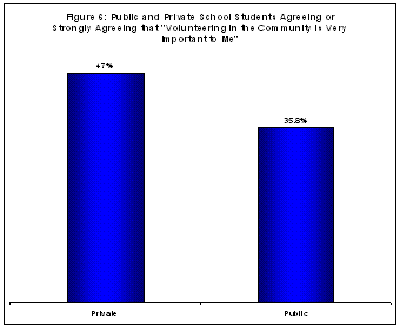
Ah well, tolerance isn’t the only civic virtue- volunteerism counts as well. Next we asked:

Tolerance 5


and while we were at it:


Tolerance 6


There were no meaningful differences between private school students attending with the assistance of a tax credit scholarship, and those who did not receive a scholarship. A minimum of 41% of tax credit scholarships are given out by groups that employ a means-test, so it is not the case that the private school kids are all wealthy and attending Dead Poet Society Schools, which are few and far between here in Arizona in any case.

Of course not all, and perhaps even none of the observed differences can be attributed to the actions of the schools. This however seems very unlikely. This was a survey of high-school students. I know I didn’t have a clue about my family income when I was in high-school, and thus wouldn’t believe the numbers we might get from asking about it, so we didn’t ask.

These results however strongly debunk the notion that private schools function as intolerance boot camps. In fact, it is much easier to build that sort of a case against public schools with the available data, though more research ought to be done.

Arizona’s $2,000 tax credit scholarships are looking like quite the bargain compared to $9,700 Arizona public schools. If you care about tolerance and volunteerism, that is.

More soon on how Arizona high school students view their schools.


Mostly Harmless

September 8, 2009

Many electrons have already been spilled on Obama’s speech today to the nation’s school children.  When news first broke of the planned speech, alarms were raised by Michelle Malkin, Glenn Beck, and Neal McCluskey (among many others). 

This was followed by a counter-backlash from the left as well as folks on the right, including the Wall Street Journal and Tunku Varadarajan at Forbes, who said that the initial reaction was “overwrought” and “demented” (respectively if not respectfully).

The counter-backlash is correct that the speech is basically harmless.  Telling kids to stay in school, say no to drugs, and the like is the sort of thing that Nancy Reagan used to say (and people used to mock not because it was indoctrinating but because it was likely ineffective.)

It’s worth stepping back from this kerfuffle to wonder why the president making a speech to the nation’s school children while they are in school is such a big deal.  The counter-backlash wants to suggest that the original backlash against the speech was motivated by crazy, conspiratorial thinking.  Presidents talk to the country all the time, they note.  And if the problem is supposed to be in the lesson plan proposed by the U.S. Department of Education, teachers can use or ignore these suggestions as they wish, just like they can regularly choose lesson plans.

But that is at the heart of the backlash and is not entirely crazy.  Parents sense a lack of control over what their children are taught in school.  This is as true of every day’s social studies lesson as it is of Obama’s speech.  Most of those lessons, just like the president’s speech, are likely to be unobjectionable to most parents. 

But on a fairly regular basis schools teach (or fail to teach) some things that are contrary to the values that parents would like conveyed to their children.  To those of us who see education as an extension of child-rearing, compulsory education privileging government-operated schools is an intrusion of the government on this parental responsibility.  To others, the intervention of the government is a positive good, protecting children from potentially dangerous values of the their parents and assuring allegiance to a common set of ideals necessary for our society to function.  As an empirical matter, government-operated schools are actually less effective at conveying that common set of ideas than are schools selected by parents.  

Amy Gutmann, in the widely read book, Democratic Education, argues that this is not really an empirical question.  The principle is that there should be some democratic input into what is taught to children, not just parental control.   But in a chapter in the book, Learning from School Choice, I dissect Gutmann’s book to show that her scheme isn’t democratic at all.  She believes that local democracies should control schools as long as they avoid discriminating and repressing.  The problem is that almost everything of importance that they do could be portrayed as discriminating or repressing.  So who, under her scheme, resolves these disputes about what is permissible for local democracies to control in schools?  Unelected judges and unelected teaching professionals.  Gutmann’s proposal is really to substitute the dictatorship of an elite for the dictatorship of parents.  As I’ve argued before, I prefer to trust even poorly educated parents to make decisions in the best interests of their own children than well-trained but differently motivated bureaucrats.

So, beneath the over-reactions and counter-over-reactions on Obama’s speech today is a real issue — Who should have primary responsibility for raising (educating) children?


Universal Voucher Benefits

September 3, 2009

Economist Maria Marta Ferreyra of Carnegie Mellon University has a new article coming out in the American Economic Review that models what would happen in a multi-district urban area if there were universal vouchers.  She finds that universal vouchers would generally improve income and racial integration and improve educational outcomes.

She explains it all in this excellent video:

UPDATED to correct typo


USA Today on Freedom from Responsibility

July 2, 2009

6a00d83451b46269e2011570a731b4970c(Guest Post by Matthew Ladner)

USA Today has an editorial piece on Victor and Miguel Mendoza, two American servicemen in Iraq who become United States citizens on July 4th.

The Mendozas represent the best of what the nation is celebrating this Independence Day weekend — liberty, freedom and the sacrifice it takes to keep them strong. They symbolize what’s right with America, a nation of immigrants that was built by opening its doors. And they speak to what could be so much better. At a time when anti-immigrant sentiment has swept through great swaths of the nation, much of it focused on those from Mexico, it’s worth recalling that more than 65,000 immigrants serve in the armed forces, about one-third of them legal residents but not yet citizens. Military service can shorten the usual five-year wait.

We should all be joyful and proud to welcome the Mendozas to our nation. USA Today notes that this contrasts starkly with the performance of Arizona high school students:

Immigrants seeking to become U.S. citizens have to pass a test, and the Mendoza brothers aced theirs this week in Baghdad. That’s more than you can say for a group of Arizona high school students who were surveyed recently on their knowledge of U.S. history and civics.

Just in time for Independence Day, the Goldwater Institute, a non-profit research organization in Phoenix, found that just 3.5% of surveyed students could answer enough questions correctly to pass the citizenship test. Just 25%, for example, correctly identified Thomas Jefferson as the author of the Declaration of Independence.

I mentioned in an earlier post that we drew the title of this study from an Edward Gibbon quote:

In the end more than they wanted freedom, they wanted security. When the Athenians finally wanted not to give to society but for society to give to them, when the freedom they wished was freedom from responsibility, then Athens ceased to be free.

That quote certainly does not apply to the Mendoza brothers. Can we say the same for young Americans born here in the United States?  The United States was the first nation established not on the basis of ethnicity  or tribalism but upon a set of ideals.

If you don’t the basics of American history and government, what chance is there that you are committed to liberty and self-determination?  The pathetic level of ignorance displayed by this an other surveys are more than an indictment on our schooling system (and yes I’m looking at you too charter and private schools) but also an indictment of our entire society.

Consider the Gibbon quote and watch the above video. We have not been providing the type of education that the founders believed was essential to maintaining a system of ordered liberty.

It would be the height of folly to continue to do so.


Freedom from Responsibility Preview part Deux

June 25, 2009

 (Guest Post by Matthew Ladner)

In the end more than they wanted freedom, they wanted security. When the Athenians finally wanted not to give to society but for society to give to them, when the freedom they wished was freedom from responsibility, then Athens ceased to be free.

Edward Gibbon

Last week we had our first sneak peak at Freedom from Responsibility.

Today, more details about the results. The Goldwater Institute randomly drew 10 questions from the United States citzenship exam item bank. We hired a survey firm to interview a sample of both Arizona public and private school high school students.

The questions for neither the citizenship test nor our survey were multiple choice. When you are asked “Who was the first President?” you must answer “Washington” in order to receive credit. Applicants for citizenship must get six out of the ten questions correct to pass. A recent trial of a slightly reformatted exam found that 92.4% of citizenship applicants passed the test on the first try.

Charles N. Quigley, writing for the Progressive Policy Institute, explained the critical nature of civic knowledge:

From this nation’s earliest days, leaders such as Thomas Jefferson, James Madison, and John Adams recognized that even the well-designed institutions are not sufficient to maintain a free society. Ultimately, a vibrant democracy must rely on the knowledge, skill, and virtues of its citizens and their elected officials. Education that imparts that knowledge and skill and fosters those virtues is essential to the preservation andimprovement of American constitutional democracy and civic life.

Paul D. Houston, the executive director of the American Association of School Administrators, also put the issue in focus:

If you look back in history, you will find the core mission of public education in America was to create places of civic virtue for our children and for our society. As education undergoes the rigors of re-examination and the need for reinvention, it is crucial to remember that the key role of public schools is to preserve democracy and, that as battered as we might be, our mission is central to the future of this country.

Here are the 10 questions randomly selected, and their answers:

1.What is the supreme law of the land?Answer: The Constitution

2. What do we call the first 10 amendments to the Constitution?

Answer: the Bill of Rights

3. What are the two parts of the U.S. Congress?

Answer: Senate and House

4. How many Justices are on the Supreme Court?

Answer: Nine

5. Who wrote the Declaration of Independence?

Answer: Jefferson

6. What ocean is on the East Coast of the United States?

Answer: Atlantic

7. What are the two major political parties in the United States?

Answer: Democratic and Republican

8. We elect a U.S. Senator for how many years?Answer: Six

9 . Who was the first President of the United States?Answer: Washington

10. Who is in charge of the Executive Branch?Answer: The President

 
A majority of Arizona public high school students got only one of these questions correct, with 58% correctly identifying the Atlantic Ocean as being off the east coast of the United States, with 42% unable to do so. It was all downhill from there. 29.5% of students identified the Constitution as the supreme law of the land, 25% of students identified the Bill or Rights as the first 10 amendments to the Constitution (12% said they were called “The Constitution” and 16% “The Declaration of Independence.”)

Twenty three percent of Arizona public high schoolers identified the House and Senate as the chambers of Congress. Nine point four percent that the Supreme Court has nine justices. Only 25% of students correctly identified Thomas Jefferson as the author of the Declaration of Independence. An almost majority of 49.6 percent identified the two major political parties, only 14.5% answered that Senators are elected for six year terms. Finally, only 26.5% of students correctly identified George Washington was the first President. Other guesses included John F. Kennedy, Ronald Reagan, George Bush and Barack Obama.

Only 26% could identify the President as being in charge of the Executive Branch. All in all, only 3.5% of public school students passed the test by getting six or more items correct. That’s 40 students out of a sample of 1,134 district students.

There were no major differences in performance based on grade (Seniors did approximately as poorly as Freshmen) nor by ethnicity. Profound ignorance is quite equally distributed in large measure across students in the public school system.

Two obvious questions to ask: is it fair to give this test? In order to answer, I examined the Arizona state standards for 8th grade social studies, which all or nearly all of these students will have taken. These standards are included as an Appendix in the study. What they show is that students are supposed to have learned about John Locke, the Mayflower Compact, the Articles of Confederation, the Constitution, Checks and Balances, Seperation of Powers, etc. etc. etc.

Everything they ought to have needed, in other words, to have passed this test. If, that is, they had actually learned any of that material in practice, which they obviously did not.

Second, I gave the test to my own 1st and 2nd grade sons. They both got 3 answers correct. We’ll be working on that. In so doing, they outscored about 40% of the Arizona high school sample, and tied or exceeded about 60 percent.

Charter school kids performed far better but still terribly- with a passing rate about twice as high as the public school kids. Private school students passed at a rate four times higher, which ultimately is both much better and still pathetic.

I had a very difficult time writing a conclusion to this study. More on that for the next post, but you tell me: if you were an Arizona lawmaker what would you do about this?