Politics and Schools, Part MCCXXIII

September 1, 2010

(Guest post by Greg Forster)

Neal notes the connection between Arne Duncan’s now-infamous embrace of Al Sharpton and the president’s continuing his new tradition of broadcasting a back-to-school message to America’s classrooms, coming up later this month.

Duncan didn’t just embrace Sharpton in his personal role as a citizen. He mobilized the U.S. Department of Education to support Sharpton by encouraging employees to attend Sharpton’s anti-Glenn-Beck rally.

Whatever you think of Glenn Beck, Sharpton cut his teeth as a professional purveyor of incitement to murder. During the Crown Heights race riots, with blood running in the streets, he said, “if the Jews want to get it on, tell them to pin their yarmulkes back and come over to my house.” He had to tone it back after the Freddy’s Fashion Mart murders, when people began making connections between Sharpton and the killings that kept following in his wake. But tone it back was all he did; he’s never repented.

Duncan spoke at Sharpton’s rally and urged his employees to attend.

A department spokesperson lamely tried to evade responsibility by saying “This was a back-to-school event.” Really? Here’s a sample of Al Sharpton’s back-to-school message for America’s youth, courtesy of the Washington Examiner:

[Conservatives] think we showed up [to vote for Barack Obama] in 2008 and that we won’t show up again. But we know how to sucker-punch, and we’re coming out again in 2010!

…and do your homework!

This is obviously intimately connected with the presdient’s decision to make it an annual tradition to use America’s government school monopoly to broadcast a message to the nation’s children. Other presidents have done so before, though none has made it an annual tradition. But it was equally wrong whoever did it, and this Duncan/Sharpton rally shows why.

Neal is trying too hard when he strains to describe Obama’s message to students as “politically charged material.” Joanne Jacobs rightly notes, “Last year’s speech raised a lot of fuss, culminating in a big fizzle as Obama told students to work hard in school.” No doubt this year the president will be equally anodyne.

[Update: Neal points out below that it was the accompanying materials sent to schools, not Obama’s message itself, that he described as “politically charged.” Fair enough! I read his post too quickly. Yet it’s worth noting that even those accompanying materials were focused on anointing Obama as a role model rather than pushing an overtly political agenda.]

The connection is rather that politics can’t be hermetically sealed. The president does have some role to play as the representative of the entire nation. But he is never just that; he is also a politician with an agenda. He will always stand for things that many Americans oppose; that’s just the nature of political life. And this president in particular seems to have more of a tendency than most presidents of associating himself with criminals and race-haters.

It doesn’t matter what Obama says. In fact, the less political his message, the worse it is. If Obama’s message really were “politically charged material,” many students would recognize it as such. The more anodyne he is, the more he gets what he really wants – to be anointed as a role model. With all that entails.

It’s wrong enough to have a government monopoly on schooling. To have the government monopoly anoint the president as a role model for our children is a hundred times more wrong. It would be wrong even if the president were relatively uncontroversial, because no president can avoid having many associations to which many parents will reasonably object. With this president – well, words just fail.


Two Senses of “Character”

July 28, 2010

(Guest post by Greg Forster)

Thinking back over these two posts on schools, citizenship and culture, I think there’s a further distinction I need to add. When I composed those posts, I didn’t explicitly distinguish two different ways in which schools can be said to contribute to the formation of national identity or moral character.

I was concerned to identify what I thought was a continuous historical dynamic, running from the foundation of the government school monopoly to the present day, in which the government monopoly is seen as a solution to America’s perennial anxieities over the formation of national identity and moral character. Because America has embraced religious freedom more fully than any other nation in history (far more fully than, say, the governments in continental Europe that preen themselves on their commitment to religious freedom while passing law after law after law governing the permissible boundaries of religious expression), and for other reasons as well, it is endemic to the American experiment that we are constantly worried about whether we will continue, over time, to share a common commitment to the shared moral values that define our civic order (don’t kill, don’t steal, etc.) and to the shared national identity that is the prerequisite of basic social cohesion. Many people are driven to embrace an aggressive use of government power, in the form of the school monopoly, in the name of various educational schemes designed to alleviate these anxieties. While many people on both sides of the ideological divide succumb to this temptation, I believe the temptation itself (as distinct from those who succumb to it) has its roots in the collectivist thinking that has historically been an ideological product of the left. And it can never work, for all the reasons that collectivism in every form can never work. And I still think all of that is right.

But I didn’t sufficiently distinguish between this dynamic and what one might call the “natural” role of schools in nurturing the formation of national identity and moral character in children. It was never my intention to deny that schools can, and should, nurture the formation of these attributes. What I deny is that the exercise of government power, in the form of a school monopoly or in any other way, contributes to such formation. Quite the opposite is the case, as the evidence shows – the more government gets out of the way, the better a job schools do at nurturing the formation of national identity and moral character.

To reiterate the wisdom of Silent Cal:

Governments do not make ideals, but ideals make governments. This is both historically and logically true. Of course the government can help to sustain ideals and can create institutions through which they can be the better observed, but their source by their very nature is in the people. The people have to bear their own responsibilities. There is no method by which that burden can be shifted to the government. It is not the enactment, but the observance of laws, that creates the character of a nation.

It is not the role of schools, but the role of government, that is the problem. What this ultimately boils down to is an insistence that schooling is a natural, and therefore prepolitical, phenomenon, not a creature of the state – and that the formation of national identity and moral character are included in the prepolitical nature of schooling. It may sound paradoxical to say that the formation of national identity is prepolitical, but it shouldn’t; indeed, the assertion that national identity precedes politics rather than following from it is basic to all liberty.


Real Enemies of Liberty — Episode 1

July 8, 2010

In case you ever get confused about where the most serious threats to liberty are coming from, we’ve started this helpful series on the Real Enemies of Liberty.

Today’s featured enemy is Iran, where the Ministry of Culture and Islamic Guidance has issued a decree on what haircuts are acceptable.  No free expression like the photo above.  Just handsome fellas like those featured below.

Fashion rules: An Iranian official shows pictures of hairstyles authorised by the Ministry of Guidance at an official hairdressing show in the capital Tehran

(HT: Patrick G.)


State, Nation, Culture, and Citizenship: Silent Cal Speaks Out

July 6, 2010

(Guest post by Greg Forster)

After publishing last week’s much-discussed post on schools, state power, culture and citizenship, I had two further experiences that I think are worth recording as a sort of appendix.

One clarification I want to add first, though – I should have bent over a little further backward to stress the distinction between “conservative ideas” and “ideas championed by conservatives.” I never denied – in fact I explicitly said – that the use of the government school monopoly to impose a moral order and civic culture on the nation is something some conservatives have advocated. What I deny is that the idea itself ought to be called “conservative.” If that’s a distinction we’re never allowed to make – which seems to be the position from which my post is being assailed – I can’t see any ground for even using labels like “conservative” at all, since they would have no meaning.

A few days after I put the post up, I was discussing Hayek’s The Road to Serfdom with a friend who is, not exactly a liberal, but certainly not a conservative. Hayek’s thesis was that the “soft” collectivist trends of the Anglo-American world mid-century were parallel in some very important ways to the “soft” collectivism of Germany after WWI – and that murderous totalitarianism was the logical endpoint of both trends. Not because the intentions of the soft collectivists were not noble and uplifting, and everything one might wish them to be; but because the unintended effect of their policies is to destroy the institutions and thought-patterns that obstruct totalitarianism, and strengthen those that give rise to it.

“Well,” remarked my friend,”it sure does make your job easier if you can tie your opponents’ position to Nazism.”

“Yes, it does,” I replied, “but that doesn’t mean it’s not true.”

The epigram to the introduction of Road to Serfdom, from Lord Acton, says it all: “Few discoveries are more irritating than those which expose the pedigree of ideas.”

I’m more than willing to have a civilized debate about the facts, provided I can find an interlocutor who’s interested in a civilized debate about the facts. Until I do, I think that’s pretty much all I have to say about this aspect of the controversy.

Then, over the weekend, I ran across Calvin Coolidge’s speech on the occasion of the 150th anniversary of the Declaration of Independence. The speech is very, very good and I encourage you to read it all. His critique of Progressivism, which was then in the slow and painful process of receding from the height of its power and influence, is simply devastating:

If all men are created equal, that is final. If they are endowed with inalienable rights, that is final. If governments derive their just powers from the consent of the governed, that is final. No advance, no progress can be made beyond these propositions. If anyone wishes to deny their truth or their soundness, the only direction in which he can proceed historically is not forward, but backward toward the time when there was no equality, no rights of the individual, no rule of the people. Those who wish to proceed in that direction can not lay claim to progress. They are reactionary. Their ideas are not more modern, but more ancient, than those of the Revolutionary fathers.

The more I learn about Coolidge, the more I think he’s known as “Silent Cal” primarily because he only spoke when he had something worth saying.

But in light of the topic I posted on last week – the contrast between the progressivism that sees the diligent exercise of state power as the grounding of a strong moral culture and civic identity, and the conservatism that trusts in our strong moral culture and civic identity as the grounding of state power – I couldn’t help but notice Silent Cal made the same point very well (and far more succinctly). Much of the speech is devoted to the idea that free political institutions ultimately derive from a culture that loves liberty, and cannot survive in its absence. After discussing the historical origin of that culture and some of the social institutions that maintain it, he remarks:

Governments do not make ideals, but ideals make governments. This is both historically and logically true. Of course the government can help to sustain ideals and can create institutions through which they can be the better observed, but their source by their very nature is in the people. The people have to bear their own responsibilities. There is no method by which that burden can be shifted to the government. It is not the enactment, but the observance of laws, that creates the character of a nation.

Wish I’d said it that neatly.

But then, how many hits did Cal’s blog have?

And how did I run across this speech? It was linked in The Corner by…Jonah Goldberg. Small world!


Israel: The Front Line in the Fight for Liberal Pluralism

July 6, 2010

I recently returned from a wonderful trip to Israel.  One of my overall impressions is that being in Israel really felt like being on the front line in the fight for liberal pluralism.

I know that may not be your image of Israel, but try this little experiment:  Try Googling for images of the Israel Gay Pride Parade.  You’ll find hundreds of photos like the one above of people freely organizing and expressing themselves.  Then try finding photos for the Gay Pride Parade in Gaza, Damascus, or Tehran.  You won’t be able to find them because there are no open Gay Pride Parades in any majority Muslim country other than Turkey (and if things keep going the way they are, there probably won’t be any such parades there in the future).

Yes, Israel contains illiberal elements — as does the U.S. or any other tolerant and diverse society.  Yes, Israelis have to compromise their freedom more than people in other liberal societies, but that is part of the price they pay for being on the front line that we don’t have to pay.  When our national security has been threatened in much less serious ways, the U.S. has sacrificed far more freedom.

Perhaps it is precisely because Israel is encircled by authoritarian enemies that the exercise of liberty there seems especially sweet.


Education and Citizenship on the Left and Right

June 29, 2010


(Guest post by Greg Forster)

I’m bowled over by the new Claremont Review – Bill McClay’s cover story on the underlying cultural and educational sources of the nation’s current crisis is a real show-stopper. In the shorter items, Charles Murray has a great piece on the ups and downs of Ayn Rand, and my dissertation advisor Steven Smith has a fantastic (not that I’m biased) overview of the issues surrounding Heidegger’s Nazism.

In the education hopper, there’s Terry Moe’s Moore’s [oops!] review of E.D. Hirsch’s new book The Making of Americans. I haven’t seen the book yet; Moe Moore writes that Hirsch, always a man of the Left, makes the lefty case for curriculum reform centered on cultural literacy. To wit, schools paternalistically imposing upon children a homogeneous American culture strongly rooted in a matrix of moral values is the best way to help the poor rise, which is what lefties want.

Moe Moore also casually inserts that in this book Hirsch renews his flat-footed argument against school choice – that empowering parents with choice won’t improve schools because what schools need is better currucula. We’ve been around this merry-go-round with Hirsch before; his argument is like saying that empowering computer users to choose what computers they buy has no impact on the quality of computers; what makes computers better is that the computer companies invest in making them better. Of course, the reason computer companies work so hard to make their computers better, faster and cheaper every year is because they have to serve their customers in a highly competative market.

Moe Moore doesn’t draw the connection between Hirsch’s lefty argument for cultural literacy and his harebrained opposition to school choice, but the connection is there. It’s equally visible in Little Ramona, who – like Hirsch – has been wrongly considered a “conservative” for many years solely because she opposes multiculturalism and supports . . . well, the lefty argument for curriculum reform based on cultural literacy.

This matters because everybody’s all topsy-turvy about what is “progressive” or “conservative” in education, and it will take some effort to get our thinking straight.

Moe Moore picks up Hirsch’s statement that the movement for “progressive curricula,” i.e. the whole Dewey-inspired attack on traditional academic curricula, is really not a movement for a progressive curriculum but a movement against having any sort of “curriculum” properly so called. The point is not to change what’s in the curriculum but to have no substantive curriculum at all when it comes to inculcating a national character or a shared national culture. This is true, and it’s relevant to the question of why lefties who love cultural literacy hate school choice.


Since the late 1960s, the “progressive curriculm” (that is, the “anti-curricular”) movement has dominated the political left by making common cause with the teachers’ unions, who were not congenitally anti-curricular but whose interests were served by promoting the anti-curricular cause. As Moe Moore insightfully points out, the anti-curricular movement is really also an anti-teaching movement; it is therefore a perfect fit for the union agenda of more pay for less work. Thus, anyone who is “pro-curricular” is pigeonholed as being on the political right.

But that is a temporary phenomenon brought about by a unique confluence of political circumstances. In its historical orgins and in the logic of the position, the drive to use schools as engines of cultural homogeneity is a phenomenon of the authoritarian political left.

This goes all the way back to the roots of the system. It’s widely known that one of the major reasons America adopted the government monopoly school system in the first place was hysteria over the cultural foreignness of Catholics. However, there’s another tidbit worth knowing. As Charles Glenn documents in The Myth of the Common School, one of Horace Mann’s motivations for pushing the “common” school system was his vitriolic contempt for evangelical Protestant Christianity. The hicks in the rural Massachusetts countryside with their backward and barbaric adherence to traditional Calvinist theology – which had survived down through the centuries from the Puritan settlers – was repugnant to civilized and enlightened Boston-Brahmin Unitarians like himself.

Someone had to do something to rescue these culturally deprived children from their unenlightened parents! That’s why Mann’s schools had such a heavy emphasis on teaching the Bible – teaching it in a very particular way. Part of the school system’s purpose was cultural genocide against evangelicals, to use the power of the state to indoctrinate their children with unitarianism. And it worked beautifully; how many traditional Calvinists are left in Massachusetts?

[Update: It has been brought to my attention that the Presbyterian Church in America, a traditional Calvinist denomination, has lately been experiencing dramatic growth in New England. So perhaps I should have said “It worked beautifully; after a century of Mann’s schools, how many traditional Calvinists were left in Massachusetts?”]

What we have to get clear is that both the anti-Catholic and anti-evangelical hysteria – then as now – were on the political left.

The great crusade in the early 20th century to use the government monopoly school system to forcibly “assimilate” immigrants with “Americanism” was likewise a movement on the political left. On this subject, please do yourself the biggest favor you’ll do yourself all year and read (if you haven’t already) Jonah Goldberg’s Liberal Fascism. Fanatical patriotism was, until the convulsions of the 1960s, the special hallmark of the left, not the right.

The issues got scrambled after the 1960s by two factors. First and most important was the rise of an aggressive cultural ideology (what we now call “multiculturalism”) seeking to use the government school monopoly to impose its amoral and anti-American value system on the nation’s children. This movement was not only born on the left, but, as noted above, it formed a fruitful partnership with the unions who were also on the left. So naturally, the backlash formed on the right, and the identification of being “anti-multiculturalist” applied to conservatives. However, this was never really the same kind of animal as the left-wing authoritarian drive to use government schools to enlighten the benighted and make them into good Americans. Conservative anti-multiculturalism is negative and defensive in character; it’s not seeking to use government to impose a culture, but to stop the multiculturalists from doing so.

Second, as Goldberg documents, the authoritarianism of 20th century progressivism began to migrate over and infect the right; hence we get absurd specatcles such as a “conservative” president saying such things as “when people are hurting, government has to move.” And, similarly, some conservatives try to use the power of the state to impose right-wing cultural values. But this is really the result of conservatives having drunk from the polluted cultural water of left-wing authoritarianism.

Now let me be perfectly clear. Anxiety about whether young people are picking up 1) moral values and 2) cultural identity as Americans is of course widespread on both sides of the political isle. Believe me, I’m as worried as anyone about whether the nation is successfully passing on its civilization to its children, and whether today’s immigrants will assimilate and self-identify as Americans – not only for the sake of the nation, but for their own sake, since the chief victims of amoralism and multiculturalism are the people who believe in them.

The difference is not in being worried about this problem, but in how we want to solve it. Using the brute power of a government monopoly school system to paternalistically impose a homogenous culture has never been a conservative idea. Go back and look at the great conservative debates over this in the 1990s; whether you’re talking about William Bennett, James Q. Wilson or Charles Murray, you just never find conservative thought leaders talking that way. It’s the lefties like E.D. Hirsch and Little Ramona who dream that their cultural anxieties can be salved with the soothing balm of state power.

And really, it should be obvious why. If you’re the kind of person who thinks the brute force of state power can change culture, well then, you’re probably also a political lefty. If you’re the kind of person who thinks our culture will get along just fine if the state will just stop tinkering with it through social engineering, then you’re probably also a political righty.

It all comes down to how you concieve of the relationship between the government and the nation – which is to say, between power and culture. As Reagan famously asked, are we a nation that has a state, or a state that has a nation? To put the same question another way, does culture drive politics or does politics drive culture? Or, to put it even more bluntly, is the use of power shaped by the conscience of the nation, or do we use power to shape the conscience of the nation?

The conservative approach to schools and American culture is to use school choice to smash state power, thus depriving the multiculturalists of their only serious weapon. Get the state out of the way and let Americans worry about how to pass on American civilization to the next generation.

Oh, and here’s one other way you can tell that this is the conservative approach: the evidence shows it works.

[HT Ben Boychuk for pointing out I misread “Terry Moore” as “Terry Moe” – and apologies to both Terrys!]

Don’t Regulate Charities, Tax Them

May 25, 2010

The Red Nose Institute mails red clown noses to U.S. troops stationed abroad.  It does so, according to its web site, “to put a smile on the faces of our troops overseas.”  They continue:

The idea is for folks who care about our military to donate red foam noses. Monetary donations are also accepted and used to purchase even more noses and also to help with mailing costs. The noses are then mailed to U.S. troops deployed anywhere overseas.  A letter is enclosed with each package telling that the folks sending them are extremely proud of our military and thankful for what they are doing on our behalf.  Servicemen and women are encouraged to share the noses with someone who might need a smile and possibly to share them with the nearby children. There is NO COST to our military or to anyone requesting noses.  We all know that relieving stress is of the utmost importance! If sending red noses to troops can help do this, our job has been accomplished!

The Red Nose Institute is also a charitable organization exempt from taxes under section 501 (c) (3) of the tax code.  This bothers Rob Reich and his colleagues at Stanford University.  Reich, who is an associate professor of political science and not the diminutive former Clinton Administration official, issued a report last year, “Anything Goes: Approval of Nonprofit Status by the IRS,”  calling for reform of the process by which the IRS approves organizations as tax exempt.

Their report laments “the distinctive modern American proclivity to confer special tax benefits to wildly diverse and indeed eccentric associations.”  The report cites The Red Nose Institute along with several other nonprofit organizations as instances that illustrate the problem.  Instead, they would like the IRS to scrutinize applications for nonprofit status more closely and raise fees to discourage applications.  They conclude:

The 501(c) code, we believe, stands in need of reconsideration in light of the massive growth of the nonprofit sector. Is this really an effective way to organize charity? Should the mere desire to associate for nearly any purpose be rewarded with tax privileges?

I see the problem completely differently.  Why should the IRS be in the position of determining whether certain organizations benefit the public or not?  I would contend that the Red Nose Institute is doing much more good for the world than the Ford Foundation has (with its funding of anti-Israel and anti-semitic groups) .  In fact a great many nonprofit organizations have promoted ideas that are much more harmful, wasteful, and just plain silly than sending red noses to boost the morale of troops overseas.  At least the Red Nose Institute has a plausible theory of action and their intervention doesn’t cost much.

Essentially, Reich and his colleagues are trying to substitute their own taste (through the authority of government officials) for the taste of individual donors.  They are just picking organizations that don’t strike their fancy rather than applying any objective or even reasonable test for whether an organization promotes the public good.

Another organization they feature in the report as obviously silly is Curtains Without Borders, which “aims to conserve historic painted theater curtains.”  Why does this serve the public good any less than museums that conserve painted canvasses let alone ones that display jars of urine containing crucifixes?

The point is that there is a particular and distorted vision of “the good” that some people would like to impose on all of us through the coercive power of the government.  I do not want to use the tax code to favor certain organizations as being for the “public good.”  Instead, I would propose treating all organizations the same in the tax code.

Frankly, I don’t even understand why we privilege non-profits over profit-seeking organizations.  As we’ve discussed before, the profit-seeking entrepreneur can do as much or more to improve the human condition as the do-gooder types to whom we regularly give humanitarian awards.

And to be clear, allowing people to keep their own money is not a “tax privilege.”  Taking people’s money through taxation is a necessary evil that we should try to keep as minimal and evenly dispersed as possible.  Taxing all organizations at the same lower rate is better than taxing some at a higher rate so that others pay no taxes.

If we can’t go all the way and end tax exempt status, I’d favor keeping the door as wide open as possible to organizations that claim to be public charities.  I’d rather err on the side of having some silly low-revenue organizations over having the IRS intimidate people into sharing a particular vision of  the good.


Polling Places and the Civic Mission of Public Schools

May 18, 2010

I voted this morning in the Arkansas primary.  The polling place used to be in the local elementary school, but for the past few elections, polling places in Fayetteville were moved out of the schools.  Ostensibly the reason for moving polling places out of public schools is concern for the safety of students.

This is part of a national trend.  A few years ago Education Week featured an article on this trend: “About 25 percent of Ohio’s 6,229 polling locations are in schools, according to research by the Ohio PTA. It passed a resolution last year encouraging local school boards to adopt policies that would prohibit schools from serving as polling places when school is in session. ‘We feel on election days, safety practices within schools are compromised, possibly putting thousands of children at risk,’ the resolution said. ‘We want to be proactive in preventing a tragedy rather than reacting to it.’”

Once again, public schools are forgetting the civic mission that is their raison d’etre.  Just as most school districts no longer use the naming of schools to promote civic values, they are failing to take advantage of elections in their building as civic teaching opportunities.

When the polling place is in the school, kids see democracy in action first hand.  They see posters out front from competing candidates.  They see people taking time to make voting a priority.  I thought educators were enamored with experiential learning.

The security problems of having the polling place in schools are grossly exaggerated.  Yes, people from the community come into the school, but it is usually through a single door and the polling place is populated with volunteers who can keep voters within the appropriate area.  Besides, every time schools take kids on a field trip they experience similar dangers of inter-acting with the public in settings that are only partially controlled.  Having a polling place in the school is like a field trip where the experience comes to the school rather than the kids going to the experience.  And if terrorists wanted to strike schools they could do so on any day with similar ease, whether there is an election or not.

It is also ironic that school advocates, like the PTA in Ohio, want to get polling places out of schools.  Making it easier for parents of school children to vote would improve the election-prospects of measures and officials that direct more resources to schools.

Unfortunately, school officials care more about political blame-avoidance than they care about their civic mission or even getting more money.


UCLA Civil Rights Project Still Wrong on Charter Segregation

April 27, 2010

How U.S. public schools should look according to CRP analysis

My colleagues, Gary Ritter, Nathan Jensen, Brian Kisida, and Josh McGee, have a piece in the coming issue of Education Next dissecting the recent UCLA Civil Rights Project (CRP) report on charter school racial segregation.  This was their initial take on the CRP report, but now they have taken a more detailed look and still find that CRP is wrong.

The primary error of the CRP report is that it compares charter to traditional public schools nationwide or at the state level.  Comparisons at this high level of aggregation are completely inappropriate because charters are concentrated in heavily minority central cities while traditional public schools are evenly dispersed.  Comparing the racial composition of urban charter schools to traditional public schools statewide or nationwide is like comparing the racial composition of U.S. schools to global schools.  We would shockingly find that U.S. schools are woefully under-representing ethnic Chinese and Indian students.  The fact that those students live half way around the globe is as unimportant to CRP as the fact that all those white traditional public school students live on the opposite side of the state or country from most charter schools.

This type of comparison is so obviously silly that one has to wonder why the CRP did it or anyone believed it.  But of course the answer to that mystery is easy — they just want something to beat up charter schools and especially to scare minority elites away from choice by equating choice with segregation.  If CRP were really concerned with segregation rather than maintaining local public school monopolies, they might have been focused on the issue Greg posted yesterday.

In any event, be sure to check out the new Ed Next piece.  It ends with a particularly strong conclusion:

The authors of the Civil Rights Project report conclude,

Our new findings demonstrate that, while segregation for blacks among all public schools has been increasing for nearly two decades, black students in charter schools are far more likely than their traditional public school counterparts to be educated in intensely segregated settings.

Our analysis suggests that these claims are certainly overstated. Furthermore, the authors fail to acknowledge two significant truths.

First, the majority of students in central cities, in both the public charter sector and in the traditional public sector, attend intensely segregated minority schools. Neither sector has cause to brag about racial diversity, but it seems clear that the CRP report points its lens in the wrong direction by focusing on the failings of charter schools. As the authors themselves note, across the country only 2.5 percent of public school children roam the halls in charter schools each day; the remaining 97.5 percent are compelled to attend traditional public schools. And we know that, more often than not, the students attending traditional public schools in cities are in intensely segregated schools. If we are truly concerned about limiting segregation, then this is where we should look to address the problem.

Second, and perhaps more important, the fact that poor and minority students flee segregated traditional public schools for similarly segregated charters does not imply that charter school policy is imposing segregation upon these students. Rather, the racial patterns we observe in charter schools are the result of the choices students and families make as they seek more attractive schooling options. To compare these active parental choices to the forced segregation of our nation’s past (the authors of the report actually call some charter schools “apartheid” schools) trivializes the true oppression that was imposed on the grandparents and great-grandparents of many of the students seeking charter options today.


Public Schools Are Segregation Academies

April 26, 2010

(Guest post by Greg Forster)

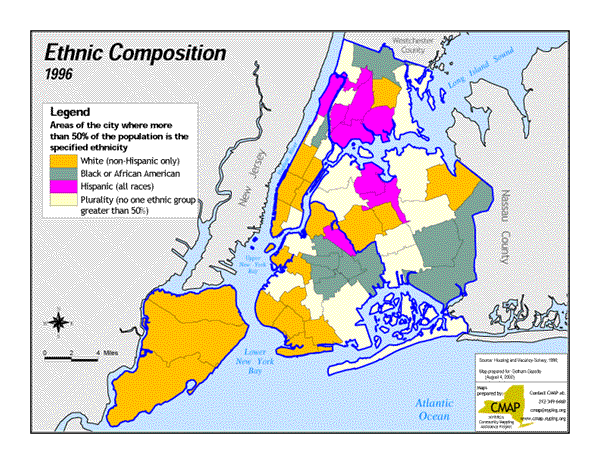
The first image above shows the school districts in Manhattan. The second shows the racial/ethnic makeup of the population; the data are a little old, but the relevant facts for the purpose of this post haven’t changed.

Take a look at the shape of District 2 – it’s the one that encompasses all of Manhattan below Central Park except for a big chunk on the southeast tip of the island.

What occasions this particular illustration? In his e-mail blast today, Whitney Tilson reprints the following correspondence “from a friend”:

Every great DOE school is selective — whether by test score or by Realtor, if you know what I mean. 

Look at the map of Manhattan District 2, one of the best public school systems in America. It could only have been drawn to intentionally ensure that white kids on Upper East Side, Chelsea, and Greenwich Village wouldn’t have to bump shoulders with black and Hispanic kids. 

Try renting a 2 bedroom apartment in that district for less than $3,000. 

Does District 2 cream? Hell yes!  Kids there have benefitted from a double-whammy (which was designed to benefit white kids, but now is increasingly filled by Asian students): they attend a middle school where you have to ace the 4th grade tests to be allowed in.  They also get the best teachers in the city because who wouldn’t want to teach the richest public school families in America? 

Schools filled with rich kids, when the system is rigged in their favor (the education level of their parents, the reality that rich kid schools are able to raise hundreds of thousands of dollars for teacher aides and books and such at fancy fundraisers, etc.), equals selective schools. 

Then we give them the best teachers and we allow their test scores to mask the city’s low aggregate scores. We create gifted and talented programs for them and give them a much stronger curriculum and higher expectations. We watch their parents spend a small fortune on afterschool tutoring and organized activities for their kids. 

OF COURSE they do well with all that extra learning! 

The NYC ‘system’ is rigged in favor of rich kids. (Joel Klein has tried to unrig it, but the political force is too strong.) 

It is why poor kids need these opportunities that are provided by the 30-40% of charters that are really, really excellent. 

What’s the quickest and easiest way to create a nationwide system of segregation academies? Force people to go to school based on where they live.

How do you make them even worse? Let the district lines be drawn by an unaccountable bureaucracy that claims to care about kids but actually doesn’t care how many children’s lives it has to destroy in order to keep the gravy trains running on time.

What is the only – the only – empirically proven way to successfully smash segregation? School choice.

Images by UNHP and Gotham Gazette