Mike Petrilli Buys into Hope and Change

May 13, 2009

Pollyanna

(Guest post by Greg Forster)

Yesterday, Mike Petrilli posted that he has “hope” some good will come from the giant geyser of money that the federal government is blindly spewing into the government school system under the “stimulus” bill.

I would let it slide, but I owe Mike a good ribbing for this. So . . .

Mr. Sulu, you have the bridge. Mr. Spock, Mr. Checkov, you’re with me. Set phasers to snark.

Mike’s “hope” comes from the fact that he attended a meeting with some state-based reform leaders and heard some stories about how states are going to do great things in order to qualify for some of the relatively tiny portion of stimulus funding that has been set aside to reward good behavior (the so-called “race to the top” funds).

He actually calls these tales “bona fide stories of state legislatures contemplating” reform. Amazing – they’re contemplating reform!

To substantiate his point, he says that because Arne Duncan said he “may” withhold some of the tiny race-to-the-top portion of stimulus funds from states that limit charter schools, Maine is “considering” enacting a charter law. What kind of charter law we might expect to get under such conditions is a question Mike doesn’t raise. Plenty of states have charter laws that effectively block the creation of any charters that might actually produce change. The purpose of the law is for state legislators to be able to claim they have a charter law. Such laws do much more harm than good, since they siphon off political capital for reform and create a few phony, lousy charters which can then be held up and pilloried to discredit further reform efforts. You think that might happen in Maine?

“Mr. Spock, is all this . . . what I think it is?”

“Tricorder readings confirm we are witnessing the phenomenon known as ‘kabuki,’ Jim. Judging by the crudity of the performance, I would estimate that this particular specimen is at a very low stage of development.”

I’ll agree with Mike on one thing, though. The stories he heard are ceratinly “bona fide stories.” That is, they clearly are stories. What kind of stories is a question worth pondering.

Ironically, Mike wrote his post in response to an earlier post yesterday from Fordham’s Andy Smarick, which adduces with devastating clarity just some of the many reasons why we have no right to even hope for good results from the edu-stimulus:

First, although the application requires the governor to sign assurances promising to make progress in four areas, remarkably, it requires neither a plan for accomplishing those goals nor details on how these billions of dollars will be spent.  The states that have applied so far have obliged, including none of this relevant information in their packages.

Second, the Department sent a letter to states on April 1 saying that states don’t have to demonstrate progress on the assurances to get the second batch (~$16 billion) of stabilization funds.  They only have to have systems in place to collect data.

Third, governors lack the power to require districts to use these funds wisely.  From the guidance released in April:

III-D-14.  May a Governor or State education agency (SEA) limit how an LEA uses its Education Stabilization funds?

No.  Because the amount of Education Stabilization funding that an LEA receives is determined strictly on the basis of formulae and the ARRA gives LEAs considerable flexibility over the use of these funds, neither the Governor nor the SEA may mandate how an LEA will or will not use the funds. 

Finally, the only leverage the Department seems to have is threatening to make states ineligible for Race to the Top funds if this money isn’t wisely spent.  But states, not districts, are the only eligible applicants for the Race to the Top funds, and, as the guidance makes clear, states can’t force districts to behave.  So the threat is misdirected.

Game, set, match – Andy.

Looks like we’re done here. Mr. Scott, three to beam up.


Clive Crook on American Education and the Democrats

May 11, 2009

6837-004-ED31B9D4

 (Guest Post by Matthew Ladner)

Clive Crook doesn’t think that the alliance between education reactionaries and Democrats is going to last. I don’t either. Crook writes in the Financial Times of London:

The keys – and here comes the political challenge – are accountability and competition. However you do it, through school vouchers if you want to be radical, or the faster expansion of self-governing charter schools if you do not, the crucial thing is to give parents alternatives to failing schools. This means firing the worst teachers and shutting the worst schools. Teachers’ unions have a death grip on the system and are having none of it. In many parts of the country, sacking a teacher, however incompetent, is next to impossible. Will Mr Obama dare to face down this powerful Democratic party constituency?

There are two reasons to hope he might. One is that he understands the issue and cares about it. Plainly he feels passionately about inequality. Improving the working poor’s economic opportunities is essential, and if schools cannot be fixed, that is not going to happen.

Another reason for guarded optimism is that the politics of education is more complicated and less predictable than you might think. The Democratic party, despite the clout of the teachers’ unions, is split. Many urban activists and community organisers – the milieu from which Mr Obama sprang – are strongly in favour of greater school choice, which one might have supposed to be a Republican rallying-cry. The pressure for reform is coming from the left as well as the right.

At a meeting in Washington to launch the McKinsey report, Al Sharpton, a black community leader and all-round stirrer of controversy, was on the platform alongside more orthodox education reformers and administration officials. He called school reform the civil-rights challenge of our time. The enemy of opportunity for blacks in the US was once Jim Crow, he said; today, in a slap at the educational establishment, it was “Professor James Crow”. He is right, and the country must hope the president agrees.


Famous Steakholders, Volume 5

April 21, 2009

(Guest Post by Matthew Ladner)

Maybe this was what Leo was talking about.


Are You Asking for a Challenge?

April 17, 2009

Over at Flypaper, Mike Petrilli found the opening paragraph of my WSJ op-ed unpersuasive:

“On education policy, appeasement is about as ineffective as it is in foreign affairs. Many proponents of school choice, especially Democrats, have tried to appease teachers unions by limiting their support to charter schools while opposing private school vouchers. They hope that by sacrificing vouchers, the unions will spare charter schools from political destruction.”

Has Mike become a fan of appeasement and declared that he has reached “education reform in our time”?  No, but he believes that his anti-voucher/pro-charter beltway buddies are principled in holding their views:

“I challenge Jay to name one person he knows who supports charter schools but opposes vouchers because he or she hopes to appease the unions. I hang out with a lot of these folks and it’s clear to me that most of them oppose vouchers either because of queasiness over church/state issues or because they don’t want public funds going to schools that don’t face any public transparency or accountability requirements. ”

Of course, there is no way to prove who’s right about this because it involves knowing people’s motivations.  If people are willing to let vouchers die because they are eager to protect charters, they won’t exactly go around telling people (or even themselves) that their views are based more on political calculation than principle.  They’ll invent reasons for their views, like being uneasy about church/state issues or having concerns about accountability, even if those are not their true motivations.

So why do I believe that the anti-voucher/pro-charter view is largely a political calculation rather than a principled position?  Well, because most people who hold this view are not consistent in their principles.  If church/state issues are the problem for the anti-voucher/pro-charter crowd, why don’t they oppose Pell Grants or the Day Care Tuition Tax Credit, both of which are vouchers that include religious schools?  If their objection is principled, then we would expect them to be consistent in applying that principle.

And if their objection is the lack of public transparency and accountability, why don’t they advocate for whatever regulations on vouchers they believe are necessary and desirable?  It is simply untrue to say that current voucher programs “don’t face any public transparency or accountability requirements.”  And if people thought even more regulations would be beneficial, the principled position would be to support vouchers with those regulations.  After all, there is nothing magical about the word “public” that makes schools accountable or transparent, so whatever regulations people prefer could be imposed on vouchers as easily as on district or charter schools. 

Of course, I think much of that regulation is unnecessary for accountability and undesirable for schools whether they are district, charter, or voucher schools, but there is nothing in principle that makes one type of school more impervious to accountability regulation than another.  A principled position for believers in choice and competition would be to support charters and vouchers and advocate for a particular regulatory regime, regardless of whether it applied to charters or vouchers.

So if the objections to vouchers among some charter supports are not based on principles, it is reasonable to suspect that they are based on political calculations.  We’ve already rehearsed this argument in an earlier post and I’m too polite to name names, but if you think hard it won’t be a challenge to come up with a the names of a bunch of people.

(edited for typos)


The UFT’s “Cue Card Check”

April 15, 2009

guy-holding-cue-card

All images from GothamSchools, whose Elizabeth Green broke the story

(Guest post by Greg Forster)

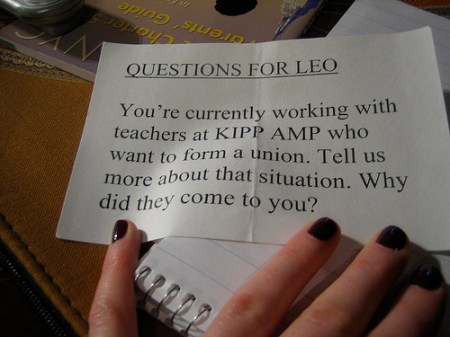
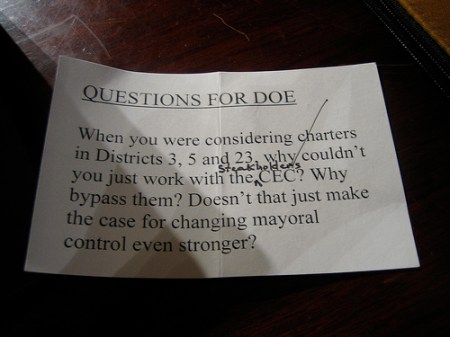
Last week, the UFT got caught handing out cue cards to New York City Council members before a public hearing of the council’s education committee. The council members dutifully asked the questions they had been given, which pointedly invited anti-charter diatribes from the teacher-union and DOE witnesses.

The members then unanimously voted to make Grigori Potemkin their new committee chairman.

Internet wags are calling the scandal “cue card check.” ALELR has consulted his deep moles within UFT and offered an intriguing report on the union’s strategy for the Council’s next hearing.

The cue cards have to be seen to be believed:

cue-card-2

cue-card

cue-card-leo

That’s “questions for Leo” as in our dear friend and Sith apprentice Leo Casey, who testified at the hearing. My pledge to you, the reader: from now on, every time Leo posts calumnies about Jay, I will post a link to this story.

cue-card-doe

And that’s “questions for DOE” as in officials from the Department of Education. The cue cards were handed out by the UFT, but is it plausible that the department officials had no idea they were being asked scripted questions?

HILARIOUS UPDATE! When I first posted this, I didn’t look closely at the handwritten edit made to this cue card. Check it out – note the spelling. And this is from an organization of teachers!

This story doesn’t seem to have broken out of the local circuit yet, but it’s getting a whole lot of attention in the city media. The Daily News is leading the way, documenting the extent of UFT political contributions to the council members who got cue cards and covering Randi Weingarten’s attempts to deflect blame by claiming that a charter school organizer once did the same thing. (Not true, says the organizer – and who has more credibility here?)

But ALELR notes that props are not being given to Elizabeth Green of the blog GothamSchools, who broke the story and snapped all the pictures you see above (and more, which you can enjoy in all their glory by following the link).

Green wryly notes that the cue cards with accusatory anti-charter questions were handed out by “a representative of the city teachers union, which describes itself as in favor of charter schools.”


Add a Little Salt

March 20, 2009

(Guest Post by Jonathan Butcher)

Last week, a South Carolina education blog called “The Voice for School Choice” posted links to an article on the worst schools in the U.S.  South Carolinians should be particularly irked with the article because 11 SC schools made the top 25.  All is not what it seems, though; below is a touch of salt to be added to the results of this article (“25 Worst Performing Public Schools in the U.S.”).  At issue is not the intelligence of the authors nor their ability; however, they make very strong claims as to the significance of their findings, and readers should be aware of the foundation on which the authors make these claims regarding student achievement.

“Worst Schools” was composed by a website called “Neighborhood Scout” and published on a financial blog operated by AOL called “WalletPop.”  Neighborhood Scout specializes in “nationwide relocation software, retail site selection, and real estate investment advertising.”  They are not an academic department at a university nor a policy research institution, and their founders do not have backgrounds in education or education policy research.  The founders’ specialty is geography, computer mapping and web design (there is no evidence that the authors are different from those described on Neighborhood Scout’s web page).

Neighborhood Scout created their own methodology for the “Worst Schools” article.  They subtracted the percentage of students who “passed” NAEP in a particular state (I am assuming they mean students who scored at proficient or above—though it could mean basic or above) from the “average percentage” of students in the same state who scored at the proficient or advanced level on the state’s mandatory test.  Their objective was to find schools in states where there is a large difference between the percentage of students proficient on a state test and the percent proficient on NAEP in order to make judgments about the difficulty (or lack thereof) of a state test.  The article does not compare similar student populations—as does NAEP—or at the least this methodology section does not indicate such disaggregation.

Of note is that the study gives no indication of being peer-reviewed, and peer-review is a robustness check even among research reports not submitted to journals.  In addition, the study is a snapshot of test scores.  It does not take into account improvement over time, student population changes, or compare scores to some baseline indicator.  For example, in the past three years, 6th graders at W.A. Perry (one of the SC schools in the bottom 25) have gone from 48% meeting or exceeding state standards in math to 66%.  They are still below the state average, but more students are meeting or exceeding state standards now than three years ago.  Similar results can be found in English/Language Arts. 

Admittedly, W.A. Perry’s 6th graders’ scores are below the state average; however, they are making progress.  My aim is not to defend schools that may be low-performing, but a snapshot of a school’s test scores at one point in time does not a failing school make.  NCLB agrees with me, as a school must be in need of improvement for three years before significant intervention takes place.

Additionally, no indication is given by the article as to the student populations served at these schools.  For example, Milwaukee Spectrum School (#25) has a total population of 90 at-risk students who had a record of truancy at other schools.  The school is often a last stop for students ready to drop out of high school all together.  Of course the school is struggling; it is intended to serve struggling students.

In the article, different grades are represented for each school.  For example, high schools are not compared to high schools, but to elementary, middle, and high schools.  This presents a problem because the trend in NAEP (generally) is that more elementary students score proficient than middle school students, and more middle school students score proficient than high school students (this is true across subjects).    

Further, scores are not reported for every grade in every subject.  So a high school with low-scoring 11th graders may be on the “Worst Schools” list right before a middle school who has low-scoring 8th graders but a class of 6th graders with scores closer to a state’s average. 

In the end, of course, readers will decide if this list of worst performing schools is convincing.  However, before sinking your teeth in, take the article with a grain of salt.

The Charter/Voucher Extended Dance Remix

March 16, 2009

My post last week on why supporters of charter schools don’t also support vouchers generated a large amount of discussion.  Here are some tidbits on the same topic:

First, Doug Tuthill, the former teacher union leader and now head of Florida’s choice advocacy group, Step Up For Students, emailed me to say:

In Florida we have adopted the same approach to charters and vouchers you advocated in your recent exchange with Andy Rotherham.  Given the idealized status of “public education” in our culture, getting into a public versus private school debate is a losing proposition.  Therefore we argue that  publicly-funded private schools are part of our public education system and the real issue is how best to regulate all publicly-funded education.   Our approach is aided by the reality that public education in Florida is expanding to incorporate a variety of publicly-funded private providers.  Many of the state’s best secondary magnet programs are run by private providers (my favorites are two aeronautic magnet programs run by Embry-Riddle University in Okaloosa County), the K-5 portion of our state online school, the Florida Virtual School, is run by a private provider, the overwhelming majority of our charter schools are run by private providers, and of course all the schools providing services through the McKay and Corporate Tax Credit Scholarships are private providers.  To arbitrarily label some of these public-private partnerships as “voucher” programs and therefore suggest they are bad is nonsensical.  The goodness or badness of any publicly-funded education program should be determined by its effectiveness and efficiency, not by how it is labeled.


Andy and President Obama, among others, are caught in the old “public-versus-private-school” paradigm, which is why they support “charters” but not “vouchers.”    But as you pointed out in your exchange with Andy, this is an illogical distinction unless one is stuck in the “public is good, private is bad” mindset and possesses a myopic view of what constitutes public and private. 


And here is an interesting item about how Orthodox Jewish groups have come out against secular charter schools as a substitute for a Jewish education.  The Ben Gamla Hebrew Charter School in Florida focuses on Hebrew language and Jewish history but has no religious instruction.  And it is drawing students away from Jewish private schools in part because the charter is free to students while the private schools have to charge tuition.  The huge expansion in charter schools may be posing an even greater competitive threat to established private schools than to traditional public schools.


Leaders of the Orthodox movement recognize this threat to their efforts to focus on religious instruction.  A spokesman for the Orthodox group Agudath Israel of America, Rabbi Avi Shafran, commented: “We are not pro-charter schools. They are not replacements for a yeshiva education, and anyone who can imagine they could be are fooling themselves… There is no end around the fact that Jewish education is a Jewish education and that can only happen in a Jewish institution with a Jewish curriculum. And because our nation does not permit religious instruction in public schools, there is no way to avoid the need that Jewish parents have for yeshivas.” 


Symbols Matter

March 11, 2009

wingdings

(Guest post by Greg Forster)

Jay points out that the president’s speech on education yesterday doesn’t resemble his legislative agenda. But it’s worse than that. There are things Obama could do to promose these good reform ideas even without legislation or budget changes, but won’t.

He calls on states to lift their charter caps. But what does he plan to do about charter caps? Even without extending federal authority over the states on charter policy, there’s plenty he could do, as Jay Matthews points out:

Will the Obama Education Department prepare and publicize a list of all the charter school cap laws in the country? Will Duncan call the governors, and legislators and school boards responsible for them and ask them to remove those restrictions on new charters, and find a way to get rid of bad charters?

Is the pope Muslim?

So on pretty much all fronts, the president’s “plan” for education is just symbolism.

But you know what? Symbols matter! The president is using his position in the spotlight to endorse choice and competition (as he did during the campaign) and rewards for performance, the two indispensable principles of sound educational reform. Even if he’s only doing it because Democratic constituencies other than the education unions expect it, it matters that the president has chosen to align himself with those constituencies rather than the unions. He could easily have taken the old line and kowtowed to the unions. But he didn’t, and that counts for something. So let’s give the president his due.

Now if only he had stopped his pals in Congress (who look an awful lot like his bosses these days) from kowtowing to the unions on vouchers.


Pay No Attention To My Legislative Agenda

March 11, 2009

President Obama gave a great speech yesterday in which he strongly endorsed charter schools and merit pay.  He also emphasized the need to remove ineffective teachers from classrooms and to expand access to pre-school.

The problem is that these words bear almost no resemblance to the education priorities contained in Obama’s legislative agenda.  This is really strange.  I’m accustomed to presidents exaggerating the attractiveness of their proposed policies.  But Obama is the first president that I can think of who pushes the attractiveness of policies that he is hardly pursuing in legislation while concealing the bulk of his actual efforts.

I’ve previously written about how the bulk of Obama’s increased education spending goes to status quo programs, such as Title I, special ed, Pell Grants, school construction, and generally holding localities harmless against losses in tax revenue.  Almost no money has been devoted to charter schools, merit pay, efforts to remove ineffective teachers, and even pre-school (which received only $4 billion of the $800 billion stimulus package, and most of that was for propping up status quo Head Start programs).  All of the great (and not so great) education policies that Obama talks about are almost completely absent in legislation that he has backed.  And he hardly says a peep about all of the education policies that he does throw money at. 

Obama just distracts us from his actual efforts with pretty words about things that he is hardly doing.  Of course, the most obvious thing he was distracting us from with his speech yesterday was the Senate vote to begin the execution of the DC voucher program.  He didn’t say a word about yesterday’s actions, knowing that all of the headlines would be about the reforms he did endorse (but has done almost nothing to actually enact).


But I Won’t Do That

March 10, 2009

There’s an awful Meatloaf song where he declares that he would do anything for love… but he won’t do that.  It’s isn’t entirely clear what Mr. Loaf (as the New York Times calls him) won’t do for love.  But it is clear that there is something he will not do even though he has just declared that he would do anything

This incoherent, cheesy awfulness reminds me of the argument that we should support charters but oppose vouchers.  I’m sure that’s what you were thinking as well.  It’s like they would do anything for choice… but they won’t do that.

If one supports the view that expanding choice and competition help students who choose and either helps or does no harm to traditional public schools, why limit that support to charter schools?  I know people say that at least charters are still public schools, but why exactly does that matter?  There is no magic pixie dust in the word “public” that makes things good or serve the public interest.  If we add the word “public” to vouchers so that we now call them “public vouchers” does that make them acceptable to pro-charter/anti-voucher folks?

I know that some suggest the important part of charters being “public” is that they can be regulated so as to assure public goals.  But whatever regulations are really necessary for public goals can be attached as a condition to vouchers as easily as to charters.  If we think teachers need to have certain credentials or students have to take certain tests, that can be (and has been) required of voucher-receiving private schools.  It’s not clear what about the publicness of charter schools, or even traditional public schools, make them better suited to serving the public good or being regulated for that purpose.

I suspect that some of the real rationale behind supporting charters but opposing vouchers is an unstated uneasiness with vouchers supporting students in religious schools.  But the U.S. Supreme Court has settled this issue as a matter of constitutional law.  And if the objection is one of desirable public policy, why is there near universal support for vouchers (Pell Grants) to attend BYU or Baylor but not St. Thomas Aquinas High School? 

This leads me to suspect that the real REAL reason for folks supporting charters but opposing vouchers is the political desire to appear moderate regardless of how incoherent and irrational it is.  Today President Obama is going to tout his support for charter schools.  And he’s going to tout his support for Pell Grants.  But he will not support vouchers.  Holding all of these positions make no logical sense, but they are thought to have some political appeal. 

I guess I understand why politicians take these incoherent positions, but why do people in academia, think tanks, and the blogoshpere do this?  Unlike politicians we don’t have to lie or make false distinctions for a living.  So I challenge anyone to explain exactly why, other than for the political advantage of triangulation, people should support charters but oppose vouchers.

My bet is that any argument will resemble the “look at the silly monkey” argument.  It’s even more powerful than the Chewbacca defense because it makes your head explode.