Charters v. Private Schools: Urban and Suburban Differences

August 28, 2012

(Guest post by Greg Forster)

Cato has new research out from Richard Buddin, examining where charter schools draw their students from. Adam Schaeffer offers a summary, emphasizing the dangers of charter schools: “On average, charter schools may marginally improve the public education system, but in the process they are wreaking havoc on private education.”

I agree with the basic premise: charters don’t fix the underlying injustice of government monopolizing education by providing “free” (i.e. free at the point of service, paid for by taxpayers) education, driving everyone else out of the education sector. As Jay and I have argued before, vouchers make the world safe for charters; that implies you can view charters as a response by the government to protect its monopoly against the disruptive threat of voucher legislation.

But what interests me more are the urban/suburban and elementary/secondary breakdowns of these data. It appears that charters are only substantially cutting into private schools in “highly urban” areas. In the suburbs, the charter school option is framed much more in terms of boutique specialty alternatives (schools for the arts, classical education, etc.) rather than “your school sucks, here’s one that works.” If you’d asked me, I would have guessed that would also cut heavily into the private school market – it would appeal to parents of high means who are looking for something out of the ordinary for their children, and that demographic would be most likely to already be in private schools. Yet the data show otherwise; apparently the families choosing boutique suburban charters weren’t much impressed with their private school options. And what’s up with this weird distribution on the elementary/secondary axis? Apparently public middle schools really stink in urban/suburban border areas.

Discuss!


Mike Petrilli is Rocking the Suburbs Just Like Quiet Riot Did

July 20, 2012

(Guest Post by Matthew Ladner)

Mike Petrilli is rocking the suburbs for school choice.


District or Charter in Arizona?

July 19, 2012

(Guest Post by Matthew Ladner)

The Economist ran a fantastic article on charter schools recently, marred only by a bit by a bit of overconfidence from Mackie Raymond on charter school authorizing:

Credo thinks that the variation in quality can be traced to the governing legislation behind the schools. Margaret Raymond, director of Credo, points to Arizona’s terrible results in 2009, which were the result of lax screening of those who were allowed to set up charter schools, and no serious reviews thereafter. Ohio, where most charters are worse than the traditional schools, gained a reputation as the “Wild West” of charter schools because it exercised almost no oversight.

Credo did report finding lower rates of academic growth in Arizona charter schools, but also some bright spots. A previous analysis of growth by UCLA’s Lew Solomon found higher rates of academic growth, and an analysis more recent that either of these found similar rates of growth between charter and district schools. Moreover, Paul Peterson noted that the Credo study may have been unduly influenced by a large number of students spending their first year in a charter school, and charter schools that were in their first year of operation. Students take an academic hit during the period of acclimation to a new school, and schools are not generally at their best during their shakedown period.

No one has performed a random assignment study on charter schools in Arizona, but the random assignment studies that have been performed are quite positive for charter schools. The weight of the available evidence leads me to believe that the same would be true in Arizona. After all, if Arizona charter schools had persistently lower rates of academic growth, it would be hard to explain why general education low-income students consistently outperformed their district peers on all 5 2011 NAEP exams:

The desirability of very cautious authorizing discussed in The Economist has sadly become conventional wisdom. Personally, I am not a fan.

First, let’s recognize that the idea of hyper-cautious authorizing fits some states better than others. It’s always bad in my view, but it would have been flat-out insane in Arizona. Before the bust, the Arizona state government had been shelling out hundreds of millions of dollars per year to build new district schools to cope with enrollment growth. Those schools are **ahem** in the red columns in the above figure.

In the absence of the hundreds of charter schools that have opened in Arizona, without state facility funding mind you, since the charter school law passed in 1994, the financial burden on Arizona taxpayers to build new school space would have been even greater. No one in Arizona had a strong reason to be terrified by the possibility of ineffective charter schools opening when we were bearing a terrible financial burden to build lots of ineffective district schools.

Now obviously this is no justification to allow convicted felons or random ya-hoos who can’t put a credible business plan together the chance to open a charter school. Bad for kids, bad for taxpayers, no doubt. It is far from clear to me however that authorizing boards are especially adept at predicting in advance who will be a success, and who will fail. In fact, it seems likely to me that the elitist authorizing processes of some other states might have declined Rick Ogston the opportunity to open Carpe Diem.

Use this hat to improve your powers of prediction..

Rather than having well-meaning bureaucrats trying to do the impossible divine the future regarding who will succeed and fail- it is a better approach to have a relatively quick hook on the back-end. Despite Arizona’s reputation as the “Wild West” a large number of charter schools have closed over the years. I am hopeful that the A-F grading system will lead Arizona parents to close even more poorly performing charter schools, as decentralized solutions work best.


School Choice and the Greenfield School Revolution

June 5, 2012

(Guest post by Greg Forster)

Today, the Friedman Foundation is releasing a study I did with James Woodworth: The Greenfield School Revolution and School Choice. We know from previous research that vouchers (and equivalent programs like tax credits and ESAs) consistently deliver better academic performance, but the size of the impact is not revolutionary. Meanwhile, the whole world is watching as charter school operators (Carpe Diem, Rocketship, Yes Prep, etc.) reinvent the school from the ground up.

It’s ironic that these schools are charters, not voucher schools. A properly designed (i.e. universal) choice program would do a better job than charters of supporting these highly ambitious “greenfield” school models. But existing choice programs are not properly designed, so our impression was that they’re excluding these educational entrepreneurs, instead simply transferring students from one existing set of schools (public) to another (private).

We wanted to test our theory and make sure it was true, not just an accident of publicity or media bias, that the reinvention of the school wasn’t being supported by existing choice programs. We combed through twenty years’ worth of federal data (CCD and PSS) to see if we could find any evidence of disruption in the structure of the private school sector in places that had school choice programs.

We found that while existing school choice programs may be delivering moderately better academic outcomes, they aren’t disrupting the private school sector the way they need to be. In one or two places we found visible impacts, but nothing like a reinvention of schooling. The only impact of any considerable size is the dramatic change in racial composition in the private school population of Milwaukee.

In addition to the empirical findings, the study outlines 1) why radical “greenfield” school models are essential to drive the kind of education reform we need, and 2) why universal school choice would do a better job than charter schools of sustaining it.

Special thanks to Rick Hess, from whom we borrow the term “greenfield,” and Jay Greene for giving us their comments and insights as we developed this study!


District or Charter Schools in the District of Columbia?

May 18, 2012

(Guest Post by Matthew Ladner)

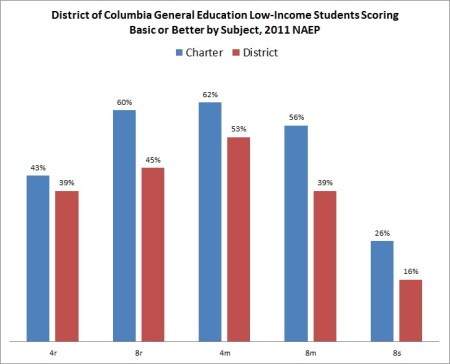
DC’s NAEP numbers allowed for some additional controls to be introduced when comparing charter and district schools than I was able to do with the Milwaukee comparison. The following chart shows the percentage of general education program students who qualify for a free or reduced lunch scoring “Basic or Better” on the 2011 NAEP exams. Special education students, ELL students and middle/high income students are not included in order to get a quick closer to apples to apples comparison.

Now of course for a real apples to apples you need a random assignment study, but those have been done and find results favorable to charter schools. This chart doesn’t address the topic of valid stastical significance, but rather whether the differences are meaningful.

Considering that charters get far less money that DCPS per pupil and show higher levels of academic achievement, this looks to be a success, albeit both the blue and the red columns leave much to be desired. The red columns leave much more to desired however, especially when you consider that that they are wallowing in money.


Charter Benefits Are Proven by the Best Evidence

May 7, 2012

It’s National Charter Schools Week, so here is the post I’ve written for the George W. Bush Institute Blog on the issue:

According to the Global Report Card, more than a third of the 30 school districts with the highest math achievement in the United States are actually charter schools.  This is particularly impressive considering that charters constitute about 5% of all schools and about 3% of all public school students.  And it is even more amazing considering that some of the highest performing charter schools, like Roxbury Prep in Boston or KIPP Infinity in New York City, serve very disadvantaged students.

As impressive and amazing as these results by charter schools may be, it would be wrong to conclude from this that charter schools improve student achievement.  The only way to know with confidence whether charters cause better outcomes is to look at randomized control trials (RCTs) in which students are assigned by lottery to attending a charter school or a traditional public school.  RCTs are like medical experiments where some subjects by chance get the treatment and others by chance do not.  Since the two groups are on average identical, any difference observed in later outcomes can be attributed to the “treatment,” and not to some pre-existing and uncontrolled difference.  We demand this type of evidence before we approve any drug, but the evidence used to justify how our children are educated is usually nowhere near as rigorous.

Happily, we have four RCTs on the effects of charter schools that allow us to know something about the effects of charter schools with high confidence.  Here is what we know:  students in urban areas do significantly better in school if they attend a charter schools than if they attend a traditional public school.  These academic benefits of urban charter schools are quite large.  In Boston, a team of researchers from MIT, Harvard, Duke, and the University of Michigan, conducted a RCT and found:  “The charter school effects reported here are therefore large enough to reduce the black-white reading gap in middle school by two-thirds.”

A RCT of charter schools in New York City by a Stanford researcher found an even larger effect: “On average, a student who attended a charter school for all of grades kindergarten through eight would close about 86 percent of the ‘Scarsdale-Harlem achievement gap’ in math and 66 percent of the achievement gap in English.”

The same Stanford researcher conducted an RCT of charter schools in Chicago and found:  “students in charter schools outperformed a comparable group of lotteried-out students who remained in regular Chicago public schools by 5 to 6 percentile points in math and about 5 percentile points in reading…. To put the gains in perspective, it may help to know that 5 to 6 percentile points is just under half of the gap between the average disadvantaged, minority student in Chicago public schools and the average middle-income, nonminority student in a suburban district.”

And the last RCT was a national study conducted by researchers at Mathematica for the US Department of Education.  It found significant gains for disadvantaged students in charter schools but the opposite for wealthy suburban students in charter schools.  They could not determine why the benefits of charters were found only in urban, disadvantaged settings, but their findings are consistent with the three other RCTs that found significant achievement gains for charter students in Boston, Chicago, and New York City.

When you have four RCTs – studies meeting the gold standard of research design – and all four of them agree that charters are of enormous benefit to urban students, you would think everyone would agree that charters should be expanded and supported, at least in urban areas.  If we found the equivalent of halving the black-white test score gap from RCTs from a new cancer drug, everyone would be jumping for joy – even if the benefits were found only for certain types of cancer.

Unfortunately, many people’s views on charter schools are heavily influenced by their political and financial interests rather than the most rigorous evidence.  They don’t want to believe the findings of the four RCTs, so they simply ignore them or cite studies with inferior research designs in which we should have much less confidence.

Progress will be made in our application of research to charter school policies by encouraging everyone to focus on the most rigorous studies, of which we have several.  To do that, supporters of charter schools also have to refrain from citing weaker evidence, which only serves to legitimize the use of inferior studies by charter opponents.  As exciting as the outstanding performance of charter schools is in my own Global Report Card research, that evidence shouldn’t be used to endorse charter schools.  Supporters don’t need to rely on the Global Report Card to make the case for charter schools because they have four gold-standard RCTs on their side.  Opponents of charter schools have no equally rigorous evidence on their side.  And that’s the point we should all be making.


Let’s Go Shopping

April 12, 2012


 (Guest post by Patrick Wolf)

We interrupt this celebration of the Jay P. Greene Blog’s four years of extraordinary wonderfulness for a “stop the presses” headline:  71% of parents in Detroit have shopped for (and enrolled a child in) an alternative to their assigned public schools within the past five years.  This is only one of many interesting results from the study Understanding School Shoppers in Detroit by Thomas Stewart and me.

Our study is based on the administration of a door-step survey to over 1000 parents living in nearly 300 different city blocks selected at random for canvassing.  We also held follow-up focus groups with parents and older students.

The report was sponsored by Michigan Future, a non-partisan non-profit organization committed to creating 35 high-quality high schools in the city over the coming years.  They are leading community efforts to improve education in Detroit and enlisted us to perform the first-ever demand study of urban schooling.

The people at Michigan Future sought basic research to better understand Detroit parents as shoppers for k-12 schools.  They wanted to know how many parents had experience with school shopping (a lot!), when did they shop (May-August), how did they shop (through social networks, school fairs, web searches, and a limited number of school visits), and what were they looking for (schools with a strong academic program and safe environment).

Charter schools are the most popular schools of choice for Detroit parents, but a staggering 15% of Detroit children currently attend public schools outside of the city.  Nearly 30% of parents said they would transport a child “up to 8 miles” to access a desirable school, and many clearly are doing so.

Stewart and I further determined that 59% of Detroit parents had the characteristics of “veteran” shoppers in that they had exercised choice in the past as well as the present and plan to continue to shop in the future.  About 12% of parents were classified as “emerging” shoppers who were new to school choice and still trying to figure out where the good stores are.  Another 8% of Detroit parents were “potential” shoppers with many of the characteristics that predicted school shopping, such as disappointment with their child’s school and an expressed willingness to travel long distances to a better school, but who had not yet actually shopped.  The final 21% of parents were classified as “unlikely” school shoppers, with attributes and attitudes that suggest they will continue to accept the default of assigned public schools.

Enjoy browsing!


Teacher union protestor: Why didn’t white folks keep charter schools for themselves?

April 8, 2012

(Guest Post by Matthew Ladner)

Wow-background here.

That has got to be the best teacher union protestor since…


Here’s Why Victory Looks Like This

March 7, 2012

(Guest post by Greg Forster)

Jay points to the way Democrats and progressives are now saying all the same things we’ve been saying for a decade, but acting like they thought of them, and remarks that this is What Victory Looks Like.

He’s right, and here’s why. To large extent, you have to let people “steal” your ideas in order to get victory. It’s not just a price we need to be willing to pay if necessary. It’s always necessary.

Major reform of a cultural system has to start with ideas and practices germinating outside the core institutions of that system. If major reform were welcome inside the core institutions, it wouldn’t be necessary in the first place. The incubators of reform can’t be seen as fringe groups – this is why organized libertarianism has had much less influence than its intellectual seriousness and devotion of financial resources might lead you to expect. But the reform incubators are never going to be inside the core, either. You need something that’s a happy medium between credibility and independence.

Now, for a long time in America, the Democratic party and the progressive ideological movement have been the “core” institutions governing education. When you ask the American people whom they trust to do the right thing about education, they overwhelmingly say Democrats and progressives. That makes them the core.

The key to victory is to get the core groups to adopt the ideas that incubated in institutions outside the core. The greatest challenge is that the core groups want to defend their “core” turf against outsiders. They want to keep control of the core, and they can’t do that if they admit that outsiders have superior ideas. The solution is to get the core groups to co-opt (i.e. steal) the ideas and pretend they thought of them.

So you’re never going to get (very many) Democrats and progressives saying, “Why, yes, as a matter of fact the conservatives were right about education all along!” Admitting that would require them to sacrifice their status as the cultural core institutions of American education. Instead they’re going to say, “What American schools need are good, liberal, progressive ideas like choice, competition, and accountability.”

That’s what victory looks like.


School Choice Researchers Unite in Ed Week

February 22, 2012

Pictured (L to R): Rick Hess, Jay Greene, Greg Forster, Mike Petrilli and Matt Ladner

(Guest post by Greg Forster)

Today, Education Week carries a joint editorial signed by nine scholars and analysists. We came together to agree that Mom and apple pie are good, Nazis and Commies are bad, and the empirical research supports the expansion of school choice:

Choice’s track record so far is promising and provides support for continuing expansion of school choice policies…Among voucher programs, random-assignment studies generally find modest improvements in reading or math scores, or both. Achievement gains are typically small in each year, but cumulative over time. Graduation rates have been studied less often, but the available evidence indicates a substantial positive impact. None of these studies has found a negative impact…Other research questions regarding voucher program participants have included student safety, parent satisfaction, racial integration, services for students with disabilities, and outcomes related to civic participation and values. Results from these studies are consistently positive…

In addition to effects on participating students, another major topic of research has been the impact of school choice on academic outcomes in the public school system…Among voucher programs, these studies consistently find that vouchers are associated with improved test scores in the affected public schools. The size of the effect in these studies varies from modest to large. No study has found a negative impact.

We have diverse viewpoints on many issues, but we share a common commitment to helping inform public decisions with such evidence as science is legitimately able to provide. We do not offer false certainty about a future none of us knows. But the early evidence is promising, and the grounds for concern have been shown to be largely baseless. The case for expanding our ongoing national experiment with school choice is strong.

This may well be the most important part:

The most important limitation on all of this evidence is that it only studies the programs we now have; it does not study the programs that we could have some day. Existing school choice programs are severely limited, providing educational options only to a targeted population of students, and those available options are highly constrained.

These limitations need to be taken seriously if policymakers wish to consider how these studies might inform their deliberations. The impact of current school choice programs does not exhaust the potential of school choice.

On the other hand, the goal of school choice should be not simply to move students from existing public schools into existing private schools, but to facilitate the emergence of new school entrants; i.e., entrepreneurs creating more effective solutions to educational challenges. This requires better-designed choice policies and the alignment of many other factors—such as human capital, private funding, and consumer-information sources—that extend beyond public policy. Public policy by itself will not fulfill the full potential of school choice.

Although I also feel particularly strongly about this:

Finally, we fear that political pressure is leading people on both sides of the issue to demand things from “science” that science is not, by its nature, able to provide. The temptation of technocracy—the idea that scientists can provide authoritative answers to public questions—is dangerous to democracy and science itself. Public debates should be based on norms, logic, and evidence drawn from beyond just the scientific sphere.

Signatories:

Kenneth Campbell is the president of the Black Alliance for Educational Options, in Washington.

Paul Diperna is the research director for the Friedman Foundation for Educational Choice, in Indianapolis.

Robert C. Enlow is the president and chief executive officer of the Friedman Foundation for Educational Choice.

Greg Forster is a senior fellow at the Friedman Foundation for Educational Choice.

Jay P. Greene is the department head and holder of the 21st-century endowed chair in education reform at the University of Arkansas, at Fayetteville, and a fellow in education policy at the George W. Bush Institute, in Dallas.

Frederick M. Hess is a resident scholar and the director of education policy studies at the American Enterprise Institute, in Washington, as well as a blogger for Education Week.

Matthew Ladner is a senior adviser for policy and research at the Foundation for Excellence in Education, in Tallahassee, Fla.

Michael J. Petrilli is the executive vice president of the Thomas B. Fordham Institute, in Washington.

Patrick J. Wolf is a professor and holder of the 21st-century endowed chair in school choice at the University of Arkansas, at Fayetteville.

Our color-coordinated mechanical lion battle chariots that join together into a giant robot are still under construction.

Defender of the empirical research universe!