Expulsion Rates in DC

January 10, 2013

(Guest Post by Matthew Ladner)

The Washington Post has an important story up about expulsion rates in DC district and charter schools.  I can’t figure out how to embed anything but Youtube videos so the link is here.

Go watch it.

I’ll be here when you get back.

Go on…

Ok good. One important item to note: if we were to go and look up the criminal incident reports we would quickly conclude that the expulsion rate in DCPS is far too low.  If I wanted to be cruel, I’d go dig up the crime data. The video specifies that DCPS expelled three students last year, while the charter schools expelled 200.

It seems self-evident to me that 3 was far too low, and it is difficult to know whether 200 is “too many” for the charter sector without a great deal more context.  A district where you have to make the FBI Most Wanted List before getting expelled is not a proper baseline for comparison.

Discuss amongst yourselves…


Happy New Year

January 2, 2013

(Guest Post by Matthew Ladner)

Ed Week’s Sean Cavanaugh looks back at the school choice world of 2012 and looks ahead to 2013. Well worth a read.


A Guide for the Perplexed — A Review of Rigorous Charter Research

December 17, 2012

(Guest Post by Collin Hitt)

So you say charter schools don’t work. That’s an empirical claim. It needs to be backed up by evidence. Here’s a helpful guide to the most rigorous research available. Once you’ve tackled this material, you’ll be in position to prove your point.

As you probably know, the gold standard method of research in social science is called random assignment. Charter schools are particularly well-suited for random assignment evaluations, since they’re usually required by law to admit students by lottery. The lotteries are fair to families – that’s why they’re put in place. But they also allow researchers to make fair comparisons between students who win or lose lotteries to attend charter schools.

To date, nine studies lottery-based evaluations of charter schools have been released. Let’s go through them, starting with the earliest work.

The first random assignment study of charter schools was released in 2004 by Caroline Hoxby and Jonah Rockoff. It focused on Chicago International Charter School. After three years, charter students had significantly higher reading scores, equal to 3.3 to 4.2 points on 100-point rankings.  Gains were even stronger for younger students.

That same year, the University of California San Diego released a study of the Preuss charter school located on the university’s campus. Test scores for charter students appeared unchanged, but the school improved college-going rates by 23 percent: 90 percent of Preuss juniors were headed to four year colleges.

So the first two random-assignment studies of charter schools won’t help your point. They find gains for charter schools. But those studies are becoming dated; most of the national charter boom has occurred since they were published. Also, the San Diego study employs few statistical controls. So these studies don’t disprove your point either. Let’s review the newer stuff.

In 2010, Harvard’s Will Dobbie and Roland Fryer released a study of the Harlem Promise Academy. Entering kindergartners experienced large gains by the third grade, sufficient to eliminate the black-white achievement gap, equal to 0.58 standard deviations (sd) in reading and 0.49 sd in math. Students who entered Harlem Promise Academy in early middle school saw smaller gains that nevertheless by the eighth grade closed the achievement gap in math and reduced it by half in reading.

Later in 2010, researchers from MIT, Harvard and Michigan released a study of KIPP Academy in Lynn, Massachusetts. The charter school is part of the national charter network, the Knowledge is Power Program (KIPP). After a single year in the school, students saw achievement gains of 0.12 sd in English and 0.35 sd in math.

And earlier this year, researchers from Yale and Brown released a study of an unnamed charter network in an anonymous school district. There were no visible math gains for charter students, but they did see awfully big reading gains of 0.35 sd and writing gains 0.79 sd.

Charter advocates will point to these studies to try to prove you wrong, since these charter schools are definitely working. In turn, you could attempt to discredit the statistical math of the authors above. (Good luck.) Or you could make a more obvious point: these studies together look only at five charter operators. There are hundreds of charter operators across the country. The researchers could be cherry-picking – studying schools that they suspected beforehand were high-performing.

Larger random-assignment studies could address these issues, if they looked at a wider number of charter schools. Luckily, we’ve got four studies that do just that, all of them fairly recent.

The first is a 2009 study led by Caroline Hoxby. It examines practically every charter school in New York City. For every year students were enrolled in a charter school, they saw 0.04 sd gains in reading and 0.09 sd gains in math. The findings here are similar to the middle school gains that Fryer found at Harlem Promise Academy, though the citywide charter gains are clearly smaller than the Promise Academy’s extraordinary gains for kindergarteners.

Later that year, a citywide study of Boston charter middle and high schools found that charters produced “extraordinarily large” gains, according to the authors, who were based at Duke, Harvard, MIT and Michigan. After only one year, Boston’s charter high schools produced gains of 0.16 sd in reading and 0.19 sd in math. Charter middle schools in the city produced similar reading gains of 0.17 sd and a remarkable 0.54 sd in math.

In 2010, the US Department of Education released the first nationwide random-assignment study of charter middle schools. It contained two useful findings. Charter schools in affluent areas produced lower results than neighboring schools, which makes some sense. Charter schools in the suburbs are competing with higher quality schools than found in the inner cities. Charter schools in urban areas, enrolling a large percentage of poor students, posted significant gains in math, over two years equal to 0.18 sd.

In 2011, the team behind the 2009 study of Boston charter schools presented findings from a statewide evaluation of Massachusetts charter middle and high schools. Overall, results were positive. As with the USDOE study of middle schools, they found that charter schools in non-urban areas produced no positive gains. On the other hand, schools located in urban areas produced middle school gains of 0.12 sd in English and 0.33 sd in math and high school gains of 0.33 sd in English and 0.39 sd in math. These gains almost perfectly mirror the findings at KIPP Lynn, which is one of many schools included in the statewide sample.

So Harlem Promise Academy and KIPP produced results that are fairly similar to other charter schools nearby. So any allegation of cherry-picking in the studies of those two schools will need to be dropped.

Altogether, these studies have remarkably similar findings that urban charter schools are producing significant gains in reading or math, or both. Suburban charter schools perform less well – you could cite this fact, but frankly this a minor concern in the battle to close the racial achievement gap in American education.

You could make a methodological point: lottery studies don’t tell us about students who never participated in lotteries. In other words, what about students who never signed up for charter schools, who don’t have charter schools in the area, or who signed up for a charter school that didn’t need to run a lottery? Some researchers use less-rigorous “observational” methods to answer these questions.

Indeed, many of the studies above include secondary observational studies to test the validity of this very argument. They look at similar but artificial comparison groups of non-charter students who for unknown reasons didn’t enroll in lotteries. Those secondary analyses broadly confirm the main random-assignment findings.

Altogether, the best research tells a consistent story: charter schools are working. In order to find much evidence to the contrary, you’ll need to dig into third or fourth tier research. And you’ll need to invent a justification to ignore the random assignment literature, though you probably shouldn’t bother. Relying solely on third-rate research simply says that you were never interested in evidence in the first place.


Romney State. Obama State. Charter States.

November 7, 2012

(Guest Post by Collin Hitt

A Romney red state and an Obama blue state both went for charter schools yesterday. Georgia and Washington faced statewide ballot initiatives to create and expand charter schools. Both measures passed.

The past two years have been years of school choice. As Greg has noted, vouchers and tax credit scholarship programs have seen a renaissance and massive growth. Charter schools have grown in turn, often receiving little notice while voucher programs and tenure reforms draw the attention of a dwindling number of anti-reformers.

Here’s a bit of policy background for understanding yesterday’s elections. Two laws must be in place in order for charter schools to open in meaningful numbers. There needs to be a law that allows charter schools to exist, obviously. And there needs to be a law giving charter schools a realistic chance of being approved by those overseeing the application process.

Forty-one states had created charter school laws, before yesterday. But several of those laws, like Virginia’s, are practically meaningless since they entrust the entire approval process for charter schools to school boards and union-dominated interests. This issue – that of charter school “authorizing” – is most important now facing the charter school movement.

Some states have created independent commissions to vet charter school proposals. Others have entrusted colleges to approve charter schools. These entities don’t need local school district say-so in order to approve a charter school in a given area. Independent authorizers bring impartiality to a process otherwise dominated by special interests. Charter commissions and universities aren’t crusading change agents either, just less partial authorities that in many states have allowed the charter school sector to bloom.

Georgia has had a charter school law on the books for years. It had an independent charter school commission for a time, as well, until the state supreme court ruled that a constitutional amendment was needed in order to bypass school district authority when approving charter schools. So the legislature placed an amendment on the ballot to do just that. Amendment One was up for a vote last night.

Washington was, before yesterday, the largest state to not have a charter school law. Through the state’s ballot initiative process, a new charter school law was proposed. This “Initiative 1240” would create a charter law, legally allowing charter schools to open. It would also create a statewide commission like that debated in Georgia, which would realistically approve applications to open charter schools. According to the Washington Policy Center’s Liv Finne, “Initiative 1240 would give Washington the best charter school law in the country.”

Both Georgia and Washington approved the measures. Georgia and Washington are not similar states. Georgia is reliably red and Romney carried it by 8 points. Washington is blue; Obama won there by 12. Georgia approved the charter school measure by 16 points, while Washington adopted the charter law by 2.4 points.

There were, of course, some common factors in both states, mainly the fierce union and bureaucratic opposition to charter schools. Both initiatives were on the one hand attacked as part of an elitist agenda of corporations and billionaires; this was supposed to incite the Occupy and labor union crowds. The teacher unions tried to hide behind the usual smokescreen of local control, as well, hoping to turn the Tea Party and rural voters against a market driven reform. The tactics – devoid of policy substance – didn’t work in either place.

Charter schools prevailed. And not just that, they prevailed on a day that was a mixed bag for other education reform voters. Between candidates and ballot initiatives, there were a number of notable elections, and the results were all over the place. Idaho rejected merit pay and tenure reforms. Michigan rebuked the teachers unions’ attempt to constitutionally guarantee collective bargaining. Republicans retook the Senate in Wisconsin.Tony Bennett lost in Indiana; Mike Pence won in Indiana.

Jay has noted that the status quo has no more intellectual defenders. Elites have bailed on the old way of doing things. There’s disagreement about which reforms are best. And the unions will still block reforms whenever they can, while remaining a potent force in elections.

But when it comes to whether American needs more school choice, the debate is over. Yesterday was evidence of that. Washington and Georgia agree, charter schools are good. Mitt Romney and Barack Obama agree, we need more school choice. There is still disagreement over how much school choice is appropriate, whether charter schools are sufficient, or whether private school options should be expanded as well. That debate will be important, but it was the thoughtful conversation that anti-reformers never wanted America to have.


What happens when we can’t give people choice?

October 1, 2012

(Guest Post by Mike McShane)

Over the weekend, Washington Post education writer Jay Matthews posed a great question on his Class Struggle blog.  He asks, in not so many words: why do education reformers fight so hard for test-based accountability systems that the charter schools they also support do not use?  If these systems are so great, the argument goes, why don’t charter schools use them?

The best way I can think to respond is to put it in terms of college football.

As a diehard Notre Dame fan I cheer for two teams every weekend, the Fighting Irish and whoever is playing Michigan.  I share the same view as an education reformer who most directly supports school choice as the means for reforming the system.  I like charters, vouchers, tuition tax credits and anything that works to dislodge the entrenched interests that prevent leaders from giving people choice.

As I have written elsewhere, the American education system has seen decades of middling performance at ever increasing cost because of the reform-resisting iron triangle formed between teachers unions, the state and local bureaucrats charged with their oversight, and the elected officials that are supposed to represent the interests of the community.  To meaningfully reform the system, we need to disrupt this power structure.

To borrow from Paul Manna’s insightful 2006 book School’s in: Federalism and the National Education Agenda, if you want to upset the power of an interest group, you can either decrease its license or its capacity.  A group’s license is its argument for action.   A group’s capacity is its ability to act.

Teachers have traditionally enjoyed substantial license.  In fact, in the recent Phi Delta Kappan/Gallup Poll, 71% of Americans had “trust and confidence in the men and women who are teaching children in the public schools”.

Why are teachers so popular?  There are many reasons, but it doesn’t hurt that when evaluated under current systems 99% of them are rated as satisfactory.  Informally, parents might have an understanding of whose classroom they would like their child in, but they lack any kind of systematic performance evidence to make their case.

When teachers are more accurately evaluated and parents are made aware that their children will be assigned to that school or classroom regardless of their wishes, it should encourage them, and the greater public, to demand more options for students.    To put a finer point on it, more accurate evaluation decreases the iron triangle’s license.  Does it decrease license as well as choice does?  Not at all.  Does the iron triangle have ample opportunity to water-down or co-opt it?  Absolutely.  But it is a step in the right direction.

Look, I’m no great fan of the one-size fits all accountability systems that many urban school reformers are implementing, but I’m not a fan of Ohio State either.  However, on that Saturday in November when the Buckeyes take on the Wolverines in the Horseshoe, you can believe that I’ll answer “–IO” to anyone that starts “OH-“, because cheering for the Buckeyes (like supporting evaluation systems) is better than the alternative.


Why E.D. Hirsch Should re-examine his position on parental choice

September 26, 2012

(Guest Post by Matthew Ladner)

So a few years ago when Sol Stern decided to attack parental choice for reasons that are still largely only known to him, City Journal posted an online debate concerning Sol’s article, which included a full-throated endorsement of Sol’s position by E.D. Hirsch.

I had a hard time making much sense of the Hirsch critique. It seemed to read much more as an indictment of bad state standards than of the parental choice movement.  The parental choice movement’s original sin seemed to be in being a “structural reform” that ignored the vital importance of imposing Core Knowlege on everyone.

Or something to that effect, near as I could tell. I was and still am confused with exactly how this is supposed to happen, but I’m sure someone has a fail-safe plan this time.

My own contribution to the debate attempted to make the point that of course the political constraints facing parental choice programs keep them from being some sort of miracle-drug cure-all, but that was hardly a reason to oppose it. I haven’t seen any other miracle cures either. Moreover, there is no reason to imagine that the parental choice movement and the standards movement need to necessarily be at odds.

In any case, above is a picture of the district middle school in my neighborhood-Shea Middle School in the Paradise Valley School District. Shea is proudly announcing that Hirsch’s Core Knowledge Curriculum will begin in August 2013 in a 9000 point font banner you see above. At least one of the elementary schools that feed in to Shea Middle School has also  adopted Core Knowledge.

Shea’s adoption of Core Knowledge might have something to do with the fact that two of the highest performing charter schools in country opened campuses in the area this fall. Arizona homegrown outfits BASIS and Great Hearts both opened new schools within a few miles of Shea Middle School in the Fall of 2012.  Both BASIS and Great Hearts have an impressive record of academic achievement. Some of the Great Hearts schools have generated 1,000 student waiting lists, and both operators have attracted the interest of out-of-state philanthropists.*

Of course it could be the case that these new schools opening in the neighborhood had nothing to do with the decision to adopt Core Knowledge, or to hang a giant banner advertising the adoption for that matter. Other Paradise Valley schools have used the Core Knowledge curriculum for years. It is within the realm of the plausible that Shea Middle School would have been adopting Core Knowledge in 2013 whether facing competition from BASIS and Great Hearts or not. If I were to have the opportunity to ask PV officials about this, they might very well make such a claim with conviction.

And if I hadn’t seen an email from a Parent-Teacher group from one of the feeder elementary schools full of steely determination not to lose students to the new charter schools, I might have even believed them. The email expressed (rational) concern about losing students and listed a number of possible strategies including the adoption of IB, foreign language immersion and (yes) Core Knowledge as reform strategies….and now the banner.

Smoking gun? No. Enough to convince a reasonable person? Certainly.

Parental choice mechanisms have done a great deal to satisfy parental demand for Core Knowledge and CK type schools. If we had more of it, we would also have a higher use of CK and similar curriculum both in district and non-district schools. Hopefully it will prove useful for Shea Middle School. Alternatively, we could dream of a master plan that transforms millions of public school teachers into Allan Bloom in one great non-incremental stroke, but I think we all know how that story ends.

Oh well, back to the old super-genius drawing board…

Personally I am a fan of traditional curriculum and want it to be available to those who desire it. I’m also leery of imposing it on those who don’t. I view American schools as having serious curriculum problems, but plenty of other problems as well. Dirigisme got us into this mess, and some of us are naturally skeptical that a new and improved version is going to get us out of it all by itself.

* Disclosure: I serve on the board of a BASIS school (not the one discussed here) and two of my children very happily attend a Great Hearts Academy (but not the school alluded to here).

Edited for Typos


This is How You Pay for That 16% Pay Raise

September 25, 2012

How will virtually bankrupt Chicago pay for the 16% pay raise over 4 years that is in the new teacher contract?

As I suggested last week, this headline in the Chicago Tribune answers the question:

Pushing the charter school agenda

With the CTU strike over, Mayor Rahm Emanuel pushes to grow charter schools
If you reduce the unionized teacher work force by 20% over the next four years by continuing to open new charter schools and close under-enrolled traditional public schools, the city might even come out ahead.  The new contract does nothing to stop this process from continuing and yet the unions are crowing like they scored a major victory.

In Chicago — Phony Merit Pay is Dead, Long Live True Merit Pay

September 19, 2012

The dust hasn’t yet settled from the resolution of the Chicago teacher strike, but it appears that the reforms the city were able to retain will result in a better “true” merit pay system than the “phony” merit pay plan they were forced to concede.

Let me explain the difference between true and phony merit pay.  True merit pay — the kind of compensation for job performance found in most industries — provides effective employees with continued employment and regular raises while ineffective workers lose their jobs.  If you do a good job you get to keep getting a pay check and if you don’t you have to look for work somewhere else.  That’s true payment for merit because un-meritorious workers stop getting paid altogether.

In phony merit pay — the kind that hardly exists in any industry — there is a mechanistic calculation of performance that determines the size of a small bonus that is provided in addition to a base salary that is essentially guaranteed regardless of performance.  You can stink and still keep your job and pay.  The worst that can happen is you miss out on some or all of a modest bonus.  To make it even more phony, in the few cases where this kind of phony merit pay has been tried, the game is often rigged so that virtually all employees are deemed meritorious and get at least some of the bonus.

According to the initial reports, the city of Chicago abandoned its efforts to institute this latter, phony merit pay.  As the Chicago Teachers Union put it: “The Board agreed to move away from ‘Differentiated Compensation,’ which would have allowed them to pay one set of teachers (based on unknown criteria) one set of pay versus another set of pay for others.”

But the city preserved key provisions that result in at least some amount of true merit pay.  Specifically, the city preserved the ability to continue opening new, non-unionized charter schools at a rapid clip.  It is already the case that almost 50,000 of the 400,000 students in Chicago’s public schools attend charter schools.  As students migrate from traditional to charter schools, enrollment in the unionized sector has plummeted, causing 86 traditional public school closures over the last decade.  Enrollment is so low in many existing traditional public schools that 120 additional schools are eligible for closure next year.  As long as the city can continue to open charter schools and as long as there is demand by students to leave for charters, traditional public schools will continue to be closed in large numbers.

When Chicago closes a traditional public school for low enrollment the teachers are laid off.  The new contract appears to place some limits on this, but the practice has generally been preserved.  In addition, unlike in some other big cities, principals in Chicago are free to hire teachers as they see fit and are not forced to take teachers laid off from school closures.  The new contract does require that half of all newly hired teachers come from those laid off and guarantees re-hiring only for the highest rated teachers, but according to the city’s summary of the agreement: “Principals maintain full authority to hire whichever teacher they deem best.”

The net effect of growing charter schools, closing under-enrolled traditional public schools, and only hiring back the best and most desired teachers from those schools is a true merit pay system.  Bad teachers are let go.  Good teachers not only get their job back, but they also get an extremely generous pay raise over the next four years for staying and being good.  That’s real merit pay.

The Gates Foundation, Michelle Rhee, and various other reform groups have pressed ahead with efforts to build a machinery to rate teachers and provide bonuses to the ones that have higher ratings.  They’ve pulled out the stops, devoted millions of dollars, and even twisted the truth to advance these merit pay systems because they are convinced that this is the most politically feasible and effective way forward.  Choice, especially vouchers, holds little appeal to them because they see it as a political dead-end.

As I think the events in Chicago help demonstrate and as I had feared in the Ed Next piece I wrote with Stuart Buck, the political calculations of these reformers are entirely mistaken.  Building reform around a top-down system of teacher evaluations and merit pay is too easily blocked, diluted, or co-opted.  But expanding choice continues to be a political winner and will result in real merit pay… and I believe real progress in student learning.


Chicago Charter Students aren’t just in school today, they are learning more than their district peers

September 13, 2012

(Guest Post by Matthew Ladner)

So I was curious as to how charter schools in Chicago compare academically to the district. I ran the NAEP numbers from the Trial Urban District Assessment for free and reduced lunch eligible general education students. This is about as close to an apples to apples comparison as you can get in the NAEP data-much smaller range in variation in family income, general education students.

Here are the results:

This is the part where edu-reactionaries will start to stare at their feet to mutter stories about how these differences must be all about the differences in motivation between parents. The random assignment studies have consistently demonstrated however that charter school students perform better on charter schools for inner city kids. The whole “motivated parents” question is irrelevant until such time that charter schools don’t have a waiting list in any case, unless of course you are willing to sacrifice the interests of children over those of adults.

The Economist recently reviewed the evidence on charter schools and concluded:

In rich countries, this generation of adults is not doing well by its children. They will have to pay off huge public-sector debts. They will be expected to foot colossal bills for their parents’ pension and health costs. They will compete for jobs with people from emerging countries, many of whom have better education systems despite their lower incomes. The least this generation can do for its children is to try its best to improve its state schools. Giving them more independence can do that at no extra cost. Let there be more of it.


Dumb Headline Conceals Smart Story

September 5, 2012

(Guest Post by Matthew Ladner)

A fascinating and revealing NYT story on the impact of charter schools in Harlem is well worth reading despite the utterly absurd headline: School Choice Is No Cure-All, Harlem Finds.

So apparently the straw-man argument generator in the headline writer’s head told him or her that a few charter schools would cure all of Harlem’s problems. I doubt that anyone else did.

Reading the actual story leads one to the conclusion that while there have been difficulties and growing pains, Harlem’s experience with charter schools has been quite positive. The most serious problem pointed to in the article, in fact, is the need for more charter schools.

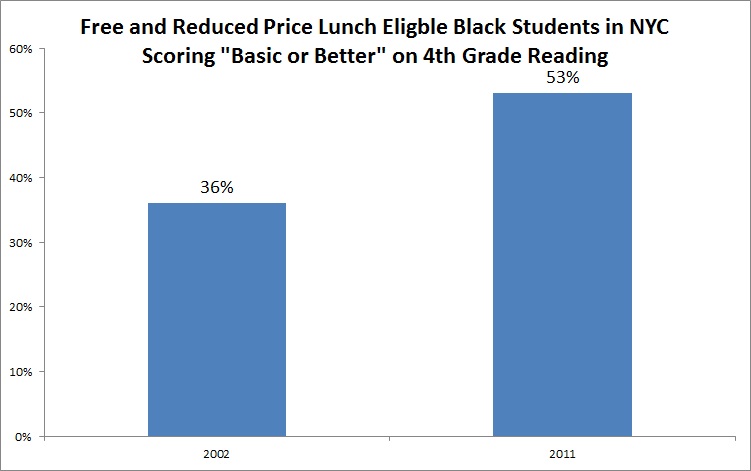
The NYT story deals with perceived difficulties in school grading. So A-F school grades and parental choice: sounds familiar. How has this been working out for NYC’s low-income Black students? Some day reporters will learn to use the NAEP Data Explorer and use actual evidence to sort through contending clouds of anecdotal fog, but in the meantime I can help out:

Did the Klein reforms cure all of the education problems of Harlem? Certainly not. They strangely also failed to cure cancer, restore sight to the blind nor did they erase the painful memories of having shelled out money to see Indiana Jones and the Kingdom of the Crystal Skulls.

They have however seen hard fought gains for disadvantaged students. Rather than wringing their hands, the New York Times should be calling for the logical next steps in reform.