Beware of Mis-NAEPery but also NAEPilism

April 3, 2018

(Guest Post by Matthew Ladner)

The 2017 NAEP will be released next week, and a few notes seem in order. Over time, the term “mis-NAEPery” has slowly morphed into a catchall phrase to mean “I don’t like your conclusions.” Mis-NAEPery however has an actual meaning- or at least it should- which ought to be something along the lines of “confidently attributing NAEP trends to a particular policy.”

Arne Duncan for instance took to the pages of the Washington Post recently in order to lay claim to all positive NAEP trends since 1990 to his own tribe of reformer (center left):

Lately, a lot of people in Washington are saying that education reform hasn’t worked very well. Don’t believe it.

Since 1971, fourth-grade reading and math scores are up 13 points and 25 points, respectively. Eighth-grade reading and math scores are up eight points and 19 points, respectively. Every 10 points equates to about a year of learning, and much of the gains have been driven by students of color.

Duncan then proceeds to dismiss the possibility that student demographics had anything to do with this improvement, as the American student body has grown “It should be noted that the student population is relatively poorer and considerably more diverse than in 1971.” This is a contention however deserving dispute, given that the inflation adjusted (in constant 2011 dollars) income of the poorest fifth of Americans almost doubled between 1964 and 2011 once various transfers (food stamps, EITC etc.) have been taken into account. Any number of other things could also explain the positive trend, both policy and non-policy related, but never mind any of that, Mr. Duncan lays claim to all that is positive.

Duncan was not finished yet, however, as he was at pains to triangulate himself away from those nasty people who support more choice than just charter schools:

Some have taken the original idea of school choice — as laboratories of innovation that would help all schools improve — and used it to defund education, weaken unions and allow public dollars to fund private schools without accountability.

Well that sounds a bit like how a committed leftist would (unfairly) describe my pleasant patch of cactus. Arizona NAEP scores, could you please stand to acknowledge the cheers of the audience:
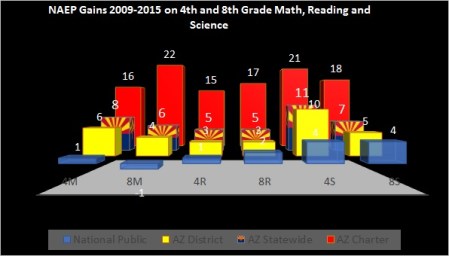
So the big problem in that chart are the blue columns. These charts stretch from the advent of the Obama years until the (until Tuesday) most recently available data. We won’t be getting new science data this year, so ignore the last two blue columns on the right. What we are looking at is changes in scores of 1 point in 4th grade math, -1 point in 8th grade math, 1 point in 4th grade reading and two points in 8th grade reading. There’s only one state that made statistically significant academic gains on all six NAEP tests during the Obama era, but it just so happens to be one of the ones adopting the policies uncharitably characterized by Duncan’s effort at triangulation.

There were some very large initiatives during these years- Common Core standards, teacher evaluation, etc. and we can’t be sure why the national numbers have been so flat, but let’s just say that a net gain of three scale points across four 500 scale point tests fails to make much of an impression. Supporters of the Common Core project for instance performed a bit of a Jedi mind trick around the 2015 NAEP by noting that scores were also meh in states that chose not to adopt, and that 2015 was early yet. Fair enough on the early bit, but the promise of an enormous investment of political capital in the project was not that adopting states would be equally meh, but rather that things would get better.

Where’s the BETTER?!?

Duncan’s misNAEPery however is of the garden variety- there has been far worse. Massachusetts for instance instituted a multi-faceted suite of policy reforms in 1993, and their NAEP scores increased from a bit better than nearby New Hampshire to two bits better than New Hampshire and tops in the country. So far as I can tell, there was approximately zero effort to establish micro-level evidence on any of the multiple reform efforts, or to disentangle to the extent policies were having a positive impact, which policies were doing what. That would be silly- everyone knows that standards and testing propelled MA to the top NAEP scores, and once everyone else does it we will surge towards education Nirvana Canadian PISA scores. Well, I refer the honourable gentleman to tiny blue columns in the chart I referenced some moments ago.

This is not to say that I am confident that testing and standards had nothing to do with MA’s high NAEP scores. I’m inclined to think they probably did, but some actual evidence would be nice before imposing this strategy on everyone. In Campbell and Stanley terms “Great Caesar’s Ghost! Look at those Massachusetts NAEP scores!” lacks evidence of both internal and external validity. In other words, we don’t know what caused MA NAEP scores, nor do we know who if anyone else might be able to pull it off, assuming policy had something to do with it.

So beware of mis-NAEPery my son- the jaws that bite, the claws that catch!  Also beware of NAEP nihilism. Taking off my social science cap, I will note that NAEP is an enormous and highly respected project and it is done expressly for the purpose of making comparisons. Yes we should exercise a high level of caution in so doing, and should check any preliminary conclusions reached against other sources of available evidence. The world is a complicated place with an almost infinite number of factors pushing achievement up or down at any point. There is a great deal of noise, and finding the signal is difficult. NAEP alone cannot establish a signal.

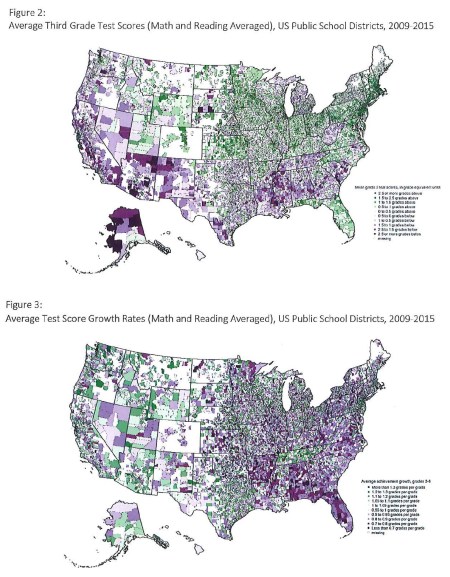
The fact that the premature conclusions drawn from the Massachusetts experience lacked evidence of internal and external validity did not mean that those conclusions were wrong but it did make them dangerous. Alas the world does not operate in a random assignment study. Policymakers must make decisions based upon the evidence at hand, NAEP and (hopefully) better than NAEP. The figure at the top of this post makes use of NAEP and there is a whole lot of top map green (early goodness) turning into bottom map purple (later badness) going on. This is a bad look assuming part of what you want out of your support of K-12 education is kids learning about math and reading in elementary and middle school. Let’s be careful, but let’s also see what happens next.


John Wiley Bryant for the Higgy

April 2, 2018

Image result for John Wiley Bryant

(Guest Post by Matthew Ladner)

As a Gen-Xer, some of my fondest memories of childhood involved waking up on Saturday mornings, pouring myself a breakfast of chocolate frosted sugar bombs into a bowl, and then watching a few hours of Saturday morning cartoons. The Warner Brothers were my personal favorites and you can learn a lot by watching these cartoons. I still recognize pieces of classical music that I associate with these cartoons for instance. If you paid attention, Bugs Bunny was actually an outstanding role model: never initiating a conflict, but always finishing them. Wile E. Coyote Supra-Genius has made more than a few appearances here on the JPGB as a symbol of technocratic overreach in K-12. In fact, there is no doubt that education reform would have profited by more viewing of Road Runner cartoons to instruct on the possibilities of unintended consequences to complicated policy efforts:

Alas the institution of Saturday Morning Cartoons itself bit the dust due to social engineering from the federal government. In 1990, our august group of Olympians in Congress took time out of their busy schedules to pass something called the Children’s Television Act. The Children’s Television Act, sponsored by Texas Congressman John W. Bryant, required networks to provide three hours per week of “educational” programming to “meet the needs” of children age 16 and younger.

What unfolded was a slow process of the FCC bureaucrats fumbling over what constitutes “educational” programming, and the steady squeezing out of Saturday morning cartoons. The last minor network holdout gave up the ghost on Saturday morning cartoons in 2014, but the institution had effectively died long ago.

The three Ladner children never once in their lives got up to have breakfast (something at least a bit more nutritionally sound than chocolate frosted sugar bombs btw) and shuffled to the television to watch federally mandated “educational” programming. The federal government is mandating this programming, but I seriously doubt much of anyone is watching it. Meanwhile, an important American cultural institution has been destroyed. Make a reference to “Spear and Magic Helmet” or “Cook-Where’s my Hessenheffer?!?” to younger people and are likely to look at you puzzled.

For pointlessly ruining a revered American cultural practice in pursuit of bossing people around for “their own good” I nominate former Congressman John W. Bryant for the Higgy Inhumanitarian Award. If President Trump wants to “make America great again” he should repeal the Children’s Television Act. Where have you gone Duck Dodgers in the 24th and a half Century?  Our nation turns its’ lonely eyes to you. The Children’s Television Act of 1990 is definitely obstructing my view of Venus.


The NCLB Era in One Handy Chart

March 21, 2018

(Guest Post by Matthew Ladner)

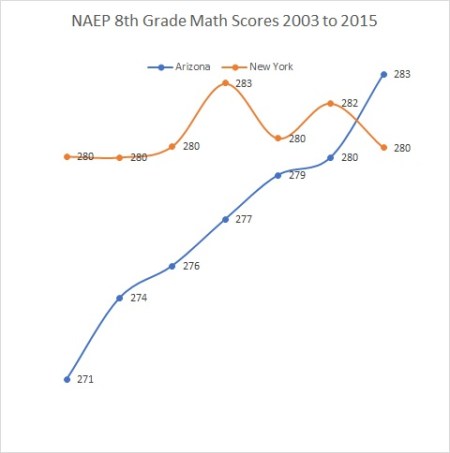
Unfortunately a large majority of the nation’s K-12 students are in the tight cluster of meh and sub-meh in the stagnation cluster. Judged by 8th grade math and reading gains 2003 to 2015, Arizona, Hawaii and Tennessee are having the best improvement. New York is still alright if you like saxaphones academic stagnation.

The 2017 NAEP will be released on April 10. Anyone else believe in any of these blue dots enough to dare a prediction?


Hitt, McShane and Wolf Meta-Analysis leads to a call for humility

March 19, 2018

(Guest Post by Matthew Ladner)

My favorite quote from Hitt, McShane and Wolf’s new study:

Even with these caveats in mind, the policy implications from this analysis are clear. The most obvious implication is that policymakers need to be much more humble in what they believe that test scores tell them about the performance of schools of choice. Test scores
are not giving us the whole picture. Insofar as test scores are used to make determinations in “portfolio” governance structures or are used to close (or expand) schools, policymakers might be making errors. This is not to say that test scores should be wholly discarded.
Rather, test scores should be put in context and should not automatically occupy a privileged place over parental demand and satisfaction as short-term measures of school choice success or failure.

P.S. Letting parents take the lead on which schools expand and/or close can work out fine on the types of tests schools have almost no ability/incentive to game:

The implications of this meta-analysis of the research literature could stretch far beyond the choice sector in time. If test scores continue to show a weak and inconsistent relationship with long-term outcomes, broad rethinking will be required. Let’s see what happens next.


Arizona Teacher Pay Frustration is Genuine but Misdirected

March 15, 2018

(Guest Post by Matthew Ladner)

A 7-year veteran teacher teaching in Arizona’s Paradise Valley Unified School District has created a social media firestorm by posting her pay stub on social media- $35,621. Before writing anything else, I like anyone else want to pay dedicated teachers much better than this. Teacher compensation decisions however are made at the district/campus level, and an examination of PVUSD finances just makes things look worse. Much worse.

The Arizona Auditor General reports on district finances. Paradise Valley received total revenue of $10,143 per pupil in 2017. This figure is above the state-wide average.  A class of 30 students produces over $300,000 in revenue. Even with benefit costs included, teacher compensation will not even sniff 20% of the revenue generated by this class of 30. Where did the rest of the money go?

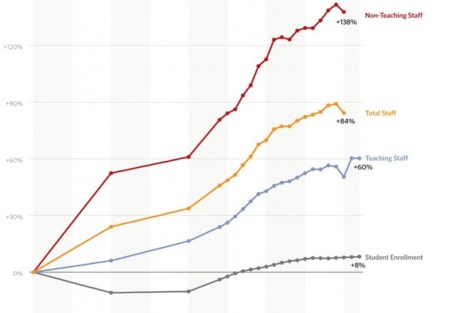
This chart from the Heritage Foundation tracks national data, and provides a big part of the answer- American schools have seen a vast increase in the hiring of non-teachers. This is not to say that any school can ever do without non-teachers, but at one point we had 2 teachers for every non-teacher in American schools. These days it looks more like 1 to 1. Despite a substantial increase in inflation adjusted spending per pupil since the 2-1 days, the large increase in non-teaching staff places a limit on teacher salaries.

Ms. Milich works for a district that receives over $10,000 per pupil in revenue. That district has both an elected school board and a chapter of the Arizona Education Association that is very active in the politics of the district. A teacher with seven years under her belt getting paid $35,000 does not suggest that either the district or the association has been placing a priority on teacher compensation.

Impossible? Just take another look at the chart. American schools have spent decades placing a priority on increasing school district employment, with a much stronger focus on non-teachers. What we refer to as “teacher unions” are actually “school district employee unions” and just as a quick mental exercise close your eyes and ask yourself: do you think the chart above would look that way if the NEA and AFT opposed these trends? What if they had been supporting them for decades?

Ok open your eyes now. Get it? Good.

This teacher has every right to feel frustrated. I hope the district decides to compensate her in a fashion commensurate with her contribution to her school. I strongly suspect that contribution is far greater than a low double digit percentage of the revenue her class generates.

Yes state spending and taxing decisions also play into this- but we should never forget that Arizona is not a wealthy state, has an unusually small working age population, and decides on school funding levels through direct and indirect democracy. In 2012 statewide voters declined to raise taxes for schools in Prop. 204 by a very wide margin. A few years ago voters (very narrowly) chose to increase school funding by increasing the payout rate from state land trust.

The lopsided loss in Prop. 204 and the narrow margin on the Prop. 123 vote both relate to a deep skepticism on the part of the public that increased funding will reach teachers like this one. This skeptical attitude is entirely justified. For instance, between fiscal year 2016 and 2017 per pupil revenue increased in PVUSD by $664 per pupil (from $9,497 to $10,143) and this teacher received a raise of $131.25 and this was after completing professional development.

Arizona voters decide school funding democratically, and they will have the opportunity to increase funding again in the future. Under the current district setup, the bucket looks to have multiple large leaks if the aim is to increase teacher compensation. Some of my tribe on the center right here in Arizona tends to think that these spontaneous teacher protest movements are secretly the work of the Arizona Education Association. I don’t believe this is the case. Although much of this frustration is misdirected at choice programs, things like this social media paystub are indicators of genuinely felt grievances.

It would be a huge mistake however to continue avoiding questions about district priorities.


Old Dog Learns New Trick

March 7, 2018

(Guest Post by Matthew Ladner)

Ok so there is this thing inside Microsoft Excel called a “macro” and today I had Dr. Youtube teach me how to do it so I can make data labels without manually typing them in. Next step- learn how to set a VCR DVR to record!


Arizona Kids Winning in the District Competition for Enrollment

March 6, 2018

(Guest Post by Matthew Ladner)

Looking through the Arizona Auditor General report on Arizona school districts, I noticed interesting variation in enrollment trends. Arizona has been the second fastest growing state for decades, and Maricopa County has become the fastest growing county in the nation. Nevertheless, many school districts show steady enrollment trends, and some even declining enrollment. Of course there are others where enrollment is growing like mad, like Chandler (a Phoenix area suburb):

A relatively small percentage of districts are taking the lead on absorbing enrollment growth statewide, along with the charter sector. The enrollment surge in Chandler seems to be working out academically: more kids and more kids performing at a high level:

Other suburban districts have not fared as well in the competition for enrollment such as Scottsdale Unified:

This decrease in enrollment is despite of 4,000 open enrollment kids who have transferred into Scottsdale Unified. According to a district demographic study 9,000 families have paid the real estate premium to live in Scottsdale Unified boundaries but choose to send their children to school elsewhere (mostly charter schools). Scottsdale Unified has had a string of recent scandals, with the Superintendent placed on administrative leave, but we should not let this distract us from improving academic trends in Scottsdale Unified:

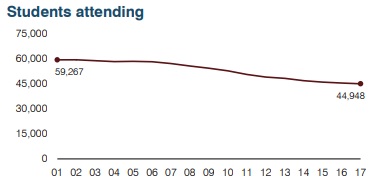
We can see similar trends in southern Arizona. Tucson Unified also has a declining enrollment trend:

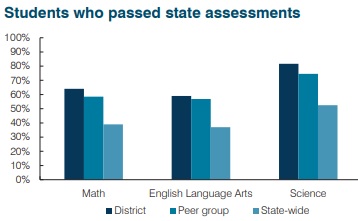
The academic results in Tucson Unified could look better compared to peer districts (middle columns) or statewide averages (right columns):

Vail Unified is one of the Tucson area surrounding districts taking in a number of open enrollment students. Accommodating growth rather than coping with enrollment decline has been the issue in Vail:

Vail getting additional students seems to be working out academically for many students as well, with proficiency rates substantially higher than in TUSD:

Recently we learned that open-enrollment students outnumber charter students approximately 2-1 in Maricopa County. Choice in Arizona is not being done to districts, but rather by districts. Note as well that rather than a zero sum game, there are positive academic trends in Arizona districts including both districts with declining and increasing enrollment. In this competition, the kids are the winners!


The Abyss Gazes into TFA…

March 5, 2018

(Guest Post by Matthew Ladner)

Max Eden provides a helpful summary of the various scandals plaguing the District of Columbia Public School system. After three Teach for America alumni chancellors we find the district scandal-ridden and clinging to a vastly overrated NAEP record as a life preserver. Upon close examination however that life preserver looks more like an anvil than a life-vest:

The best proxy for disadvantage is parental education. The achievement of students whose parents had high school diplomas but no postsecondary education decreased by three points in math and one point in reading. That puts DCPS two points below Detroit Public Schools in reading and one point above in math. But at least Detroit improved by two points in reading and 10 points in math.

Although there’s apparently little difference between DCPS and Detroit for disadvantaged students, there should be for “evidence-based” policy experts. Given that DCPS’s spending is about twice that of Detroit, DCPS appears to be one of the worst school districts in the country for serving disadvantaged students.

The two bright spots for DC K-12 are as follows: in the choice sector for disadvantaged students and in select pockets of excellence in the District. Momma always said that DCPS would be good at something- who knew that it would be educating highly advantaged kids?

Take a good long look at the above chart. DCPS 8th grade Black students are had nowhere even close to the level mathematics achievement that DCPS White students had as 4th graders (272 for 4th grade White students in 2011 compared to 248 for 8th grade Black students in 2015).

Perhaps some of our friends who remain committed to the DCPS teacher evaluation system could grace the comment section to explain why Black students in DCPS only progressed 36 points (very meh) on NAEP math between 2011 and 2015. DCPS Black students made 38 points of math progress between 2003 and 2007, which isn’t meaningfully different- oh brave new world!

The question isn’t whether the DCPS teacher evaluation system is a magic bullet- it isn’t. Given these numbers I’m wondering if the teacher evaluation system constitutes a bullet at all. Not only did DCPS achievement remain stalled in DCPS, it actually slowed in DC charter schools. Between 2003 and 2007 Black students in DC charter schools displayed a cohort NAEP gains of 54 points, but only 46 between 2011 and 2015. I’ll put it on my to-do list to look at these numbers again when the 2013-2017 cohort gains become available.

For now, teacher evaluation looks more like a pea that got stuck in someone’s straw than a magic bullet imo. In any case, DCPS provides a cautionary tale of those holding a torch for better living through proper management. Chubb and Moe called this almost three decades ago: the fundamental problem with American K-12 is politics and the sad conclusion to draw from the DCPS experience is that the ability of school district politics to corrupt the TFA alumni network >>> than the network’s ability to redeem school district politics. Would that it were otherwise, but this conclusion is as unavoidable as it is disappointing.

Where to go from here? Eden lays out a compelling case:

DCPS is no longer a case study for education reformers, but for teachers unions. Union leaders can look at what weakened job protections and metric-chasing mandates have wrought and say, “I told you so.”

So, what should come next? Admitting a problem is the first step toward fixing it. A movement that talks incessantly about “accountability” ought to practice it within its own ranks. To maintain basic credibility, reformers must admit failure and ostracize, rather than celebrate, those responsible.


Somebody Stop Me-2017 NAEP predictions

March 2, 2018

Mamma Mia- Here we go again!

(Guest Post by Matthew Ladner)

NAEP has announced that it will release new math and reading results on April 10. I am going to do something truly foolish and dare to make a few predictions.

Making predictions is foolish because the reality is that our understanding of NAEP trends is imperfect at best. In any case, I have a theory about what has been driving NAEP gains here in the Cactus Patch, and I’m willing to make a few calls in advance on the 2017 NAEP based upon that theory.

Prediction 1: Arizona continues to improve.

Arizona’s improvement process is multi-faceted but the elephant in the room in my book is a hyper-active open enrollment market, the nation’s largest and most geographically inclusive charter sector and private choice programs. Arizona lead the nation in academic gains even during a period in which it had the largest cuts in spending due to the Great Recession. If we can do this during a period of funding cuts, we ought to manage it during a period of funding recovery given the broad consistency of policy. Note however that the state’s A-F letter grades has been turned off during the entirety of the 2015 to 2017 period, the demographics of students have continued to move further into majority-minority status, etc. Put me down for Arizona improving anyway based on the AZMerit improving in both 2016 and then again in 2017.

Prediction 2: North Carolina climbs.

Recent NAEP trends have not been great in NC. Notice in the Reardon tables that North Carolina starts with a (good) greenish tint on the top map-showing good early scores-but turns purple on the second map (bad) on cohort NAEP gains during the 2011 to 2015 period.

I suspect North Carolina will do better in 2017 based upon the information in this news report- basically that while statewide enrollment is growing, school district enrollment has been relatively flat due to the growth of choice options. North Carolina lifted a statewide cap on charter schools in 2011, created voucher programs for low-income and special needs children. I’m not sure whether they’ve done enough to start the open-enrollment virtuous cycle, but I think they may have done enough to shake things up a bit.

Third prediction: Indiana improves.

Give Indy a good stare in the Reardon chart, and it looks a bit like the green/purple undesirable combo between the two maps. It looks to me though like the districts are getting into the choice act (until 2007 you had to pay tuition in order to attend an out of zone school) and so I’m willing to buy some Hoosier stock.

Anyone else willing to dare a prediction should spell out their theory/evidence in the comment section.


The Rise of Indiana Open Enrollment

February 26, 2018

(Guest Post by Matthew Ladner)

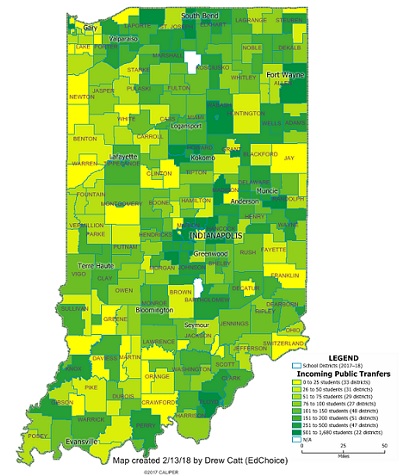
Ed Choice’s Drew Catt created this open enrollment map of Indiana. For those squinting at their iPhones, bright yellow signifies a district taking in 0-25 open enrollment students, while dark green denotes a district bringing in 501 to 1,680 open enrollment students.

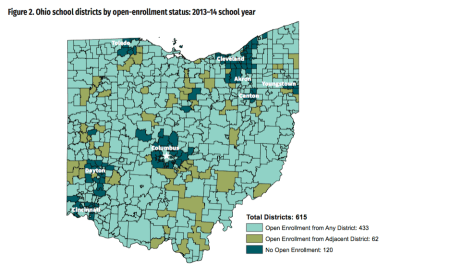
So let’s contrast this with the Fordham Ohio open enrollment map:

The Fordham map denotes participation/non-participation by districts in open enrollment. Suburban non-participation jumps off the page of the Fordham map, so let’s contrast Indianapolis with Columbus. The Indiana map has a lot of green around Indianapolis, signifying open-enrollment participation by the suburbs.

Now let’s compare Indiana to the open enrollment data available from Arizona.

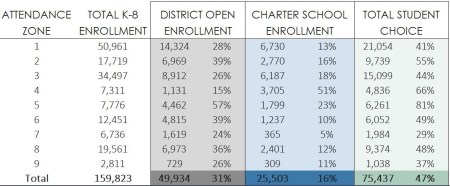
Much larger numbers in these Arizona districts, but also a broader definition of open-enrollment being utilized for the Arizona data that includes students transferring within district boundaries. Nevertheless, we know from a separate source that Scottsdale Unified has 4,000 students from outside of district boundaries, which is more than twice the number of any of the Indiana districts in the Ed Choice map.

So here is my provisional take, subject to your challenge in the comments: Indiana’s combined choice programs have coaxed the state out of the Ohio-like geographic segregation. Private choice program design may have contributed to this- Ohio’s voucher programs focus almost exclusively on urban students, while Indiana’s are more inclusive. Indiana has had the nation’s fastest growing voucher program in recent years. Although means-tested, Indiana’s private choice programs create empty seats in suburban districts more than is the case in the Ohio programs, which reach only suburban special education students.

The open enrollment boulder has been rolling down hill for a longer period of time in Arizona. Open-enrollment students outnumber charter students 2-1, and charter students outnumber private choice participants by 3-1. In other words, in Arizona school choice is being done primarily by school districts themselves. This of course did not happen exclusively through a process of spontaneous enlightenment whereby Arizona school districts threw down the drawbridge over the moat to welcome in thousands of out of district transfers out of the goodness of their hearts. Rather it was the product of incentives- hundreds of charter schools opening in suburbs and towns and a couple of decades of geographically inclusive private choice programs.

Charters and private choice do not deserve all the credit, as some suburban districts relatively unaffected nevertheless chose to participate in open enrollment. Chandler Unified for instance watched their enrollment grow by a third despite a large increase in charter schools and has been rocking academic growth to boot. I’m told that there is not a non-district charter in the Vail Unified district south of Tucson, but there are a many students from Tucson Unified. I doubt they are sweating choice much, but they have nevertheless chosen to participate, and Arizona’s students are the richer for it. Nevertheless, it seems self-evident that a main reason that Scottsdale Unified took in 4,000 students is due to the 9,000 students that live in the district boundaries and do not attend school in the district.

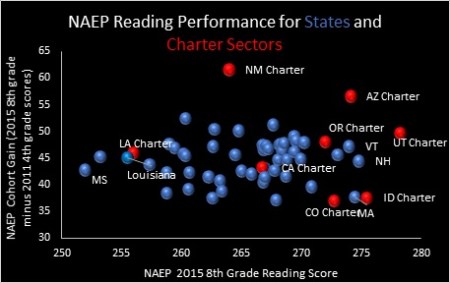
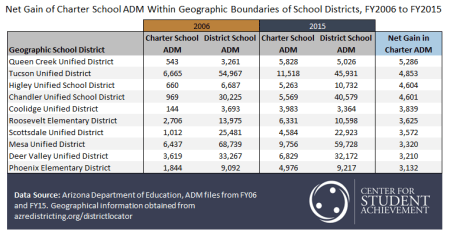
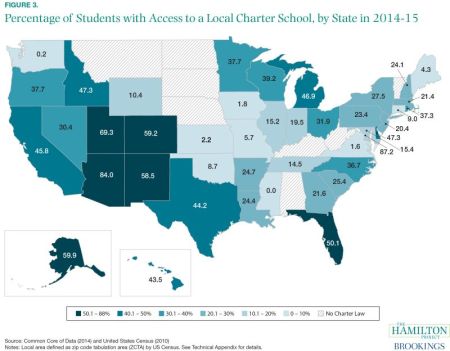
It may be no accident that the state with the highest access has also been leading in NAEP gains…

The defection of early open-enrollment adopters increases the pressure on other districts to participate, creating a virtuous cycle. I’m thrilled to see evidence of this in Indiana. The School Choice 1.0 failed urban students insomuch as it failed to unlock the suburbs. It’s time for the movement to embrace an inclusive “Social Justice Plus” strategy that aims to give urban students access to private, charter and suburban schools.