Make Sure Not to Be Born in Michigan when Poor and Black

November 1, 2011

(Guest Post by Matthew Ladner)

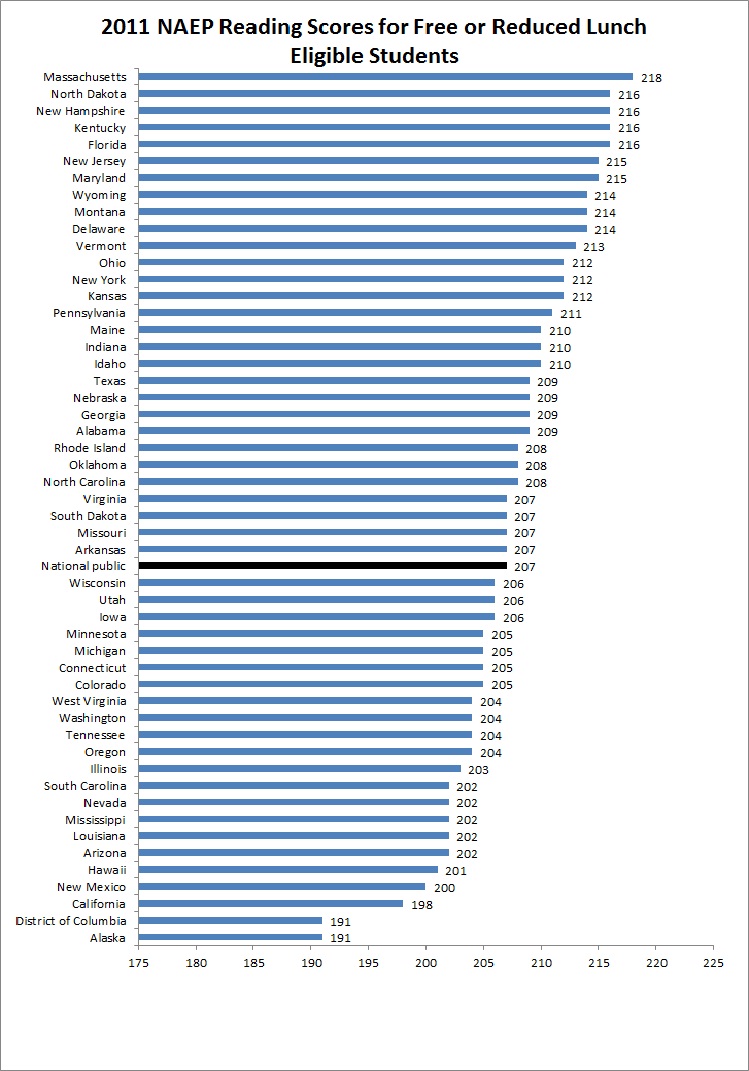
If you want to learn how to read anyway, you need to stay away from Michigan, that is to say Detroit, if you are concerned about being born a poor Black child in the next life. The 2011 NAEP says to stay away from Iowa, Maine and DC for good measure.

On the other end of the scale: MA, NJ, DE, MD and FL are looking relatively good. Low-income Black children in Massachusetts reads a mere 2.5 grade levels ahead of their peers in Michigan on a 4th grade test.

Must run to the airport now. More later…


The 2011 NAEP Guide Where Not to be Reincarnated as a Poor Child

November 1, 2011

(Guest Post by Matthew Ladner)

The chart on the right presents scores for Free and Reduced Lunch Eligible students on the 2011 NAEP 4th grade reading test. Memo to self: remember not to come back as a poor kid in Alaska or DC in the next life. Ten points roughly equals a grade level worth of progress. Low-income kids in Alaska and DC are reading almost as poorly as 1st graders in Massachusetts, which is to say, not much all.

Florida hit a wall in terms of improvement (more on that later), DC saw nice math gains but not much progress in reading, Arizona finally started to move the needle a bit, and it is not entirely isolated to Hispanic children.

The 2009-2011 scores are pretty “meh” so far, and this biggest story I am finding is something big and positive going on with Maryland’s reading scores: 8 point gain for FRL kids between 2009 and 2011, and a nothing to sneeze at five point gain among middle and high income students.

More to come…


Liberal Goons Disrupt Common Core Presentation

October 29, 2011

(Guest Post by Matthew Ladner)

Jay, Rick Hess and others have been critical of the Common Core effort for running a “stealth campaign.” Here in the following youtube video however, you will see Common Core proponents come out to make a public presentation, only to be shouted down by a bunch of left wing yay-hoos.

Apparently the irony of inviting officials to a “real conversation about education” when they have just shouted one down doesn’t sink in to the tiny little brains of these people. Ditto for shouting “Shame! Shame!” as the panel takes the only sensible action and leaves.

Sadly a growing portion of the left seems to espouse free speech right up to the point when someone says something with which they disagree.


Steve Wynn for Al Copeland Humanitarian Award

October 28, 2011

"Stay Thirsty My Friends..."

(Guest Post by Matthew Ladner)

Last year, Jay nominated the Most Interesting Man in the World for the Al, arguing that he represented an appealing avatar for the manly good life.

Often on the blog, I have used the image of Leonardo di Caprio’s portrayal of Howard Hughes in the Aviator as a tribute to the restless innovator overcoming challenges.

Today it is my pleasure to nominate a real person who embodies qualities of both of these fictional characters: Steve Wynn.

WSJ reporter Christina Brinkley wrote a fascinating book about the battle to control the Las Vegas Strip called Winner Takes All: Steve Wynn, Kirk Kerkorian, Gary Loveman and the Race to Own Las Vegas. There were many interesting things about this book, but Steve Wynn without a doubt steals the show.

Steve Wynn essentially created the modern Las Vegas, transforming the city from a seedy, neon lit gambling hole to what it is today. I’ll let you decide for yourself what it is today, because the seedy neon lit gambling hold is certainly still there.

Ick...

I can remember watching the U2 video I Still Haven’t Found What I’m Looking For, filmed on Fremont Street back in the late 1980s and thinking to myself “Vegas is repulsive. I have absolutely no interest in ever going there.”

Some of you reading this will have exactly the same reaction to Vegas today, but mine has entirely changed, and it is because of Steve Wynn. Steve Wynn invented the Las Vegas that I enjoy visiting.

Steve Wynn invented the modern Las Vegas in the late 1980s when he built the Mirage, the first of the modern casinos, on the strip. Wynn’s vision for updating Vegas was straightforward: he was out to build destination resorts so interesting that people would want to visit even if they weren’t interested in gambling.

Today, the Mirage has fallen into meh status (a volcano? Snore….) but that is a tribute more to the fantastic cycle of one-up manship that the success of the Mirage inspired.  Wynn imagined a Las Vegas that would appeal to far more than gambling junkies, paving the way for a hyper-competitive market in every type of distraction, from fine dining to elaborate stage productions, fine art to high-end nightclubs.

In other words, the tacky Vegas is still available, but now, so is everything else.

Winner Takes All paints a fascinating portrait of Steve Wynn as the ruthless capitalist moving Vegas forward. Others had tried to top Wynn in developing new resorts, but for the most part, Wynn was in a competition against himself. In building the Bellagio, a resort which would make Louis XIV green with envy, someone asked Mr. Wynn what he had in mind for decoration behind the check in counter. When someone suggested a piece of fine art, Wynn liked the idea so much that at one point he had multiple auctioneers in New York and London buying everything in sight. When you read winner takes all, you can imagine the London and New York auctioneers wondering to themselves Egads, who is this person in Las Vegas buying all of our art?”

Today, you can visit Mr. Wynn’s gigantic Picasso collection in a restraunt in the Bellagio known, appropriately enough, as Picasso’s, which combines fine dining with a museum of art experience. I highly recommend it.

Winner Takes All details the rise and fall of Steve Wynn. In building the Bellagio, vacuuming up fine art, and other projects (including the Beau Rivage, a “baby Bellagio” in Biloxi Mississippi- a market faux pas) Binkley presents Wynn as the capitalist gone mad. Wall Street analysts began calling Wynn out on his extravagent spending. Wynn’s reaction as conveyed by Binkley is priceless, something along the lines of “These idiots and their quarterly profit statements! Don’t they get it? I’m an artist!”

Wynn went so far off the financial deep end that his rival Kerkorian, developer of the MGM, wrote a check and bought Wynn’s company straight out from under him. I’m trying to imagine anyone having the ability to write a check with enough zeros in it to purchase the Bellagio and various lesser properties, but it certainly says something about the depths to which Wynn had driven his stock price. The transformative mastermind of the modern Las Vegas was finished, a victim to his own obsession.

Well, that wouldn’t do for an ending, now would it?

Despite losing it all, Wynn found new investors willing to back his vision of excellence. Wynn secured $2.7 billion to build the Wynn hotel, buying an old property for a relative song, and topping himself yet again with a fantastic new resort. Today Vegas is down like everything, but don’t count Steve Wynn out. Personally I can’t wait to see what the mad artist/capitalist comes up with next.


Some Thoughts in Advance of NAEP ’11 Release

October 27, 2011

(Guest Post by Matthew Ladner)

NAEP is going to release the 2011 Reading and Mathematics results on November 1st. I thought it would be interesting to boldly make some predictions in advance. Here’s my first one: the 2011 results won’t be all that different from the 2009 results.

I know, I’m going waaaaay out on a limb here, but that’s my prediction and I am sticking to it.

While a number of states have engaged in far-reaching reforms, the vast majority of these efforts still lie in the implementation stage. Possible exceptions in my mind include Washington D.C., Louisiana and Florida.

For DC, the 2011 NAEP will constitute the first plausible check on the tenure of Michelle Rhee. DCPS began making substantial math and reading progress in the mid 1990s, with huge gains but with scores still low. Assuming normal lags between changes and impacts, I believe that the 2009 NAEP arrived a bit early. I’ll be very interested to see what happens with the 2011 scores. Washington DC is also experiencing gentrification, so I will look at the free and reduced lunch numbers.

Louisiana will be a very interesting case, as some important statewide reforms still remain in the implementation phase, but where New Orleans has been in serious reform mode since 2005. I’ll take a look at the trend in urban numbers.

Florida of course enjoyed a steady increase in NAEP scores since 1998. Florida lawmakers also instituted a fresh set of far-reaching reforms in 2011, but the verdict on those will come years down the road. Governor Crist failed to pursue far-reaching reforms of his own, and vetoed some of those that reached his desk. Florida’s scores may rise again, but I won’t be surprised if they hit a plateau.

The Great Recession may also make this NAEP a little less incremental that usual. It will be interesting to see what happens to scores in the “Sand States” with the greatest property crashes (Arizona, California, Florida and Nevada) in addition to other states with acute economic distress like Michigan.

I will look with some interest at Arizona’s scores. Not only is the state face down on the economic canvass, with house building and flipping having been signature industries before the pop, it is possible that the infamous SB 1070 may lead to the illusion of progress in Hispanic scores. To the extent that the already partially overturned SB 1070 convinced undocumented families to leave Arizona, it may create the appearance of academic improvement.

Outside of that, I’ll be looking for pleasant surprises. Tell me what you are interested in seeing from the 2011 NAEP in the comments.


In Defense of “Achievement Gap Mania”

October 19, 2011

(Guest Post by Matthew Ladner)

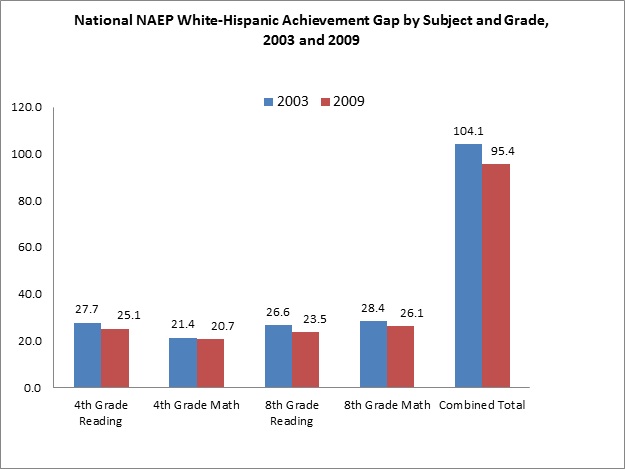
So the early appearance of the 2011 NAEP has given me reason to update a project, leaving me with some interesting charts to burn off. The above chart measures the national White-Black achievement gap for all four of the main NAEP exams for the 2003-2009 period. Mind you, that on these exams, 10 points is approximately equal to a year worth of average academic progress. These are White scores minus Black scores, with the 2003 gaps in Blue and the 2009 gaps in Red.

In Jay’s post below, you can watch a Fordham discussion that includes debate over whether we have fallen into the grip of “achievement gap mania.” If so, we have precious little to show for it. We did have some narrowing of the achievement gap between 2003 and 2009, but at two and a half plus grade level gaps in all four subjects. Start your low-calorie, carrot juice diet and mark your calendar for 2075 or so, assuming that we can maintain today’s glacial pace of closing.

The news is approximately as dismal on the White-Hispanic front:

While I do sympathize with the argument that we need to get everyone to understand their stake in education reform, I must say that there is a reason why people are passionate about achievement gaps. The term “disgraceful” does not begin to describe the catastrophic failure represented in the charts above. Black and Hispanic children score little better than what the average 1st to 2nd grade Anglo student would score on a 4th grade reading test. It’s only the developmentally critical literacy acquisition window after all.

The focus on the achievement gap is important because it cuts to the heart of American ideals. We believe in equality of opportunity. We believe in meritocracy. We believe in class mobility and self-determination. Call it the triumph of hope over experience if you wish, but we believe that public education can help achieve all of this and we refuse to give up on the notion.

The terrible truth of course is that our public education system is pervasively classist to an extent that goes far deeper than the naive equity funding attorneys ever seemed to grasp. If we auctioned the limited supply of high quality public school seats on Ebay rather than covertly through mortgages, perhaps all of this would more transparent. If we could tag our highly effective instructors, we could watch a time-lapse film of them fleeing dysfunctional school systems for the leafy suburbs and/or leaving the profession entirely. Increased resources could in theory ameliorate these problems, but strangely enough they didn’t.

Why? Paul Hill said it best:

Money is used so loosely in public education—in ways that few understand and that lack plausible connections to student learning—that no one can
say how much money, if used optimally, would be enough. Accounting systems make it impossible to track how much is spent on a particular
child or school, and hide the costs of programs and teacher contracts.  Districts can’t choose the most cost-effective programs because they
lack evidence on costs and results. 

The sad thing is, some are so desperate to maintain the above paragraph that they are willing to ignore the consequences, including the two charts above. They comfort themselves with excuses. Blah blah poverty yadda yadda video games. Whatever. I’m not saying that achievement gaps are the sole responsibility of schools, or that we will live to see them completely closed. I agree with Rick Hess that there are serious shortcomings to a reform strategy solely based on gaps.

We can however do a hell of alot better than this. We focus on achievement gaps not because it is expedient, but because it is necessary.


Buckle Up…2011 NAEP release on Nov. 1st

October 18, 2011

(Guest Post by Matthew Ladner)

NAEP is releasing 4th and 8th Grade Reading and Math results for 2011 on November 1st.

I’ll comb through the data and post the results here.


Bob Bowdon Interviews National Summit Protestor

October 15, 2011

(Guest Post by Matthew Ladner)

Just returned from the National Summit in SF, where I saw a number of friends and made some new ones. We received some “protestors” this year. Bob Bowdon interviewed one of the protestors, and sometimes it is best to just sit back and let your opponent talk all they want.

CIA, the United Nations, movie star oppression and Harry Potter. What will these guys come up with next?


Heritage Foundation on Education Savings Accounts

October 5, 2011

(Guest Post by Matthew Ladner)

The Heritage Foundation has published a new web memo on Education Savings Accounts as a vehicle for parental choice. At this point, Arizona has passed an ESA program for special needs students, a proposal is under consideration in Ohio, Florida lawmakers considered a provision last year, and Utah has a whopper of a proposal on the way.

I had the opportunity to speak to Utah legislator John Dougall about his forthcoming proposal.  Rep. Dougall plans to file a bill that would send all education funding into Education Savings Accounts controlled by parents and guardians, but does not intend to make private school tuition a permissable expense for funds in the account. Dougall in essence plans to have a discussion about customized learning rather than a public vs. private school debate.

Being a Longhorn, this of course brings to mind a scene from the master thespian of our era, the great Matthew McConaughey:

McConaughey: Hey man, you got some private school choice in that ESA proposal?
Passenger: No man, not in this proposal.

McConaughey: Well, it would be alot cooler if you did!

Seriously though, Dougall’s proposal is sufficiently mind-blowing that it doesn’t really bother me that he is choosing to leave private schools out of the mix. If ten years from now Utah is funding district and virtual schooling through an ESA system and the private choice options available were going through tax credit and voucher mechanisms, you won’t hear any complaints from me.


Indiana is the new Florida, but Florida is the new FLORIDA

September 29, 2011

(Guest Post by Matthew Ladner)

I have received reports from a reliable source, as yet undocumented, that digital learning courses more than doubled last year, and that in the wake of the new charter school law rewarding excellence, that the state has received over 300 applications for new schools. If there was any doubt left, the choice genie is officially out of the Florida bottle.

Indiana will have to redouble their already impressive efforts.