Expulsion Rates in DC

January 10, 2013

(Guest Post by Matthew Ladner)

The Washington Post has an important story up about expulsion rates in DC district and charter schools.  I can’t figure out how to embed anything but Youtube videos so the link is here.

Go watch it.

I’ll be here when you get back.

Go on…

Ok good. One important item to note: if we were to go and look up the criminal incident reports we would quickly conclude that the expulsion rate in DCPS is far too low.  If I wanted to be cruel, I’d go dig up the crime data. The video specifies that DCPS expelled three students last year, while the charter schools expelled 200.

It seems self-evident to me that 3 was far too low, and it is difficult to know whether 200 is “too many” for the charter sector without a great deal more context.  A district where you have to make the FBI Most Wanted List before getting expelled is not a proper baseline for comparison.

Discuss amongst yourselves…


Talking ESAs on RedefinED

January 8, 2013

(Guest Post by Matthew Ladner)

Over at RedefinED Ron Matus and I discuss ESAs as a new type of school choice program.


Happy New Year

January 2, 2013

(Guest Post by Matthew Ladner)

Ed Week’s Sean Cavanaugh looks back at the school choice world of 2012 and looks ahead to 2013. Well worth a read.


A Modest Proposal on State Standards

December 19, 2012

You can check in any time you like, and you can always leave.

(Guest Post by Matthew Ladner)

A few years ago while serving as a VP at the Goldwater Institute I received a request to come out hard against the adoption of Common Core standards in Arizona. I didn’t know whether it would have mattered or not but the request originated from people who I continue now to hold in a great deal of respect. I considered the matter very carefully.  I had deep misgivings regarding Common Core at the time, the most serious of which was the governance of the standards over time. At the time I was of the opinion that unless Ben Bernanke took up the task of governing the standards that it would inevitably follow that Common Core would eventually result in the Great American Dummy Down.

Nevertheless in the end I decided not to oppose Arizona’s adoption of Common Core standards.  Regardless of how bad Common Core started out or later became, Arizona simply had nothing to lose.  Arizona had just about every testing problem you could imagine- dummied down cut scores, massive teaching to test items, and something at least in the direct vicinity of outright fraud by state officials regarding the state’s testing system. Our state scores had “improved” substantially through a combination of lowered cut scores and teaching to the test items, but NAEP showed Arizona scoring below the national average on every single test and precious little progress. The status quo was worse than a waste of time.

I spent some years repeatedly pointing out this enormous flaws in the Arizona testing system. I was not willing to turn around and wrap myself in the Arizona flag to pretend these tests and standards were somehow sacred because they were developed out here in our humble patch of cactus. Now if I were living in one of the states with high and rising NAEP scores with cut scores near NAEP proficiency, my calculus would have been quite different. I would have died on a hill fighting the adoption of Common Core.

Very few states however qualify for this lofty status. Most state standards and tests qualified as meh or worse than meh. I decided that if I were to draw up a list of the top 10 education problems facing Arizona, that Common Core adoption wouldn’t make the list.

Arizona adopted Common Core as a direct response to the prospect of getting Race to the Top money which we did not ultimately win. Common Core remains however the default, and quite frankly, the main arguments being made against it these days are not compelling enough to make many reasonable people want to reject it. To briefly summarize:

1. The United States Supreme Court Decision on Obamacare fundamentally altered the odds of a “lock in.” A few years ago murmuring in Washington raised the eery prospect of making major federal education spending programs like Title I contingent on Common Core adoption. Not only did this not happen, the Supreme Court enormously complicated the already dim prospect for such a move. My understanding of the Obamacare decision would in fact make it unconstitutional to deny Title I funds to a state choosing not to participate in Common Core.

The Congress could in theory come up with a new funding stream for purposes of bribing/incentivizing state action or could even perhaps pass a tax upon the citizens of states not adopting Common Core a la the individual mandate. Let’s face it though, one can only describe the prospects of either of these things happening as quite dim-somewhere in the vicinity of an extinction inducing asteroid strike in the short to medium term.

States therefore remain free to drop Common Core at their leisure. The dozen or so states having won RTTT money might face some delays in doing so, but Common Core is hardly an issue that any President is likely to call out the National Guard over.  States voluntarily joined (albeit with many seeking RTTT money) but they also remain free to withdraw. This is fundamentally different from the old “Fiscal Blackmail” scenarios of 55 mile per hour speed limits and 21-year-old drinking ages. States can leave Common Core without federal penalty.

The Obamacare decision also largely addresses the chief concern that I have expressed: a great national dummy down of the Common Core. If it happens, states can leave. It’s not clear whether the threat of states leaving will lean against the dummy down.

2. The latest fad to sweep the Common Core debate involves horrified concerns that Common Core is going to drive literature out of schools. I don’t however presume to know the “right” balance of fictional and informational texts and like most scare stories there is less to this one than meets the jaundiced eye seeing everything as yellow.

People do have varying preferences over such things though, making these sorts of disagreements inevitable. Still, nothing close to compelling enough to make me want to switch Arizona back to the failed AIMS regime.

Common Core opponents therefore have a fundamental problem: Common Core is now the default in 45 states and superficial scare stories may be jolly good fun to spread but aren’t likely to prove to be of much utility. Common Core opponents therefore should consider a new strategy. I suggest a Constructive Vote of No Confidence.

Common Core opponents have painted themselves into a corner of being defacto in favor of preserving joke standards and tests, including some that you can pass by signing your name while blindfolded. The way to escape this trap is not just to be against Common Core but in fact in favor of something else. Something better.

In short, if I were sitting on the State Board of Education in Arizona and someone brought a motion to pull Arizona out of the Common Core effort in preference to our bad joke status quo, I would vote no. If however the suggestion was that we pull out of Common Core and instead adopt the Massachusetts standards, I could very comfortably vote yes.

Mind you, it would be a struggle to adopt MA standards in AZ, and we might not prove up to the task. The same it true of Common Core. Plus the MA standards are battle tested and I would prefer to have a group of people running the show that I can actually talk to, beat up in the press and vote against. Democracy has it’s faults, but I’ll take my chances with it.

Regardless of which side of the Common Core debate you stand on, you should not labor in defense of the indefensible status-quo of many state testing regimes. Last year for instance, the Mississippi legislature debated charter school legislation. Suburban superintendents were able to exclude their districts and then ultimately kill the legislation based upon the rather incredible notion that their fantastic districts did not need charter schools. Suburban Mississippi imagines itself to be in possession of “good schools” which would be threatened by charters, you see.

Examination of the studies comparing NAEP and state tests however shows that you can pass the Mississippi 4th grade reading test as “proficient” with a score the equivalent of 163 on the NAEP. This score is far lower than the lowest recorded NAEP score in the recorded history of the troubled Washington DC district (179) which is itself unbelievably pathetic.  The Mississippi testing system is not only failing to produce improvement, it can be best understood as a gigantic fraud in which taxpayer dollars are actively used to deceive Mississippians into a false sense of security.

Common Core is hardly an ideal strategy to deal with this problem and there are any number of ways that it could fail. Opponents should not mistake the fact that horrible state tests and standards represent a very real problem. A constructive vote of no-confidence has the potential to create a respectable alternative to Common Core which in fact would fulfill the main purpose of Common Core.


Florida Crushes the Ball on Progress in International Literacy Study

December 11, 2012

(Guest Post by Matthew Ladner)

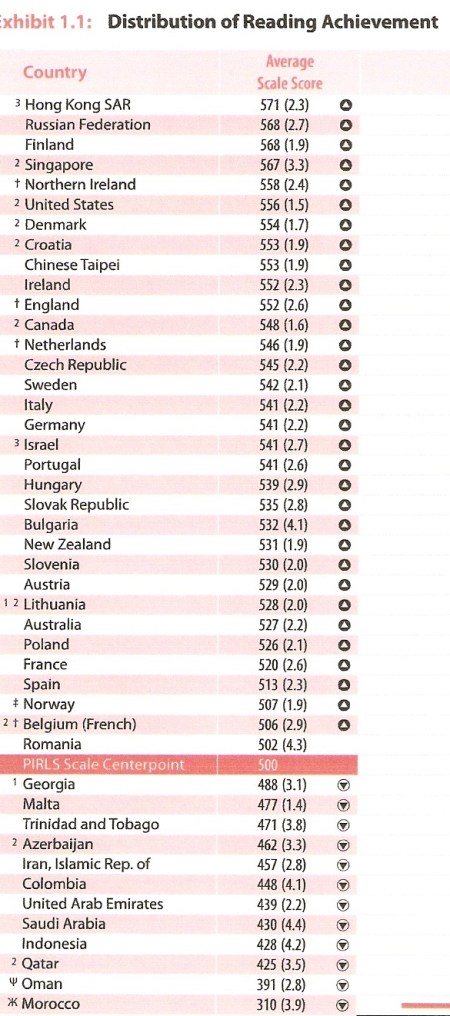
TIMS released 2011 results today in a variety of subjects. This time a handful of states were brave enough to volunteer for a pullout of their results. Here are the results on 4th grade reading:

PIRLS 4

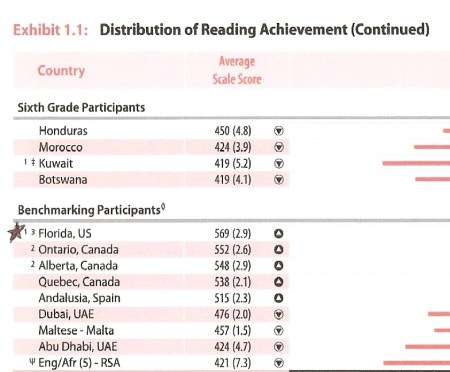
Here are the pullouts:

PIRLS 3

You got it: Florida students notched the second highest score in the world. Even above (gasp!) Finland.

Late for a meeting. More later, but for now:

BOOOOOOOOOOOOOOOM!!!!!!!!!


The Moynihan Corollary to Baumol’s Cost Disease

December 10, 2012

(Guest Post by Matthew Ladner)

Over at the Ed Fly Blog I discuss the Moynihan Corollary to Baumol’s Cost Disease, my theory that Moynihan intended to leverage Hillarycare for welfare reform before killing it, and more on the failure of the staffing-bloat-as-ed-improvement strategy.


The Way of the Future: Unbundling K-12

December 3, 2012

https://i0.wp.com/photo.epg.co.kr/photo/movie/28269/282696.jpg

(Guest Post by Matthew Ladner)

We have a new contender in the education reform race: Michigan! Very interesting proposal.

Michigan has an iron-clad constitutional prohibition on public money going to private schools, so it is hilarious to see some of the usual suspects in the above article calling this a “voucher proposal.” Nevertheless, this raises some interesting questions. Is a student taking a Massachusetts Institute of Technology (public institution) class online through EdX (a private 501 c3) taking attending a “private school?”

What if they are taking a Harvard course through EdX? What about a University of Michigan course through Coursera?

Luckily it doesn’t much matter because they are free and don’t require much in the way of public funding.  It would be highly desirable to allow students to use public money to pay for the $89 testing fee in order to receive college credit, especially for children of limited means, but not necessary. Presumably Michigan is going to develop their own system of end of course exams in order for purposes of transparency and accountability. College credit will be a bonus.

Note that while the usual conspiracy theorists have already donned their tin-foil hats about evil profit driven plots that for-profit providers while they will in fact be in direct competition with brand names like Stanford and Princeton who will be providing courses free of charge.

Let me also note that rather than providing $2500 per semester of early graduation, it would make more sense to put all education funding into an Education Savings Account and let the providers compete on both the basis of quality and cost.  A greatly reformatted system of in-person schooling customizing their offerings to meet individual needs would result. All providers would need to compete on the basis of quality and cost, updating the 19th Century Prussian factory model of schooling in the process.

This however is simply an optimizing detail-congratulations to Governor Rick Synder and his team of visionaries for reimagining K-12 education for the 21st Century.

HT: Adam Emerson.


Yahoo, yayhoo or patriot? You be the judge…

November 20, 2012

(Guest Post by Matthew Ladner)

A reader of this blog has taken me to task for not spelling the word “yahoo” correctly. This is deeply distressing and unfair! An expert in such things (a man from Wyoming) once imparted to me lore regarding the distinction between a “yahoo” and a “yayhoo.” Perhaps it is spelled the way it is pronounced: “yay-hoo.” I can’t be certain.

The distinction was very fine-I think “yahoo” might have made reference to people who don’t know as much as they think they do, whereas “yayhoo” might refer to someone far-gone on the ideological spectrum as to have lost touch with reality. I find it all a bit confusing, so I tend to use the terms interchangeably.

Now the writer also makes her case against Tony along the way. “With the advent of President Bush’s No Child Left Behind in 2001, followed by President Obama’s Race to the Top, Common Core and NCLB waiver programs, we have been under constant pressure to surrender education decision-making to Washington and its trade association partners. Every aspect of voter disdain can be traced to the requirements imposed by federal programs such as the Race to the Top Fund Assessment Grant and the NCLB waiver.”

So the people of Indiana rose up in long-suffering anger regarding federal interference in schools and chose to take it out on Tony Bennett. This is plausible if we take “the people” to mean “the writer” but not so much otherwise.

Tony didn’t have anything to do with NCLB, and Indiana pulled out of the Race to the Top competition. I’d be willing to wager by left big-toe that if we administered a survey to the Indiana public and asked them to explain the elements of Indiana’s NCLB waiver that all but a small percentage would likely reply “what NCLB waiver?”  or something similar. People are rational actors and the vast majority of them won’t make time in their lives to learn anything more about NCLB waivers than studying Mayan hieroglyphs absent some good reason to do so. I’m also willing to bet that the new Superintendent will lose her real or imagined federalist fervor and choose not to nullify the waiver so as to have almost every public school in Indiana facing NCLB sanctions.

Never mind any of that- we mustn’t let mere logic or facts get in the way of a good conspiracy theory, especially if the conspiracy is thwarting the will of the public. Tony Bennett was controlled by Arne Duncan and special interests, and this NEA candidate will serve as Tribune to the People. Let’s see how that works out. Tuttle concludes “As for Ladner and his ilk, I note that long ago, the British disdainfully called the patriots ‘Yankee Doodles,’ and they mocked George Washington as an ignoramus. So go ahead. Call me a yahoo. But if you paint my portrait, make sure you show me holding the Declaration of Independence in one hand and the Constitution in the other.”

For my part, I’m content to allow Tuttle to continue to draw her own self-portrait and for readers to reach their own conclusions.


Brother Bob Smith Retires from Messemer

November 16, 2012

(Guest Post by Matthew Ladner)

Citing health issues, Brother Bob Smith has announced that he is stepping down from Messemer schools. Brother Bob was a leading light of the Milwaukee school voucher movement in addition to being a successful educator and school leader. Keep Bob in your thoughts and prayers as he faces additional surgery.


Read ‘Em and Weep Edureactionaries

November 14, 2012

(Guest Post by Matthew Ladner)

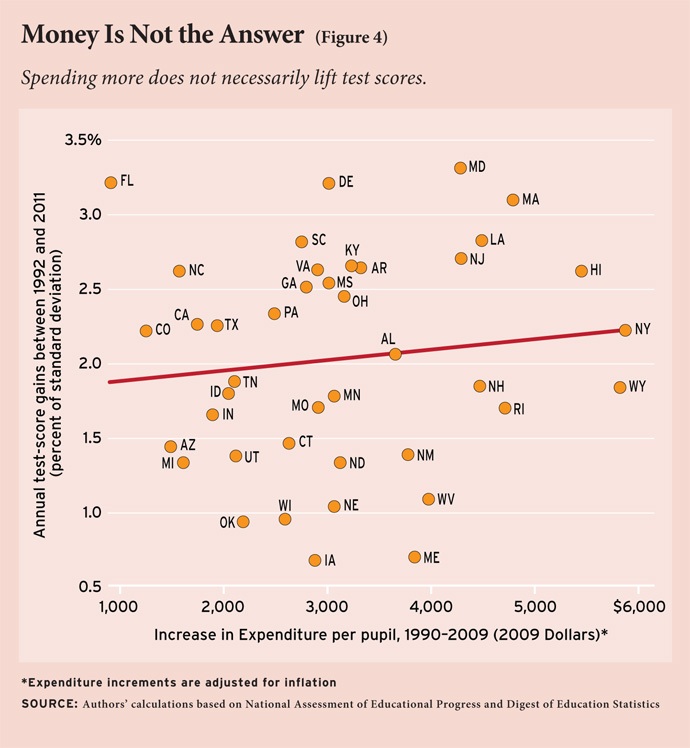
There is a great deal of interesting material in the Hanushek, Peterson and Woessmann study on international/American state academic achievement. Below however is the chart from the Ed Next version that I found most interesting:

Focusing on the 4th Grade Mathematics exam between 1992 and 2009, the authors found that increasing spending does not have a strong relationship with improved student learning. Par for the course.

Take a close look at the top of the chart however in terms of the states making large gains and how much additional revenue per pupil they spent to get them.

The states showing the top gains (in order) are Maryland, Florida, Delaware and Massachusetts. MD, FL and DE essentially tie with MA slightly behind.

Notice however that the inflation adjusted spending per pupil increase in Florida between 1992 and 2009 was $1,000. In Delaware it was $3,000. Maryland looks near the midpoint between $4,000 and $5,000 so lets roughly call it $4,500. Massachusetts looks to be $5,000.

So Florida managed first class gains with a much smaller increase in funding. If I were to go and look up the numbers, we would find that Florida’s smaller increase also came from a smaller base- MD, DE and MA were all likely to have been outspending Florida in 1992 and then really outspending them in 2009.

It is also worth noting that Florida faces considerably greater demographic challenges than MD, DE or MA- far more free and reduced lunch eligible children, more ELL kids, and to the extent you want to factor race/ethnicity into the equation it is a far more diverse state with a majority-minority student population.

So conflict-adverse state policymakers with extra billions of dollars burning a hole in their pocket and very wealthy and pale complected students should study MD, DE and MA for clues on how to improve their student outcomes.

If however you live in a state with average or above student diversity, real budgetary constraints on the amount you can spend on K-12 and strong competing demands for any additional revenue you are likely to scrape up, you should study Florida. In fact you should study Florida regardless unless you lack the guts for a good tussel.

P.S. Notice that NY and WY both had gigantic spending increases (an inflation adjusted $6k per student) only to achieve average and below-average gains respectively. At least WY is just wasting money they are pumping out of the ground. NY seems intent to drive their citizens out of state. Taxpayers and especially students are the losers in both cases.