Florida Legislature proposes ESA funding and eligibility expansion, NVESA wonkathon is west bound and down!

June 16, 2015

(Guest Post by Matthew Ladner)

Travis Pillow over at RedefinED has details on the Florida special session budget process proposal for expanding funding and eligibility for Florida’s ESA program. Looking good Billy Ray!

Meanwhile NV ESA wonkathon is loaded up and truckin! New entries from Jonathan Butcher, Tracey Weinstein and Andy Smarick today. Each piece makes important points in my view.

Butcher (quite rightly) warns of the dangers of over-regulation and unintended consequences. Sith lord enforcers overly empowered bureaucrats will inevitably find your lack of faith in their benevolent wisdom…disturbing.

Weinstein raises equity concerns. She has a map (!) showing that Nevada’s modest pre-existing private school infrastructure tends to be clustered in well-to-do areas. Those experimenting with high-quality low-cost private school models-I’m looking directly at you Christo Rey, Acton and Notre Dame ACE Academies- we are firing up the signal!

And you bring something nice to wear…

Seriously though I hope we will see deeply committed efforts to expand the supply of options for disadvantaged children. Seth Rau raised the possibility of using the tax credit program to enhance the buying power of low-income students, which ought to be viewed in a benign fashion so long as the total amount of aid does not exceed the average spending per pupil. In the absence of these programs however, new private school efforts for low-income areas were terribly unlikely. I expect future wonkathon posts to raise additional equity concerns. These deserve careful consideration, especially if the trailer park schools with substitute teachers don’t happen to cluster in the leafy suburbs. The program does provide more funding for low-income children, but I view it as a perfectly legit topic for further discussion as to what level those funding differences ought to be set. This is a question upon which Nevada legislators must deliberate and decide on an ongoing basis.

Andy Smarick sounds a note of Burkean caution:

My bigger worry, though, relates to the rapidity and expanse of possible changes. Fast, fundamental change of longstanding institutions is generally hazardous. What we have today (in education and elsewhere) is the result of trial-and-error processes played out over generations. It is never perfect, but it is robust, and it often possesses wisdom.

I actually don’t expect rapid change. The supply of private school seats will start off quite limited, and our experience with private choice programs shows consistent incremental take-up rates. This program has more allowable uses and broader eligibility than most, but even so we have no reason to expect a blast furnace of participation in the early years. Funded eligibility creating a credible exit option will be crucial, the rate at which parents choose to exercise that option- not as much.

The McKay Scholarship program has been contributing to substantial public school gains among public school special needs children since 2001. It doesn’t bother me in the slightest that only 7% of Florida special needs students directly utilize the program, or that there are more special needs students in Florida public schools today than when the program passed in 1999, more people working in the schools etc. Color me blissfully unconcerned so long as the parents who have their children in the public schools are there by choice- meaning they had other options. Constraints on the supply of private school space just makes it all the better that Florida lawmakers have made ESAs available as well.


Nevada ESA Wonkathon

June 16, 2015

(Guest Post by Matthew Ladner)

The first three salvos in Fordham’s Nevada ESA oversight wonkathon have been fired by Michael Goldstein, Seth Rau and Yours Truly.

Goldstein’s call for a “harbormaster” has me a bit concerned about going from this:

To this:

I’m a big fan of the New Orleans experiment, and would like to know more specifics about the role of “harbormaster” but personally would like to see what Nevada parents come up with rather than having things nudged hard in a particular direction. I’m also a fan of charter schools chock full of TFA Ivy League kids but in the end that is more of a formula of tiny hot-house sectors rather than a model that can reach scale.

In my view we should work to improve the bill (inclusion of ELL and SPED weights and long-term higher education savings especially critical) and give parents space to see what they come up with. Living out in the wild west myself gives me an appreciation for the benefits of messy freedom. In the Arizona charter sector we often hear laments regarding the fact that the very expensive KIPP organization avoids our patch of cactus. I’d like to have KIPP, but I’m consoled by the development of low-cost high quality models like BASIS, Great Hearts and Carpe Diem. High quality and (lower) cost is what the country will badly need in the near future. MG’s call for micro-schools sounds like a great start.

Although I disagree that the use of a state test is in any way desirable, I admire Seth’s creative attempt at analogy.

My entry, New Tools for New Challenges, is here. I’m hopeful that we can apply the accountability lessons of uber to the education sector, especially the technology-enabled hyper transparency.

More posts in the wonkathon are on the way so stay tuned.


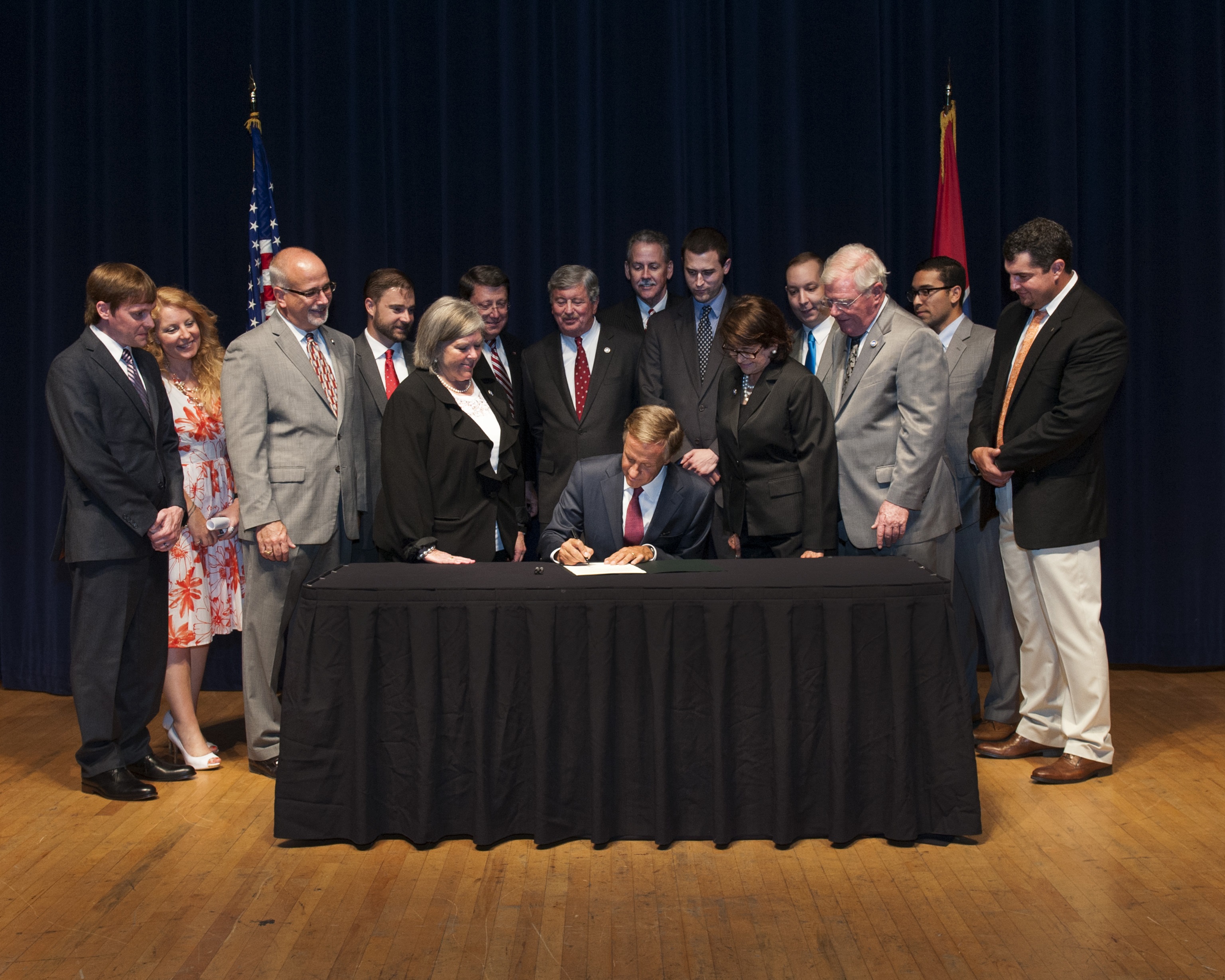
Governor Haslam signs TN ESA

June 12, 2015

6/10/2015 Governor Bill Haslam signs SB 27

(Guest Post by Matthew Ladner)

Ryan Mahoney (Excel in Ed colleague- and the tall thin chap in the middle) sent me this happy photo of Governor Bill Haslam signing SB 27, the Tennessee ESA bill a couple of days ago.  I don’t know everyone in the photo, but do know some, including Rep. Debra Moody and Sen. Dolores Gresham (sponsors) along with Justin Owen from the Beacon Center, Jonathan Butcher from the Goldwater Institute and Daniel Zavala from Students First.


Oklahoman: School Choice is All Around

June 12, 2015

(Guest Post by Matthew Ladner)

Nice piece from the Oklahoman discussing the progress of school choice. P-Diddy Wolf consulted, which is always good. This quote got my attention:

There are essentially three policy mechanisms for providing private school choice: vouchers, tax credits, and the new kid on the block, education savings accounts (ESAs).

So choice bills continue to pass and more are to come. Hang tough and we can debate 2011 vs. 2015 after the smoke clears.


If the System Can’t Kill the Bunny with $312k per classroom, perhaps new choices will help them out

June 10, 2015

NSEA letter

(Guest Post by Matthew Ladner)

So during the recent Nevada legislative session, Nevada State Education Association President Ruben Murillo Jr. sent the above letter to the members of the Senate Finance committee. In the letter (in case you are squinting) he included the following paragraph:

However, the abundant number of overcrowded and aging campuses, high class sizes in middle and high schools, hundreds of unfilled licensed teaching positions, and an 81% non-compliance rate of the elementary class size limit law all point to the fact that Nevada’s public schools remain under-funded.

Well, that’s a little rich don’t you think? Especially given that the Digest of Education Statistics reports that inflation adjusted current spending per pupil more than doubled since 1969:

NV spending


Despite this doubling of current funding, there can be no doubt that overcrowding remains a chronic problem in Nevada. National Public Radio recently profiled Forbuss Elementary school in Clark County. Architects designed the building for 781 students, but it currently has 1,230 students, spilling out into 16 trailers. The Nevada public school system has been unable to keep up with either physical or human capital needs-thus the unfilled public school teaching positions cited by President Murillo. In the same NPR piece, a teacher in Bertha Ronzone Elementary School reports having 33 students in an overcrowded trailer classroom.

Now my excel spreadsheet says that if you multiply 33 by $9,455 you get $312,015 in current spending, with more in capital spending. How do you kill the bunny with these claws and teeth  hire a teacher for only $312,015? Sounds like they at least should not have a series of substitute teachers going through those trailer classrooms. But wait, Murillo notes hundreds of unfilled teaching positions. What’s that? Overhead?!? C’mon you’re a BEAR man!


Of course, if you can’t keep up with enrollment growth, can’t build public schools fast enough, can’t hire enough teachers, and create trailer parks outside your schools for extra classroom space, well, you’ve got problems. If the Census Bureau further projects a huge increase in your youth population and the NAEP say you only get a fraction of your students proficient this actually makes an entirely compelling case for giving as much choice as possible. Apparently the Nevada public school system needs as much help as it can get.

So Silver State legislators:

NSEA: thanks for the assist!


Randomistas Seek to Dispel Guesswork in Anti-Poverty Efforts

June 8, 2015

(Guest Post by Matthew Ladner)

Interesting article in the WSJ today on the use of random assignment studies in anti-poverty efforts. Known as “Randomistas” these economists show a lot of promising results. At one point in the article Columbia’s Jeffery Sachs attempts to pour cold water on the process:

Prof. Sachs says that “many, almost surely most, of the cutting-edge breakthroughs in actual development in recent years did not result from [randomized controlled trials].” He believes that tackling problems at the level of communities or entire societies, rather than just households, is likely to be more effective—though, he adds, randomized controlled trials should be “a part of a diverse arsenal of analytical and policy tools.”

Retorts Prof. Duflo of MIT: “The big difference between Jeffrey Sachs and us is that he knows what needs to be done, and we don’t. We’re trying to learn it.”


West Overtakes East in Improbable 2015 Comeback

June 4, 2015

(Guest Post by Matthew Ladner)

While East leads West 3 ESA programs to 2, West has pulled an improbable victory over East with much broader eligibility.

To wit:

The once lonely Arizona program has been joined by neighboring Nevada. The Arizona ESA makes around a quarter of Arizona public school students eligible to participate. The new kid on the Western bloc makes 100% of public school students eligible.

While East has three programs, wonderful programs I might add, all three focus exclusively on special needs students, and in two out of three cases not even all special needs students.

I’m calling it: West is your leader in the clubhouse.


Nevada Legislature Embraces the Way of the Future

May 29, 2015

(Guest Post by Matthew Ladner)

Silver State lawmakers have sent an account-based choice bill to Governor Sandoval. With a signature Nevada will have the most robust parental choice program in the country. All students having previously attended public schools will be eligible to receive a use-restricted account to pursue their K-12 education under state oversight.  Bill specifics from FF. No existing law can match this measure’s combination of broad eligibility and multiple uses- education choice, not just school choice.

Jason Bedrick has some useful details about why this is an especially great policy for Nevada (Las Vegas public schools = deluged with enrollment growth).  The Nevada Constitution guarantees public education, it’s not going anywhere, and it needs all the help it can get. The overwhelming experience of previous choice programs demonstrates that there will be no mad exodus. Instead the program will take the edge off of a crushing rate of public school enrollment growth and create a crucial exit option that will provide positive pressure to improve.

Nevada lawmakers have made history-an experiment in liberty giving parents the ability to customize the education of their child. Big problems require bold leadership: hats off to Silver State legislators! Congrats also to the #Team ESA folks scattered across multiple organizations who worked so hard and effectively on this effort.

P.S.


!!!!!!!!BOOOOOOOOOOOOOOOM!!!!!!!


The Phantom Poverty Menace?

May 27, 2015

This is my apprentice, Darth Baloney…

(Guest Post by Matthew Ladner)

I was intrigued by President Obama’s claim that when one includes transfers that the poverty rate has declined substantially from the 1960s. This would seem to represent a considerable problem for those attempting to waive off the poor performance of American public education based upon a poverty mantra. Spending up and poverty down makes for a tough sell.

Well sure enough, the left-leaning Center on Budget and Policy Priorities has a handy-dandy blow-by-blow on how the official poverty rate masks progress on poverty. It has charts like:

Hmm, that looks like 11% when it used to be 22.5% or so. An addition illuminating chart:

If you are squinting at that last one, it basically shows that the inflation adjusted (in constant 2011 dollars) income of the poorest fifth of Americans almost doubled between 1964 and 2011 once various transfers (food stamps, EITC etc.) have been taken into account.

Before you ask, childhood poverty is also down (see Figure 5a on page 23). So basically you have a very hard time blaming increasing poverty for this: