Creating and Managing Schools = Feature Not a Bug

February 6, 2019

(Guest Post by Matthew Ladner)

Over at the Chamber Business News I pose a few questions to charter opponents who want to force Arizona charter management organizations to competively bid out the management of new schools. Questions for the hive mind: can anyone think of a reason this should be done to charters but not districts? I mean you know given stuff like this:

…wouldn’t most reasonable people take a look at that dot on the top right, learn that it has a majority-minority student population, gets only a modest level of funding, and take in kids from districts in their state with below average test scores and conclude “hmmm these schools seem to be pretty well managed?” Given Arizona’s growing school population, am I nuts to think such a provision would stop new school construction dead in its tracks if applied to either districts or charters? I’m trying to imagine either CMOs or districts raising millions to build a new school only to RFP off the management of that new school, and I’m coming up empty trying to imagine a case to build the new school. Maybe you can help me out in the comments.


“Get Me Roger Stone”

January 26, 2019

(Guest Post by Matthew Ladner)

I do as much as I can to avoid paying any attention to Washington DC. The House passes bill with full knowledge that the Senate won’t do anything other than greet themselves in the mirror each morning as “Good morning Mr./Madame President.” It’s a unique combination of pointlessness and vanity imo. Anyway I had never heard of Roger Stone until CNN was there with a news camera to arrest him on something to do with Russiagate. I heard something about him having a tattoo of Richard Nixon’s face on his back. A friend strongly recommended that I watch “Get Me Roger Stone” on Netflix, which I did this morning.

I’m still trying to process it.

If you mix Forrest Gump’s proclivity for being around big events with a Denny Crane scale ego and a large dash Idiocracy politics, that maybe kind of sorta is a starting place, but only a start. I’ve never seen anything remotely like it. It is both profoundly disturbing and occasionally hilarious, and it leaves people like me politically homeless living in a VAN down by the RIVER.

Go watch it. Like now! And then see if you can console me in the comments section. This is all going to be ok like somehow right?


The Hour is Later than Osborne Thinks

January 22, 2019

(Guest Post by Matthew Ladner)

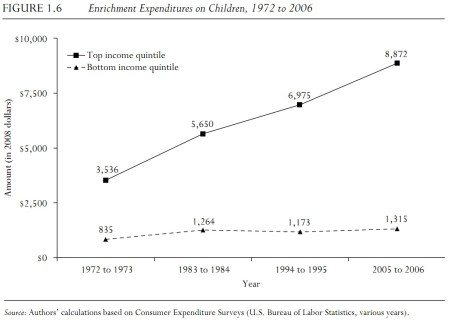
Over at RedefinED I make the case that David Osborne’s fears of universal education savings accounts have in fact already come to pass with universal public schooling. Osborne opposes universal ESAs because he fears that wealthy families would top-off, well, guess what has been going on since the early 1970s:

The age of multi-vendor education dawned for upper income families decades ago. John Stuart Mill made a respectable case that government should restrict education activity to providing subsidies for the poor, but the justice and political viability of such a system seems deeply suspect given that no one has ever been told they can’t attend a education institution because their parents paid too many taxes. The best solution imo is to provide broad access with a significantly higher level of subsidy, but consider this your invitation to read the piece and reveal the flaws in thinking in the below comments section.


Educational Opportunity and the Widow’s Mite

January 2, 2019

(Guest Post by Matthew Ladner)

Over at Chamber Business News today I discuss the above map from the indespensible Garrett Archer showing that areas with large Native American populations alone voted yes on Proposition 305 (marked green). They did so despite the fact that they were already included in the ESA population and despite the fact that a credible case could be made that it was not in their own selfish interest to vote yes. There is a lesson for the rest of us in all of this.

Native Americans were not voting their self-interest in supporting ESA expansion. They were already included in ESA eligibility. Because “No” prevailed, the ESA program reverted to the pre-expansion program, an annual cap on the number of new participants cycles off in 2019. If “Yes” had prevailed an overall cap would have come into effect, and this could have limited Native American participation absent further action. Every tribal community residing student is eligible to participate in the ESA. Nevertheless, it was they that voted “Yes” to expand eligibility- why?

We can’t be sure, but perhaps these communities are better acquainted with the desperation that parents feel when their child is failing to flourish in a school. Perhaps it is more obvious from the tribal community areas that while open enrollment and charter schools are good things, they aren’t a solution for everyone. We parents in Maricopa County have a vast array of district, charter, magnet and private school options. We may have made the mistake of taking choice for granted. It may be the case that other communities have a better grounding in just how vital and precious a thing it is for families to have a chance to find a school that fits their child’s needs and aspirations.

Many of us are very fortunate with regards to the education of our children. We carefully purchase our homes with an eye to attendance boundaries. We use open enrollment, we consider magnet schools, and/or enroll our children in charter schools. Those of us fortunate enough to live in this world would do well to remember that the communities with the fewest of these opportunities voted to expand opportunity further at some risk to themselves.

A Navajo proverb holds “Always assume your guest is tired, cold and hungry, and act accordingly.” Like the widow and her mite, Arizona’s Native American communities offered what little that they had and revealed once again the great nobility of their spirit. This is an example to which all Arizonans should aspire. We should not hoard opportunity, even if it superficially seems to our own advantage to do so. Rather we should provide opportunity to everyone.


Today we are CANCELLING the APOCALYPSE!!!!!!!!!!

December 18, 2018

(Guest Post by Matthew Ladner)

Over at RedefinED I pay homage to the dumbest awesome movie of all time, or is it the most awesome dumb movie of all time? Silly me- IT’S BOTH! Oh and also there might be some discussion of why it is absurd to talk about Florida education in apocalyptic terms.


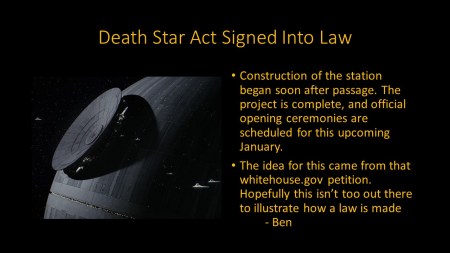
That’s no moon, that’s a Death Star Bill!

December 11, 2018

(Guest Post by Matthew Ladner)

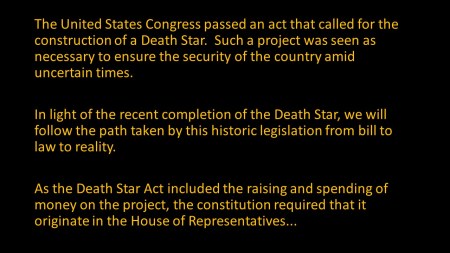
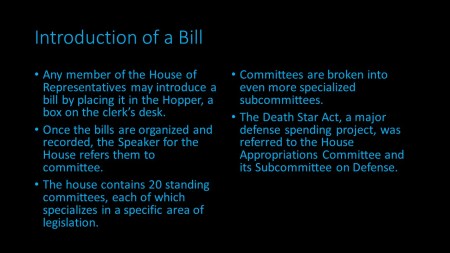
So my son Ben had an social studies assignment to explain the legislative process. He had to build a powerpoint and then this happened. Yes it went down the y-chromosome. I got a kick out of it, figured some of you might as well.

Slide1

Slide2

Slide3

Slide4

Slide5

Slide6

Slide7

Slide9

Slide10

Slide11

Slide12


The Prodigal Nerd Returns to Florida

December 3, 2018

(Guest Post by Matthew Ladner)

A bit of personal news- I’ve taken a new gig at the Arizona Chamber of Commerce and Industry and as editor at RedefinED. Over at RedefinED online I offer an introductory post re-introducing myself to my friends in Florida:

Florida is a grandly innovative state with a record in policy implementation that is far greater than average. It’s very hard to appreciate this when you are close to your own inevitable policy and political messiness, but trust me, it is very clear from over here. I’m proud, for instance, that Arizona originated both scholarship tax credits and education savings accounts. Both innovations have been successfully taken to greater scale, however, in Florida – in no small part due to the relentless attention paid to the details of implementation.

You’ve taken crucial first steps towards equalizing opportunity in schooling. The sky not only did not open with a rain of frogs or locusts, you’ve seen real tangible progress. Florida public education, despite much protestation from traditionalists, is not only still there, it is substantially improved.

Funding for public education is guaranteed in the Florida Constitution and is as close to a permanent institution as you get in American society. It’s here to stay. Florida, however, has the chance not just to practice the form of public education, but to fulfill its actual promise. Much divides our society, but Americans still unite on crucial issues, including education. We desperately want an education system that gives students the knowledge, skills and habits needed for success and to responsibly exercise democratic citizenship. We – left, right and center – commonly and fiercely desire a system of schooling which serves as an engine of class mobility. Florida has moved the needle in this direction by setting families free to pursue opportunities that would otherwise be denied to them. More of this is needed and the next step will be to develop a consensus around setting educators free as well.


Miscellaneous post holiday links

November 26, 2018

(Guest Post by Matthew Ladner)

Paul Peterson interviews Justice Clint Bolick on the 2018 elections and school choice,Brett Kavanaugh and other topics. Quick note on the AZ Prop 305 vote: we have something called Voter Protection in Arizona, which means that the legislature has a severely limited ability to alter something passed at the ballot. As Clint explained, it was the ESA eligibility expansion rather than the program that was on the ballot in November. Because the expansion contained a statewide cap (30k students statewide) many pro-choice groups chose not to engage in support of the expansion as it would have voter protected a cap that would have been practically impossible to alter. We had wildly conflicting polls up until the end but Arizona voters decisively chose not to expand eligibility, which means that the program continues with the current eligibility pool (Students with Disabilities, foster care children, children attending D/F rated public schools, military dependents and orphans and siblings of eligible students) and (given this result) no participation cap starting in 2019, but with the more limited eligibilty pool described earlier. Efforts now should focus on improving the administration of the program.

Yours truly teamed up with David Lujan, former state lawmakers and Director of the Arizona Center for Economic Progress in support of ASU Prep charter school., a high performing charter in downtown Phoenix threatened by a demand for a large increase in rent from the Phoenix Elementary School District. In combination the district and charter schools of the area scored at the 99th percentile of academic growth, which as both righties and lefties like Mr. Lujan and I both agree is something well worth preserving, so hopefully the grownups work something out.

Lots of interesting discussion going on about standardized testing. I remain in favor of lighter footprint testing but man oh man we’d better be coming up with ways to lower the perceived costs and increase the perceived benefits.


Proposition 305 Delayed the Modernization of the Arizona Empowerment Scholarship Program

October 30, 2018

(Guest Post by Matthew Ladner)

The Arizona Auditor General has performed an update on their review of the Arizona Department of Education’s administration of the Empowerment Scholarship Account program. Back in 2016, the Auditor General found a number of deficiencies in the Department’s oversight of the program. Two years later, they find…many of the same shortcomings. Given the proximity of a public vote on ESA eligibility and administrative modernization, this is basically like pouring a bucket of chum in shark infested waters. Overreaction is guaranteed, despite the fact that the funds discussed represent less than 1% of the total. The greatest irony here is that the bill that the Save Our Schools group placed on the ballot (thus either delaying or killing depending upon the will of the voters) took robust steps to improve the administration of the program.

ESAs are complex programs to administer, and bless their hearts the Arizona Department of Education volunteered to be the first to try. The Arizona Republic’s story on the Auditor General update includes push-back from the outgoing Superintendent of Public Instruction Diane Douglas on the Auditor General update:

State schools Superintendent, Diane Douglas said the misspending of the voucher money is the result of decisions by the Republican-controlled Legislature to deny her department money needed to properly administer the program. Douglas said lawmakers resist properly funding oversight because they want a private entity to oversee it.

“If you’re not willing to put the resources into the oversight, then it doesn’t happen appropriately,” Douglas told The Arizona Republic on Monday. 

She said her staff has “done a phenomenal job with the lack of resources.”

She criticized the audit for glossing over the Legislature’s failure to properly fund oversight.

That’s a story but not a credible one. From the outset, the Arizona Empowerment Scholarship Program has included fees for management companies as an allowable expense for accounts. While the Arizona Department of Education had no experience in managing multi-vendor accounts, there are in fact multiple private firms which have gone up and down the learning curve of managing (for instance) health savings accounts. Other states with ESA programs have contracted with these firms in order to build digital platforms so that both administrators and parents can view accounts and account transactions in real-time. They’ve also developed methodologies to prevent misspending of account funds from occurring. They do this for a very modest fee. These platforms also collect user reviews to help inform the decisions of other parents- which is the only plausible way to hold, for instance, an occupational therapist or online education provider accountable for performance.

What was requested of the department repeatedly and I know this because I myself personally all but begged them to do this on multiple occasions- was to have them hire one of these firms so as to radically improve the administration of the program. The parents would have received superior program that was easier to use, misuse of funds could be dramatically curtailed, and transparency improved. Everyone wins, and you can see this underway in Florida, where the main Gardiner Scholarship administrator (Step Up for Students) has contracted with SAP Ariba to create such a platform.

I interpreted the feedback I received as “Nah man- hold my beer! We’ve GOT THIS!” No wait I think what I was actually told was “the Superintendent is suspicious of outside vendors” which translated in practice to approximately the same outcome. In any case since then the Department’s administration of the program has looked something like:

Notice that this is not a bureaucratic turf issue. The avenue allowed left the Department of Education in charge of the program. Any outside vendor would have reported directly to them, and they could tell them what to do and hire/fire them at will within the normal confines of state contracting. The great advantage here is that these firms have decades of experience in navigating these waters and there are multiple players in the space that could compete if the state created an RFP.

The complaint about under funding of administration also rings hollow because as previous reporting from the Republic established the Department failed to spend the resources allocated for program administration by leaving funded FTE spots open. If you don’t spend the funds appropriated for you, then you don’t get to complain that you needed more funds. And by the way, the private firms with plentiful experience in managing account based program could have been funded for a very modest fee by the account holders, and would have not needed to subtract from the funds the department didn’t in any case fully spend.

Oh but it gets better.

Arizona SB 1431 from the 2017 session included a large number of items to improve the administration of the program and to increase transparency. You can read a list of these items here. In evident despair of the Department modernizing the program administration, the legislature (wisely imo) included these provisions:

Directs ADE to post on its website information and data that are updated monthly regarding ESAs that includes the following:

a)info on all purchases and expenditures made with ESA monies that does not violate the personal privacy of any student or family and that includes only aggregate date;

b)the number of enrolled students disaggregated by eligibility; and

c)any other information or data that may be pertinent to promoting transparency and accountability of the ESA program.

and…

Requires, rather than allows, the Treasurer to contract with private financial management firms to manage ESAs and directs ADE to cooperate with the Treasurer and the contracted firm.

The collection of signatures against SB 1431 by the Save Our Schools group at minimum delayed the modernization of the program in the form of Prop. 305. If the yes vote prevails, SB 1431 will take effect, whereas if no prevails it’s back to the drawing board. The polls on this provision have been mixed, and at the time of this writing it seems the proposition could go either way. Regardless of what happens at the ballot, it remains abundantly clear that program administration must be modernized.

Just as a reminder, this is the same Arizona Department of Education which mis-allocated $85,000,000 in federal title I and IDEA funds, giving some schools too much while short-changing other schools. The “blame the legislature” trick also doesn’t work here as the positions that allocate funding are funded by Uncle Sam (like every other state) but one doesn’t read stories about Montana, Oregon or (fill in the blank here) managing to make a mess of these sorts of things.

Note that the response to this has never been nor should it be “If the Department can’t administer Title I we should just get rid of it!!!!” but I’m fairly confident that I could go on to twitter right now to find this argument being made with hypocritical gusto. In fact I fear I could find this double standard being applied by the very people who delayed the modernization of the program. It’s a neat trick to prevent the implementation of solutions while continuing to complain about the problems. Let’s see what happens next.


Baby Baby DARLING You’re the WEST!

October 22, 2018

(Guest Post by Matthew Ladner)


So I decided to see how the charter sectors of the Top 10 rated charter laws in the National Alliance for Public Charter Schools would look in a cohort gain chart compared to the Cactus Patch. The top ten (in order) are Indiana, Colorado, Washington, Minnesota, Alabama, Mississippi, Maine, DC, Florida and Kentucky. The above chart shows 4th grade math and reading scores from 2013, and then 8th grade math and reading scores from 2017-when the 4th grade cohort from 2013 were 8th graders.

Sadly of these states NAEP only reports charter student scores for Colorado, DC, Florida and Minnesota. You have to have a minimum number of students before the NAEP will report scores, and mind you that you can find male Asian scores in some states. It’s a mixed bag with the non-reporting states- some of the laws are old and just not very active in producing “charter schools” (Indiana) and others are young and not very active at producing charter schools (Washington, Alabama, Mississippi, Maine and especially Kentucky). When they do open schools they are going to be AMAZING– as in I’ll have to extend the axis scales on these charts. For now I’ve included them clearly in the above charts as very dark dots. What? Can’t see them? Not to worry just squint hard and use your imagination.

I’m fond of the charter sectors in all of the remaining top 10 states (i.e. the four with actual schools) in different ways. Colorado is a fellow member of the Wild West, Florida is an honorary member, DC charters clearly do better than DC districts despite getting about half of the funding and few of the families with both parents having law degrees, and Minnesota kicked off the charter school movement.

I think that all of these charter sectors have majority minority student populations with the exception of Colorado. I’ll let you decide whether Colorado’s higher 4th grade scores or Arizona larger gains and higher 8th grade scores qualifies as most impressive, but either way darlings you’re the west best!