
(Guest Post by Matthew Ladner)
Difficult for me to find much fault in this Jeff Rice column, keep hoping to wake up like Bobby Ewing and discover last season was a dream.
(Guest Post by Matthew Ladner)
Difficult for me to find much fault in this Jeff Rice column, keep hoping to wake up like Bobby Ewing and discover last season was a dream.
 2 Comments |
  Uncategorized | Tagged: Idiocracy, Jeff Rice |
  Permalink
 Posted by matthewladner
(Guest Post by Matthew Ladner)
Tom Patterson recently wrote a column about Arizona NAEP scores, and stated that Arizona had the highest overall gains in combined Reading and Math scores between the 2015 8th grade scores and the same cohort of students 2011 scores as 4th graders. I decided to check it out.
NAEP has been following an odd number year cycle, meaning that the four-year gap between the same cohort of student can be measured. In this case, I took the statewide 2015 Math scores and subtracted from them the statewide 2011 4th grade math scores. We more commonly compare 8th grade scores to those of previous 8th graders, but measuring cohort gains is also of interest.
A note of caution before proceeding it is possible to do well on the below gains analysis without ranking terribly high. Likewise you could have the highest overall 8th grade scores but also had high 4th grade scores four years earlier and look meh in this particular analysis. Like achievement gaps, each state’s gain score requires a close look before drawing conclusions- but generally speaking the states with the biggest scores below would have started with modest 4th grade scores and then shown much higher scores for the same students as 8th graders. Obviously factors other than school system effectiveness could come into play (massive gentrification in the District of Columbia comes readily to mind) and every state will have students both come and go between 2011 and 2015.
Okay now that you’ve read the warning label:
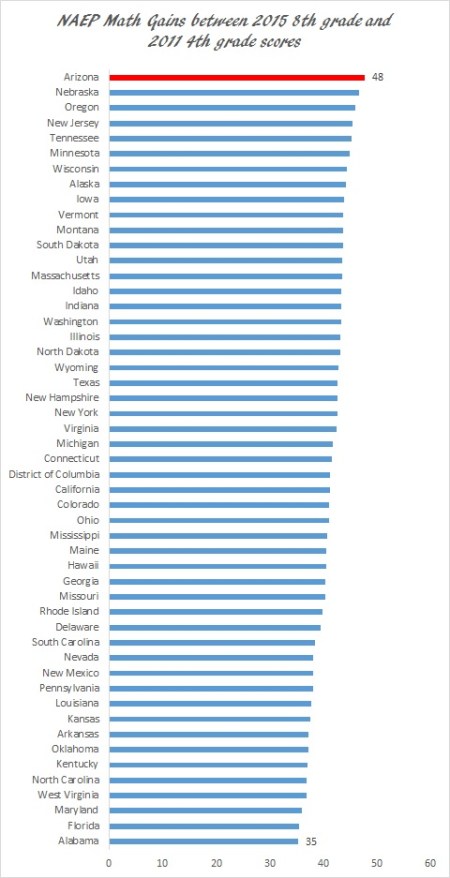
In terms of context, Arizona’s 4th graders scored 5 points below the national average in 4th grade math in 2011 but two points higher in 8th grade math in 2015. There is nothing about starting below the national average that makes it inevitable you will crush the ball in gains. Alabama for instance had 2011 4th grade math scores 9 points below the national average but then displayed 8th grade scores in 2015 that were 14 points below the national average.
Reading gains below:
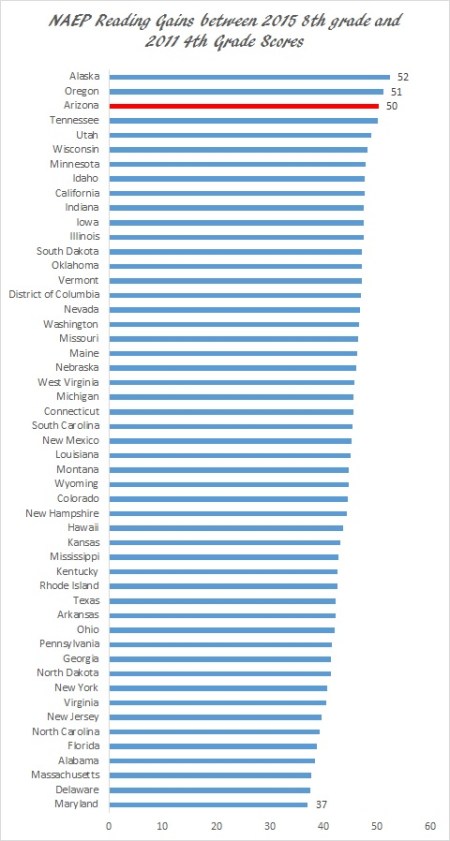
Arizona’s 4th graders scored 8 points below the national average in 4th grade reading in 2011. As 8th graders in 2015 however this group of students had scores only one point below the national average- within the margin of error thus catching them up to the national average. In short, Tom Patterson nailed it- AZ looks to have had the best 2011 to 2015 period.
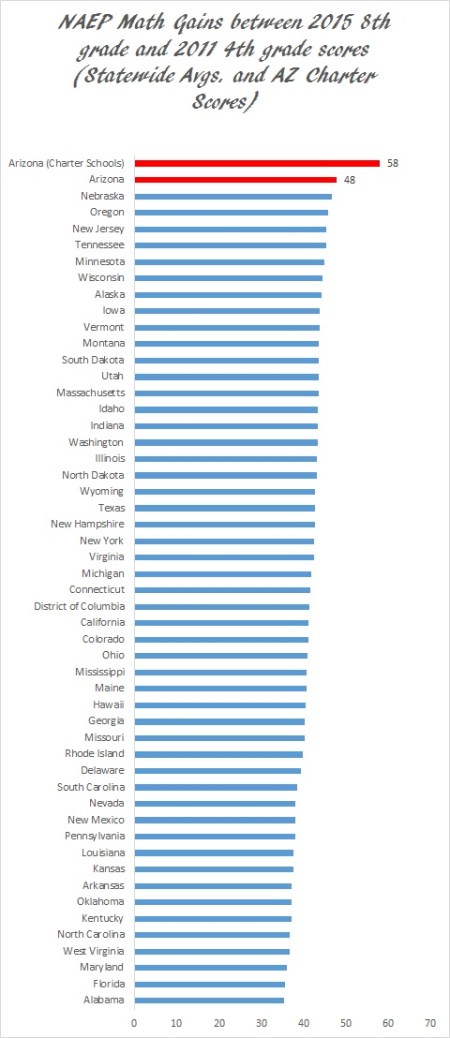
So this got me to thinking-what if we tracked the same cohort gains for Arizona charter school students and compared them to statewide averages? As we’ve noted before, with the largest state charter sector as a percentage of the population, Arizona has substantially more students than the entire public school system of Wyoming. The National Alliance of Public Charter Schools also compiles data about state charter sectors, so we know that the sector (like Arizona as a whole) has a majority minority student body.
Well this is what it looks like for Math:
Keep on rocking the free world! Similar story with reading:
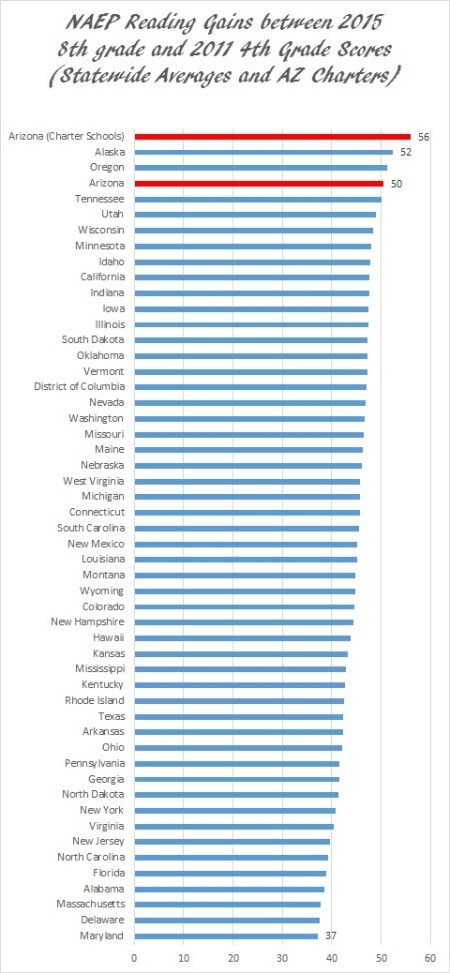
Given the Arizona’s charter schools rank near the top in over NAEP scores, and first in overall NAEP cohort gains between 2015 and 2011, they have a great deal to celebrate- as does Arizona as a whole. Nothing in these results makes a case for complacency Arizona has only numerically exceeded one of the national averages on the four main NAEP exams, and America remains a low performing nation. Nevertheless if this is what getting an F on the Ravitch report card looks like, what can we do to get an F minus minus?




4 Comments | NAEP | Tagged: Arizona charter schools, Arizona NAEP scores, Tom Patterson | Permalink
Posted by matthewladner
(Guest Post by Matthew Ladner)
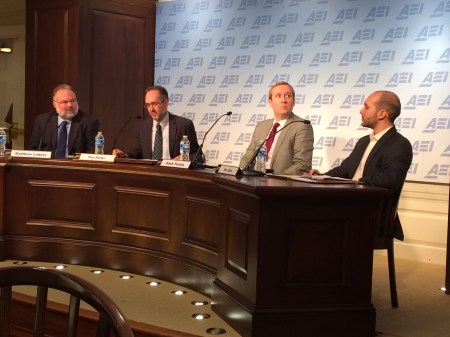
We had a wonkapolooza on ESAs at the American Enterprise Institute earlier this week! What- you had a friend in from out of town and couldn’t make it? Ah well not to worry the video is here:
On the first panel, our discussant MI’s Max Eden advised tapping on the expectations brakes, noting a number of practical difficulties. The biggest of these difficulties was summarized by Adam Peshek’s slide:
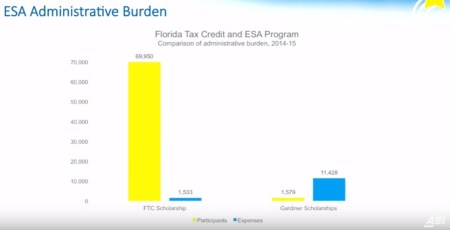
So, yeah, this slide basically shows 70,000 ish Florida tax credit students using approximately 1,500 vendors (private schools). Meanwhile the Gardnier Scholarships programs had south of 1,600 students, but those 1,600 students made **ahem** almost 11,500 purchases. A new set of practices and techniques will be necessary to administer such a system.
Fortunately we have practices from other policy areas to draw upon and companies highly adept at account management and oversight from Health Savings Accounts and others. It’s going to take time. In the paper and presentation I referenced the Greek myth regarding the birth of Athena- who sprung from the skull of Zeus not only fully grown, beautiful and powerful but also clothed and even armed for battle!

Alas outside the realm of myth we have little choice but to engage teams of people to grind on problems over time, as ESAs did not emerge fully formed from the mind of some mighty being as a finished product. Evolutionary improvement and innovation may not make for as good of a story as the goddess of wisdom springing forth, but for us mere mortals it will have to do. I’m anxious to see what happens next.
Anyway- great event and thanks especially to our friends at AEI for hosting it. Also make sure to see Anna Egalite’s guest blogging on RHSU on ESAs and also Jonathan Butcher’s new report on mobile payment systems and ESAs for the Goldwater Institute. Also Heritage President Jim DeMint tells a Texas suffering from parental choice dehydration to jump on in, the school choice water is fine!
Leave a Comment » | Education Savings Accounts | Tagged: Adam Peshek, AEI, Anna Egalite, ESAs, Jim DeMint, Jonathan Butcher, Matthew Ladner, Max Eden, Tim Keller | Permalink
Posted by matthewladner

(Guest Post by Matthew Ladner)
After the 1929 stock market crash the American public became firmly convinced that the government had to do something: “Action and Action Now!” as Franklin Roosevelt put it. In reality, the government had already taken far too much action and deepened the crisis. Congress foolishly passed and President Hoover signed an act that instituted a global trade war. The Federal Reserve tightened credit during the downturn (the Fed had even less of an idea about what it was doing in those days) in a move reminiscent of medieval leech medical practice. Anxious to do their part, the New Dealers flailed about chaotically creating a never-ending series of agencies dedicated to the proposition that the American government knew how to order our affairs better than the American people. The United States had plenty of stock market crashes and recessions before 1929, but previous downturns tended to be of a short-lived variety. It took a parade of highly empowered fools to create and sustain the Great Depression. To the credit of the New Dealers, they at least recognized and corrected Hoover’s folly in creating a system for liberalized global trade after World War II- a system that helped generate and sustain growing global prosperity.
Angry populists of today should take the time to study this sad history. “I’m from Washington, and I’m here to help!” was once understood as the punchline to a joke due to the unfortunate tendency for government action to backfire. Efforts on the left to raise the minimum wage to $15 for instance will doubtlessly accelerate a substitution of technology for routine labor. The inexperienced and unskilled will suffer most. We’ve already for instance seen the advent of an automated hamburger joint:

Great for a relatively small group automation experts, not so much for a huge group of 16 year old kids looking for work.
Likewise let’s consider two scenarios for the United States slapping 45% tariffs on foreign goods. In the first scenario, other countries recognize our greatness and beg for forgiveness, submitting to whatever demands we care to make. In the second scenario, impacted nations retaliate with tariffs against American goods sold in their markets, costing the United States jobs. We reverse the economic benefits of comparative advantage and specialization to indulge in another idiotic trade war that the World War II generation wisely swore off. Whatever net manufacturing employment gained represents a direct transfer from the pockets of consumers, who now must pay higher prices for goods. Needless to say, those with the least amount of money suffer the most from increased prices.
The first scenario seems fantastically unlikely, the second almost certain. H.L. Mencken stated that “Democracy is the theory that the common people know what they want, and deserve to get it good and hard.” Let’s be careful what we wish for- empowering a new generation of economically illiterates will end in disaster, especially for the poor.
1 Comment | Uncategorized | Tagged: Bernie Sanders, Bolt Burgers, Donald Trump, HL Mencken | Permalink
Posted by matthewladner
Leave a Comment » | Education Savings Accounts | Tagged: Matthew Ladner, Nelson Smith, Nevada ESA debate | Permalink
Posted by matthewladner

(Guest Post by Matthew Ladner)
My Ed Next debate with Nelson Smith over the Nevada ESA program has spilled over into the pages of the Desert News. Moreover Agent Smith has cloned himself in the form of Nevada Education Association President Reuben Murillo Jr. and the Century Foundation’s Halley Potter!

We’re going to enjoy watching you die, Mr. ESA!
Oh well the more the merrier! From the story:
Murillo’s chief concern with the ESAs is that they will undermine financial and political support for “zoom schools” and “victory schools,” two programs Nevada launched in recent years targeted at low-income or English as a second-language students. The state commitment to funding such innovations will be undermined by the revenue lost to private schools, he argued.
Ah, well, fewer than 1% of eligible students applied during the first application period, so I’m a bit perplexed why this would have any impact on zoom and/or victory schools-may as well fear the NVESA program drawing down an asteroid strike to Vegas. Next up Halley Potter:
“The biggest losers in this model will likely be the most disadvantaged children, whose families lack the information and resources to access high-quality opportunities,” echoed Halley Potter, a research fellow at the Washington, D.C.-based Century Foundation.
The most disadvantaged children, whose families lack information and resources to access high-quality opportunities, have of course already lost big under the status-quo. I’m continually amused by the fantasy version of public education implicit in many critiques of choice, where Platonic Equity prances in fields of beautiful flowers on saddled unicorns. In Nevada “public education” for poor children often entails being crammed into portable buildings with long-term substitute teachers. 20 percent of Nevada FRL kids read proficiently in 4th grade- with hundreds of thousands of more students projected to be on the way.
Nevada is far from a fixed pie. As I told the Desert News:
“People who live back East have never seen the kind of crushing growth that we see here in Nevada and Arizona,” Ladner said. “The reality is that there is plenty of room for growth in public, private and charter schools at the same time.”
Information is something that can be addressed, and the ESA law stands in stark contrast to the public school system by actually gives more money to low-income kids. Wake me up when the rich Anglo kids in Incline Village are getting less than the poor Hispanic kids in Vegas under the district financing system, but this will happen the instant NVESA survives legal challenge, albeit without the unicorns and flowers.
Mind you NVESA is not a magic cure-all for every problem in the Nevada school system, but neither is anything else. NVESA deserves to be judged against the actual context is which it will operate and as a part of an overall reform strategy. If judged fairly and in context, fewer people would volunteer to serve as agents of the system.

2 Comments | Education Savings Accounts | Tagged: Desert News, Eric Schulzke, Halley Potter, Nelson Smith, Nevada ESA, Reuben Murillo Jr. | Permalink
Posted by matthewladner
(Guest Post by Matthew Ladner)
Our movement is incredibly blessed to have leaders like John Kirtley. Watch the whole video and watch how to dismantle the case of deeply misguided opponents in a systematic and factual way. Lots of great stuff in this speech, this is my personal favorite:
“Now with that level of diversity, is a one-size-fits-all, top-down system where we assign kids by their zip code-is that going to produce excellence for every single child? I’m not sure that it is. But fortunately Florida is a leader, probably the leader in the country, in moving toward what I would call a new definition of public education. And that is this: raising taxpayer dollars to educate children, and then letting parents direct those dollars to different providers, and even to different delivery methods, that best suit their individual children’s learning needs. We are very fortunate that we have districts-school districts in our state-that are moving towards this new definition.”
and:
“Is uniformity really the principle around which we want to organize public education in this new century? Have the plaintiffs targeted virtual learning, or dual enrollment? Charters or magnets, which are not uniform? No they have not. No they have only targeted the program that only serves low-income children who were doing very poorly in their assigned schools. Should they succeed, 80,000 children will be evicted from schools that are working for them, but they’re not the only ones that will suffer, district schools and taxpayers will suffer. 80,000 children will return to public schools in a day-there is no other way for them to pay for the tuition. We have 20,000 kids in Dade County- they’re concentrated, they’re not spread out. In two zip codes in Orange County, in Orlando, two contiguous zip codes, we have 2,000 kids that will show up one day- that’s four or five elementary schools.
I read the paper last week and the Superintendent of Oscela County Public Schools was lamenting the fact that they have to create 5,000 new spaces over the next five years, and how difficult that is going to be. In fact the quote was from the article ‘The County hopes that new charter schools will enroll some of the students and ease the strain on the traditional schools.’
Ladies and gentlemen we have 3,000 students in this scholarship students in Oscela County. If the Superintendent is concerned about absorbing 5,000 over the next five years, how will they absorb 3,000 in one day?”

!!!!!!!BOOOOOOOOOOOOOOOOOOOOOOOOOOOOOOOOM!!!!!!!!!
1 Comment | tax-credit scholarships | Tagged: Economic Club of Florida, John Kirtley | Permalink
Posted by matthewladner

(Guest Post by Matthew Ladner)
Nelson Smith and I square off in Education Next on the Nevada ESA program. Podcast debate coming later in the week.
I’ll have more to say later, but for now let me ask, is it just me or is there something odd about Nelson’s fire analogy? I read through it and thought “so everyone pays the taxes to support fire service, but if you pay too many taxes then the fire truck should bypass your house when it is burning.”
Mind you only 42% of Nevada children whose incomes are too high to qualify for a free and reduced lunch (middle and high income students) scored Proficient or Better on the 2015 NAEP 4th grade reading test. It therefore seems like a mistake to me to assume that all is well in the leafy suburbs.
Anyway give it a read and decide for yourself.
Leave a Comment » | Education Savings Accounts | Tagged: Education Next, Matthew Ladner, Nelson Smith, Nevada Education Savings Accounts | Permalink
Posted by matthewladner

(Guest Post by Matthew Ladner)
Full clip from RR HoF tribute to George Harrison:
1 Comment | random pop culture | Tagged: Jeff Lynne, Prince, Prince Rock and Roll Hall of Fame, Still by Guitar Gently Weeps, Tom Petty | Permalink
Posted by matthewladner
(Guest Post by Matthew Ladner)
Classic Little Ramona today in Salon where she conjures up a huge conspiracy between the Koch Brothers, ALEC and southern segregationists to overthrow Brown vs. Board. Mostly standard baloney. You can’t “re-segregate” if you never de-segregated in the first place, the public school system everywhere (not just in the South) is highly segregated by both income and race due to attendance boundaries and segregated housing patterns, etc. This line is however is worth noting:
Now the media celebrates all-black schools and ignores the fact that they are segregated. The subtext is: Look at this! An all-black school with high test scores! Isn’t that great?
Couple of things:
The students attending the sort of high performing charter schools Ravitch dislikes attend the school through the voluntary choice of their parents. In the event that the school had more applications than seats, the law requires schools to hold a random lottery for admission.
Let’s compare this to what would happen if these same black children tried to transfer to a suburban district school. Now I want to take care to note that many school districts do participate in open-enrollment, some even if state law does not require it. However if you look into the details of open-enrollment it tells you something more than a little disturbing. Even if the law requires consideration of such a transfer, they universally allow schools to determine whether or not they have space for transfers. In 1999 I interviewed the Superintendent of a fancy inner ring suburb near Detroit and asked him why his district chose not to participate in the open-enrollment program. The man literally told me “I think historically the feeling around here is that we have a pretty good thing going, and we want to keep the unwashed masses out.”
I mean there is just no way to see that statement in any sort of racial or segregationist context is there? In addition to what amounts to voluntary participation, open enrollment laws typically do not require admission lotteries- which leaves it wide open to picking and choosing.
So back to that all-black charter school- it is absurd to even imply that a school whose enrollment is driven by voluntary association and random admission lotteries equates to the old southern hillbilly governor standing at the school-house door with a baseball bat scenario. The tools used by districts on that front are more subtle than a baseball bat these days, and thus far more effective. But I digress- should we celebrate an all-black charter school with high test scores?
I don’t see why not-we have far too many all-black district schools with low-test scores after all. Those kids are in those low-performing district schools in part because they were excluded from other opportunities, whereas the charter students were included in a new education opportunity that would not exist if Ravitch had her way. Nice try Big Sister, but war is not peace, freedom is not slavery and ignorance is not strength.
6 Comments | charter schools | Tagged: Diane Ravitch | Permalink
Posted by matthewladner


 Jay P. Greene's Blog