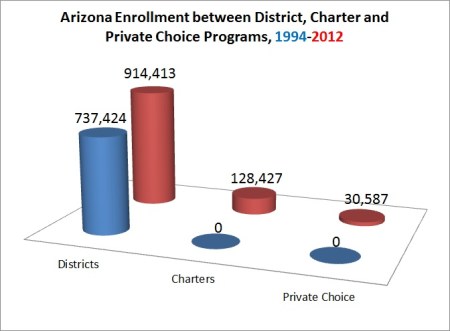
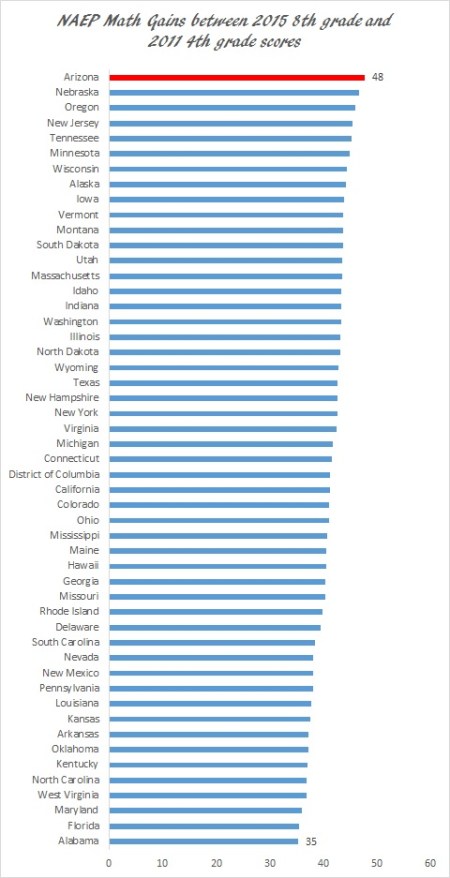
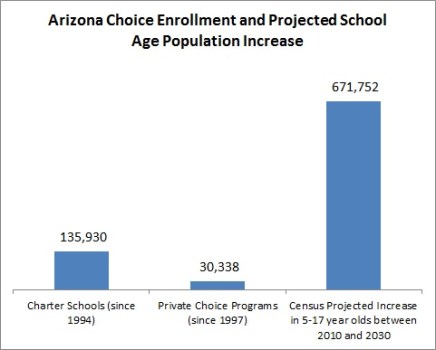
We are but warriors for the working day, but our hearts are in the trim

March 14, 2017

(Guest Post by Matthew Ladner)

The Arizona Republic was kind enough to run the below letter to the editor from yours truly this morning in response to this editorial. If you are feeling the least bit skeptical, feel free to look these numbers up for yourself. The Republic’s editorial claims that now is not the time to expand parental choice because district schools are vulnerable. My claim is that Arizona district schools have never performed at a higher level than now and that we should in the immortal words of Darrel K. Royal “dance with the one that brung ya” which is to say stick with the strategies that brought success. Letter follows:

On the most recent Nation’s Report Card, Arizona 8th graders tied the state of Maryland in math, and outscored many states including Rhode Island, Delaware and North Carolina. These states spend far more per pupil than Arizona. None of these states has a majority-minority student population (Arizona does) but fortunately our students didn’t get the memo that they weren’t supposed to win. Instead they have been leading the nation in academic gains.

Arizona’s charter schools get still less money overall but scored higher than the statewide averages of 49 states on the same test. Arizona charter schools educate a majority-minority student population, but scored a single point lower than the highly funded and demographically advantaged Massachusetts-the nation’s long-time state academic champion. Again, the “you are supposed to lose” memo apparently went to Arizona’s spam folder, and our students and educators achieved an unprecedented academic triumph.

Arizona is never going to win a spending contest, but that is not the purpose of our investment. Our goal must be to maximize opportunity, not spending.


9


Andy Smarick on K-12 Paradigm Shift

March 13, 2017

(Guest Post by Matthew Ladner)

Andy Smarick has a new paper out from AEI discussing Thomas Kuhn’s paradigm shift framework and the current context of American K-12. Everything he describes is very apparent in the discussion of K-12 out here in the Cactus Patch, especially the discussion about “Incommensurability.” Smarick describes the process by which adherents of the old and new paradigms stop making sense to each other:

According to Structure, the perspectives of adherents of the new paradigm are, in many respects, permanently and irrevocably incompatible with those of their predecessors. It is not just that the paradigms take different positions on particular issues; it is that they ask fundamentally different questions, look for different types of answers, and prioritize different things. Kuhn described it as talking past one another and “practic[ing] their trades in different worlds.

Just yesterday an unsigned editorial in the Arizona Republic read:

This year’s ESA budget is about $40 million according to the Arizona Department of Education. That is more than the state provided to fix things like lead-laced water and mercury in public schools.

In the same edition, Jeb Bush wrote a guest editorial:

ESAs will not cause a mass exodus from public schools. Instead the result will be improved public schools. An enterprise that can take its customers for granted behaves much differently than one that risks losing them.

In the Republic’s paradigm the state is responsible for flooring installed in some district campuses in the 1960s and 1970s and should cease giving students further choices until everything is all clear in district land. Obviously this is a serious problem that needs to be addressed, but the billions in funding that state taxpayers gave districts every year can be used on facilities, not just any additional emergency assistance. Moreover, the state was going to fund the ESA kids whether they went into the ESA program or not, and in fact the majority of them are special needs children, and the consistent claim of the districts have been that they must divert local funds for each child. It’s not like the budget for the ESA program in other words prevents districts and the state from addressing mercury-vapor inducing flooring in other words.

Under Governor Bush’s paradigm, the districts will continue to improve as long as parents have the ability to vote with their feet-whether it is to get away from toxic mercury vapors or a toxic academic or cultural climate etc.

And so it goes…


Kevin Carey Flashes Back to 2009 for a Wild West tax credit tale

March 3, 2017

(Guest Post by Matthew Ladner)

Kevin Carey is at it again- this time by flashing back to eight year old allegations about the Arizona tax credit program as a dire warning about the dangers of a federal tax credit. When these stories ran in 2009, here is what I had to say about it here on the Jayblog:

When presented with this type of information, the first instinct of some will be to deny it, to hunker down, to accuse our enemies of far greater misdeeds, or to otherwise try to put lipstick on a pig. Good luck with that.  It is blindingly obvious to me that Arizona’s tax credit is system is a good program overall that suffers from specific weaknesses that can and must be addressed.  Otherwise, writing articles like this one will become the journalistic equivalent of using a shot-gun to shoot fish in a bucket.

Since then, things have improved substantially, but Kevin did not get the memo. Here are a few items that Kevin left out:

Subsequent to 2009, the state enacted new legislation to require STOs to both consider financial need in the granting of scholarships, and to report to the Arizona Department of Revenue on the family income of recipients. When you examine the Arizona Department of Revenue Reports, you find that approximately 80 to 90 scholarship funds went to middle and low-income students. This not only is a more progressive distribution than many public schools and school districts, it beats the living daylights out of another Arizona tax credit for public school kids that overwhelmingly goes to advantaged public schools. Quite frankly it is likely that a large majority of private choice funds were going to middle and low-income children before the state required reporting. It’s just nice to have an Arizona Department of Revenue report that confirms it.

Carey wrote “Some states, like Alabama and Indiana, limit tax credit vouchers to low- and middle-income families, or to students who were previously enrolled in public school. But others, including Arizona, do not, subsidizing private education for the well-off.” Two of Arizona’s credits are means tested, and two are not. One of the two that is not means tested exclusively serves children with disabilities. I’ll be for completely means-testing private choice programs the very instant that Kevin gets means-testing passed for district schools. Until such time, let’s note for the record that the Arizona private tax credit programs serve provide far fewer dollars to “well off” kids than say, Scottsdale Unified. Someone please wake me up when the Times runs a breathless expose about rich kids getting exclusive access to fancy and abundantly funded public schools.

In addition to the state taking action, donors apparently expressed their displeasure with what they read about in the East Valley Tribune as well during the next donation cycle (see page 8.) If donors don’t like the way scholarship groups run their business, they have the option of not donating, or donating to other groups. 2010 was a rough year for scholarship groups. Decentralized accountability strikes again!

Reasonable people can disagree about the degree and extent of oversight and other devilish details in a program like this. Even we in the Wild West have to make adjustments on occasion, and the democratic process is ultimately pretty good at hashing these sort of things out. I’ll be happy to make my donation this April to help a low-income parent choose a school for their child.


Why Arizona Charter Leaders Should Feel Confident About the 2017 NAEP

March 2, 2017

azmeritnaep

(Guest Post by Matthew Ladner)

So the 2017 NAEP is underway as we speak. As the NAEP released all six 2015 exams a cornucopia of good news spilled out for Arizona as a whole and (especially) for Arizona charters. Statewide Arizona has been leading the nation in 4th to 8th grade cohort gains since 2009. That’s a pretty good measure of overall school quality for those grades, as the demographic profile of the cohort isn’t likely to change much for a cohort between (for instance) the time when they were 4th graders in 2011 to when they were 8th graders in 2015. Kids will come and go of course, but absent a DC level of gentrification the academic ability of those coming and going should not skew heavily in a particular direction. You also have a measured amount of sampling error in both the 4th and 8th grade measures, but these are quite modest.

Arizona’s charter schools rocked all 2015 NAEP exams in the fashion of a New England state. This is quite impressive given the very modest level of per-pupil spending in Arizona charters, the majority minority student population etc. Sampling error is a bigger issue with regards to charter schools, but as you can see in the figure above, the state’s AZMerit exam tells us a story very similar to NAEP, and does not involve sampling. AZMerit in short provides backup to the findings in NAEP.

The figure above should lend confidence to Arizona charter leaders that they are likely to rock the NAEP again in 2017. The figure shows 4th and 8th grade NAEP scores from 2015 (proficiency rates) and then the proficiency rates for districts and charters from 2016 on AZMerit. These tests are not scaled exactly the same so you would not expect them to match up exactly, but the similarity in the pattern provides confidence that 2015 was not a fluke. Some of the differences between Arizona charters and districts can be attributed to differences in student demographics, although not nearly so much as sometimes are imagined, but New Hampshire doesn’t have any excuses for losing out to Arizona charter schools.

On the final set of columns on the right, for perspective, Arizona charters scored just a smidge below the highest performing state (MA) while Arizona districts would be right around the national average. Drawing random samples of students leaves room for goofy variation in subgroup scores, but there isn’t any reason to believe such goofiness would skew the same way in six different samples unless one wants to believe the NAEP is stacking the deck for charter schools in Arizona for some nefarious reason. While they were at it, the same conspirators would have to have infiltrated the AZMerit as well.

Absent goofiness and based on what we see in the AZMerit, I’m expecting Arizona charter students to CeleNAEP Good Times again in 2017. The statewide trend will be of even greater importance. Let’s see what happens next.


Jason Riley: The Next Step is Education Savings Accounts

March 1, 2017


(Guest Post by Matthew Ladner)

Jason Riley weighs in on ESAs, federalism and parental choice in his Wall Street Journal column today:

After years of federal overreach through No Child Left Behind, Common Core and Obama administration “guidance” on lavatory usage, the states—where Republicans now occupy 33 of the 50 governors’ offices—are not only reasserting local control of K-12 education but reimagining it.

In addition to this charter progress, education reformers see prospects for more private school choice in the form of education savings accounts, or ESAs, which they describe as the next step in school choice. Under an ESA system, money that would otherwise go to funding a child’s public-school education is instead placed into a restricted-use bank account, from which the family can withdraw to spend on a variety of education-related services. Like vouchers, ESAs allow the money to follow the child. But ESAs don’t limit education options in the way that vouchers do. Instead, families can use money in the account for tuition, textbooks, tutoring, test preparation, transportation, Advanced Placement courses, online learning and even college savings accounts.

Jason Bedrick, a policy analyst at the research organization EdChoice, told me that along with allowing families to tailor spending to the education needs of their children, ESAs can control costs. “Moving from a coupon or voucher model to a bank-account model helps guard against tuition inflation like we’ve seen in Pell Grants,” he said. With ESAs, “there’s no price floor. If you’ve got a $5,000 voucher, no school is going to charge less than $5,000. With an ESA, there’s a lot more competition because private schools are not just competing against each other and against public schools but also competing against other sorts of education opportunities.” In other words, a parent with an ESA has the ability to hold both public and private schools accountable.


Spontaneous Order, Foreign Aid and K-12

February 28, 2017

(Guest Post by Matthew Ladner)

Annie Lowrey’s NYT magazine article The Future of Not Working is well worth reading. The article describes a Silicon Valley funded experiment with a universal basic income in Africa. Personally I’m skeptical of the notion that human labor is going to become obsolete, and I am even more skeptical of the idea of a universal basic income when we currently stand tens of trillions short on previously made commitments. Nevertheless, this article is well worth reading to the very end, as it contains a powerful insight. With the benefit of modern cell phone banking account technology, this group has been giving aid in the form of small cash payments instead of whatever the aid organizations happen to want to give out. This allows people to work things out for themselves:

The residents of this village had received money in 2013, and it was visibly better off than the basic-income pilot village. Its clearings were filled with mango plantings, its cows sturdy. A small lake on the outskirts had been lined with nets for catching fish. “Could you imagine sitting in an office in London or New York trying to figure out what this village needs?” Bassin said as he admired a well-fed cow tied up by the lakeside. “It would just be impossible.”

Many popular forms of aid have been shown to work abysmally. PlayPumps — merry-go-round-type contraptions that let children pump water from underground wells as they play — did little to improve access to clean water. Buy-a-cow programs have saddled families with animals inappropriate to their environment. Skills training and microfinance, one 2015 World Bank study found, “have shown little impact on poverty or stability, especially relative to program cost.”

All across the villages of western Kenya, it was clear to me just how much aid money was wasted on unnecessary stuff. The villagers had too many jerrycans and water tanks, because a nongovernmental organization kept bringing them. There was a thriving trade in Toms canvas slip-ons: People received them free from NGO workers and then turned around and sold them in the market centers. And none of the aid groups that had visited the villages managed to help the very poorest families.

The article goes on to explain that cash payments have been abjured in aid programs in the past. It would deprive beneficiaries of the “benevolent guidance” of very well-meaning people, and would also require fewer such people. It however seems entirely obvious that the Kenyan villagers in this article know their own needs much better than the distant would-be do-gooder, and that they are far more capable of making good use of resources. All of this very much brings to mind the Douglas Carswell quote (via Matt Ridley):

The elite gets things wrong, says Douglas Carswell in The End of Politics and the Birth of iDemocracy, ‘because they endlessly seek to govern by design in a world that is best organized spontaneously from below.’ Public policy failures stem from planners excessive faith in deliberate design. ‘They constantly underrate the merits of spontaneous, organic arrangement, and fail to recognize that the best plan is often not to have one.’

Education Savings Accounts anyone?


How to Turn Your Leafy Suburban School Districts into Defacto CMOs

February 27, 2017

(Guest Post by Matthew Ladner)

I had the opportunity to catch up with Dr. Tom Patterson on Friday. Patterson was a crucial legislative supporter of both the Arizona charter and scholarship tax credit laws that passed in 1994 and 1997, respectively. Dr. Patterson related to me that in his first run for the state legislature in 1988, he attended a candidate forum at Arcadia High School, a Scottsdale Unified School District school to which I am zoned. At the time he was campaigning on an open-enrollment law (which came to pass in the 1990s), an idea that his opponent denounced as “crazy.”

A close look at Scottsdale today demonstrates that Dr. Patterson was crazy- crazy like a fox. In fact, without open enrollment Scottsdale Unified would be in trouble today. I came across an interesting power point presentation prepared by demographers for the Scottsdale Unified School District in 2014. Lots of interesting stuff in the document but when I came across the figure that Scottsdale Unified takes in 4,000 out of district transfers, it occurred to me that this was probably a large enough transfer population to get Scottsdale Unified to compare favorably to the state’s larger charter management organizations. Sure enough:

4,000 out of district transfer students would rank Scottsdale Unified as the 9th largest CMO in the state, if it were a CMO. Arizona law requires districts to adopt open enrollment policies, but gives district schools an free hand in deciding which students to accept.

Sadly no one collects statewide data on open enrollment these days, but my spidey-sense tells me that it is underrated here in the Cactus Patch. Based upon a report from the Arizona Auditor, Scottsdale should have a fairly acute interest in open enrollment transfers, as the Arizona Auditor General reports that the district was using 65% of facility capacity in 2012:

The higher cost was primarily caused by the District maintaining a large amount of excess school building space, which was likely not needed because many of the District’s schools operated far below their designed capacities. In fiscal year 2012, Scottsdale USD had total school building capacity of about 38,000 students but only had about 25,000 students enrolled, or in other terms, the District was using about 66 percent of its building capacity. Maintaining more building space is costly to the District because the majority of its funding is based on its number of students, not the amount of square footage it maintains. Had Scottsdale USD maintained a similar amount of school building space per student as its peer districts averaged, it could have saved approximately $3.8 million, monies that the District otherwise potentially could have spent in the classroom. Although the District closed one school campus at the end of fiscal year 2014, in light of its large amount of excess building capacity, the District should continue to review options to further reduce excess space.

Factors other than choice impact Scottsdale enrollment, including an aging population, higher home prices, etc. but choice is playing a role. The demographic report noted that while Scottsdale gained 4,000 students from open-enrollment that they had 9,000 school age children living within their district boundaries not attending Scottsdale Unified schools. Choice programs in other words interact with each other in a dynamic fashion. Many prominent figures in the parental choice movement have argued that Scottsdale kids “already have school choice” but it turns out that when you give them more meaningful school choice, you free up spots for other kids.

The report also includes an analysis of transcript requests as a method for tracking where kids are going. About half of requests came from charter schools-with BASIS and Great Hearts in the lead, another 29% came from private schools, and the remainder came from online schools.

The Arizona Republic wrote up a story about the presentation of the report to the school board, which included a question from a member of the school board as to why an online charter was the largest single recipient of transfer requests when the district had started their own online learning program. “These are kids who, essentially, most of them would be dropping out,” came the reply from an Associate Superintendent.

Two notes on this comment- an online charter was not only the largest recipient of transcript requests, another such school was the third largest single recipient. Not the best look if they were “kids who were going to drop out anyway.” Second, the possibility of negative selection bias may call for a far more careful look at the results of online charters. “Demographic twins” may or may not work out in a rough and ready fashion when we don’t suspect selection bias, but when we do have reason to suspect it..but I digress.
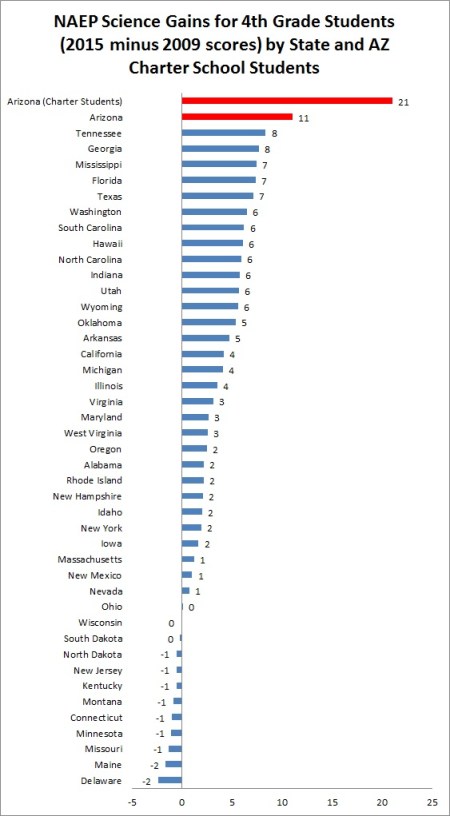
4th-grade-science-gains-charter

The overall picture in Arizona is one marked by robust accountability (losing students and money) rather than double secret probation accountability. The state turned off the A-F accountability system two years ago to revamp it in light of new tests. Word has reached my ears that the State Board recently had the opportunity to consider a formal written proposal to include student vegetable consumption in the school A-F grading formula.

No I’m not making that up. I also heard they decided not to move forward with the proposal. I’m comforted by the widespread use of the Greatschools website, which has their own ranking system and parent reviews. Overall the Cactus Patch has a vibrant bottom up accountability system (vrai pas faux) while still having to go through the motions on what appears to these eyes to be a relatively dysfunctional system of normal compliance activities amounting to…I’m not sure just what.

So it is great to have Scottsdale Unified competing in the choice mix. It makes me happier to pay my taxes than I otherwise would be. Should Arizonans want still more parental choice?


Parents to Technocrats-mind if I cut in?

February 9, 2017

(Guest Post by Matthew Ladner)

Mike Petrilli published a piece on charter school authorizing and oversight in response to Jason and Jay. Before the fun starts, let’s just note the following:

  1. State authorities are going to occasionally close charter schools whether I, Mike, Jay, Jason or anyone likes it or not. Let’s therefore not worry about whether or not we should close a charter school caught having students sacrifice goats to Baal out on the playground- it’s going to happen.
  2. Whether or not this is going to happen or even should happen is not terribly relevant. Mike cites a 3% estimate for charters closed by authorities over academics. I’m personally comfortable with a far higher closure rate. So long as parents take the lead, I’m not going to sweat some authority jumping in front of the parade to close the Baal school.
  3. Ultimately therefore the debate should be about how to get to a policy environment where parents are taking the lead on quality control.

The reasons for this are ultimately very practical. Technocrats make mistakes and many do not develop the close relationships and sweat the details behind test scores the way Mike describes. More to the point all of these schools have access to the legal system, can lawyer up, engage in delaying tactics, get their parents riled up to resist closure etc. It is genuinely worth asking whether the juice is worth the squeeze in many cases.

Meanwhile, when parents close a school there is no resistance, no lawsuits, no delaying tactics. This is the most potent and brutally efficient form of accountability by a very wide margin. Now…breather deeply…

…close your eyes…

…channel your inner Rick Hess and think broadly about what sorts of policies and practices can get you there…

…do you see it?…yes….

Now…you are back on the green…nicely done….yes and now you are doing it again…

Good…very good…yes both of those states scored a 9/33 on NACSA’s ratings but rocked the 2015 NAEP like an 80s hair band trashing a hotel room suite that had it coming. Breathe even deeper…do you see a role for an all-powerful command and control technocrat in this vision?

No? Good-me neither. Light touch stuff inevitable, heavy-handed stuff risky and counterproductive, parent lead highly desirable. I don’t think there is a whole lot to argue about.

Okay open your eyes now. I think we have this all sorted out!


Good reads

February 3, 2017

(Guest Post by Matthew Ladner)

The WSJ detects the Stockholm Syndrome of the six-inch Dark Lord of Nightmares MA Charter School Association and Eli Broad.

Derrell Bradford earns a BOOOOOOM! by explaining to the charter school bear that the hunter has plenty of bullets left for them.

So does Max Eden by exposing the NYT phony “analysis” of Detroit charter data.

Mike McShane joins the fun by explaining how our notions of accountability need an update.

Rick Hess cautions choiceniks to be careful what we wish for from the feds.