Another ESA momma bear attack spotted in the Arizona Republic letter page

August 15, 2017

(Guest Post by Matthew Ladner)

If you are squinting  at your iPad, this letter basically asks where the calls for oversight were when her child’s district received $26,000 from the state and the district delivered an hour of speech therapy with a side order of indifference. “Before we attack and try to defund the ESA program that is doing a lot of good things for disabled kids, maybe we should look into the lack of oversight and accountability in our public schools.”


Monday Links

August 14, 2017

(Guest Post by Matthew Ladner)

Andy Smarick turns in an interesting article on the Structure of Scientific Revolutions and education reform in National Affairs. Great article, although I believe Smarick’s article would profit by acknowledging almost catastrophic flaws in school district democracy, including often extremely low voter turnout rates and resulting opportunities for regulatory capture.

Kate Walsh on K-12 progress that is going unnoticed. Before this college success of charter school meme gets entirely out of hand, I want to suggest that we should get the comparisons between control group and experimental group studies on long-term success nailed down before going to town on this. We do have reason to suspect those applying to charters are different from those that don’t.

Interesting article on Why Education is the Hardest Sector to Automate by Raya Bidshahri.

Yours truly on Arizona Horizon debating ESAs with SoS leader Beth Lewis.


Recall Challenge for Arizona ESA expansion

August 10, 2017

(Guest Post by Matthew Ladner)

Anti-choice activists delivered 111,540 petition signatures to the Arizona Secretary of State’s Office two days ago in advance of the deadline in order to subject SB 1431 (2017 ESA expansion) to a vote of the public. Whether or not this will result in the number of legally required valid signatures remains unclear- judging from the previous history of validity rates it is very likely to be close either way. It will take weeks before we have a final answer. Only the expansion of the program, rather than the program itself, faces uncertainty. The program will continue to operate for the students eligible under the previous law without interruption.

What “Save Our Schools” group has done is both impressive and misguided. The chattering classes in Arizona, including me, were broadly skeptical regarding their chances. Gathering signatures out in the summer Arizona heat is an indicator of real passion. Their fury however were deeply misplaced. The real victims here are the hundreds of parents who had submitted an application to the Department of Education to participate and the larger number who had planned to apply.

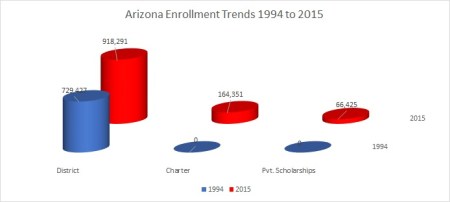
Last Friday at a public Arizona Talks debate, Zeus Rodriguez made the point that the question of whether to have parental choice and the question of how much to spend on public schools are entirely separate decisions. Choice opponents seem to fail to appreciate that school funding decisions are reached democratically (both directly and indirectly) and that districts remain (by far) the best funded option both in absolute and on a per student basis. The fixation on the ESA program as a boogeyman is especially odd. Approximately 3,500 students participated in the AZESA program last year- we have multiple individual high schools with more students. Whether you examine numbers of students or dollars invested, the absurdity of blaming private choice for every district grievance becomes clear:

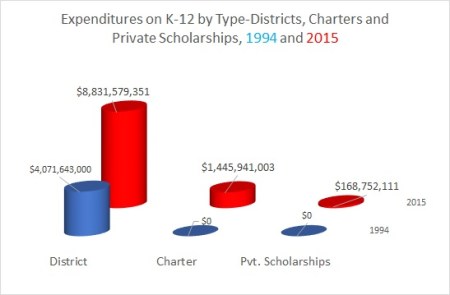
and in terms of dollars:

Funding for K-12 education is guaranteed in the Arizona Constitution and this provision enjoys the broad support of the public. It is under no threat from anyone as far as I can tell. The history of the last 22 years demonstrates that even the district portion of public education has more kids and more money than when parental choice experiments began. Fast growing states do not in other words face a zero sum game. Had Arizona choice supporters been out to “destroy public education” in the state the two charts above demonstrate that this imaginary effort would have to be judged a spectacular failure.

Fortunately, our real project is entirely different.

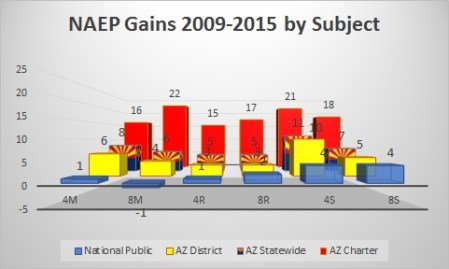
The evidence supporting the real project (improving variety, diversity and performance) is much stronger. Arizona has more choice options than any other state, and alone among all states made statistically significant progress on all six NAEP exams for the entire period that we can track all exams (2009-2015). When you net out significant declines from increases the typical state saw one significant increase during this period.  Arizona students made more progress on math 2009 and 2013 as 4th/8th graders, and then did it again between 2011 and 2015. This of course does not prove that choice caused the improvement, but when you take a close look at the gains, it is very difficult indeed to argue that they have hurt:

Stay tuned to see what happens next. My sympathies lie entirely with the families who just had an opportunity yanked away just before the start of the school year.


Innovators and Laggards in Southern Arizona

August 7, 2017

(Guest Post by Matthew Ladner)

The Tucson Daily Star carried an (unintentionally) amusing vignette on education policy. Arizona has a growing teacher shortage. Baby Boomers retiring, fewer students going to Colleges of Education, etc. Old hat to long-time JPGB readers such as yourselves. So last session the legislature decided to show a bit of respect to “local control” and give school districts more flexibility in hiring. Arizona charter schools have been hiring non-certified teachers for 22 years now and it seems to be working just dandy on the whole, so why not give districts the same larger pond in which to fish for talent?

I must have seen my friend Janice Palmer, the former lobbyist for the Arizona School Boards Association who now works for the Helios Foundation, attempt to remind legislators that they believe in local control umpteen dozen times over the years. Moreover I am entirely confident that I saw but a small fraction of the total number of such appeals. Districts want local control-so here it is!

So what’s the problem? Nothing much, except most of the districts in Tucson either don’t want it or can’t quite figure out what to do with it. From the Daily Star:

The measure, approved in May, was designed to get more teachers into classrooms, yet weeks before the school year was set to begin, Tucson-area districts reported having nearly 200 openings to fill.

Tucson’s largest school district, TUSD, made up the bulk of those vacant teaching positions, with 120 as of Wednesday, July 26. Still, TUSD said it plans to place long-term substitute teachers in classrooms rather than hiring people with no formal training.

“We’re big advocates of teacher certification programs, believing that teaching kids is an art and you learn that in teacher education programs,” said TUSD interim Superintendent Gabriel Trujillo. “I don’t want to make the assumption that someone without certification would be bad for kids. There are a lot of wonderful adults who would do well by kids … I would say they wouldn’t be as effective as a teacher as somebody who is fully certified.”

Well then let’s check the research-paging Dr. Gordon. Dr. Robert Gordon of the Brookings Hamilton Project. Dr. Gordon? Oh here you are:

So certification path seems to have approximately nothing to do with student learning gains. Colleges of Education shouldn’t feel too bad as I am sure that medical schools in the Middle Ages also suffered from this sort of thing. And of course the “long-term substitutes” theory tends to often work out as “revolving door of instructors inflicted on kids” rather quickly in practice.

Ah well, not all is lost in southern Arizona. The district with the strongest reputation for innovation-Vail Unified to the south of Tucson-took a different approach. They decided to use their new freedom.

The Vail School District, recognized as one of the top achieving districts in the state, however, has decided to give noncertified teachers a shot, putting 40 people with no formal training into classrooms.

As a result, Vail started the new school year two weeks ago with no vacancies in a regular classroom.

“That was a huge accomplishment,” said Vail Superintendent Calvin Baker. “If you look at what’s happening in other school districts in the county, many have over the last couple years as the teacher shortage has become more acute, often students were starting the school year with a substitute teacher. We had to do that in the last couple years and we managed to avoid that this year and we did that because in part we had access to a larger pool of candidates.”

But the Vail School District isn’t just hiring anyone, Baker said.

Of the 24 elementary alternative certification teachers, 17 are Vail School District parents.

“I think that’s a really important statistic because it indicates that the alternative teachers we are hiring, most of them are not just somebody we met or just on a fluke decided to apply and we hired because we are desperate,” Baker said. “These are people we know because their children are going to school here and often their principal said, ‘You should apply.’ And these are people who know us and who have trusted their children to us and have a very strong commitment to making sure our schools are of high quality.”

Superintendent Baker was quick to add that liberalized certification is not a cure-all for the teacher shortage (I agree) but kudos to him for starting the year with a teacher for every classroom. And call me crazy but hiring people who have skin in the game and have already been volunteering and training them up sounds like a great idea.

Tucson Unified kids have been transferring to Vail schools through open enrollment in large numbers for many years. If TUSD parents find their kids getting the revolving door treatment, they should consider doing the same.


Wonk Action Shot!

July 28, 2017

IMG_0087

(Guest Post by Matthew Ladner)

Shot from Denver of some of my favorite folks…


The Ambition of Delaware’s ESSA plan

July 26, 2017

(Guest Post by Matthew Ladner)

Taking up where Jason left off the topic of USDoE labeling Delaware’s ESSA goal to cut the number of low-performing students as “not ambitious” I decided to look at NAEP gains in Arizona. You may or may not have heard, but Arizona students have been leading the nation in NAEP gains in recent years basically regardless of how you measure gains. Arizona was the only state that saw a statistically significant gains on all six NAEP exams for the entire period we can track all of them (2009-2015). When you subtract declines from gains the average state landed at +1. Measured on a cohort basis, Arizona students lead in gains between 4th grade in 2009 and 8th grade in 2013, and lo and behold they did it again between 2011 and 2015.

Arizona students did not however come remotely close to reducing the percentage of students scoring “Below Basic” by half on any of the NAEP exams on a statewide basis.

Not.even.close. You can track NAEP scores for Arizona’s super-high flying (on average) charter sector from 2005 to 2015, and even they don’t show that kind of progress and those folks moved a majority-minority student body into New England NAEP score range on all six tests.

The ESSA statute calls for “ambitious” rather than “completely fantastic” goals.


Parents Administer Frontier Justice in Wild West Charter Schools

July 18, 2017

(Guest Post by Matthew Ladner)

Parents out west administer quick frontier justice to undesired charter schools and the results are pretty awesome in today’s 74.

Yippie kai yay!


What Went Right?

July 6, 2017

(Guest Post by Matthew Ladner)

I was one of the people who decided to read more about Islamic history after 9/11. Half way through Bernard Lewis’ book What Went Wrong? it occurred to me that Lewis had asked the wrong question. Lewis explored the question of why the Islamic world had gone from arguably the world’s leading civilization to a relative backwater. By the time this had happened however most of the world was a relative backwater in relation to western Europe. The more relevant question therefore in my mind is not “what went wrong” everywhere else but rather “what went right in the West?”

This thought came to mind when reading David Griffith’s paen to regulation in choice programs. David asked “Is there a state in the union with strong oversight, robust market supports, and a low-performing charter sector?” Actually yes there is- NACSA’s top ten state charter sectors are nine miles of bad road interrupted by a unique one-off in Louisiana towards the bottom of the ten.

Griffith writes “Yes, there are a few states where charters have achieved strong results despite a weak framework for intervening in low performing schools, or a dearth of quality authorizers, or limited parental supports. There is an exception to every rule.” Arizona, Colorado and Utah all display the high NAEP/low NACSA score combo. They are not alone btw. By “high NAEP” I mean “near or above Massachusetts scores.” By “low NACSA” I mean a score of 8 or 9 on the NACSA rating before the most recent NAEP. Other flourishing charter sectors, which display either some of these same types of rock star scores in the case of Florida, or else significant advantages over district performance in the case of DC, also dwell outside the top 10 NACSA rated charter laws.

Griffith seems to have mistaken the exception for the rule. It is a simple matter to point to multiple examples of the high NAEP/low NACSA score combo. The high NACSA/high NAEP combo is actually very rare. This is either because top rated states have charter sectors too small to meet NAEP reporting standards-like Indiana and Nevada- or just still struggling after all these years despite the benevolent regulation of the state like Texas.

Now it might be a coincidence that we see high NAEP/low NACSA combos aplenty in the 2015 NAEP. The 2017 NAEP will be released in October. I expect the data to show us more of the same, but time will tell. It could also be a coincidence that voucher programs in Louisiana and Indiana experienced unusually low private school participation rates and struggled academically in the early year evaluations. Some of us started sounding alarm bells on the participation rates before the test score evaluations became available. You don’t need a random assignment study to tell that something is wrong with a voucher program that 70% of private schools choose to avoid, just a bit of common sense. The random assignment studies then did tell us something was indeed wrong, and then a helpful survey of schools pretty much nailed down why it happened. Griffith seems to believe that the problem with LA vouchers is under-regulation. There seems to be an abundance of evidence however that the opposite is true.

So getting back to Lewis, I am convinced that the right question is “what went right in Arizona, Colorado, DC, Florida, Utah etc?” rather than just “what went wrong in Ohio?” Under what set of circumstances can parents take the lead in putting down undesired schools with brutal efficiency? What factors lead this to working in some jurisdictions, but flopping in others? Texas went down the high regulation road in 2001, and well…let’s just say it does not bode well for Ohio.

Even if my friends with a preference for high levels of regulation had evidence to suggest that their approach has benefits (currently lacking) their yearning to apply a one-size-fits-all approach on 50 states with wildly varying needs would still be unwise. Nevada for instance can take little comfort from their high NACSA rating as they continue to suffer extreme levels of public school overcrowding with only a few dozen charter schools. There are hundreds of thousands of children on charter school wait lists in neighboring states with more welcoming charter school laws-why would operators in the surrounding states give Nevada a second thought? This is not a game, and these policies have very real consequences. This fall I will be sending the three Ladner children back to two fantastic charter schools. If either of these schools slips I have other options. Also this fall uncounted thousands of Nevadans will be sending their kids to portable building to meet the first of what will be a series of substitute teachers for the year. These parents have little in the way of other options. What is the case for keeping things this way in Nevada?


Arizona ESA Momma Bear Mauls Arizona Republic in LTE

June 29, 2017

(Guest Post by Matthew Ladner)

#!!BOOOOOOOOM!!

I’ll give the Republic credit for running the letter, but totally agree with Mrs. Visser.


LGK on Arizona’s “Wild West” Charter Schooling

June 28, 2017

(Guest Post by Matthew Ladner)

Lisa Graham Keegan takes to the pages of Fordham to talk about lessons learned out here in the Wild West in When Regulating Charter Schools Proceed with Caution. Lisa raises the point that other policies, including A-F school grading, may have contributed to our success. I suspect that she is entirely right about that, but to me this is the money quote:

Moreover, Arizona’s “wild” charter journey led to many low-income, highly performing charter management organizations that can only be found in the Grand Canyon State. Many are community-focused and community-developed, which we all say that we want, but their first priority was on stabilizing the communities they grew from. In other words, they weren’t very good academically to start—but they did transform their neighborhoods, and parents trusted these new schools with their precious children over many other options that went out of business due to lack of enrollment. Years later, many of them, like Academies of Math and Science, Mexicayotl Academy, and Espiritu Schools, are now among the top performing schools in not just the state, but in the country, and were highlighted in last week’s Education Equality Index. The thing is, it took a decade to do that. And we Arizonans let it happen.

Translating this into Ladnerese- if Arizona had five year charters and default closures we might have arbitrarily closed some schools which blossomed into very high performing operations that now do a great job with disadvantaged kids. I use the word might because even if the Arizona Charter School Board had gone hillbilly nuts technocrat (Hey man- hold my beer while I close this school- this gonna be AWESOME!) the schools in question would have got their parents riled up, hired lawyers to engage in delaying actions, etc. I for one am happy that the schools LGK mentions could focus their energies on improving academics rather than fighting a bureaucratic guerrilla war.

Meanwhile these schools faced a much harsher form of accountability- from Arizona parents. Hundreds of Arizona charter schools have closed, and their average length of existence is 4 years, with an average of only 62 students in the final year of operation. If you live to see year 5 as an Arizona charter school, you are probably doing something right because everyone wants your students- your home district, fancy school districts like Scottsdale, Madison and Chandler are playing the open enrollment game, the other charter schools, and the private schools with the assistance of choice programs.

Frontier justice does not allow for parents to appear at a hearing to vent their anger, or for lawyers to file motions, or allies to lobby their political contacts for reprieve. The parents simply never enroll and/or walk away, there are private efforts to explain the reality of the situation to those institutions needing hospice care to wind down, and meh and sub-meh bleeds out on a dusty street full of hot lead. Some of you don’t believe this. Some of you don’t want to believe this. Well…just maybe…