AFT Goes Up in Smoke

August 6, 2008

(Guest Post by Matthew Ladner)

[Editor’s note — See new post on “Broader, Bolder” here.]

P.J. O’Rourke once described the early Clinton administration as “running the country by dorm-room bull session.” Some recent ferment among education progressives makes me wonder if they too have fallen back onto some old college habits. Catherine Johnson over at Kitchen Table Math for instance wrote on Randi Weingarten’s first speech as AFT President. Weingarten engages in NCLB bashing, and then lays out a vision for the future of public education:

“Imagine schools that are open all day and offer after-school and evening recreational activities and homework assistance … and suppose the schools included child care and dental, medical and counseling clinics, or other services the community needs,” Ms. Weingarten said. “For example, they might offer neighborhood residents English language instruction, GED programs, or legal assistance.”

Personally, I’m trying to imagine a system of public schools that could teach 4th grade kids how to read after spending $40,000 or more on their education. In 2007, 34% of American public school 4th graders scored below basic in reading on the NAEP. If we can’t trust schools to teach kids how to read, just why would we want them trying to fix our teeth or attempting to resolve our legal issues?

Weingarten echoes the “bigger and bolder” crowd, who seem to believe that schools can become more effective by becoming less focused on academics. Given the AFT opposition to standardized testing, these schools social welfare centers will ideally be free to thrive without the burden of academic transparency.

This of course is precisely the wrong direction to take. Paul Hill recently conducted a series of studies for the Gates Foundation concerning the stubborn lack of academic progress despite increased public school spending. After a series of studies, Hill reached the conclusion:

“…money is used so loosely in public education – in ways that few understand and that lack plausible connections to student learning – that no one can say how much money, if used optimally, would be enough. Accounting systems make it impossible to track how much is spent on a particular child or school, and hide the costs of programs and teacher contracts. Districts can’t choose the most cost-effective programs because they lack evidence on costs and results.” (Hat tip: Nevada Policy Research Institute’s Steven Miller)

Summarizing then, public schools have yet to do a cost-benefit analysis on the nearly $10,000 per year per child they are already spending. They therefore have a very poor idea about which of their activities help achieve the goal of producing a well educated child, and which do not. They, in essence, just do what they do, which certainly helps explain how a school system could burn through tens of thousands of dollars without teaching a child to read.

Let me be specific. In Arizona, 44% of 4th graders score below basic in reading. Despite that fact, we have elementary school days that include a regular coursework in art, music and physical education. These offerings are of course enriching and wonderful for many children. Why however would a 3rd grader who can’t read be taking courses in art or music? We know that children not gaining basic literacy skills in the early grades are all but doomed to academic failure.

Could it be the case that schools should reallocate their resources under the theory that one’s lifelong ability to appreciate music and art would be greatly enhanced by learning how to read?

We’ve got quite a problem to sort out here and I will submit that the last thing we would want to do is get schools even less focused on academic achievement. It isn’t hard to imagine burning through even more money while still failing to teach basic academic skills to large numbers of kids: schools have been doing it for more than 40 years.

(edited for typos)


Pass the Popcorn: Baron Munchausen Turns 20

July 31, 2008

(Guest Post by Matthew Ladner)

The Ladners spent time this July in Prescott to escape the summer heat of Phoenix. The Raven coffee bar has been showing the films of Terry Gilliam on Monday nights, which meant that I had a chance to visit an old friend: The Adventures of Baron Munchausen.

Released in 1988, Baron Munchausen was one of the greatest film fiascos of all time. Budgeted at $23m, it cost more than $46m. Worse still, Columbia pictures was being sold at the time of release, meaning that they only got it out onto a handful of American screens, which translated into an $8m American box-office take, $15m worldwide.

Ooops. The only equivalent brilliant move I’ve seen was Miramax releasing The Grindhouse slasher-zombie flick during the Easter season, giving them a total box office take of me going to see it twice.

Looking back at the film now, I can only wonder: how in the world did Gilliam make this movie for only $46m? It’s many times more visually interesting than several films I could name with far larger budgets and supposedly superior technology available (yes, I am looking at you George Lucas).

Fiasco though it may have been for the studio, for a viewer, the Baron is a pure delight. I’ve seen the film included on lists such as “Cool movies no one saw” and “Children’s Films That Adults Will Love.” It’s all that, and more.

I’ve always loved the film, as the main character reminded me very much of my grandfather: German, very charming, sometimes grouchy, a flirt with the ladies, full of tall tales, and always in search of adventure. Oh, and I suppose that the massive crush I had on Uma Thurman 20 years ago didn’t hurt.

The Baron, a character out of German folklore, finds himself disgruntled to be living in “The Age of Reason.” The Baron sets forth to save a city from the armies of the Grand Turk by finding his former extraordinary servants, encountering gods and monsters and literally cheating death along the way.

The movie had an all-star cast, including small parts by Robin Williams and Sting. Columbia’s loss is your gain: Netflix it now, and did I mention that Gilliam reenacted a certain famous mythological painting?

Yeah, well, the movie is better than the painting.


Should You Redshirt Your Kindergartener?

July 31, 2008

(Guest Post by Matthew Ladner)

“Redshirting” children (having children start school at an older age) has become a fad. Some parents have held children back from entering kindergarten with the idea that their child will benefit academically from being older and/or more mature. According to research by Sandra E. Black, Paul Devereux and Kjell G. Salvanes at Vox (an interesting hybrid between a blog and an academic journal for economists) this fad is like many previous education fads: intuitively plausible but actually worthless.

The researchers were able to isolate the impact of late school starting from those of mere age by comparing Norwegian military IQ tests of students born on December 31 to those born on January 1st :

The administrative rule in Norway is that children must start school the year they turn seven. Children born on 31 December start school a year earlier than those born on 1 January – even though they are almost exactly the same age. This provides an exogenous separation between age and school-starting age.

Result: age matters but not school-starting age. Would-be redshirt parents can relax, or more likely, seek an edge some other way.


USA Today: Parental Choice Popular in Sweden

July 25, 2008

(Guest Post by Matthew Ladner)

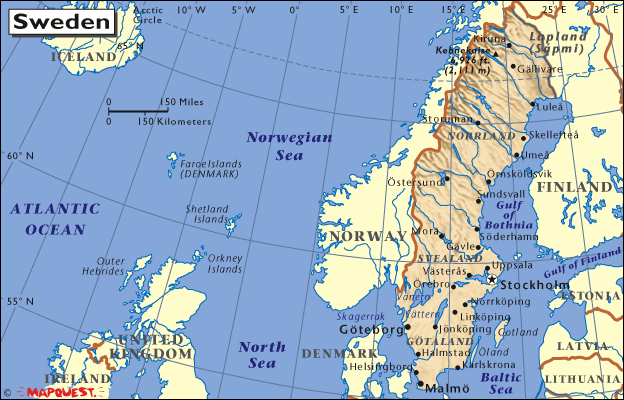
Sweden, of all places, went for government funding of private school attendance in 1992. The quasi-market system has proven very popular, so much so that even the teacher unions don’t complain about it.

Perhaps next they will go really crazy and outsource their bus services, to the delight of Greg and Andy.


Private Choice and the Disruptive Technology Model

July 24, 2008

(Guest Post by Matthew Ladner)

Christensen has made the case that online learning is a disruptive technology: competing against non-consumption, filling niches, and on the way to becoming a much more prevalent practice. I have been thinking lately that a similar model may apply to the private school choice movement.

One big difference: private choice often competes against demonstrable failure in the public system rather than non-availability of schooling at all. Inner city students in Cleveland, for example, have access to public schools. The problem isn’t that they don’t have access to schools at all; it is that the schools they do have access to often perform outrageously poorly.

Thus we experience political difficulty in promoting private choice. It would be much easier to compete against non-consumption. Ironically enough, a Democratic State Senator in Texas proposed just this sort of bill last year: a school voucher bill for dropouts.

The modern choice movement began in Milwaukee in 1990 when a group of frustrated inner-city Milwaukee Democrats teamed with Republican Governor Tommy Thompson to create the Milwaukee Parental Choice Program.

Since 1990, we’ve seen the creation of Milwaukee-like programs in Cleveland and Washington DC, failing school vouchers in Louisiana, Ohio and Florida. Lawmakers have created broad eligibility tax credit programs in Arizona, Illinois, Georgia and means-tested tax credit programs in Arizona, Florida, Iowa, Minnesota, Pennsylvania and Rhode Island. Voucher programs for children with disabilities have passed in Arizona, Florida, Georgia, Ohio and Utah, and Arizona passed the nation’s first and (as yet) only voucher program for foster care children.

Some in the movement would look at this list and say the movement needs to refocus on inner city programs. Some resentment towards the success of the special needs programs (5 and counting) has been expressed. These sentiments reflect deeply held value preferences.

I however disagree with them.

The passion of the progressive private choice movement is to provide the opportunity for low-income inner city children to have the chance to attend a high quality school. This is a passion I share, obsessively. Low-income inner city children are too often trapped in schools so dysfunctional that no one reading this would even think having their own children attend. Using the Rawls criteria of justice- if those schools aren’t good enough for your children in theory, then they aren’t good enough for disadvantaged children in practice.

Children with disabilities, however, have an equally compelling case for choice, and may in fact be the most poorly served children and frustrated parents in the public school system. Pop quiz: would you rather be born to a low-income family in an inner city, or the son of a billionaire with autism? The current IDEA system promises an “Individualized Education Plan” for children with disabilities, but all too often involves simply filing out the paperwork to prevent a successful lawsuit. Children- especially minority children- are often mistakenly shunted into special education due to poor reading instruction and effectively if not purposely left to rot academically in the most blatant and vivid example of the bigotry of low expectations imaginable.

In case for foster children is also compelling- having already rolled snake-eyes in their opening roll in life, children in foster care bounce from home to home, and thus because of attendance boundaries, from school to school. Ultra-frequent transfers between schools effectively destroy any chance they have to make academic progress.

Anyone for giving these kids a chance to attend a stable set of schools over time free from the disruption of attendance boundaries? Good- me too.

Thinking again of the disruptive technology model- inner city poor children are a niche that we should passionately seek to aid through parental choice. They do not however constitute the entirety of students extremely poorly served by the public school system. Children in failing schools, dropouts, English language learners, foster care children, free and reduced lunch children, functional illiterates, and special needs children are all demonstrably poorly served in the public school system.

One argument made used to be that special needs programs could not demonstrate systemic effects on public schools. This is no longer true. Nor is the case for the failing schools model. Don’t get me wrong: I prefer larger and broader programs to smaller ones, every day of the week. I’m most interested in helping as many poorly served children to get as much access to a broad array of school choices as fast as possible.

The passage of special needs bills were followed by choice bills with a broader set of eligibility in both Utah and Georgia. From a disruptive technology perspective that is a good thing.

From a disruptive technology perspective, the problem with say, Wisconsin would be that they haven’t moved on to new aid disadvantaged children in different niches. There are low-income children in places like Racine, for example, moving through dropout factory schools. Children with disabilities around the state could benefit enormously from a special needs voucher bill.

Ohio, on the other hand, started with a means-tested bill focused on Cleveland, and then moved on to a bill for children with autism and a statewide failing schools bill. Choice efforts in the state now focus on moving to a full blown McKay bill. Bully for them.

Florida’s programs focused on free and reduced lunch eligible children (Step Up for Students Tax Credit), special needs students (McKay Scholarship Program) and students in failing schools (Opportunity Scholarships). That’s a good start to build on, and Florida has overcome a very contentious debate on choice to develop bipartisan support and strong statewide public school improvement.

Once again: I’ll have what Florida is having.

(edited to correct typo)


Dan Lips Interviews the Chef

July 22, 2008


(Guest Post by Matthew Ladner)

Dan Lips interviews Jeb Bush about education reform on National Review Online today.


Pass the Popcorn: Black Belt Jones

July 18, 2008

(Guest Post by Matthew Ladner)

A few weeks ago, we covered the great cinematic saga of Truck Turner, a multisensory journey through a pimp civil war in 1970s Los Angeles. Your humble correspondent reported that, without a doubt that Truck Turner represented the most delightfully over the top Blaxploitation film.

There is however one contender to the supremacy of Truck. Filmed in the same year (1974) by same filmmakers and using 8 of the same actors as Truck Turner, the film Black Belt Jones is also a cinematic masterpiece of the genre.

The plot of BBJ revolves around an African-American Kung-Fu school in downtown Los Angeles. THE MAN, in this episode portrayed stereotypical Italian mobsters, wants to get their greedy clutches on the kung fu shop so they can destroy it and build a convention center. Remember, no Institute for Justice back in the 1970s.

Scatman Crothers runs the school, and THE MAN begins putting the screws on him to sell his property. Sadly, given his advanced age, years of drinking, gambling and carousing, Scatman’s Kung-Fu powers had grown weak, and he dies during a confrontation with the mob.

Scatman’s death draws the attention of the School of Kung-Fu’s most illustrious alumni, Black Belt Jones, played by the great Jim “Dragon” Kelly. PSSSSRSSST! goes the can of instant whoop-ass that Jones opens up on the spaghetti-eating mobsters.

Now, Black Belt Jones isn’t just about Black empowerment, but also women’s liberation. Jones gets help in his war against THE MAN from the daughter of Scatman, Sydney. Her kung-fu powers are equal those of Jones, and she knows how to put a sexist pig in his place-

Great moments in Women’s Lib

In any event, Netflix BBJ. You’ve never seen fights on a train, the use of undergarments as a weapon in a car chase, or a soap bubble filled climatic battle at a car wash before, but trust me, you need to in order to be that well-rounded highly educated person your mother always wanted you to be.


Bolick on School Choice and the Election

July 17, 2008

(Guest Post by Matthew Ladner)

Clint Bolick, recovering from an accident in Wyoming, nevertheless managed to hit the Wall Street Journal this week on education and the Presidential election:

Education is slipping in priority among many voters but not among Hispanics, many of whom see school choice as a deciding factor in whom to vote for this fall. This has implications for the presidential election.

A new poll shows that 82% of Hispanics consider education as one of three most important issues facing this country. The survey also shows that, even while Hispanics trust Democrats over Republicans on education by more than a two-to-one margin, that ratio could change if Republicans heavily promote school choice while Democrats oppose it.

The poll was conducted last year among more than 800 registered Hispanic voters for the Alliance for School Choice and the Hispanic Coalition for Reform and Educational Options, but never publicly released. It was conducted by two polling firms, The Polling Company (which works primarily for Republicans) and the Ampersand Agency, (which polls mostly for Democrats).

This survey found that although Hispanic voters generally consider public schools to be effective, they also favor, by a wide margin, school choice (defined as allowing parents a choice in whether to spend their children’s education dollars in public or private schools).

Fifty-two percent of Hispanic voters have a favorable view of school choice, according to the poll, while only 7% had an unfavorable view. When asked about vouchers specifically, 32% expressed a favorable opinion compared to 13% unfavorable.

But where the poll really gets interesting is on school choice as an electoral issue: 65% of those surveyed reported that they would be more likely to support a candidate for office who supports school choice, including 35% who said they would be “much more likely.” Only 19% said they would be less likely to vote for a pro-school choice candidate.

These numbers were high regardless of whether the person was of Mexican, Puerto Rican or Cuban descent. They also transcended party affiliation: 67% of Republicans, 70% of independents and 63% of Democrats preferring pro-school choice candidates. And 70% of those who prefer pro-school choice candidates — including 66% of Democrats — said they would cross party lines to vote for a candidate who supports school choice over one who opposes it.

Barack Obama has hinted at being open to serious education reform. Before the Wisconsin primary in February, he praised Milwaukee’s highly successful school-voucher program. But, facing furious criticism from the establishment, which is disproportionately influential in Democratic politics, he backtracked.

John McCain has been a consistent supporter of school choice and passionately endorsed it during one of the Republican debates, although the issue is far from a mainstay of his campaign. His appointment of pro-school choice former Arizona Superintendent Lisa Graham Keegan as his campaign’s top education adviser may signal a new emphasis.

Sen. Obama will count heavily on teachers’ unions for support. The unions, though, have nowhere else to go. Hispanics do. If Mr. Obama opposes school choice, he will cede to his opponent a huge opportunity to make inroads among Hispanic voters — if Sen. McCain seizes it.

Hispanic votes will be crucial in key battleground states, including Florida, Colorado, Nevada and New Mexico. George W. Bush won 40% of Hispanic votes in 2004, but support slipped to 30% for GOP congressional candidates in 2006. Mr. Obama fared poorly among Hispanics in the presidential primaries, while Mr. McCain carried 74% of Hispanic votes when he won re-election to the Senate in 2004. All that adds up to this: Hispanics voting on school choice could tip the balance of the election.

Hispanic voters are overwhelmingly young and have exhibited a propensity toward political independence — and no issue is more tangible for them than educational opportunity. If Hispanics align their voting with the educational interests of their children, it could alter the electoral landscape — not merely for this election, but permanently.


I Love It When a Plan Comes Together

July 15, 2008

(Guest Post by Matthew Ladner)

Recently I wrote about Arizona’s system of testing having jumped the shark. The cut scores for the AIMS had been dropped severely, and the state’s version of the Terra Nova exam spun a tale of Arizona students scoring above the national average in every grade and subject tested. Arizonans were asked to believe this, despite having a very difficult to educate K-12 population and NAEP scores below the national average in every test given since the early 1990s.

I am pleased to say that the Arizona legislature, acting in a bipartisan fashion, took corrective action. Essentially they limited the current testing contracts to a single year, and appointed a commission to design a new testing system, specifying the use of a college readiness exam as a graduation exam along the lines of the Michigan model with the ACT.

The challenge now will be for the commission to create a challenging, consistent system of testing providing proper transparency for parents, teachers, administrators and policymakers. The first step was to admit that there was a problem, which the Arizona legislature has now done emphatically.


John Rawls and Education Reform

July 9, 2008

(Guest Post by Matthew Ladner)

Matthew Miller’s book The 2% Solution utilizes the philosophy of John Rawls to make the case for parental choice in education. I’m more of a Nozick guy myself, but let’s follow the Rawls rabbit-hole down to the bottom.

John Rawls’ hugely influential work A Theory of Justice argued that societal ethics ought to be decided as if we were behind a theoretical “veil of ignorance.” Behind the veil, no one would be aware of what his or her position would be in a forthcoming society. You would not know whether you would grow up the child of a billionaire or poor in the inner city. The veil creates an incentive to leave a path out of the latter scenario. While many contest Rawls’ philosophy, it is hugely influential in left of center thinking. Does today’s system of public education remotely approach the Rawlsian ideal?

No, not even close. In fact, today’s public education system closely resembles the opposite. Today’s system systematically disadvantages the poor.

Consider the expanding body of research on teacher quality. Researchers have shown that the effectiveness of individual teachers plays a huge role in student learning gains. Examining test scores on a value added basis (year-to-year gains) has revealed that some teachers are hugely effective, while others are much less so.

What we have not had before is quantifiable evidence regarding just how important high quality teachers are in driving outcomes. Researchers examined the differences between teachers succeeding in adding value (the top 20% of teachers) and the least successful teachers (the bottom 20%). A student learning from a low quality teacher learns fifty percent less than a similar student learning from an effective teacher during the same period.

The question then quickly becomes: how do we get more teachers that are effective into the classroom? Only by making big systemic changes. Teaching is a profession with many rewards, but which has been tragically divorced from any recognition of merit. The teacher who works effectively and tirelessly is paid according to a salary schedule that will treat them identically to someone who does neither.

Job security and summers off are not big lures for the capable and ambitious sorts of people we need to attract into teaching in droves. To be sure, we have such people in our teaching ranks now, but the system treats them poorly. Our public schools do not pay them according to productivity- no rewards for success, no sanctions for failure. In short, we treat teachers not as professionals, but as unionized factory workers.

Most of our capable teachers will leave the profession frustrated, or go into administration. Those that we do keep in the classroom cluster in leafy suburbs far from the children who need them most.

What does the public system do for those children losing the Rawls lottery, who find themselves growing up in poor urban school districts? All too often, it assigns them to schools with decades long histories of academic failure. These children will serially suffer ineffective instructors.

Frighteningly high percentages of these students will never learn to read at a developmentally appropriate age. Many will never learn to read. Such students fall further and further behind each year. Unable to read their textbooks, never envisioning themselves advancing on to higher education, they will begin to dropout in large numbers in late middle school.

Fortunately, it is not hard to envision a better system. Public schools today are spending beyond the dreams of avarice for administrators from previous decades. We simply need to get a much better bang for our buck. A captive audience of students sponsors and promotes adult dysfunction in our schools. We should radically expand parental choice options for parents, especially for those for disadvantaged students.

More broadly, our students desperately need a complete overhaul of the entire system of human resource development and compensation for teachers. The system we have today largely reflects the preferences of the education unions. The education unions oppose parental choice, merit pay for teachers, alternative certification or differential pay based on teacher shortages. All of these positions are rational for a union boss, but detrimental to children.Progressives have traditional ties with organized labor, including the education unions. This marriage will not last.

Ask yourself if you would risk today’s education system from behind Rawls’ veil. There’s a good chance of being forced to go to school in the Dallas, DC, Detroit, Los Angeles, Newark or the_________ (fill in the blank with the closest large city) inner city public schools.

That sickening feeling in your stomach is telling you that those schools would not equip you with the skills you need to succeed in life. Rawls would say if those schools are not suitable for you in theory, then they are not suitable for inner city children in practice. Liberals should work closely with the education reform community in order to secure equality of opportunity for all children. Progressives can either have progress, or they can have an alliance with educational reactionaries, but they cannot have both.