(Guest Post by Matthew Ladner)
The chief education advisors for the McCain and Obama campaigns debate next week online. Check it out.
(Guest Post by Matthew Ladner)
The chief education advisors for the McCain and Obama campaigns debate next week online. Check it out.

Perhaps children will read better by the light of my Broader/Bolder money bonfire…
(Guest Post by Matthew Ladner)
John Rawls’ influential work A Theory of Justice argued that societal ethics ought to be decided as if we were behind a theoretical “veil of ignorance.”
Behind the veil, no one would be aware of what his or her position would be in a forthcoming society. You would not know whether you would grow up the child of a billionaire or poor in the inner city. The veil creates an incentive to leave a path out of the latter scenario.
Matthew Miller’s reading of Rawls calls for the aim of public policy to be the creation equality of opportunity, rather than equality of condition. But how much of a path do public schools actually represent for disadvantaged children?
Gauging opportunity is tricky, given that we really only have information on the equality of condition. Let’s be brave and speculate. The percentage of free or reduced price lunch students scoring “Advanced” on the 4th grade NAEP reading test in 2007 was — drumroll – two.
That’s right. Two percent- two point zero. While this was double the one point zero from 1998, it is hardly satisfying.
Mind you, total per pupil spending as of 2004-5 was $10,725. So, a child that has been in the average public school in this country since kindergarten will have had somewhere in the neighborhood of $55,000 spent on their education by the time they reach 4th grade.
Might we not get two percent scoring advanced in the complete absence of a public school system? If we spend $55K per kid to improve their opportunities, shouldn’t we be doing a lot better than 2%?
Some of course will grumble that the Advanced level on NAEP is simply too high a bar to expect an economically disadvantaged child to clear. So, let’s go down a level- 15% of free and reduced lunch kids score “Proficient” on 4th grade reading. Add in your two scoring Advanced, and you have 17% of low-income children reading at a high level.
In return for the taxpayer’s $55,000, we get 83% of our low-income children reading at less than a high level. Half of these children score “Below Basic.” Here is NAEP’s definition of Basic in 4th Grade Reading:
Fourth-grade students performing at the Basic level should demonstrate an understanding of the overall meaning of what they read. When reading text appropriate for fourth-graders, they should be able to make relatively obvious connections between the text and their own experiences and extend the ideas in the text by making simple inferences.
That doesn’t sound like a great deal to ask for $55,000 and five years of schooling- but half of the nation’s low-income children didn’t get there in 2007.
Now, we actually have NAEP data for one urban school district- Washington DC. DCPS shells out over $20,000 per year per student. So, a 4th grader has “benefited from” more than $100,000 of funding. Or, at least someone has benefited. DCPS had exactly zero point zero low-income students scoring at the advanced level in 2007. Well, not precisely zero- the NAEP footnotes note that the number “rounds down to zero.”
Six percent of DCPS low-income 4th graders scored Proficient or better, 29% at Basic or better, and 71% at Below Basic.
Regardless of your philosophical viewpoint, these results simply cannot be credibly defended. When the Texas Rangers overpaid for Alex Rodriquez and found themselves in last place, the General Manager noted that he could be in last place with the lowest rather than a sky-high payroll. DCPS is in the same boat. Give me half of the DCPS budget as an incentive program for kids to read books at the library, and I’ll get you more than zero kids scoring as advanced readers.
Education is the key to social mobility. Those who believe in Rawlsian ideals will be facing the reality that they can either have an alliance with the defenders of the status-quo, or they can have an effective K-12 path out of poverty, but they cannot have both.
 3 Comments |
  politics | Tagged: DC Public Schools, John Rawls, Matthew Miller, NAEP |
  Permalink
 Posted by matthewladner
(Guest Post by Matthew Ladner)

Next up....raining frogs.
Lots of tough games coming up…I’m going to enjoy every minute of it.
2 Comments | college sports | Permalink
Posted by matthewladner
(Guest Post by Matthew Ladner)
Stock portfolio taken a dive? Cheer up…you could be running a gin-joint in a third world country controlled by the Nazis and run into your long lost love, only to find that she is married to the leader of the resistance.
Leave a Comment » | economics | Tagged: Casablanca, Dooley Wilson, Knock on Wood | Permalink
Posted by matthewladner

(Guest Post by Matthew Ladner)
I have an admittedly odd appreciation for left-wing protest songs. For my money (sorry baby-boomers) there is none finer than Tracy Chapman’s Talkin’ Bout a Revolution. Released in 1990, Chapman’s spare and urgent song delivers an ominous warning:
Don’t you know they’re talking about a revolution?
It sounds like a whisper
While they’re standing in the welfare lines
Crying at the doorsteps of those armies of salvation
Wasting time in unemployment lines
Sitting around waiting for a promotion
Don’t you know they’re talking about a revolution?
It sounds like a whisper
Poor people are gonna rise up
And get their share
Poor people are gonna rise up
And take what’s theirs
Although stirring, the underlying assumptions of this song are dead wrong. Income redistributing revolutions obviously have a romantic appeal to some, but rather sordid history in practice. Ask the Russians.
Anti-poverty strategies fall into two broad categories: redistribution plans and growth oriented plans. One can either try to take wealth from one group and give it to another, or else focus on creating more wealth for everyone.
Today, the growth strategy stands triumphant.
A recent World Bank report, for example, finds that we are living in a golden age of global poverty reduction. The World Bank notes that economic growth is producing a “spectacular” decline in Asian poverty. In 1990, there were over 470 million people in the East Asia and Pacific region surviving on less than $1 a day. By 2001, there were 271 million living in extreme poverty- a 42.5% decline.
The World Bank projects that by 2015 there only 19 million people will be living under such squalid conditions- a 96% decline in twenty-five years. A complete elimination of extreme poverty in this region seems entirely possible well within our lifetimes, thanks to high rates of economic growth and job creation. Free market policies are lifting millions out of poverty, in stark contrast to the catastrophic consequences of income redistribution policies of socialist and communist regimes.
Other parts of the world, notably Africa, have not been doing nearly as well. A broad consensus now exists in explaining the reason. The work of Hernando de Soto on development economics, for instance, has convinced observers from Bill Clinton and Kofi Annan on the left to Ronald Reagan and George W. Bush on the right that a system of property rights is absolutely critical to allowing economic growth and thus eliminating poverty. Why do some countries remain mired in poverty? People cannot own property such as land, they cannot reliably contract with each other. Rotating cliques of kleptocrats often take turns using government as an instrument of theft, corruption, and oppression. Poverty will not decline without addressing these fundamental flaws, regardless western aid.
One does not need to look abroad for examples of growth reducing poverty. In 2006, the Goldwater Institute released a study comparing the relative success of states in reducing poverty during the 1990s. The study found that during the 1990s, on average high tax states had increases in poverty rates during the booming economy of the 1990s, while low tax states on average saw larger than average declines.
Economic growth (or lack thereof) can quickly make a big difference in poverty statistics. Mississippi began with the highest poverty rate in the country in 1990, twice as high as California’s poverty rate (25% compared to 12.5%). Enjoying the benefits of economic growth, Mississippi’s poverty rate dropped by 20% in the 1990s, while poverty increased by 13.6% in California. If such rates were to be sustained (by no means a given) then California would overtake Mississippi in poverty rates by 2010.
As we struggle through the current financial crisis, we must take care to remember the radical success of free trade and free market polices have produced in reducing poverty. Those who promoted free trade, property rates and lower taxes weren’t just talking about a revolution: they delivered one.
8 Comments | economics | Tagged: Free Market Economic Reform, Poverty Reduction, Tracy Chapman | Permalink
Posted by matthewladner
(Guest Post by Matthew Ladner)
Ok- so I don’t like Bill O’Reilly, don’t watch his show, etc.
I also think that he should have made a more substantive case against Frank. Anybody who buys stock based on what some Congressman says on CNBC, after all, is asking for trouble, especially if it is Barney Frank.
Having said that, Frank’s story he tries to get out about doing something about the Freddies as soon as he became chairman is simply revisionist spin.
3 Comments | economics | Tagged: Bailout, Barney Frank, Bill O'Reilly, Credit Crunch | Permalink
Posted by matthewladner
(Guest Post by Matthew Ladner)
And the winner of the greatest bad movie of all time….
The rest of the flicks are going down! It’s gotta be that way!

Barney Frank’s version of events in the $700b taxpayer heist, bailout, rescue plan.

A sequel? You’ll have to pay me $50m, bro! Go Netflix Speed 2 if you want to see what happens in a Keanuless Keanu sequel…

2 Comments | Pass the Popcorn | Tagged: Point Break | Permalink
Posted by matthewladner
(Guest Post by Matthew Ladner)
Las Vegas (AP) Casino companies have entered into talks with the Ladner and Loftis LLP regarding a possible recapitalization of select Las Vegas Resorts.
Unable to resist economic gravity as in previous economic downturns, Las Vegas casinos have been laying off employees. “Las Vegas casinos are a great American institution,” noted James Loftis “the government got us into this mess, and the free market is going to have to get us out.”
“Vegas casinos face a short-term liquidity crunch. We will provide needed financial assistance,” noted Matthew Ladner. “We may even MAKE money on this deal!”
The precise assets to be purchased remain under negotiation, but are likely to include many hours at the tables, cigars, drinks out by the waterfall at the Wynn, multiple bets on college football games, and an umbrella drink or three by the pool.
L&L partners wouldn’t comment on ongoing negotiations, but rumors say that the bailout weekend may occur on the weekend of October 18th. The L&L partnership are raising funds from potential equity partners, or better yet, taxpayer funding.
“If we are going to subsidize real estate speculation, why not blackjack? It’s much more fun,” Ladner stated.
UPDATE: L&L officials confirmed the securing of a line credit from the newly formed Strategery Capital Management, LLC. An L&L official anonymously commented “Laissez Les Bon Temps Roulez!”
2 Comments | economics | Tagged: Bailout, Credit Crunch | Permalink
Posted by matthewladner

(Guest Post by Matthew Ladner)
Public school officials have come to resemble the kids at college football games holding up the sign “Hi Mom! Send More Money!” Public school officials constantly call for additional resources, a call that lawmakers have answered. Nationally, inflation adjusted spending per pupil nearly quadrupled between 1959 and 2004. Unfortunately, there was very little evidence of increased student learning during that period- NAEP scores have been largely flat since the late 1960s despite the increase in funding.
One state, however, has figured out how to utilize the insatiable appetite of schools for additional funding as a carrot to improving student performance.
Florida education reforms not only have improved early childhood literacy, but have also prepared a higher percentage of minority children for college work. Governor Jeb Bush pushed a One Florida Initiative, which sought to replace race based affirmative action with more effective instruction: better preparation rather than lower standards. The results have been impressive.
Working in partnership with the College Board beginning in the year 2000, the One Florida plan sought to increase the academic achievement of Florida’s students, particularly underrepresented in universities. The comprehensive plan included professional development for teachers and counselors and free PSAT exams for students. Florida officials created AP Potential – a web-based tool to identify promising students for AP coursework.
The program relied heavily on incentives, creating an AP Teacher Bonus – $50 for every passing score, up to $2,000. The program also created an incentive for the school, paying the school an additional bonus of $650 per student passing an Advanced Placement exam. Florida officials carefully wrote this bonus into the funding formula so that it went to the school, not to the school district.
The reformers didn’t stop there, however. Florida’s A-Plus reform plan assigns letter grades to schools based upon student performance. The One Florida plan provided an additional school bonus of $500 per student passing an AP exam for schools rated “D” or “F.” The idea was to set high expectations and to reward success.
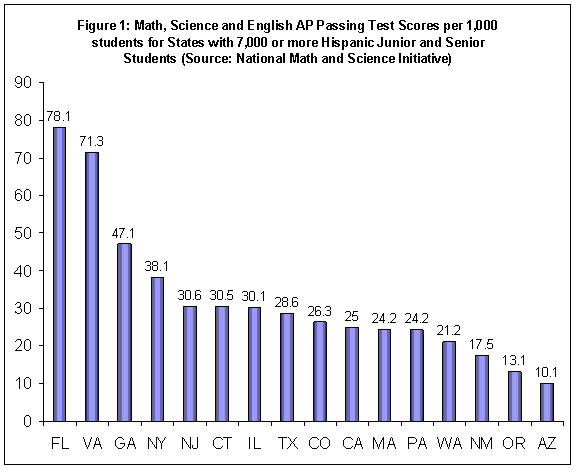
The National Math and Science Initiative recently collected data on the number of students passing AP exams, broken down by ethnicity. Figure 1 presents the number of Hispanic students having passed an AP exam per 1,000 junior and senior Hispanic students. Florida not only leads the nation in Hispanics passing AP exams, they do so at a rate nearly 8 times greater than that of my home state of Arizona.
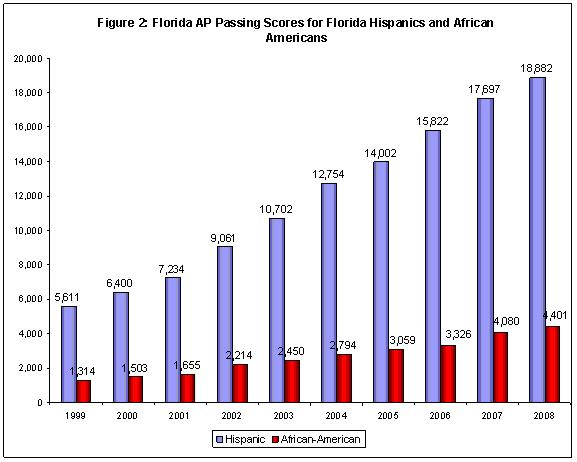
Do schools respond to incentives? Judge for yourself: between 1999 and 2007, the number of Florida students passing AP tests increased by 154%. Figure 3 below shows that the number of Florida Hispanic and African American students passing an AP exam more than tripled between 1999 and 2007.
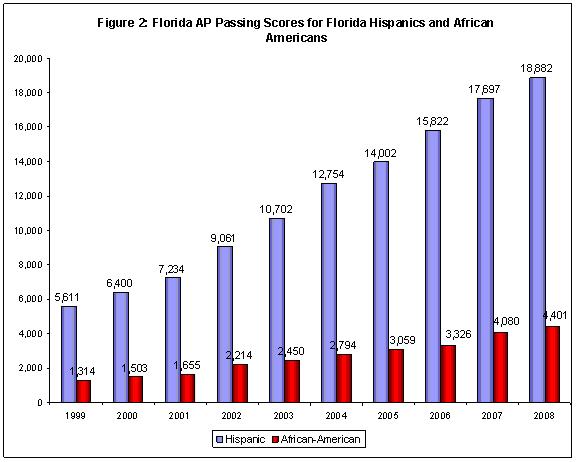
Florida’s education reformers achieved these results for what ultimately amounts to a tiny portion of the Florida K-12 budget. Floridians should not be satisfied with these results, but should be proud of this level of progress- and work to extend it.
The next time the public school establishment calls for additional resources in your state, the question should not only be whether they should get them or not. The question should also be “in return for what?” Pay for performance is an excellent idea for education funding.
In Florida, high-schools get more money the old fashioned way- they earn it.
8 Comments | instructional reform | Tagged: Florida education reform | Permalink
Posted by matthewladner

(Guest Post by Matthew Ladner)
If I live to be 120 years old, I won’t live to see a statement so brazenly and knowingly mistaken as the one uttered by Congressman Barney Frank (D-MA) regarding the current financial crisis: “The private sector got us into this mess. The government has to get us out of it.”
Say the statement out loud. Swish the sour taste in your mouth. This statement is the precise opposite of the truth. As chairman of the House Financial Services committee, Frank knows better.
It was in fact the public sector that got us into the subprime mess: specifically, government sponsored entities Fannie Mae and Freddie Mac. These “Government Sponsored Entities” engaged in social engineering in the housing market by buying up reckless mortgages. Perversely, lenders now had no incentive to consider the credit worthiness of borrowers, as they could quickly off-load even absurd mortgages to the GSE’s.
On September 30th, 1999 the New York Times reported on Congressional efforts to expand subprime lending. “Fannie Mae, the nation’s biggest underwriter of home mortgages, has been under increasing pressure from the Clinton administration to expand mortgage loans among low and moderate income people and felt pressure from stock holders to maintain phenomenal growth in profits,” the Times reported.
“Fannie Mae has expanded home ownership for millions of families in the 1990s by reducing down payment requirements,” Franklin Raines, former Clinton administration official and Fannie Mae chairman told the Times. “Yet there remain too many borrowers whose credit is just a notch below what our underwriting has required who have been relegated to paying significantly higher mortgage rates in the so-called subprime market.”
Raines made this statement as a justification for Fannie Mae easing the credit requirements on loans purchased from lenders. In other words, Fannie blew even harder into the housing bubble. “By expanding the types of loans it will buy, Fannie Mae is hoping to spur banks to make more loans to people with less-than stellar credit ratings,” the New York Times reported.
See video on unsuccessful efforts to rein in Freddie and Fannie from 2004-2005 here:
Sadly in all of this, the housing market social engineers were unable to suspend the law of unintended consequences. Bartenders became would be real estate moguls, and the lenders played along collecting fees secure in the knowledge that when it all went south, they wouldn’t be left holding the bag. Speculative bubbles thrive on someone making a quick buck, drawing others into trying to do the same. Freddie and Fannie fueled the bonfire of stupidity.
The ultimate blame lies not with the lenders, but rather with those who created the perverse incentives.
Sadly, similar economic myths have been promoted in the past, and still afflict us to this day. As a university student, I was fed the story of how the Great Depression proved the ultimate failure of free-markets, and how the administration of Franklin Roosevelt heroically saved the nation from crisis.
This version of history is also very much at odds with the truth. Research by Milton Friedman and others has firmly established that the Stock Market Crash of 1929 played only a limited role in creating and sustaining the Great Depression. Rather, a series of policy errors by Congress, the Hoover Administration (creating a global trade war), the Federal Reserve (tightening monetary policy during a contraction) and the Roosevelt Administration (too many errors to list) created a prolonged downturn.
The United States had suffered plenty of stock market crashes, and economic downturns. What stands out about the Great Depression is not that it happened, but rather that it lasted so long due to a series of tragic missteps.
This too provides a lesson for today: the main thing we should fear are not bank failures or stock market declines, but rather the rushed and foolish actions of politicians. The only thing we have to fear is not fear itself, but rather fear and reckless government mistakes.
Congressman Frank, who defended Freddie and Fannie from attempt to rein them in after scandals emerged, was even so brazen as to dismissively put this crisis “back to Ronald Reagan, when at his inauguration he said, ‘Government is not the answer to our problems; government is the problem.’”
Sorry Congressman: Reagan got it exactly right and you have it precisely wrong.
20 Comments | economics | Tagged: Barney Frank, Credit Crunch | Permalink
Posted by matthewladner


 Jay P. Greene's Blog