Dave Saba of the American Board for Certification of Teaching Excellence (and of Friday Fish Porn fame) recommends that education reformers adopt a comprehensive education reform plan to improve public schools with as many credible strategies as possible. A must read.
Tina Fey as Sarah Palin: “John McCain and I, we’re a couple of mavericks, and gosh darn it, we’re gonna take that maverick energy right to Washington and we are gonna use it to fix this financial crisis and everything else that is plaugin’ this great country of ours.
Queen Latifah as Gwen Ifill: How will being a maverick solve the financial crisis? What will you do?
Tina Fey as Sarah Palin: You know, we’re gonna take every aspect of this crisis, and look at it, and ask ‘What would a maverick do with this situation?’ and then, you know, do that.”
Mike, pally, careful with the maverick talk! You’ve got to at least give us all some space from the election so that just hearing the word doesn’t sound like fingernails scratching a chalkboard.
Leo over at EdWize (the AFT blog) has posed the question: “When you have spent that last decade telling everyone who would listen that public schools should be for sale, on what grounds do you complain about someone who would sell a Senate seat to the highest bidder?”
Leo has a different recollection of my past decade than I do, as I don’t remember ever telling anyone that public schools ought to be for sale, much less doing it constantly. Never mind that however, I think that Leo is on to something here. The prime targets for leveraged buyouts are companies whose stock valuation falls below the value of their assets. This of course only occurs through gross mismanagement, where companies become worth less than the stuff they have lying around. The management of such companies should be seen at best as incompetent, and at worst as rent-seeking leeches drawing paychecks while destroying value.
Many American school districts likely fall squarely into just such a state of mismanagement- taking $10,000 per year per student, but failing to teach 36% of 4th graders how to read, and failing to get half of African American and Hispanic student to graduate from high school. These are simply averages, and obviously many districts contribute far more than others.
Leo, you are a genius. We can put together a LLC to do the LBOs once the credit crunch ends. Who could be better at defeating the poison pill strategies of the leeches than a former AFT guy?
Leo, you do not yet realize your importance: with our combined power, we can destroy the leeches- they have foreseen this. Join me, and we can put an end to this destructive conflict, and bring learning, order and profit to the nation’s schools.
The Arizona Supreme Court heard arguments today in the case against the two voucher programs for special needs students, and for children in foster care. You can read the Arizona Republic account here.
Andrew Morrill, Vice President of the Arizona Education Association, notes in the article that public schools are “transparent.” Well, the NAEP does find that 74% of children with disabilities in Arizona public schools score below basic in 4th grade reading, which is significantly worse than the 64% nationwide average. So…Morrill has got me there, but unfortunately for him, the transparency of which he boasts reveals an appalling lack of effectiveness.
If we’d like to equal the amount of transparency for private school students, well, we will need to get the NAEP to increase the size of their private school sample. The state’s testing system…well, don’t get me started.
I had the opportunity to listen to about half of the oral arguments. I’m not a lawyer, and I don’t play one on TV, so I was awfully confused by many of the assertions made by the bad guys. As it stands, plenty of Arizona students are educated at private schools at public expense and have for many years, and that is okay, so long as it is the school districts doing the choosing of private schools.
If you have the parents do the choosing, however, the ACLU would have you believe THAT, now that is unconstitutional.
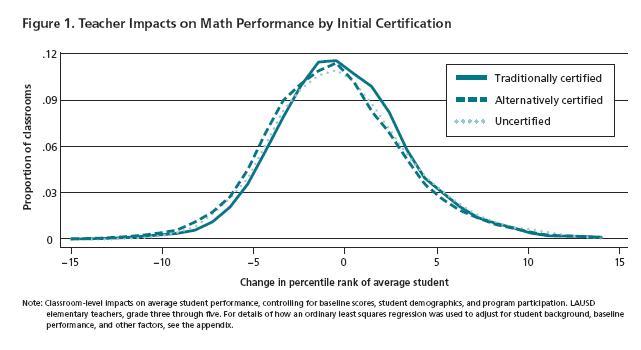
This chart from Brookings is one of the most important education charts I’ve seen in several years. Rather than me going on about why I think that is, super edu-nerd bonus points for you if you do so in the comments section. We are all about community here a JPGB!
Ed Sector’s Kevin Carey’s article on the technological transformation of American higher education is a must read. Carey’s article leaves much to discuss, but a bottom line conclusion is that computer based learning at traditional universities is improving instruction, lowering costs and moving us in the direction of outcome based assessment- all very positive developments.
The other story however is that many universities are pocketing the efficiency savings and jacking up tuition, making undergraduates even bigger cash cows than they used to be. Higher education is on an unsustainable path, and yet Carey writes:
Long-prosperous colleges risk finding themselves in the perilous state of the newspaper, with competitors using the Internet to drive down prices in businesses that were once profit leaders. That would be a mixed blessing, at best. The Web is a boon for those who need to access higher education at a distance. For colleges that have grown complacent and inefficient—and there are many—a dose of fiscal reality would do them good. But the financial cross-subsidization at the heart of the modern university also sustains much of what makes it a uniquely valuable institution, more than a mere conveyer of credits and degrees. Much as newspapers use classified advertising to support money-losing foreign bureaus, subsidized scholarship makes huge contributions to the scientific, cultural, and civic lives of the nation. The University of Phoenix does not.
Carey is of course correct about the huge contributions of university academic departments which cannot financially sustain themselves. I suspect however that the costs of many such departments are far greater than their benefits. It’s not a stretch, for example, to view, say, a Sociology department with a large number of faculty and few students as a group of self-indulgent rent seekers whose dead-weight cost helps drive up tuition and wastes taxpayer money. Mind you, there has been some great work done by sociologists, but there seems to be much more taxing of plumbers to subsidize coffee house revolutionaries going on.
Not just to pick on the Sociologists, when I was a Political Science graduate student in Texas, my fellow graduate students and I once counted up the number of Ph.D. programs in political science in the state. We wondered “do we really need so many?” The answer was obvious: no, hell no.
I think Carey’s use of the newspaper analogy is an apt one- it just hasn’t happened yet. A little Schumpeterian creative destruction in higher education seems long overdue.
If you’ve never watched the BBC House of Cards series, you need to rectify this gaping hole in your life immediately. Go to Netflix, type in House of Cards, get them delivered. Watch them. The second installment is called To Play the King, and the third The Final Cut. Get started without delay.
Michael Dobbs- a former aid to Prime Minister Thatcher- provided the source material. Ian Richardson, a stage veteran and founding member of the Royal Shakespeare Society, turned in a performance for the ages as the completely-evil-but-appealing Machiavellian Francis Urquhart. Known simply and appropriately by his initials “FU”, Dobbs and Richardson created one of the most delightfully sinister characters you’ll ever have the chance to secretly root for, whatever your feelings of guilt for doing so.
FU is the Chief Whip of the British Conservative government who cheats, lies, steals, bullies and murders his way to the top with ice cold precision and with aristocratic gentility, humor and style. The series debuted on the BBC just as the Conservative Party had thrown out Thatcher and replaced her with John Major. It quickly became a national sensation. FU’s frequent refrain “You might very well think that. I couldn’t possibly comment” entered into the British pop lexicon and remains there to this day.
Try it sometime. It actually is a handy phrase.
In this scene, FU makes his move against the weak John Major like Prime Minister who he has dutifully served but consistently undermined. Ben Landless, a media mogul, is readily identifiable as a character based upon Rupert Murdoch.
Richardson’s portrayal can only be described as inspired. FU frequently addresses the audience en route to perform some new work of villiany. His knowing smiles to the camera are simply priceless. One reviewer noted:
His depiction defines menace and cold cunning but his ultimate success lies in his ability to make Urquhart simultaneously loathsome and likeable. The audience may be repelled by his ruthlessness, but his wit, coolness, preening intelligence and conspiratorial asides to camera combine to make this minister a strangely charismatic monster.
In one scene, FU has done something terrible- had some of his aides killed and made it look like an IRA bombing, or something worse. FU isn’t too fussy to occasionally perform an occasional murder himself, or to order troops to open fire on unarmed crowds.
Riding in the back of his Jaguar limo after some such offense , he looks at the camera and chides you for getting “squeamish.” Urquhart intones with what came to be known in Britain as “the voice”:
Britain needs strong leadership. You voted for strong leadership, andeverything I do, you partake of it.
If that doesn’t make you want to take a shower, well, nothing will. Usually I recommend things that are so bad they are good, but this is just good. Very, very good.
The University of Texas system has emphasized transparency in recent years. The following table comes from a UT Austin report, comparing UT finances to peer institutions.
State Appropriations plus Tuition & Fees per Full Time Equivalent Student, Fiscal Year 2006
University of Texas at Austin
$13,560
UC Berkeley
$23,470
UCLA
$25,210
University of Illinois Urbana
$16,060
University of Indiana Bloomington
$16,710
University of Michigan Ann Arbor
$23,830
Michigan State University
$17,370
University of Minnesota Twin Cities
$23,200
University of North Carolina Chapel Hill
$26,220
Ohio State University
$19,850
University of Washington Seattle
$18,270
University of Wisconsin Madison
$16,580
DCPS
$24,600
Ok, so this isn’t precisely the table- something has been added. While most of these are first rate public universities, one of them is one of the nation’s most dysfunctional school districts-the District of Columbia Public Schools (DCPS). The number for DCPS is a spending per pupil figure computed by Cato Institute scholar Andrew Coulson.
So don’t hurry off to the comment section to complain that universities have other sources of revenue-granted they do- research grants, private gifts, etc. But I think any fair minded person would have to concede however that modern American universities spend money in ways that would make a drunk sailor blush. Paragons of frugality they are not. Universities are also engaged in an activity inherently more expensive teaching K-12 skills- no school district needs to hire legions of people holding Doctorate degrees in order to be successful. The total spending per pupil are much higher for these universities, but much of that spending has next to nothing to do with student education.
Notice however that the money spent per pupil in DCPS would cover all the tuition, fees and state appropriations to send expenses for all of these institutions other than UCLA and UNC Chapel Hill, where it comes very close.
Take the least expensive option on the list. UT Austin ranked as the 15th best University in the world according to the Times of London in 2004. UT Austin employs 2,300 full time faculty members, 51% who were tenured, including Nobel Prize winners, etc. etc. UT Austin has esoteric departments with few students, and things like atom smashers and a nuclear reactor, seven on campus museums, seventeen libraries with 8 million volumes, a Gutenberg bible and many other obscenely expensive ornaments.
And yet…almost two students can attend UT Austin for spending per pupil in DCPS. I could dwell on just how bad DCPS test scores are, but that would be cruel. As the Joker burned his cash bonfire, he told stunned onlookers “It’s not about money, it’s about sending a message.”
With absurdly high spending and tragically low scores, what message does DCPS send?


 Posted by matthewladner






 Jay P. Greene's Blog