So the recent closing of BAEO has me reflecting a bit. The Milwaukee Parental Choice Program passed in 1990, followed by the first charter school statute in 1991 in Minnesota. This makes the choice movement a millennial. Like many millennials, the education choice movement is still a little rough around the edges, still a little up in the air about whether she’s going to pull it all together. She does show promise, but just might be holding herself back despite some lessons learned the hard way that she does not quite, really want to confront and accept. Lessons like:
Needless to say, there are more, which you can add in the comments. I for one am optimistic that our sometimes out of sorts millennial is going to make it after all.
New Year’s Eve was the end of an era with the closing of the Black Alliance for Educational Options (BAEO). The PISA data show just how vital BAEO’s mission remains. Developing countries like Chile and Estonia outscore American Black students despite spending a fraction of what American schools spend per pupil. It staggers the imagination to believe that the structure of our incredibly generously funded K-12 system plays no role in this appalling state of affairs imo.
So…let’s start with the good news: despite dire predictions of apocalypse, human civilization is still alive and kicking. No global trade wars broke out, the economy shows signs of life. If you google around a bit you can learn things like that the Trump administration is running at about half of the pace for deportations from the Obama administration peak.
That’s all I have to say about that. Ok I take it back-you should also read this. Keep your fingers crossed.
It should be obvious now that this was overwrought. As it happens 2017 goes into the books as a mixed year on the choice front, contra the fears of DeVosaphobes. Advances in Illinois, North Carolina and Wisconsin were offset by a setback in Nevada and a cliffhanger in Arizona. The initial drama surrounding the prospect for federal legislation eventually simmered towards an incremental approach sans apocalypse. Kentucky passed a charter school law, but not one likely to produce many charter schools. There are people getting excited for and against the 529 provision, but color me mostly meh. Other provisions of the tax bill may wind up being more significant.
There was a lot of discussion of ESSA plans. I’m not sure why. Perhaps 2018 will see more of the ESSA cottage industry think through the implications of NGO school rating systems. What’s that? Okay I’ll mark my calendar for 2084. Later?!? Fine. Meanwhile approximately 3,650,000 additional Baby Boomers reached the age of 65 in 2017. No one on either side of the aisle in DC seemed to notice. Arguments over inaugural crowd sizes and Russian conspiracy theories took precedence. Excuse me 2018? I’ll have another 3.65m please! Oh and send the check over to the kiddie table.
Perhaps the most encouraging news I heard this year came from the Modern States Project. MSP developed MOOCs and free online textbooks designed to allow students to pass AP/CLEP courses for only the cost of the exam (~$85.) This looks like a straightforward solution to the credit problem, at least in lower level courses and inches the ball closer to free.
The 2017 NAEP will be released in a few months. Election years don’t usually serve as the setting for broad K-12 reforms, but my money is on Greg beating Mathews yet again.
So still no spoilers here, but as a Gen Xer I have to say that the generational overtones between the Boomers and the Millennials in the new Star Wars flick make me chuckle. Luke as an old crazy guy is just…appropriate. That it was the next generation that helped drive him over the edge is…spot on. Where have you gone Master Obi-Wan? Our galaxy turns its’ lonely eyes to you.
Spoiler free review: I loved it, want to see it again. One subplot too many, but still very good. If “there is always a way to blow it up” sums up The Force Awakens, the title of this post summarizes this film. New ranking:
The Arizona Republic requested a FOIA for emails between the Arizona Department of Education and the Goldwater Institute concerning the ESA program. In those emails they found…a giant nothing-burger. I am a Goldwater alumnus and participated fully in the creation of the original ESA program. This opens me to charges of bias, but it certainly makes me familiar with the subject at hand. I don’t believe there is any bias in the case I will lay out below. That case is as follows: it is utterly routine for agencies to interact with stakeholder groups from all sides on all issues-including (dun! Dun! DUN!!!!!) the Goldwater Institute. Requesting the emails of a single group hardly begins to paint a remotely full picture of what goes on, and this article fails to make a case even within the confines of a narrow perspective provided by the emails of the single group.
You’ll have to read the article and navigate a great many assurances that there is something coming in the nothing-burger before you get to the end and are left with basically nothing. But along the way you get treated to gems like:
Special interests often write concepts for legislation or offer drafted bills and then lobby lawmakers to pass them. But Goldwater’s attempts to exert control over the Empowerment Scholarship Account program, from idea to implementation, was highly unusual if not unprecedented, experts say.
“This is almost an iron grip-level of influence from the beginning of the process on,” said Thomas Holyoke, an associate professor of political science at California State University-Fresno, who studies interest groups and lobbying.
Dr. Holyoke might need to go outside a bit more often. Let’s start with some basic facts. Arizona is a pluralistic democracy. Anyone and everyone in Arizona is completely free at any time to write emails to elected officials or agency officials. This happens non-stop and will continue to do so (God willing) for as long as Arizona exists. It is in fact one of the reasons agencies have email systems, but they also receive letters, phone calls, and various other forms of communication. They often meet with people in person. It is the gambling that goes on in the casino of American democracy, and everyone is invited to play.
I can assure you that ESA opponents have also been in frequent communication with the Arizona Department of Education officials as well, as have lots of other groups and people on this and lots of other issues. If one is inclined to create conspiracy stories, you don’t need to request emails.
Here I’ll do it now just for fun and to show how easy it is to do: one of the officials who helped oversee the administration of the ESA program was the son of a former President of the Arizona Education Association and currently lobbies for the Arizona School Boards Association. Another left the Arizona Department of Education to lobby for the Arizona Education Association. Perhaps all of those administrative problems that the Republic has documented over the years are like on purpose man! Maybe the Goldwater Institute was emailing the department because THE MAN doesn’t like kids having the ability to control their own education!!!
It’s like a CONSPIRACY!!!!
Just to be clear I don’t have a problem with either of these individuals- happy to have a drink with one or both of them on occasion when they are tolerant enough to hang out with Dr. Evil at a social event. And for the record, I don’t think that the Arizona Empowerment Scholarship Program has been the victim of conspiratorial administrative sand-bagging. The administration of the program has challenges to be sure. This however is true of many things in a Department that, for instance, sends Title I and IDEA funds to the wrong schools, and has had the state’s student data system in years past crash for months at a time. It’s true that there have been issues with ESA program administration, deeply infuriating ones in fact, but this is basically true of a great many things and is unfortunately par for the course.
Previous reporting from the Republic has shown that the Arizona Department of Education has not spent even close to the full amount appropriated for program administration in prior years. The Republic has documented administrative shortcomings, and recounts some of this in the current article. If the Goldwater Institute wielded all-powerful “iron grip” influence, do we imagine that the Department would leave resources lying around and serious problems with program administration unaddressed? After all, what they want is for the program to work smoothly. Parents who sign an agreement with the state only to find the state fails to fund their accounts on time for instance tend to get angry. Bully for Jonathan Butcher for trying to go to bat for them.
In short I’m having a hard time spotting a conspiracy in this, either in motive, methods or outcomes.
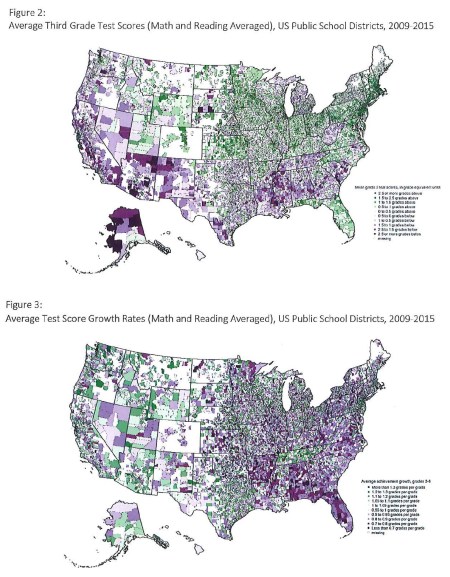
Fascinating new study from Stanford University’s Center for Education Policy Analysis using standardized test scores from 45 million students to track academic growth in over 11,000 school districts. The study tracks progress from grades 3 through 8. The money graph comes on page 33 and is included above. Just to save your eyes from squinting, let me provide a play by play: the top map shows average 3rd grade scores by district. Purple is low, green is high.
The second map shows academic progress over time between grades 3 and 8 between 2009 and 2015. Again purple is low, green is high.
Ok so just to (once again) brag on the Cactus Patch, you’ll notice that everything and anything on the top map bordering Canada looks green, anything and everything bordering Mexico from the Rio Grande Valley to So-Cal looks purple on the top map. Many decades after Senator Moynihan noted that the average performance on state tests is highly correlated with proximity to Canada, it remains the case today.
Cast your gaze down to the second map and you’ll see some signs for hope-most prominently in my book Arizona flipping from almost entirely purple to mostly green in growth. BOOOM!
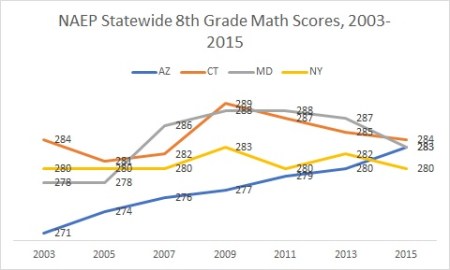
Now before I get comment section bricks thrown my way from the Dr. Eponymous, let me hasten to add that these results while relying upon state test scores, are entirely consistent with Arizona’s NAEP results in Arizona’s case. Given that there is no ability or incentive to teach to the NAEP, I feel reasonably confident that either the academic knowledge or the testing “give a darn” of Arizona students (or some combination thereof) is on the rise. I interpret either of these things as very welcome developments and I’m not overly concerned about the mixture.
It is also worth noting that since these results focus only on school districts with the highest statewide percentage of Arizona students attending charter schools, and Arizona charter schools exceeding districts in academic growth on NAEP (see below), that the above charts underestimate Arizona’s total progress between 2009 and 2015. Arizona is does the purple to green flip with only the yellow columns in the below NAEP graph (same period as the Sanford study): * see correction below
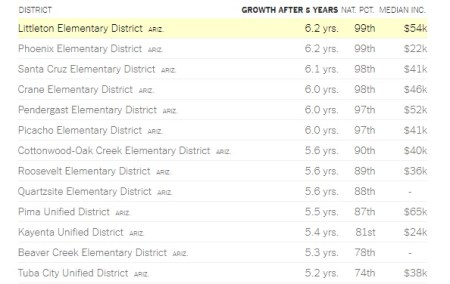
Tennessee also does the purple to green flip so bully for them. Notice that most of the Northeast starts out very green and ends pretty purple, but er, they aren’t alone in this. Cool graphic features in this NYT write up where you can plug in a school district and watch it move between 3rd and 8th grade here.
It’s too much…it’s too much winning! No Arizona we’ve got to win MOARRRRRRRRR!!!!!!!
CORRECTION : The author included charter school scores in the districts in which they operate.


 Posted by matthewladner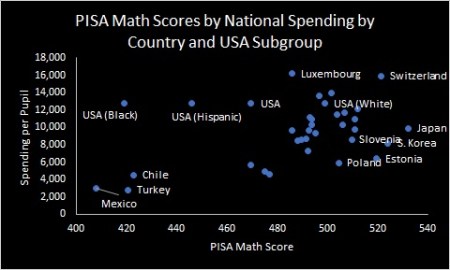










 Jay P. Greene's Blog