(Guest Post by Matthew Ladner)
W*O*W
(Guest Post by Matthew Ladner)
W*O*W
 7 Comments |
  teacher union | Tagged: Bob Chanin, Chanin NEA convention speech |
  Permalink
 Posted by matthewladner
(Guest Post by Matthew Ladner)
Why Homeschool has it with an Independence Day Theme.
1 Comment | blogging | Tagged: Carnival of Homeschooling | Permalink
Posted by matthewladner
(Guest Post by Matthew Ladner)
1 Comment | economics, politics | Tagged: California economy, Joel Kotkin | Permalink
Posted by matthewladner

(Guest Post by Matthew Ladner)
Earlier we had a lively debate on the obvious superiority of cover songs. This is a good lead in to my grand theory of popular music, which is: there is nothing new under the sun, so you may as well repackage tried and true things.
My theory holds that rock music essentially played itself out in 1974 with the creation of Punk Rock. If Rock and Roll was ultimately about rebellion, then you can’t get any more rebellious than anarchists who don’t know how to play their instruments screaming into a microphone. Of course most punks were poseurs. As Johnny Rotten said in advance of a reunion tour for what remains of the Sex Pistols “I am the Anti-Christ, won’t you buy me merchandise?”
But I digress.
Rock has been dead for ages, what to do then? Answer: take other genres of music, put a fresh coat of paint on them, and sell them to the kids as something new and cool! Much of it actually is cool.
The Ramones invented punk by taking 50s bubble gum pop songs, speeding them up, and giving them a psychotic twist. The Police were basically a Anglo-American reggae band. Paul Simon went through an interesting and profitable stage of his career by blending African music into an American context. Big Bad Voodoo Daddy and others brought Swing music back into fashion in the 1990s, and Green Day and company did the same with punk, etc. etc. etc.
Bryan Setzer is obviously a master at this- having brought back Rockabilly with the Stray Cats and Swing with his orchestra. His latest album is a fun work that develops swing/rock versions of classical music.
Sting not only dabbled in reggae with the Police, but also jazz and even country music as a solo artist. In Desert Rose Sting wrote an Arabic song and got the biggest Arabic singer to do the song as a duet:
Genre-bending reached it’s natural conclusion with the development of mashups, which I understand to be matching different lyrics and music, with a good bunch of sampling thrown into the mix.
Example: take the tune to Jimmy Hendrix’s Purple Haze. Now do the same tune, but sing the words to the TV theme song to Green Acres in place of those of the original.
There, you just did your first mental mashup!
Some of the DJ’s doing mashups these days are really quite creative. They move in and out of genres within a single song, briefly foreshadow something to come, and then beat you over the head with the best part of it.
Here’s an example of two things you wouldn’t think would work in a fairly basic mashup: Madonna and the Sex Pistols
Ebert once describe Quentin Tarrantino movies as throwing a whole series of big scenes at you. He said that most thrillers might build up to a single shocking or grizzly scene, but that Tarrantino hits you with 12 of them with plenty of homages to previous films thrown in to boot.
A good mashup does the same: rather than having a song build to some single crescendo, they’ll take an alternate path to build to the same crescendo and then flip on to another. You already know how the original got to the crescendo-why not fast forward to the fun part?
2 Comments | random pop culture | Tagged: Bryan Setzer, Madonna, mashups, Paul Simon, Sting, Stray Cats, The Ramones | Permalink
Posted by matthewladner
 (Guest Post by Matthew Ladner)
USA Today has an editorial piece on Victor and Miguel Mendoza, two American servicemen in Iraq who become United States citizens on July 4th.
The Mendozas represent the best of what the nation is celebrating this Independence Day weekend — liberty, freedom and the sacrifice it takes to keep them strong. They symbolize what’s right with America, a nation of immigrants that was built by opening its doors. And they speak to what could be so much better. At a time when anti-immigrant sentiment has swept through great swaths of the nation, much of it focused on those from Mexico, it’s worth recalling that more than 65,000 immigrants serve in the armed forces, about one-third of them legal residents but not yet citizens. Military service can shorten the usual five-year wait.
We should all be joyful and proud to welcome the Mendozas to our nation. USA Today notes that this contrasts starkly with the performance of Arizona high school students:
Immigrants seeking to become U.S. citizens have to pass a test, and the Mendoza brothers aced theirs this week in Baghdad. That’s more than you can say for a group of Arizona high school students who were surveyed recently on their knowledge of U.S. history and civics.
Just in time for Independence Day, the Goldwater Institute, a non-profit research organization in Phoenix, found that just 3.5% of surveyed students could answer enough questions correctly to pass the citizenship test. Just 25%, for example, correctly identified Thomas Jefferson as the author of the Declaration of Independence.
I mentioned in an earlier post that we drew the title of this study from an Edward Gibbon quote:
In the end more than they wanted freedom, they wanted security. When the Athenians finally wanted not to give to society but for society to give to them, when the freedom they wished was freedom from responsibility, then Athens ceased to be free.
That quote certainly does not apply to the Mendoza brothers. Can we say the same for young Americans born here in the United States? The United States was the first nation established not on the basis of ethnicity or tribalism but upon a set of ideals.
If you don’t the basics of American history and government, what chance is there that you are committed to liberty and self-determination? The pathetic level of ignorance displayed by this an other surveys are more than an indictment on our schooling system (and yes I’m looking at you too charter and private schools) but also an indictment of our entire society.
Consider the Gibbon quote and watch the above video. We have not been providing the type of education that the founders believed was essential to maintaining a system of ordered liberty.
It would be the height of folly to continue to do so.
5 Comments | civic values | Tagged: Freedom from Responsibility, Goldwater Institute, Miguel Mendoza, USA Today, Victor Mendoza | Permalink
Posted by matthewladner
(Guest Post by Matthew Ladner)
Arizona has one of the worst budget deficit problems in the country (live by the property bubble…) written about here and here. New governor Jan Brewer has called for a “temporary” sales tax increase to prevent the sort of belt-tightening of the Arizona budget already having been done by most Arizona families.
We at the Goldwater Institute strongly disagree, and put out the following humorous video today to explain why:
1 Comment | economics | Tagged: Goldwater Institute, Jan Brewer | Permalink
Posted by matthewladner

(Guest Post by Matthew Ladner)
In Shakespeare’s Richard III there is a scene where Richard makes an offer to Elizabeth, widow of the former King Edward. Allow me to marry your daughter and you will continue to live a life of royal luxury. If you refuse, you die.
Elizabeth asks Richard “Shall I be tempted by the Devil then?”
Richard replies “Yes, if the Devil tempt you to do good.”
Needless to say, the Devil is not in the business of tempting anyone into doing good. People with far more expertise than I possess will be required to evaluate GreenDot’s own deal with the proverbial devil in the form of a collective bargaining agreement with the United Federation of Teachers. Needless to say, there is a potential for a win-win on both sides here, but as always, the devil is in the details. Here is one devilish detail that I certainly would have refused:
Article 10
Student-Teacher Ratio, Class Size and Teacher Load
The School shall maintain a school-wide staffing ratio of no more than twenty (20) students to one (1) full-time classroom teacher. Unless otherwise approved by the Calendar Committee and ratified by a majority of Bargaining Unit Members and the Board, an individual class may not exceed thirty (30) students. Moreover, there must be a total of no more than one hundred thirty (130) students in all of a teacher’s classes excluding advisory.
Translated: “There shall be an arbitrary and unsupportable cap on the total productivity of any individual teacher imposed on these schools. This cap will have the added benefit to the union of limiting the possibilities for differentiated pay, or attracting and keeping talented teachers in the classroom. Oh and by the way this will happily hamstring any hope of bringing Green Dot to a widespread scale. Thanks for playing sucker– this mole has now been successfully whacked. HURTCHA!!!!”
These standards may very well fit comfortably into GreenDot’s current practices. GreenDot’s current practices, however, are for a niche player and are not at scale. These terms of course could be renegotiated in the future, but good luck changing them once they are in place.
Teacher unions are rational actors. Their rational incentive is to maximize employment for dues paying members. If this happens to mean that we wind up throwing legions of all-to-often-ill-suited-and-ill-prepared-bottom-of-the barrell-students into the teaching profession at great expense and to castastrophic effect, them’s the breaks. Things would be better if we spent (even more) money!
This agreement is almost certainly an improvement over what NYC’s rubber room contract, but that does not mean it will prove to be worthwhile.
2 Comments | teacher union | Tagged: GreedDot/UFT collective bargaining agreement, GreenDot, Richard III | Permalink
Posted by matthewladner

(Guest Post by Matthew Ladner)
In the end more than they wanted freedom, they wanted security. When the Athenians finally wanted not to give to society but for society to give to them, when the freedom they wished was freedom from responsibility, then Athens ceased to be free.
–Edward Gibbon
Last week we had our first sneak peak at Freedom from Responsibility.
Today, more details about the results. The Goldwater Institute randomly drew 10 questions from the United States citzenship exam item bank. We hired a survey firm to interview a sample of both Arizona public and private school high school students.
The questions for neither the citizenship test nor our survey were multiple choice. When you are asked “Who was the first President?” you must answer “Washington” in order to receive credit. Applicants for citizenship must get six out of the ten questions correct to pass. A recent trial of a slightly reformatted exam found that 92.4% of citizenship applicants passed the test on the first try.
From this nation’s earliest days, leaders such as Thomas Jefferson, James Madison, and John Adams recognized that even the well-designed institutions are not sufficient to maintain a free society. Ultimately, a vibrant democracy must rely on the knowledge, skill, and virtues of its citizens and their elected officials. Education that imparts that knowledge and skill and fosters those virtues is essential to the preservation andimprovement of American constitutional democracy and civic life.
Paul D. Houston, the executive director of the American Association of School Administrators, also put the issue in focus:
If you look back in history, you will find the core mission of public education in America was to create places of civic virtue for our children and for our society. As education undergoes the rigors of re-examination and the need for reinvention, it is crucial to remember that the key role of public schools is to preserve democracy and, that as battered as we might be, our mission is central to the future of this country.
Here are the 10 questions randomly selected, and their answers:
1.What is the supreme law of the land?Answer: The Constitution
2. What do we call the first 10 amendments to the Constitution?
Answer: the Bill of Rights
3. What are the two parts of the U.S. Congress?
Answer: Senate and House
4. How many Justices are on the Supreme Court?
Answer: Nine
5. Who wrote the Declaration of Independence?
Answer: Jefferson
6. What ocean is on the East Coast of the United States?
Answer: Atlantic
7. What are the two major political parties in the United States?
Answer: Democratic and Republican
8. We elect a U.S. Senator for how many years?Answer: Six
9 . Who was the first President of the United States?Answer: Washington
10. Who is in charge of the Executive Branch?Answer: The President
Twenty three percent of Arizona public high schoolers identified the House and Senate as the chambers of Congress. Nine point four percent that the Supreme Court has nine justices. Only 25% of students correctly identified Thomas Jefferson as the author of the Declaration of Independence. An almost majority of 49.6 percent identified the two major political parties, only 14.5% answered that Senators are elected for six year terms. Finally, only 26.5% of students correctly identified George Washington was the first President. Other guesses included John F. Kennedy, Ronald Reagan, George Bush and Barack Obama.
Only 26% could identify the President as being in charge of the Executive Branch. All in all, only 3.5% of public school students passed the test by getting six or more items correct. That’s 40 students out of a sample of 1,134 district students.
There were no major differences in performance based on grade (Seniors did approximately as poorly as Freshmen) nor by ethnicity. Profound ignorance is quite equally distributed in large measure across students in the public school system.
Two obvious questions to ask: is it fair to give this test? In order to answer, I examined the Arizona state standards for 8th grade social studies, which all or nearly all of these students will have taken. These standards are included as an Appendix in the study. What they show is that students are supposed to have learned about John Locke, the Mayflower Compact, the Articles of Confederation, the Constitution, Checks and Balances, Seperation of Powers, etc. etc. etc.
Everything they ought to have needed, in other words, to have passed this test. If, that is, they had actually learned any of that material in practice, which they obviously did not.
Second, I gave the test to my own 1st and 2nd grade sons. They both got 3 answers correct. We’ll be working on that. In so doing, they outscored about 40% of the Arizona high school sample, and tied or exceeded about 60 percent.
Charter school kids performed far better but still terribly- with a passing rate about twice as high as the public school kids. Private school students passed at a rate four times higher, which ultimately is both much better and still pathetic.
I had a very difficult time writing a conclusion to this study. More on that for the next post, but you tell me: if you were an Arizona lawmaker what would you do about this?
29 Comments | civic values | Tagged: civic knowledge, Edward Gibbon, Freedom from Responsibility, Goldwater Institute, High school civic knowledge, Matthew Ladner | Permalink
Posted by matthewladner
(Guest Post by Matthew Ladner)
Robert Tracinski and Tom Minchin have written an interesting article about the role of evidence in the global warming debate in Australia. By their account, the Aussie’s have looked over an economic cliff and decided not to jump.
3 Comments | politics | Tagged: Australian cap and trade, global warming, Robert Tracinski, Tom Minchin | Permalink
Posted by matthewladner

(Guest Post by Matthew Ladner)
I have a new study coming out from the Goldwater Institute called Freedom from Responsibility: A Survey of Civic Knowledge Among Arizona High School Students. You dear reader get a special sneak-peak!
This study employs a straightforward methodology: we designed a telephone survey instrument to test civic knowledge based upon the United States Citizenship and Immigration Services (USCIS) exam items. The USCIS administers a test to all immigrants applying for citizenship and makes the questions public.
USCIS officials choose 10 questions out of the item bank of 100 questions and give them as a citizenship exam. In order to pass, the applicant for citizenship must answer six out of the 10 questions correctly. The questions are not multiple choice, instead requiring applicants to supply an answer. When they ask “Who wrote the Declaration of Independence” the applicant has to answer “Thomas Jefferson” in order to get the question correct.
Recently, the USCIS had 6,000 citizenship applicants pilot a newer version of this test. The agency reported a 92.4 percent passing rate for the test among citizenship applicants on the first try. I did not expect Arizona high school students to do that well of course, given that those seeking citizenship have had the opportunity to prepare for the test. On the other hand, Arizona high school students have some advantages of their own: multiple courses in American history and social studies, hopefully exposure to American history outside of school, etc.
I randomly selected 10 of the USCIS questions and included them in a survey, curious to see how many high school students would pass the test required of immigrants.
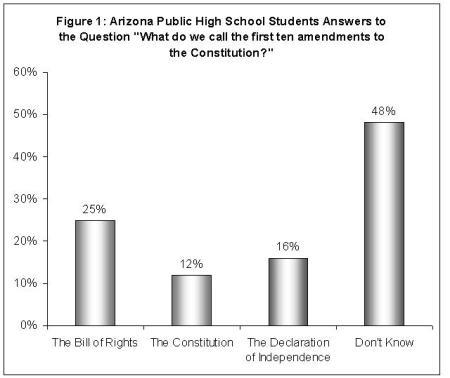 Here’s your free sample: One of the questions was “What do we call the first ten amendments to the Constitution?” How many high school students attending public schools answered correctly?
“I don’t know” beat “the Bill of Rights” by almost a two to one margin, and 75% of students got the question wrong.
Notice also that 12% of Arizona students thought that the first ten amendments to the Constitution were called “The Constitution.”
Phoenix, we have a problem…
21 Comments | civic values | Tagged: Goldwater Institute, High school civic knowledge, Matthew Ladner | Permalink
Posted by matthewladner

 Jay P. Greene's Blog