The Way of the Future Sighting in Yuma

August 13, 2009

(Guest Post by Matthew Ladner)

The Arizona Charter School Association has calculated student learning gains in grades 3-8 for every district and charter school in the state and posted the results online. Interestingly the same school came top in both math and reading- Carpe Diem E-Learning in Yuma Arizona. They not only came in first, it was by a pretty wide margin.

So, what’s the secret sauce? They let you know right on the school webpage:

Our academic program is a “hybrid” program consisting of on-site teacher-facilitators (coaches) and computer-assisted instruction (CAI) utilizing a computer-based learning and management system. Our program offers an extensive online library of interactive instructional courseware, providing learners and teachers with access to thousands of hours of self-paced, mastery-based instruction.

Our program considers individual differences in ability, knowledge, interests, goals, contexts and learning styles. Our instructional resources and strategies give our “coaches” the power to effectively tailor their instructional practices, accommodating the individual needs of the learner with the goal of achieving student mastery.

In the Carpe Diem Collegiate High School and Middle School (CDCHS), we believe that all students should have a high quality experience and technology-based education designed to help them be successful today, tomorrow and in the future.  What is “success?” At Carpe Diem, success means the student must demonstrate appropriate character and content proficiency (learning mastery), not just course completion.

Hybrid model mixing classroom instruction and technology delivered content. Teacher really serving as a guide on the side rather than a sage on a stage, only in a context where is finally makes sense. Sound familar?

Clayton Christensen has predicted that as a disruptive technology the day would come, after of years of occupying niches here and there, steadily growing like the mice at the feet of the dinosaurs, when people would realize that online learning represents a superior technology to Jurassic schools.  After reaching this tipping point, Christensen sees a rapid rise in online learning.

Terry Moe and John Chubb also see a bright future for e-learning, albeit one a bit more constrained by politics. Moe and Chubb see a chance to substitute technology for labor, providing the opportunity to provide better education for less money. Needless to say, this leads to opposition from the education unions, but Moe and Chubb see technology subtly but surely eroding the power of the unions.

Two of the most obvious possible advantages of online learning: self-paced schooling and required mastery of content to advance, both of which are featured at Carpe Diem.  I’ll be keeping a close eye on Carpe Diem’s progress, but producing the state’s largest gains in a relatively low-income area certainly has my attention.


Never Going to Give Your Teen Spirit Up

August 12, 2009

(Guest Post by Matthew Ladner)

This is <sniff> b*e*a*u*t*i*f*u*l


AZ Newspaper Lets Rip on Tax Credits

August 6, 2009

(Guest Post by Matthew Ladner)

In the climax of the Branagh film Dead Again the protagonist struggles with the villain over a pair of scissors. The winner is all but certain to use them to knife the loser to death. Losing control of the scissors, the villain (played by Derek Jacobi) says in classic British understatement “I shall be very interested to see what happens next.”

The East Valley Tribune has a three part series titled Rigged Privilege on the Arizona tax credit system.  At the time of this writing, they are only through parts one and two.

A little background. In 1997, the Arizona legislature created the nation’s first scholarship tax-credit law. Donors were allowed to make a $500 donation to a non-profit group, which could then give scholarships for children. State oversight in the bill was limited to some reporting. The law specified that scholarship organizations had to give scholarships to more than one school, and that donors could not make a donation for the benefit of their own child. The law allows 10% of funds to be spent on administration.

The bill had been means-tested, but the sponsor reluctantly dropped the means test during the process. The bill had almost no support from Democrats, and the last vote needed to put the bill over the top agreed to support it only if it did not contain a means test. Over the years, the maximum amount that could be donated for a married couple filing jointly has been raised to parity at $1,000. Arizona lawmakers created a corporate credit in 2006 which included a means test.

Last year the credit raised about $55 million dollars.  For a bit of perspective, that is about 10% of the annual operating budget of Arizona’s largest school district. The credit created 28,234 scholarships last year. With more than ten times the money, the state’s largest school district serves less than three times as many students as the tax credit. 

Sound like a bargain so far? Don’t answer yet! This is not a program with a lottery, and thus it does not lend itself to a high quality test score evaluation with a proper control group. The Goldwater Institute has however surveyed Arizona public and private high school students and found substantially higher levels of student satisfaction, perceptions of academic rigor and school safety, and higher levels of political tolerance among private school students (forthcoming). The credit in short produces a better education at a lower cost according to the students.

A number of organizations employ means test for students. Even those that do not are aiding some as yet uncounted number of low-income families. I have personally met students whose academic careers and lives were changed by the opportunity that this program created.

Having said all of that, the EVT details what happens with a program containing minimal oversight and ultimately having no one, in either the private or public sphere, with the authority to police the program: abuse.

I encourage you to read the article for yourself. One of the stories focused on a scholarship group who somehow raised money for a few years but failed to provide any scholarships (the law requires you to spend 90% of your funds on scholarships). Federal law prohibits designating a beneficiary for a charitable donation, for obvious reasons. Some scholarship groups have engaged in “recommendations” for donations, and have appeared to engineer donation swaps among parents. Grey area material, at best.

Groups maintaining accounts for individual students seems like a bright-line violation of federal tax law. I don’t yet understand the workings of this “tax credit for fetuses” business, but let’s just say for now that it seems like a pretty clear perversion of the intent of the law, even if it is legal, which it may not be.

So I’m inclined to think that the Arizona tax credit system could use a clean up. Opponents of parental choice have predictably seized upon this report as proof that the whole idea of tax credits is some evil corporate plot to destroy Western civilization, etc. Such people could use some Valium sprinkled in their coffee. In the big picture, the tax credit is providing higher quality education opportunities than average at a dramatically lower cost.

Does the program need a referee with the power to throw a flag and assess a penalty, even eject a player from the game? Yes. The absence of such a referee is basically not only inviting, but begging for abuse.  Should lawmakers means test the program? It depends on your perspective, but I’d say no, or rather, only conditionally yes. I would readily agree to a means test if we can do the same for public schools. The average scholarship in this program is in the neighborhood of $2,000. Average public school spending in the state is just south of $10,000. As long as we are handing out $10,000 to the children of North Scottsdale millionaires, I can’t see a reasonable argument to deny them $2,000 instead to save the rest of us some money.

There are better ways to address equity concerns than a means test. When I worked at the Alliance for School Choice, we developed a set of model bills in cooperation with the Friedman Foundation and the American Legislative Exchange Council. In our tax credit bill, we included a requirement that scholarship organizations give a percentage of their funds to free and reduced lunch eligible children equal to the state average. Around half the children in Arizona public schools are free and reduced lunch eligible, and under this provision, STOs would have to give about half of their dollars raised to free and reduced lunch eligible students.

Groups would be free to do more than this (I serve on the board of a group which only gives scholarships to free and reduced lunch children) and such a requirement would obviously need to be phased in order to avoid serious disruption. Half the kids in Arizona public schools are free and reduced lunch eligible, but I wouldn’t count on them getting half the total K-12 money. Adoption of such a provision would likely make the tax credit more focused on equity than the public school system.

Carrie Lips Lukas, writing for the Goldwater Institute in 2003. called for a series of reforms. Last year, I fundamentally revamp the system by creating a personal use credit and means testing the scholarship credits at the free and reduced lunch level. This would expand parental choice, eliminate swapping, and create a universal system of choice with an advantage for the poor (who could benefit from both credits). Scholarship credits would still be vital, but would be purely charitable in nature.

When presented with this type of information, the first instinct of some will be to deny it, to hunker down, to accuse our enemies of far greater misdeeds, or to otherwise try to put lipstick on a pig. Good luck with that.  It is blindingly obvious to me that Arizona’s tax credit is system is a good program overall that suffers from specific weaknesses that can and must be addressed.  Otherwise, writing articles like this one will become the journalistic equivalent of using a shot gun to shoot fish in a bucket.


Pass the Popcorn-Bullitt

July 24, 2009

(Guest Post by Matthew Ladner)

So my favorite coffee shop, the Raven in Prescott, has Monday night movies and so I went down to see Bullitt. I had never seen a Steve McQueen movie before, so I was curious. Growing up as a kid in the 1970s and early 80s, I watched a fair amount of BBC television on PBS, and so the only thing I knew about Steve McQueen was that the British were totally crazy about him, making frequent Steve McQueen references, often in reverant tones.

A couple of years ago, I think Ford made a commercial with old McQueen footage for their revamped Mustang. Apparently, McQueen was associated with muscle cars. Still, Steve McQueen flew in my cultural blind spot for the first 41 years of my life.

But no more!

Bullitt is hardly a great movie, but I can’t wait to see more like it. Some of the acting seems George Lucas style stilted. Except of course for McQueen, who was the Platonic ideal of American stoic tough guy. This guy can almost kill a bad guy with a cold icy silent stare. If that doesn’t work, he’ll be happy to lay a beating on you, fill you full of lead, or chase you off the road in his muscle car until your produce a mini mushroom cloud as the gas in your tank (which should have been fairly empty after that hour long high speed chase) explodes in  a fiery inferno. McQueen uses his tough-guy powers to put the extra gas in your tank just to make sure you are a crispy critter for daring to think your death race skill begin to match his own.

Speaking of which, you can watch Bullitt’s famous car chase through San Fransico here. It really starts after about three minutes and thirty seconds.

Hello netflix! If you have any other Steve McQueen movies to suggest, zap me an email or leave them in the comment section.


Detroit Public Schools Consider Bankrupcy

July 22, 2009


(Guest Post by Matthew Ladner)

An enormous experiment in school choice is going on in Michigan, and it doesn’t receive a fraction of the attention it deserves. The Detroit Public Schools- perhaps the most dysfunctional of the nation’s large urban districts- has been bleeding students and is now actually considering seeking bankruptcy protection.

The Wall Street Journal lays it out:

DPS’s enrollment — which largely determines its allotment of state funding — is about half what it was in 2001, as suburban districts and charter schools have siphoned off tens of thousands of students. By this fall, DPS will have 172 schools open and more than 100 vacant. Meanwhile, the high-school-graduation rate is 58%; coupled with the enrollment losses, only about one-quarter of students who start high school in the district graduate from it in four years, according to outside estimates.

But DPS’s problems go beyond the type that sank GM and Chrysler. Wide-scale corruption has depleted district coffers, which held a $103.6 million surplus as recently as 2002. In June, Mr. Bobb’s new team of forensic accountants found DPS paychecks going to 257 “ghost” employees who have yet to be accounted for. A separate Federal Bureau of Investigation probe in May led to the indictment of a former payroll manager and another former employee on charges of bilking the district out of about $400,000 over four years.

Given the longterm academic results of DPS, shrinking it in half in 8 years should be considered a humanitarian triumph. Don’t cry for the people working for DPS- all that money has shifted to schools where parents would rather have their children. Instead- celebrate for the students.

In the late 1990s, state lawmakers abolished the Detroit school board and appointed a CEO. I recall that person studied the situation for a few months and concluded that not a single business function of the district worked as it should. Contractors were being paid for work they didn’t do. The reported high school dropout rate was around 75%.

The inescapable conclusion: DPS was a money trough for adults that might occasionally educate a student here and there, but only by accident.

Further- bankruptcy could be very much in the best interest of the students in the district. It would allow administrators to modify union contracts and perhaps, gasp, make it feasible to let teachers go for academic failure or professional misconduct. Perhaps even reward teachers for outstanding work.

An interesting set of dynamics led to this point. In 1999, I coauthored a study for the Mackinac Center exploring the dynamics of public school choice. I interviewed a number of inner-ring suburban superintendents, some of whom were quite candid with me.

The basic story is that initially, the suburbs were not interested in participating in open enrollment competition for students. One superintendent, when I asked him why his district didn’t participate, replied “I think the feeling around here is that we’ve got a pretty good thing going, and we want to keep the unwashed masses out.”

As the charter schools got into the act, however, it compelled some of the school districts to defect and begin accepting open enrollment transfers. This had a snowball effect- now districts were losing students to both charter schools and school districts. This motivated them to accept transfers themselves.

As more districts opened their doors to transfers, and more charter schools continued to open, the biggest opportunitity gains were realized by students in Detroit.


Question for Leo: Why is the Citizen’s Civil Rights Commission on your case?

July 16, 2009

(Guest Post by Matthew Ladner)

I’m just starting to read the Citizen Commission on Civil Right’s report National Teacher Unions and the Struggle Over Education Reform, but I’ve already found a wonderful quote:

While teachers’ unions are legitimately concerned with securing fair and unbiased treatment at the hands of management, these concerns have often been translated into fierce opposition to reforms designed to hold schools and their faculties accountable for how their students perform.

This resistance has posed a barrier to improving educational opportunity for the most disadvantaged students and closing the performance gap between them and their more advantaged peers. It has also led to calcified systems in which talented people are deterred from applying or staying as teachers because they believe their skills will not be recognized or rewarded.

Hmmm…does this statement have more than a faint echo of this? I predicted that the political marriage between progressives and education unions would come under increasing strain, and this report is the latest signal.

Question for Leo: how does it feel pretending to be a “progressive” when you are actually a part of the most reactionary force in American politics?


General Powell Brings in the Heavy Artillery

July 16, 2009

(Guest Post by Matthew Ladner)

Leonard Greene of the New York Post turns in an account of Colin Powell telling it like it is at the NAACP convention:

Former Secretary of State Colin Powell joined an NAACP panel of civil-rights giants yesterday and urged a new generation of leaders to declare war on failure in America’s schools. “There’s nothing more important for us as a nation than to sit back down with our kids and return a sense of pride and dignity,” Powell said at the Hilton New York. The retired general was joined by a who’s who of activists, including the Rev. Jesse Jackson, former UN Ambassador Andrew Young, Washington power-broker Vernon Jordan and five of the famed Little Rock Nine students, who faced violent mobs to integrate an Arkansas high school in 1957.

Powell rattled off a string of ignoble statistics, including a 50 percent dropout rate among African-American students, 30 percent of whom are born out of wedlock. “There’s a connection,” Powell said before pointing to the Little Rock alumni. “Is this what they fought for?”


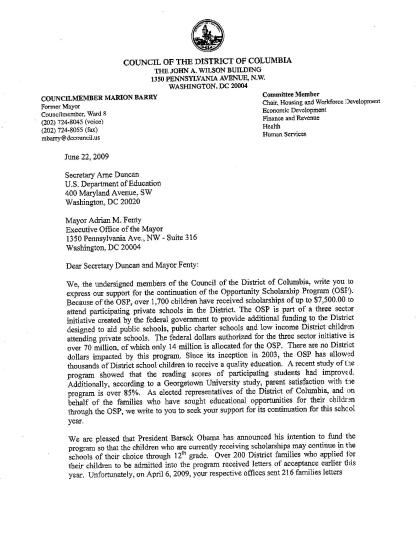
DC Council: Continue Opportunity Scholarships

July 10, 2009


(Guest Post by Matthew Ladner)

Yet another BOOOOOM! Now a majority of the DC City Council weighs in for DC Opportunity Scholarships!

Read the letter at the DC Children First website here.

Or read it below:DC letter 1 


DC letter 2 


WaPo: A Plea to Mr. Duncan

July 10, 2009

(Guest Post by Matthew Ladner)

The Washington Post brings it again on behalf of the victims of Department of Education’s slavish decision to deny over 200 children access to the DC Opportunity Scholarship Program.

Seven council members — including those who represent the poorest sections of the city — wrote to Mr. Duncan on June 22 challenging his decision not to admit new students to the D.C. Opportunity Scholarship Program. The federally funded program provides vouchers of up to $7,500 so that low-income students can attend schools of their choice. Because the program’s future is uncertain, Mr. Duncan decided — disappointingly to our mind — to rescind scholarships awarded to 216 families for this upcoming school year.

Ooops, there goes the local control argument. Perhaps Mr. Duncan and company would like to stand up and confess “We’d like to help these kids, but sadly, we toil as the servile minions of teacher union thugs. Please don’t pay attention to what we do, but rather to what we say. Move along, nothing to see here…”


Texas has nothing to learn from California except…

July 10, 2009

2809LD1(Guest Post by Matthew Ladner)

Interesting article from the Economist on California vs. Texas: America’s future.

I’ve been an Economist reader for 20 years now, and their work is usually outstanding. They do however occassionally fall prey to an easy stereotype, and this article contains such a folly.

Read the article for yourself, but keep in mind that Texas has among the highest NAEP scores for Hispanic students in the nation (now edged out by Florida on 4th grade reading) and spends over $10,000 per child per year.

The only thing Texas has to learn from California is what not to do.

P.S.

This has been a settled question on the only true field of battle for some time now.