Pass the Clicker: Shazam! and Isis

October 10, 2008

Since the summer movie blockbuster season has ended and Lost has not re-started, we need something to amuse us on Fridays.  I’d like to introduce Pass the Clicker, a journey to the classic TV shows of yesteryear.  By classic I mean it either in the Greg sense (really good) or in the Matt sense (so bad that it is good).

So, for today’s Pass the Clicker I’d like to feature the Shazam!/Isis Hour.  I’m pretty sure that this falls in the so bad that it is good category.

The set-up for Shazam! is that a young man, Billy Batson, travels around the country in an RV with an old guy called Mentor.  And when trouble strikes, Billy says Shazam! and invokes the powers of Solomon, Hercules, Atlas, Zeus, Achilles, and Mercury.  It’s a lot like the Super Best Friends on South Park, except not intended to be funny.  The council provides advice to Billy and transforms him into a super-hero played by a different actor, who’s got a square jaw, is about a foot taller, and has 50 extra pounds of muscle.  Mentor also provides Billy with advice and for some reason is always wearing the same 70s leisure suit.

This clip should provide you with a true taste of the total awfulness of the show.  In it Billy and Mentor are helping Curtis, a young black man with a giant Afro, in his efforts to try-out for the Inner-City Orchestra.  No racial stereotypes here!  But Curtis says he’s not “turned-on” about working and dreaming for something only to have it taken away from him.  But don’t let the Man keep you down, Curtis.

The set-up for Isis is that a school teacher discovers an amulet that gives her super-powers.  She uses her super-powers to give the young boys watching the show that tingly feeling that they don’t quite understand. 

And in this marvelously horrible clip Isis teaches a young girl the important lesson that people can be beautiful on the inside.  And Isis teaches this lesson in her mini-skirt outfit.  Yes, this show was on Saturday mornings for children and not on pay-per-view.


Feeling Stabilized Yet?

October 10, 2008

Congress passed the Emergency Economic Stabilization Act (EESA), but the markets have hardly stabilized.  Don’t the markets know that it is against the law for things not to be stable now that Congress passed a stabilization act?

I think recent events demonstrate that the EESA was completely unhelpful if not counter-productive.  But others interpret events as showing that the EESA didn’t go far enough.  I’m sure that there are also Marxist academics out there still arguing that full communism has never really been tried because the Soviets didn’t go far enough.  And there are education interest groups saying that the doubling in real per pupil spending hasn’t yielded academic improvement because we haven’t spent enough yet.  Something didn’t work?  Just try more of it!

Well, I came across a very sensible op-ed in the WSJ yesterday that offers an explanation for why the crisis continues and what might be done to really bring about stability.  Manuel Hinds suggests that the problem at this point is that financial institutions are refusing to lend to each other.  The problem is that some of those institutions won’t repay money that is lent to them because they are truly insolvent, but no one knows for sure who those institutions are.  So the safe thing to do is not to lend to any other banks.  But this lack of inter-bank lending is having a negative spiral effect.  Hinds likens the problem to playing poker with ten people knowing that a few aren’t good for their chips.  No one will play until you figure out who can settle at the end of the game. 

The solution is to improve transparency so that we all more clearly know who is and who isn’t able to repay money that is lent to them.  One of the best ways to gain that transparency is to allow insolvent institutions to go bankrupt so that we know the ones still standing are healthy.  Efforts to prop up insolvent institutions just prolong the crisis by disguising who really can repay and who can’t.  It would also be essential for transparency to continue mark-to-market accounting, despite calls to do away with it.  Without mark-to-market we would have much less information about the value of securities held by financial institutions.  More information is the solution and ending mark-to-market subtracts information.  There may also be reasonable regulations that would improve the quality of information about financial institutions.

There are real problems in financial institutions but masking them just makes the problem worse.

(edited for typos)


Bloggers Shouldn’t Have Rapper Names

October 8, 2008

In my last post I described Jennifer Jennings as the blogger formerly known as Eduwonkette.  I had thought we only had to call her Eduwonkette when we didn’t know who she was.  But I guess she continues to go by her rapper name, Eduwonkette.  And Aaron Pallas, an otherwise respectable scholar, continues to call himself Skoolboy — with a k!  And I guess they are both cribbing (in the non-rapper meaning) from Eduwonk, who we’ve always known to be Andy Rotherham.

I find the use of rapper names by bloggers to be downright silly.  It’s especially silly when accompanied by self-aggrandizing cartoons and graphics.  Here at Jay P. Greene’s Blog we’ve gone for a minimalist approach, both out of laziness and an aesthetic vision that tried to put the focus on content.

But if a bunch of other folks are going to continue to call themselves rapper names and have cartoon graphics to represent themselves, maybe I should do the same.  Perhaps I should go by my rapper name — DJ Super-Awesome.  And maybe we should use Thundarr the Barbarian graphics to represent ourselves.  I call the image of Ookla and I’ll let Greg and Matt fight over who gets to be Ariel.


Policymaking By Anecdote

October 7, 2008

Is it good policy to reduce barriers to firing sub-par teachers?

According to Jennifer Jennings, the blogger formerly known as Eduwonkette, the answer is no.  We need to preserve teacher tenure, she argues, because she has found an example of a really great teacher, Art Siebens, who was fired when his DC school was reconstituted.  His case is “haunting for the glimpse it offers into the brave new world of unchecked principal autonomy.”

Well, Siebens wasn’t actually fired.  He wasn’t re-hired at the same school and was instead offered a job teaching a different science course at a different DC public school.  Don’t fret ye of weak hearts — continued employment for teachers is still essentially guaranteed even if not in the school and class of their choosing.

It’s puzzling why Siebens wasn’t re-hired given that he was an award winning teacher with what appears to be a strong record of excellent work.  But the fact that he wasn’t is hardly evidence against DC superintendent Michelle Rhee’s proposal to offer teachers significant pay increases if they give up tenure.  Perhaps there is more to Siebens’ story than is publicly known.  

More importantly, the case of Art Siebens is not evidence against abandoning tenure because it is a single case.  The plural of anecdote is not data.  We shouldn’t make policy by referencing anecdotes.  Instead, we should look “through the lens of social science,” as a wise person once wrote, and consider systematic evidence when formulating education policy. 

The remarkable investigative reporting by Scott Reeder has powerfully documented the problems with teacher tenure.  After filing 1,500 Illinois Freedom of Information Act requests with the state board and all 876 Illinois school districts, Reeder uncovered the following:

1) “Of an estimated 95,500 tenured educators now employed in the state [of Illinois] an average of only seven have their dismissals approved each year by a state hearing officer. Of those seven, only two on average are fired for poor job performance. The remainder is dismissed for issues of misconduct.”

2) “Of Illinois’ 876 school districts only 61, or 7 percent, have ever attempted to fire a tenured faculty member since the teacher evaluation reforms were imposed 18 years ago.”

3) “Of those 61 school districts, only 38 were successful in actually firing a teacher.”

4) “Not only is it exceedingly rare to fire a tenured teacher in Illinois, but it also is extraordinarily expensive. In fact, Illinois school districts that have hired outside lawyers in these cases have spent an average of more than $219,000 in legal fees during the last five years.”

5) “In the last 10 years, about 477,000 evaluations of Illinois tenured teachers have been performed, but only 513 received unsatisfactory evaluations… In other words, only 1 out 930 evaluations result in a tenured teacher receiving an ‘unsatisfactory’ rating.” Conducting those evaluations consumed 2.5 million administrative hours.

OK, so it is next to impossible to fire tenured teachers.  And we also know from systematic evidence that the quality of the teacher is the single most important factor within school control to influence student academic improvement. (See for example the research referenced here.)

Unless we believed that all but .007% of tenured teachers are doing a solid job, the current system is clearly keeping incompetent teachers in the classroom.  Any meaningful reform strategy has to involve getting rid of dud teachers and attracting better teachers as replacements.  Rhee’s proposal to increase pay in exchange for greater flexibility in terminating sub-par teachers seems like a promising idea to do just that.  The higher pay might attract better new people into teaching and the flexibility on termination could remove bad teachers from the classroom. 

Of course, the blogger formerly known as Eduwonkette makes a fair point when she asks, “Why are you confident that principals will always – or even often – pick the ‘best teachers?'”  For a system with reduced tenure protections to work, principals would also have to be properly motivated to distinguish between effective and ineffective teachers.  But this could be done either through meaningful merit evaluation and rewards for principals or through market accountability in choice programs.  If continued employment or pay raises for principals depended upon identifying effective and ineffective teachers, they are unlikely to let talented teachers like Art Siebens go and are likely to get rid of duds.

But we should all accept that any system of hiring and firing teachers will have its injustices.  The status quo tenure system has the injustice of protecting bad teachers in their jobs.  And if cuts have to be made it is newer teachers who have to be let go, even if they are better teachers than their senior colleagues.  A system like Rhee proposes will occasionally mistakenly let go of a good teacher.  But with well-designed incentives for the principals this should be the exception and not the rule.

Besides, we have to ask ourselves:  how many kids do you want to condemn to an ineffective teacher to avoid the possibility of unjustly terminating a good teacher?  If we care more about the kids than the adults in schools, then the injustice to the students should matter much more to us than the possible injustice to a few teachers.


Socialism for Sports

October 2, 2008

George Carlin compares football and baseball.

The congressional bailout isn’t the only scheme that redistributes resources, punishing excellence and rewarding failure.  The National Football League’s revenue sharing scheme does the same.  All football teams, regardless of their performance or fan base, draw an equal share of the TV revenue, which is the lion’s share of all revenue in football.  Doing so rewards teams that flop and undermines the incentive to excel.

The arguments for revenue sharing are unpersuasive.  People say that revenue sharing produces parity, where all teams have an equal chance of winning, which makes it more exciting to watch.  But flipping a coin also has parity, with an equal chance of either side “winning.”  Who wants to watch a coin being flipped? 

I think what people really want — or at least should want — is excellence.  That is, sport offers fans the chance to see excellence in athletic achievement.  If all we wanted to see was parity, people would fill stadiums to see little league games where the players are randomly assigned to teams.  Instead, people fill stadiums to see the very best athletes doing the very best they can.

Now, it’s true that we wouldn’t see excellence if one team could beat the other without effort.  If teams could simply buy so much superiority that they didn’t have to try to win, we would be disappointed.  But the reality is that without revenue sharing teams still cannot be assured victory, especially over an entire season.

Just look at Major League Baseball, which has limited revenue sharing and historically had none.  The highest spending baseball teams cannot assure themselves a spot in the playoffs, so they must regularly try hard.  There is a relationship between how much a baseball team spends on its payroll and how many games it wins, but that relationship isn’t very strong.  In 2008 the correlation between team payroll and regular season games won was only .33.  Consider that the top three payroll teams (Yankees, Mets, and Tigers) aren’t in the post-season, while the Tampa Bay Rays, who spent 1/5 as much as the Yankees, are.

We shouldn’t want to see no correlation between team payroll and success because the revenue partially serves as a reward for winning, motivating excellence.  It’s also true that larger media market teams get more revenue without necessarily winning more games.  But we should want larger market teams to have a better chance of having the resources to win.  After all, those teams have more fans.  We wouldn’t want to shut large market teams out of the post-season and turn-off the bulk of the nation’s fans.  So, it is altogether fitting and proper (as A. Lincoln would say) that Los Angeles and Chicago each have two teams in the baseball playoffs even while NY has none.  And small market teams like Tampa Bay and Milwaukee clearly still have a fighting chance.

Obviously, it wouldn’t be any fun to have a team that never had a hope of winning because its market was too small to generate the revenue for a competitive team.  But if there were such a team the solution would be to move that team to larger market rather than to move revenue to the market that wasn’t viable.

So, this weekend I’ll be watching the baseball playoffs rather than the NFL.  I’d rather watch excellence than a coin being flipped.


Stop Congress Before They “Help” Again

October 1, 2008

Greg and Matt had some excellent posts yesterday on the bailout.  Matt described how we got into this mess and Greg outlined the issues in dispute.  Today I want to talk about where we go from here.

I do not believe that a Congressional bailout is necessary to avert a catastrophe nor do I believe that it will effectively stop the economic damage that remains to be inflicted.  All that Congress is likely to do is shift the cost of the economic damage to a broader pool and hinder future growth with unwise regulations and new programs.

Despite scare-mongering to rush a bill through Congress, the reality is that the current turmoil is a normal popping of a speculative bubble fueled by Fannie and Freddie (government) guarantees on mortgages and artificially low Federal Reserve interest rates.  No matter what Congress does, a fair number of people are in homes they cannot afford and a number of banks own mortgages that will never be repaid. 

Shifting those bad mortgage securities from financial institutions to the government balance sheet changes nothing.  Someone is going to have to eat those losses.  If the bailout pays the banks above the market value for those securities, then the taxpayers will bear those losses, either in the form of raised taxes or higher inflation.  If the bailout pays market value, then the banks will not have any additional capital on their books and they will be no better off.  Either way, the economic damage of these bad mortgage securities on the economy will remain the same.

The only way that the government bailout could help is if the government pays above market value for the mortgages, strengthening bank balance sheets, but the amount that is paid turns out to be less than the intrinsic value of those securities, so the mortgages can later be resold without a loss to taxpayers.  But there is no reason to believe that the market value of those securities is less than their intrinsic value or that the government knows what the true intrinsic value of those securities is and will pay less than that amount.

To believe the case for the bailout you would have to believe that the government is the smartest hedge fund out there.  Keep in mind, there are potential buyers with capital willing to buy the bad mortgage securities, but not at a price that banks are currently willing to sell.  The banks don’t want to sell for the price that buyers would buy because they would have to write down the losses and be forced to raise capital themselves, which they are currently unable to do easily.  Instead, the banks are holding on, hoping that the government will pay them a higher price or that the market for these mortgages will somehow improve.

Instead of a bailout we should allow the market to work out these losses.  The government cannot stop the losses; it can only move them around.  And it can do some extra damage in the process, such as imposing new regulations and introducing moral hazard for future financial mistakes.

Despite elite opinion in the media and from many on Wall Street that a bailout is necessary, the passing of each day without a catastrophe demonstrates otherwise.  Sure, the markets have been volatile, but short-term market movements don’t indicate the long-term wisdom of policies. 

And let’s put things in perspective.  The economy grew last quarter.  Credit-worthy consumers can still get mortgages, car loans, and business loans.  The stock market is still higher than where it was a decade ago.  Things are painful but they are not catastrophic.

As Peter Robinson over at National Review’s The Corner says, “it has become impossible—simply impossible—to dismiss opponents of the bailout as mere hayseeds and (what to a lot of people amounts to the same thing) House Republicans.”  And a group of 200 academic economists from all ends of the political spectrum have come out against the bailout.

The hardest thing to do in a moment of crisis is to do nothing.  But in this case nothing is probably exactly what we need.

UpdateAlan Reynolds has a great piece at Forbes in which he documents that consumer lending has not declined.  He writes:

“On CNBC Monday, Democrat majority leader Steny Hoyer said the objective of the rescue package is to “unlock the credit” for consumers and business. And a Wall Street Journal editorial writer told CNBC, “Until we get the banks lending again, the economy will continue to contract.”

Such alarming comments never mention any facts. Why not? As Neil Cavuto recently noted on Fox Business News, the Fed reports bank loans every week.

U.S. Bank Loans (Billions of Dollars)

Week Ending Wednesday Business (Commercial & Industrial) Real Estate Consumer Interbank (Other Than Fed Funds)
Aug. 13 1,514.5 3,639.4 841.6 77.6
Aug. 20 1,509.1 3,653.3 845.6 75.3
Aug. 27 1,515.1 3,650.6 848.0 76.3
Sept. 3 1,514.8 3,631.3 846.8 77.2
Sept. 10 1,512.0 3,630.3 850.5 74.0
Sept. 17 1,531.2 3,625.2 847.1 72.3
         
Year Ago:        
Aug. 2007 1,311.1 3,498.4 774.0 82.7


Federal Reserve Board, “Asset and Liabilities of Commercial Banks in the United States” (H.8).

In August, bank loans to consumers were 9.5% higher than they were a year earlier–the fastest increase since 2004. The year-to-year increase in consumer and industrial loans was 15.5%, down only slightly from a recent record high of 21.6% in March. Real estate loans were up 4.1% for the 12-month period ending this August–flat lately, but not down…

Contrary to many comments, consumer and industrial loans actually increased in the latest week. Troubled giant banks have cut back on lending, but smaller banks have picked up the slack. Consumer and real estate loans dipped insignificantly through Sept. 17, remaining much higher than they were a year earlier. “


Blog Security Risk

September 29, 2008

I don’t mean to alarm all of you, but I should tell you that Greg Forster, Matt Ladner, and I were all in the same place last week.  I know that this was an unacceptable breach of blog security — if something awful should have happened to us, if terrorists had struck, who would have been left to carry-on with the blog?

Normally we maintain blog security by ensuring that one of us is kept in a bunker in an undisclosed location when the other two meet.  Having us all three together was running an unreasonable risk.

We have taken concrete steps to improve blog security.  In particular, I have successfully cloned myself so that Jay Prime can go to the bunker if the three of us ever get together again.  Jay Prime has been taught all of the secrets of the Jay P. Greene Blog so that if anything should happen the blog will be able to continue.  The Blog Security color remains orange, so we will continue to be vigilant against any and all threats.


Reporter in Bed with School Official, Literally

September 27, 2008

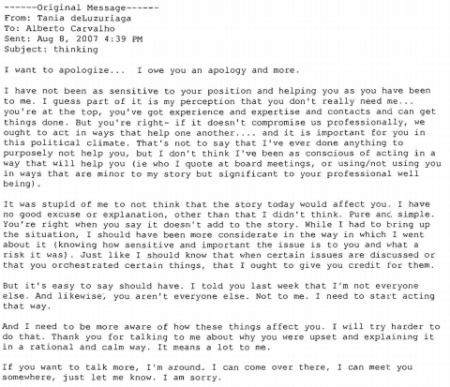
A series of e-mails between reporter, Tania deLuzuriaga, and a senor Miami-Dade school official, Alberto Carvalho, suggest an affair between the two while deLuzuriaga covered Miami schools for the Miami Herald.  deLuzuriaga has resigned from her job at the Boston Globe, where she moved last fall.  And Carvalho’s  selection as the new superintendent of Miami-Dade schools is in jeopardy.

The most alarming part of this story is not the affair itself, but how the affair distorted news coverage.  In addition to documenting the relationship, the emails detail how deLuzuriaga attempted to shape her reporting to preserve her relationship with Carvalho and how he bullied her about it.  In this exchange we see that Carvalho argued with deLuzuriaga about her coverage and she apologizes, asking for “understanding” about not quoting him more and giving him more credit:Carvalho

And in this e-mail deLuzuriaga explicitly apologizes for not helping Carvalho more and pledges that “we ought to act in ways that help one another”

Carvalho2Unfortunately, too many education reporters, especially outside of major cities, are in bed with school officials — figuratively.  They depend upon those officials for access and treat their pronouncements and views as accepted facts when they should be much more skeptical. 

If you want to see some examples of the rare investigative education reporter, check out Scott Reeder or Mike Antonucci.


What Credit Crunch?

September 25, 2008

If there really were a credit crunch requiring a massive government bailout (even via an insurance scheme), it shouldn’t be the case that people could currently obtain mortgages, auto loans , and consumer loans at reasonable rates.  If credit were scarce, interest rates for these loans should be really high and/or impossible to get.  Neither is the case, so the claims of a crunch are false.


The Arkansas Lottery Lock Box

September 23, 2008

Arkansas’ Lt. Governor, Bill Halter, has staked his political fortunes on a constitutional amendment creating a state lottery.  Halter has urged adoption of the lottery to increase funds for college scholarships and K-12 teacher bonuses.  All of the money, he emphasizes, will be used to increase education spending: “The bill specified that revenue generated by the lottery would expand, not replace, existing education funding.”

Promising that lottery dollars will be earmarked for increasing education spending is a common strategy to expand political support.  But of course it is impossible to guarantee that lottery proceeds would supplement and not substitute for spending.  Dollars are fungible, so it is always possible that lottery dollars would replace dollars from other sources that would have been used to fund increases.  That is, as long as education spending goes up (as it consistently has in the past), who’s to say whether those increases would not have occurred anyway without the lottery?  The lottery money could just free what would have been spent on education to be spent on something else.  That is, lotteries are basically just general tax increases even if it is claimed that the revenue is targeted for a particular purpose.  (See for example Spindler, 2003)

So, if lotteries are just another tax increase and not a free way to increase education spending, are they a good way to increase taxes?  Well, the tax burden from lotteries falls disproportionately on the poor and disadvantaged.  Supporters of progressive taxation shouldn’t be very interested in lotteries. 

On the other hand, some people enjoy gambling and want lotteries.  Liberty concerns would probably favor permitting gambling.  But a state operated lottery is effectively a local gambling monopoly, which lovers of liberty should dislike.  I guess the question is whether a monopoly is better than a prohibition as far as liberty goes.

However you slice it, the lottery isn’t a great deal.  There is no lock box into which the lottery dollars go to ensure that they increase education spending and cannot substitute for other dollars.  Lotteries are a regressive tax.  And lotteries barely increase liberty because they are operated as local monopolies.  Bill Halter may want to find a new issue to make his political fortune.