
Grasping at Straws Over Detroit’s Charter Schools

July 1, 2016

grasping20at20straws

(Guest Post by Jason Bedrick)

Following the exposure of all the errors, distortions, and key omissions in the recent NYT hatchet job on charter schools, the new line from the reporter and her teacher union allies is that the CREDO data is current only through 2011-12, but the charter cap was lifted starting in the 2012-13 school year. So sure, charters may have been outperforming district schools before “opening the floodgates,” but now the supposed “free market” (which, for the record, has no price mechanism, no free entry and exit, and lots of regulations regarding school mission, admission standards, testing, etc.) is letting in all sorts of bad actors.

But is there any hard evidence for this? Charter critics point to several anecdotes, but as Jay noted earlier, the plural of anecdote is not data. They’re simply grasping at straws.

Until CREDO updates their report or some other group tries to replicate it, we won’t have accurate apples-to-apples comparisons. Until then, we can’t conclusively reject or accept that hypothesis. But what data we do have cast doubt on it.

According to the Mackinac Center’s “2014 Michigan Public High School Context and Performance Report Card,” which used data through 2013, Michigan’s charter schools are punching above their weight: “Though charter schools make up just 11 percent of the schools ranked on this report card, they represent 35 percent of the top 20 ranked schools.” Two of the top 10 high schools in the state were charter schools in Detroit. The study awarded an “A” or “B” to four of the 14 Detroit charter high schools, while only two received an “F.” By contrast, 12 of 14 non-selective Detroit district schools received an “F.”

Results from their 2015 Elementary & Middle School Report Card are more mixed, but charters still come out slightly better.

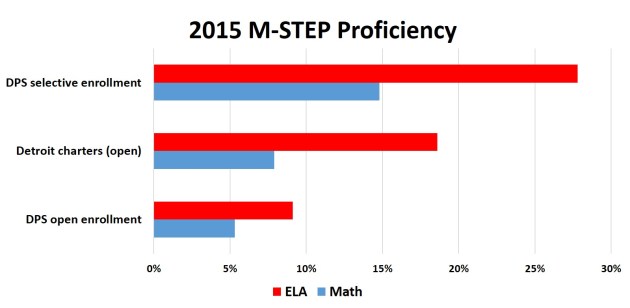
The Great Lakes Education Project also broke down the 2015 M-STEP proficiency and found that Detroit’s charter schools–which must have open enrollment–outperformed Detroit’s open-enrollment district schools, although they lagged behind Detroit’s selective-enrollment district schools (and, frankly, none of the sectors have particularly stellar performance). Again, this is not an apples-to-apples comparison, so we should be cautious in interpreting these data, but they certainly don’t lend support to the notion that the charter sector is particularly troubled.
ed561657-352e-434f-ac45-8ff15d0854ab

Detroit’s open-enrollment charters outperform open-enrollment district schools.

Moreover, as shown in this infographic that GLEP put together, Detroit’s charters are over-represented among the top-performing schools and outperform Detroit’s district schools on average:

18 of the Top 25 schools in Detroit are Charter schools

22 of the Bottom 25 schools in Detroit are DPS schools

 Charter average: 14.6%

 DPS average: 9.0%

 Charters are 62% more proficient than DPS

 71 charters (79%) perform ABOVE the DPS average and 19 charters schools (21%) perform BELOW the DPS average.

 20 DPS schools (30%) perform ABOVE the DPS average and 46 DPS schools (70%) perform BELOW the DPS average.

 12 DPS schools (18%) perform ABOVE the charter average and 54 DPS schools (82%) perform BELOW the charter average.

 40 charter schools (44%) perform ABOVE the charter average and 50 charter schools (56%) perform BELOW the charter average.

To reiterate yet again, these are not apples-to-apples comparisons. For that we will need another carefully matched comparison, like the CREDO studies, or (better yet) a random-assignment study. But until then, charter critics should be more circumspect in their allegations. Certainly there is plenty of room for improvement in both Detroit’s charter and district schools. But the charter critics have not presented any hard evidence that Detroit’s charter sector is particularly troubled, or that the increased choice and competition is at fault for the poor performance in either sector (especially since Detroit’s district schools have been seriously troubled for decades).

Neither Detroit’s charter schools nor their district schools are above criticism. But critics should put their criticism in its proper context — and be sure to bring evidence.


Controlling Math Curriculum

July 1, 2016

(Guest Post by Ze’ev Wurman)

Recent weeks saw a welcome attention to the groupthink that saturates what is mellifluously called the “education reform” community. I thought Rick Hess’ (School Reform Is the New Ed. School) and Jay’s (Ed Reform is Animal Farm) were particularly powerful, but their main focus was – as it should be – on the systemic and structural aspects of school reform that has become the new orthodoxy, and on the reform movement character becoming essentially a power struggle for control, not much different from what ed schools and teacher unions already do.

Here I want to focus on a particular aspect of this change by school reformers – the effort to  impose their curricular ideas based not on what works but on their interest in centralized control, and about their efforts to silence objections and dissent.

Last week the Fordham Institute published its 2016 look at Common Core math implementation in the classroom. Fordham has been a big Common Core supporter from early on so it is not surprising that despite finding skepticism and frustration among parents and students, and despite finding enthusiasm among elementary teachers (who largely know little math) but a negative response among middle school teachers (who actually know some math), Fordham still is supportive:

For the first time in our nation’s history, there is a high level of consistency regarding what’s taught in American elementary and middle school math classrooms. Fewer teachers appear to be closing their classroom doors and doing their own thing.  … [S]tudents are being exposed to fewer topics in more depth, spending significant time on applications.” (p. 44)

What struck me was the praise for the “high level of consistency,” justified by students spending “significant time on applications.” Perhaps I shouldn’t have been surprised by Fordham’s love of consistency. After all, it was Checker Finn who signed the 2011 Shanker Manifesto that called for uniform national standards – not only in math and English, but also in civics, the sciences, and health and physical education. Clearly, centralized uniformity has been a high priority for Fordham for quite some time.

But what about the praise for “significant time on applications” brought by Common Core, supposedly Fordham’s  justification why it is OK to impose Washington’s will on the country? Just three days before the Fordham report was published, a new large study of students found that the “difference between the math scores of 15-year-old students who were the most exposed to pure math tasks and those who were least exposed [and exposed instead to real-world problems] was the equivalent of almost two years of education.” Surely if Fordham was driven by research evidence rather than by faddish support of centralized education it would have at least restrained itself from blindly supporting one-size-fits-all model, when a year old study clearly says:

[G]iven the pervasiveness of the belief in a conceptual-then-procedural sequence despite the lack of empirical evidence, would additional research convince those who hold the belief? In fact, widespread endorsement of this belief among mathematics education researchers may help to explain why so little research has directly evaluated it. Thus, it seems important to briefly consider nonempirical reasons that might support this belief and which could impede progress in addressing it … [C]ulture may play into the persistence of this belief. The directionality of developing conceptual and procedural knowledge seems to only be debated in the USA. This may be because in the USA and some other Western cultures, practice is not believed to aid the development of understanding. In many Asian countries, by contrast, practice is viewed as a route toward understanding, where there is a public perception that only through a great deal of practice can true understanding be developed. Our anecdotal interactions with mathematics education researchers in non-Western countries suggests that they are confused by the debate in the USA. Elsewhere, it is taken as obvious that procedural knowledge can lead to conceptual knowledge (and vice versa).

I wanted to comment on Fordham’s site about this, and then I realized that … Fordham has eliminated reader comments. I guess it was tired of even those few dissents that found their way to their pages. So no more of that! Now that I think of it, Education Next, the journal that “will steer a steady course, presenting the facts as best they can be determined, giving voice (without fear or favor) to worthy research, sound ideas, and responsible arguments” also decided recently that giving voice to sound ideas does not include readers’ (moderated) comments and shut them off without warning. So much for openness to dissent, so much for the voice of the parents and the unwashed masses, so much for being research driven.

The creatures outside looked from pig to man, and from man to pig, and from pig to man again; but already it was impossible to say which was which.