Colorado State Becomes the First American University to Accept MOOCs for Credit

September 10, 2012

(Guest Post by Matthew Ladner)

Udasity and EdX have set up a system for proctored final exams for their Massive Open Online Courses. The NYT reports that Colorado State University has become the first institution to accept such a proctored courses for university credit.  The NYT reports that several European universities have already done so. Given that hundreds of thousands of people are taking MOOCs, expect more to follow.

Kevin Carey turned in an interesting report on the Silicon Valley higher-ed tech revolution for Washington Monthly.

Time to switch back to you, K-12 brain…

I’m starting to wonder whether the K-12 Reactionary and the Higher-Ed Revolutionary voices can continue to coexist peacefully inside Carey’s head, but I digress. Massive Open Online Courses are going to productively disrupt both higher education and K-12 while putting a great education at the fingertips of billions.


Diane Ravitch, Super-Villain…. And Related News

September 10, 2012

I’ve avoided writing about Diane Ravitch recently because I think it’s now clear to all sensible people that she has gone completely nuts, lacks credibility, and was probably never much of a scholar.  But I just couldn’t resist noting that in addition to all of her previous vices, Ravitch is now seeking to play the part of a super-villain.  She always had the megalomaniac dimension of a super-villain, but has now added the dimension of making threats if her demands are not met.  In a recent post [UPDATED], she declared:

The election, I hear, will be decided in Ohio and Michigan.  As it happens, I have a very large following of teachers and principals in both states.  My decision could swing several thousand votes in both of these key states.  I hold the election in my hands.  Bwahahahaha! And if my demands are not met within 24 hours I will reverse the Earth’s gravitational pull and everything will go flying into space. Bwahahaha!

Actually she didn’t say the last bit, but she did say that President Obama should “read this and heed my advice… while you still can, puny Earthling.”  Again, she didn’t actually say the last bit, but I think you get the picture.

And in related news… The Chicago Teachers Union has decided to go on strike.  In their own effort to play the part of a super-villain, they are demanding that virtually bankrupt Chicago and its Democratic mayor Rahm Emanuel transform all matter in the universe into currency to pay for increased teacher salaries,  gold-plated pension and health benefits, and a hot tub for each teacher filled with KFC gravy.

And in related news… the Chicago Tribune has reacted to the demands of these super-villains by calling for vouchers for Chicago students.


Dumb Headline Conceals Smart Story

September 5, 2012

(Guest Post by Matthew Ladner)

A fascinating and revealing NYT story on the impact of charter schools in Harlem is well worth reading despite the utterly absurd headline: School Choice Is No Cure-All, Harlem Finds.

So apparently the straw-man argument generator in the headline writer’s head told him or her that a few charter schools would cure all of Harlem’s problems. I doubt that anyone else did.

Reading the actual story leads one to the conclusion that while there have been difficulties and growing pains, Harlem’s experience with charter schools has been quite positive. The most serious problem pointed to in the article, in fact, is the need for more charter schools.

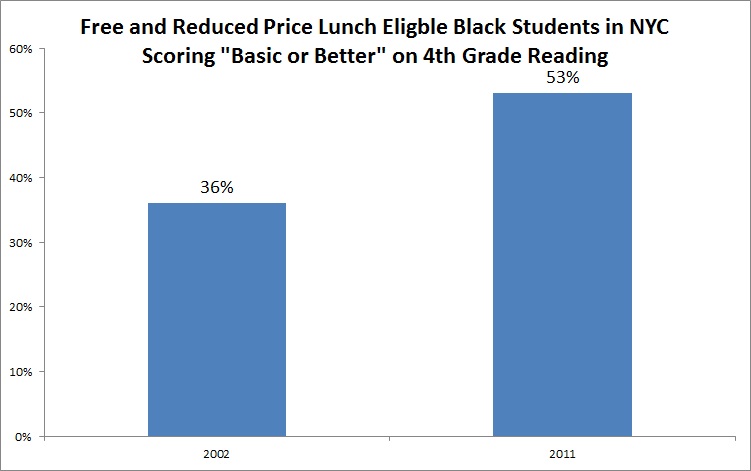
The NYT story deals with perceived difficulties in school grading. So A-F school grades and parental choice: sounds familiar. How has this been working out for NYC’s low-income Black students? Some day reporters will learn to use the NAEP Data Explorer and use actual evidence to sort through contending clouds of anecdotal fog, but in the meantime I can help out:

Did the Klein reforms cure all of the education problems of Harlem? Certainly not. They strangely also failed to cure cancer, restore sight to the blind nor did they erase the painful memories of having shelled out money to see Indiana Jones and the Kingdom of the Crystal Skulls.

They have however seen hard fought gains for disadvantaged students. Rather than wringing their hands, the New York Times should be calling for the logical next steps in reform.


Paging Mr. Nottroth, Mr. Wim Nottroth…

September 5, 2012

(Guest post by Greg Forster)

I think the JPGB post I’m most proud of is my nomination of Wim Nottroth for the Al Copeland award. I was deeply honored, of course, to have my nominee go on to win “the Al.” But I was even more honored to help more people learn about Nottroth and what he did for all of us.

Readers interested in similar threats to liberty may have been following the case now pending in Germany, where a rabbi is under criminal investigation for the “offense” of circumcising children. For those who are interested, over on the new group blog I edit called Hang Together, I offer four lessons Americans can learn from the German circumcision case as we wrestle with our own struggles on religious freedom.


If Teachers are Underpaid, Why Don’t They Earn More When They Move to Other Professions?

September 4, 2012

[Note — AEI’s Jason Richwine noticed my post urging people to read the debate in Education Next over how to assess teacher compensation.  He asked if he could submit this post to address an argument raised by Mishel and Roy that he did not have the space to respond to in Ed Next.]

(Guest Post by Jason Richwine)

The fall issue of Education Next features a debate: “Are Public School Teachers Underpaid?” Andrew Biggs and I contributed an argument based on our report released last year, while Lawrence Mishel and Joydeep Roy from the Economic Policy Institute (EPI) offer a rebuttal. Unfortunately, Andrew and I had only 300 words for our subsequent rejoinder, so much of their critique went unaddressed.

One of the points we made in our original piece is that EPI’s underpaid-teacher hypothesis generates a testable prediction: If teachers are underpaid relative to their skills, teachers who leave the profession should, on average, earn more in their new jobs. Likewise, new workers coming into teaching should, on average, take a pay cut from their previous jobs.

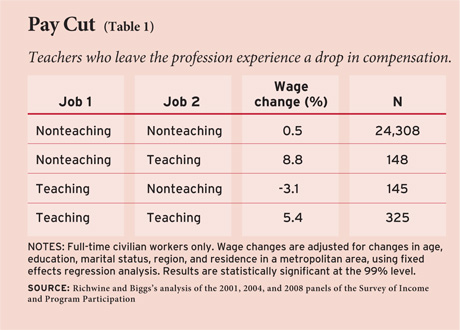
Andrew and I showed that, if anything, the opposite is true: Individuals get an average salary increase of 8.8 percent when they enter the teaching profession and a pay cut of around 3.1 percent when they leave.
Mishel and Roy confirm our empirical finding. In fact, they add that ex-teachers typically do not become engineers or chemists—they often become “librarians, cashiers, secretaries, and clergy.”

This would seem to cast strong doubt on the underpaid-teacher hypothesis, but Mishel and Roy don’t interpret it that way. They point out that just 1 percent of teachers actually leave for a different profession each year, and those who do leave tend to be making the lowest salaries. Therefore, they argue, we can hardly make inferences about the skill level of the average teacher based on this tiny, unrepresentative fraction. They don’t explicitly say that leavers have below-average skills, but the implication is needed for their argument to make sense.

I agree that teachers who stay could be more skilled than teachers who leave, but possessing these allegedly greater skills clearly does not compel them to seek higher salaries in the private sector. That was our point. If teachers are insufficiently compensated for their skills, we would observe teachers – particularly those with greater skills – leaving for higher-paying jobs. But despite all the anecdotes, the data just don’t show that happening.

In fact, Mishel and Roy’s response to us on job switchers is something of an own-goal. They are saying that, despite their own claims about teaching being underpaid relative to other professions, just 1 percent of teachers actually leave for a different profession each year. And that 1 percent may be made up of the least-skilled teachers. So tell me again why we need to raise teacher pay across-the-board…