Sen. Rubio Letter to Sec. Duncan on National Standards
September 14, 2011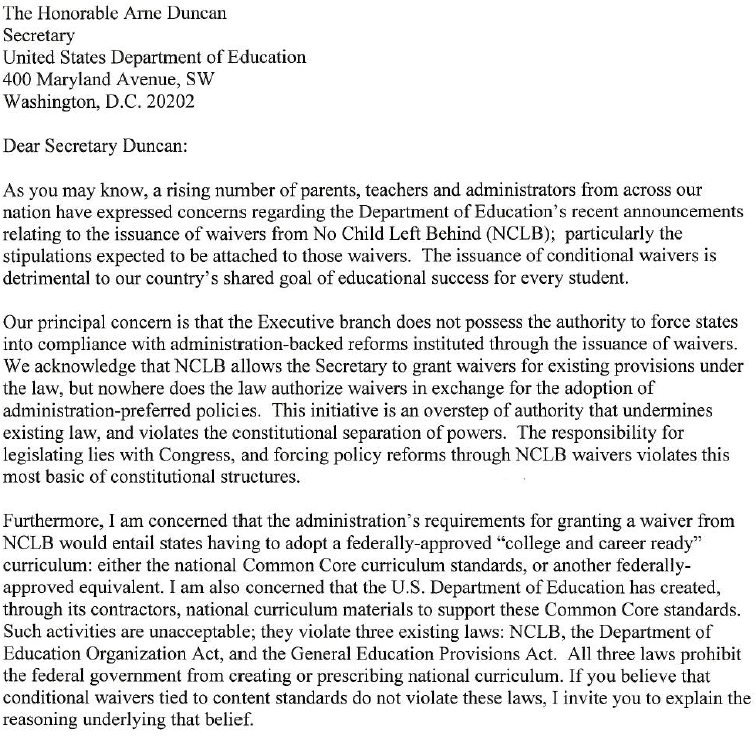
 2 Comments |
  instructional reform | Tagged: Arne Duncan, common core, Marco Rubio, national standards, NCLB waivers |
  Permalink
 Posted by Jay P. Greene
J.K. Rowling: The Jeb Bush of the NEPC Florida Fantasy
September 13, 2011 (Guest Post by Matthew Ladner)
The Arizona School Boards Association had their annual law conference last week, and had William Mathis from the Think Tank Review Project present on “Are Things as Sunny as They Seem in Florida?”
I went first, and presented charts like this, showing the vast improvement in Florida’s 3rd grade reading scores:
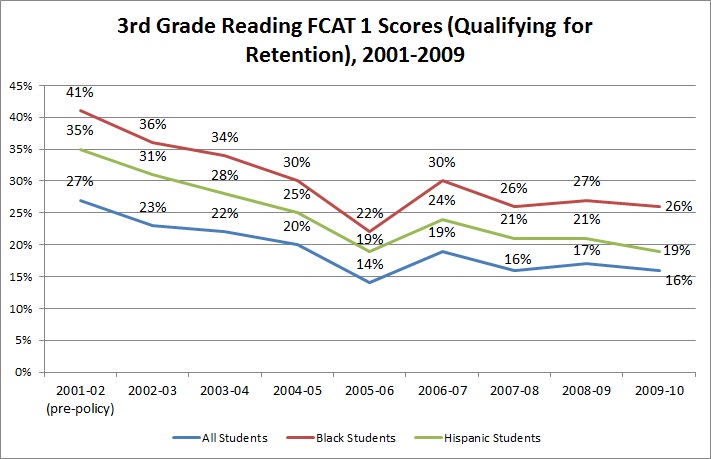
I have repeatedly asked the Think Tank Review Project people to explain why Florida’s 4th Grade NAEP scores continued to rise in 2007 and 2009 even as 3rd grade retention fell substantially. Or for that matter, why their 3rd grade scores have improved so strongly. Dr. Mathis made no attempt to address the issue.
I also presented charts like these:

Now, call me crazy, but when you are the state called “Arizona” in above chart, you might want to make a careful study of what the other state did to get their English Language Learners to read. This phenomenon of course is not limited to ELL. Another chart I used showed the combined learning gains on all four NAEP tests for children with disabilities for the entire period we have data from all 50 states (2003-2009).

Just in case you are squinting that’s Florida in red with a gain of 69 points and Arizona in green with a decline of two points.
Dr. Mathis proceeded with his presentation unperturbed. He complained about the 3rd grade retention policy without any effort to explain why Florida’s 3rd grade scores had so profoundly improved, and why Florida’s 4th grade NAEP scores continue to increase even as retention rates have significantly declined.
To give Dr. Mathis’ presentation the fairest possible reading, I would say that he was trying to make the following points: that correlation is not causation, and that to use the terminology of Campbell and Stanley, I had not “controlled for history.” That is to say, there could be other possible explanations for Florida’s gains other than the reforms.

Now it is of course the case that correlation can lead us very much astray, and it is the case that “history” has a nasty habit of bedevilling our theories of causality. As I have noted in the past, however, the Florida reforms unfolded in the real world, rather than in a random assignment study. A great many things unfolded all at once. This is called “life” and there is nothing to be done about this but to gather as much data as possible to draw the best informed decisions we can.
Both Chatteriji and Mathis ignored the Education Next piece in which Dan Lips and I examined other possible explanations for Florida’s gains. Huge spending increases (nope), decline in the percentage of low-income or minority students (nope-increases in both), preschool voucher program (nope- students too young to have aged into the NAEP sample) and class size amendment (nope- implemented very slowly, gains already well under way, formal evaluations negative) and retention law (scores continued to rise even as retention fell). This sort of information might be unhelpful if you are simply trying to get the idea in that something other than a set of hated reforms drove the gains.
Mathis however posited other types of “history” and noted other ways that the world had changed after 1998. On his list of other parts of uncontrolled “history” with regards to Florida’s gains were Harry Potter books (kids reading more fiction) and the more widespread availability of personal computers at home.
Sadly, the format of the panel did not provide time for rebuttal. We had two other people on with us, and took questions from the audience. Had there been such time, however, I would have noted that while Arizona may seem backwards to outsiders (Dr. Mathis lives in Colorado) that we do in fact have Harry Potter books and even personal computers in our humble little patch of cactus. In fact, I am rather confident that Harry Potter books and personal computers became increasingly pervasive in all 50 states.
You never know, Harry Potter books could have powerful educational properties that only manifest themselves on massive peninsulas with high rates of humidity and large concentrations of alligators. The children of Arizona, landlocked in an arid climate, and with not much more in the large lizard department than the occasional Gila monster, may have been left behind. I can’t prove that this isn’t the cause after all.
Nevertheless I’m going to stick with my theory that Governor Bush’s success in implementing a varied and comprehensive set of K-12 reforms in 1999 served as the driver for the large increases in academic attainment seen in Florida’s NAEP scores since 1998. Dr. Mathis and his compatriots can continue to play their stategic nihlism game if they wish, ignoring the problems with their arguments and the studies most on point for the subject at hand (like the regression discontinuity studies of Florida’s retention policy).
Until they put forward a plausible explanation for Florida’s gains, I cannot for the life of me find any reason to take them seriously.
8 Comments | research reports | Tagged: Florida K-12 education, NEPC, Think Tank Review Project, William Mathis | Permalink
Posted by matthewladner
One Book, But Why That Book?
September 13, 2011
In the last decade a large number of colleges and universities have initiated a “community reading” program, where everyone in a university and its neighboring community is required or strongly encouraged to read one book and discuss it over a series of events in an academic year.
In principle the One Book idea sounds great. Even as core curricula in higher education are being eviscerated, this appears to be an effort to have a shared intellectual experience on issues that are central to the missions of each participating university.
The practice, however, has not met that potential. As Harold Bloom put it, “I don’t like these mass reading bees… It is rather like the idea that we are all going to pop out and eat Chicken McNuggets or something else horrid at once.” Of course, we don’t have to select the book equivalent of Chicken McNuggets, but in practice that’s what universities appear to be doing when they choose their One Book.
The National Association of Scholars (NAS) has a report that documents what books universities actually choose based on a review of One Book programs at 245 universities and colleges. The results are incredibly disappointing. Rather than choosing high quality and intellectually stimulating books, universities tend to pick current, shallow, popular books. In particular the NAS report finds:
First, almost 90% of the books selected were published since January 2000. If important works tend to stand the test of time, almost none of the One Books have passed that test. Once you look at the list of what was selected, I think it’s safe to bet that almost none of them will be read a hundred years from now. Rather than exposing the university community to enduring truths or works of enduring quality, the One Book programs almost always picks a topic that is likely to be a passing fad or a disposable work.
Second, the topics are remarkably skewed toward what is considered politically correct. Out of the 245 selections, 58 were on African American themes, another 18 on African themes, 10 on Native American themes, 7 on Latino themes, 5 on East Asian themes. 24 One Books were about environmentalism, 10 about Hurricane Katrina, 10 were comic books or graphic novels, and 8 were self-help books or about the pursuit of happiness.
Third, memoirs and biographies dominated the list. There were 79 memoirs and 62 biographies, more than half of the total. Why so many memoirs? The NAS report answers:
… memoirs are “a genre familiar to students.” In high school English courses, students are taught to base their interpretation of works of literature on their own personal experiences. A recent study on high school literary study finds that this emphasis on the personal “may be contributing to the high remediation rates in post-secondary English and reading courses.”
Training students to write from the perspective of personal reflection gives them a taste for more of the same. This is one explanation for the popularity of the memoir in common reading programs. Another is that our society has an appetite for true stories. The growing number of reality TV shows is evidence of this. Getting to hear from the author in person at a scheduled campus speech is part of the allure of the memoir. The emphasis on memoir may also reflect the rise of post-modern sensibilities in American higher education. A memoir often presents “my truth,” rather than “the truth.” It is a way of asserting the primacy of self and the importance of opinion as trumping common judgment, authority, and hard-won facts.
The most popular One Book is The Immortal Life of Henrietta Lacks(2010) by Rebecca Skloot, which was selected at 39 of the 245 institutions. The NAS report describes the work:
The book does make a history of complex scientific research accessible to average readers, and Skloot explains biological jargon in simple terms. Readers will come away from the book having learned new things, but the writing itself is journalistic, not intellectual. Judging by what they say about it, some colleges seem to have chosen The Immortal Life of Henrietta Lacks in part because it can be read as a story of racial injustice.
Tied for the next most popular is Zeitoun by Dave Eggers, which was selected by 9 institutions. Wikipedia summarizes the plot:
It tells the story of Abdulrahman Zeitoun, the Syrian-American owner of a painting and contracting company in New Orleans who chose to ride out Hurricane Katrina in his Uptown home. After the storm he traveled the flooded city in a secondhand canoe rescuing neighbors, caring for abandoned pets and distributing fresh water. Soon after the storm, Zeitoun was arrested without reason or explanation at one of his rental houses by a mixed group of National Guardsmen and local police. He was not immediately charged with a crime but was imprisoned for 23 days without having stood trial. During that time he was accused of terrorist activity presumably because of his ethnicity, was treated inhumanely, and was refused medical attention and the use of a phone to alert his family. His wife and daughters, staying with friends far away from the city, only knew that he had seemingly disappeared from the face of the earth.
Also selected by 9 institutions was This I Believe: The Personal Philosophies of Remarkable Men and Women, which is a self-help book by Jay Allison and Dan Gedimen. Seven institutions picked The Other Wes Moore: One Name, Two Fates by Wes Moore. NPR summarized the plot:
In the book, author Wes Moore tracks his own life, alongside the fate of another man of the same name.
While both Wes Moores grew up in poverty in Baltimore, the two men had dramatically different fates: The author became a Rhodes Scholar, while the other Moore is serving a life sentence in prison for murder.
And 6 universities or colleges chose No Impact Man by Colin Beavan about a New York City family that attempts to have no impact on the environment for an entire year by buying nothing newly made, producing no non-compostible trash, and only buying food produced within 250 miles of their apartment.
Another 6 chose The Absolutely True Diary of a Part Time Indian, which Wikipedia says “is a novel for young adults written by Sherman Alexie. It is told in the first-person, from the viewpoint of Native American teenager and budding cartoonist Arnold Spirit, Jr. (better known by the nickname “Junior”). Detailing Arnold’s life on the Spokane Indian Reservation and his decision, upon encouragement from a reservation high school teacher, to go to an all-white high school in the off-reservation town of Reardan, Washington, the novel deals with issues such as racism, poverty, and the following of tradition.”
If you didn’t notice Shakespeare, Camus, Ellison, or Plato on the list, you’d be right. But the NAS helpfully compile a list of 37 suggested books that includes these authors and would be far better for One Book programs.
As the old United Negro College Fund commercial used to say, “A mind is a terrible thing to waste.” So is the opportunity for everyone at a college or university to read and discuss a quality book.
(edited for typos)
9 Comments | higher education | Permalink
Posted by Jay P. Greene
Incomplete Report Is Incomplete
September 12, 2011
Education reform, like highway. Man walk left side of street, okay. Man walk right side of street, okay. Man walk middle of street . . . chhhhhheeerrrrrriiiik! Just like grape.
(Guest post by Greg Forster)
A think tank called Third Way has a new report out, titled “Incomplete,” on the mediocrity of middle class schools. And with a name like Third Way, you know it has to be good!
On the surface, the point of the report is to emphasize that we don’t just have an education crisis in “the inner city” (i.e. in somebody eles’s neighborhood); we have an education crisis in “middle class” schools.
And that’s true! Part of me wants to be positive about this report and say, “okay, people are starting to get that this isn’t just about the 10% of kids in the worst schools.” After all, we’ve always said around here that we won’t get the education reforms we need until white suburbanites see how inadequate their own schools are.
But this report frames everything all wrong. Here are the three “key findings” they list:
- Most students are taught in middle class schools (duh)
- Middle class schools spend the least per pupil, pay teachers the least, and have the highest enrollment to teacher ratios.
- Middle class students are underachieving in test scores and college graduation rates.
The report offers no action items and no conclusions of substance beyond “a second phase of education reform focused on middle-class schools can’t begin soon enough.”
Right! Because the assumption that we don’t need to think about the policy specifics since everything is about mo’ money, mo’ money, mo’ money worked so well in the first phase of education reform!
Normally I wouln’t bother highlighting yet another blob mouthpiece hawking the mo-money line, but I wonder if this is going to be a new trend. A focus on the black/white, urban/suburban achievement gap doesn’t translate to mo-money for them any more, because they’ve gotten mo-money for that for decades and have squat to show for it. Is the mo-money line going to start migrating to other issues now?
Perhpas they’ve discovered a perpetual motion machine. You spend decades complaining that we need to increase spending in the inner city because we spend less there than in the suburbs, then once you can’t say we spend less in the inner city any more, you start saying we need to increase spending in the suburbs – because, of course, we spend less there than in the inner city! Rinse and repeat in perpetuity.
1 Comment | money myth | Tagged: Greg Forster, Third Way | Permalink
Posted by Greg Forster
Benjamin Ginsberg on Administrative Bloat in Higher Ed
September 9, 2011
Johns Hopkins political scientist, Benjamin Ginsberg has a new book out: The Fall of the Faculty: The Rise of the All-Administrative University and Why It Matters. In it he documents how universities have experienced explosive growth in the number of administrators and other non-faculty professionals and how this administrative bloat is making costs soar while distracting universities from their primary mission. His argument is virtually identical to the report I wrote last year with Brian Kisida and Jonathan Mills that was released by the Goldwater Institute.
I’m thrilled that Ginsberg is getting more attention for this issue. Here is a taste from his Washington Monthly article summarizing his book:
Between 1975 and 2005, total spending by American higher educational institutions, stated in constant dollars, tripled, to more than $325 billion per year. Over the same period, the faculty-to-student ratio has remained fairly constant, at approximately fifteen or sixteen students per instructor. One thing that has changed, dramatically, is the administrator-per-student ratio. In 1975, colleges employed one administrator for every eighty-four students and one professional staffer—admissions officers, information technology specialists, and the like—for every fifty students. By 2005, the administrator-to-student ratio had dropped to one administrator for every sixty-eight students while the ratio of professional staffers had dropped to one for every twenty-one students.
Apparently, as colleges and universities have had more money to spend, they have not chosen to spend it on expanding their instructional resources—that is, on paying faculty. They have chosen, instead, to enhance their administrative and staff resources….
Every year, hosts of administrators and staffers are added to college and university payrolls, even as schools claim to be battling budget crises that are forcing them to reduce the size of their full-time faculties. As a result, universities are now filled with armies of functionaries—vice presidents, associate vice presidents, assistant vice presidents, provosts, associate provosts, vice provosts, assistant provosts, deans, deanlets, and deanlings, all of whom command staffers and assistants—who, more and more, direct the operations of every school. If there is any hope of getting higher education costs in line, and improving its quality—and I think there is, though the hour is late—it begins with taking a pair of shears to the overgrown administrative bureaucracy.
I also particularly enjoyed this bit Ginsberg had on strategic planning at universities:
Another ubiquitous make-work exercise is the formation of a “strategic plan.” Until recent years, colleges engaged in little formal planning. Today, however, virtually every college and university in the nation has an elaborate strategic plan. This is typically a lengthy document— some are 100 pages long or more—that purports to articulate the school’s mission, its leadership’s vision of the future, and the various steps that are needed to achieve the school’s goals. The typical plan takes six months to two years to write and requires countless hours of work from senior administrators and their staffs.
A plan that was really designed to guide an organization’s efforts to achieve future objectives, as it might be promulgated by a corporation or a military agency, would typically present concrete objectives, a timetable for their realization, an outline of the tactics that will be employed, a precise assignment of staff responsibilities, and a budget. Some university plans approach this model. Most, however, are simply expanded “vision statements” that are often forgotten soon after they are promulgated. My university has presented two systemwide strategic plans and one arts and sciences strategic plan in the last fifteen years. No one can remember much about any of these plans, but another one is currently in the works. The plan is not a blueprint for the future. It is, instead, a management tool for the present. The ubiquity of planning at America’s colleges and universities is another reflection and reinforcement of the ongoing growth of administrative power.
Be sure to check out Ginsberg’s book. We plan to have some meetings to discuss it, will form a study group to consider recommendations, and will then issue an action-plan that is aligned with our strategic priorities.
1 Comment | higher education | Permalink
Posted by Jay P. Greene
The Second College Football Missile Crisis
September 8, 2011 (Guest Post by Matthew Ladner)
We interrupt your regularly scheduled education policy wonk nerdapalooza to bring you this update on college football!
A few years ago the Big 10 conference succeeded in pulling in a lot of money with a Big 10 Network, and then announced that they would add a 12th member (they had operated with 11 members since Penn State joined the fold in the early 1990s).
This set off the first College Football Missile Crisis. The Big 10 has long yearned for Notre Dame, and also dreamed of adding the 24 million television sets in Texas. Rejected by Notre Dame and Texas, the Big 10 added Nebraska.
During this first College Football Missile Crisis, the Pac-10 made a huge play for Texas as well, offering to add the Colorado, Texas, Texas Tech, Texas A&M, Oklahoma and Oklahoma State to form the first 16 team super conference.
Larry Scott, the PAC-10 commissioner, crafted a shrewd offer for the University of Texas. The inclusion of Texas Tech would lessen political issues, and constituted a sweetener that the Big 10 would be unwilling to match (all Big 10 schools were AAU members until Nebraska got the boot last year- quelle horreur!)
Furthermore, by including a bunch of neighboring schools of Big 12 and the Arizona schools, Texas and Oklahoma would basically have their own mini-conference to minimize travel. One trip to the West Coast per year (So-Cal, No-Cal, Oregon or Washington) plus a trip to Arizona every year (bring your golf clubs) and then a bunch of places you are already familiar with. Scott’s plans brought in major media markets in Texas and Colorado for the PAC 16 network to exploit, and gave the network a supply of games in the Central Time Zone (the East Coast tends to be asleep by the time a Pac-10 night game hits the air).
Three problems arose with this plan. First, Baylor summoned up the blood in an attempt to get the Texas legislature to quash it. Second, the Aggies decided that they didn’t want to join the PAC-X, and began to make noises about joining the Southeastern Conference. Finally, Texas decided that the same reason that the PAC 10 wanted them was the same reason they didn’t want to go: they would contribute more than took out. Instead, Texas athletic director DeLoss Dodds extracted an agreement to allow individual schools to create their own networks and sell their 3rd tier rights from the Big 12. Sensibly, Scott decided not to match this offer.
Colorado, not taking any chances with Baylor’s political machinations, quickly accepted an offer from the PAC 10, the PAC 10 also brought on The University of Utah to create the PAC 12. Fox and ESPN actually increased the total amount of money going to the Big 12 despite having lost Colorado and Nebraska (fragmentation of the television market has networks paying a heavy premium for live sporting events these days) and the College Football Missile Crisis drew to a close well short of Armageddon.
…or so it seemed last year.
ESPN partnered with the University of Texas to create the Longhorn Network, pledging a minimum of $300 million dollars over a long period of time for what amounts to 3rd tier rights (out of conference road kill football game, basketball games the networks don’t want, and Olympic sports). Despite the fact that the average payout to Big 12 teams had just doubled, the wailing and gnashing of teeth began. It all reminds me of this:
Now, this is the part of the story where the Aggies dive off the deep end. During the First College Football Missile Crisis, elements of the Texas A&M Board of Regents, including an a former University of Alabama football coach (seriously) banged on pots for the Aggies to join the SEC. This ignited a fan rebellion which was only put down with difficulty, and which was reignited by envy of the Longhorn Network.
So shortly after signing long-term agreements with Fox and ESPN, the Aggie brain trust started pounding on the door of the SEC, which just so happens to be entirely tolerant of members selling their 3rd tier rights. In fact, six out of the top 10 schools in generating 3rd tier rights revenue are….wait for it…..SEC schools. I’m willing to bet that they are all chomping at the bit to benchmark their inventory against the Longhorn Network as soon as their current contracts expire. If they aren’t, they need to fire their athletic directors.
Last week or so A&M sent a letter to the Big 12 announcing an exit date contingent upon their acceptance in another conference. Yesterday, the SEC Presidents met in Atlanta and unanimously voted to accept A&M’s application to join the SEC, contingent upon each of the Big 12 schools signing a waiver of any right to sue the SEC conference.
Imagine a state legislature passing a voucher law contingent upon the teacher unions signing a legal document pledging not to file suit against it in court. Some of the universities have contingency plans, and some do not. Most notably, Baylor, Iowa State, Kansas and Kansas state face an uncertain future if the Big 12 expires. You may remember the current President of Baylor University:

Yes, that Ken Starr! The possibility of Starr going on a fishing expedition discovery process seems to have deterred the SEC. Say what you will about the Whitewater fiasco, but there can be little doubt regarding Starr’s ability to exact vindictive revenge if provoked. Sure, the SEC wants A&M, but only if A&M falls into their lap. It reminds me of how Fred Thompson “wanted” the Presidency: he’ll take it as long as he doesn’t have to work for it. Otherwise they are good with being a movie star with a stunning young wife the most successful athletic conference in the country.
Facing a conference abyss, rumor has it tonight that Baylor and some of the other smaller Big 12 schools aren’t going to sign a waiver unless the University of Oklahoma decides to stick with the Big 12 conference. Oklahoma, quite understandably, still seems interested in joining the PAC-1X conference. No one really seems to care whether the Aggies take their inferiority complex/delusions of grandeur over to the SEC for a weekly dose of gridiron humiliation: put some popcorn in the microwave and pull up a chair! The schools without good options just don’t want the conference to implode.
I will say this in defense of the Aggies: the Pac 1X would be an odd fit for them:
As a Texas fan, my main concern with the Aggies going to the SEC is the exposure the other teams will get as they turn A&M into their doormat, and begin some of those extra special SEC style recruiting tactics, like showing up with a dufflebag stuffed with $200,000 cash money. Given that the Big 10 has a research consortium that seems to bring in an extra $200m-$300m a year in research dollars, much of which is agriculture related, the obsession on the Texas A&M board of regents with joining the SEC tells us what we need to know about them: they are making decisions like t-shirt wearing football fans rather than as regents.
The Texas athletic department has been trying very hard to have their cake and eat it too. They want their network, and to be a part of a conference. They have also revealed some control freak tendencies. An astute Longhorns sports blogger noted that college football is supposed to be about fun and the Big 12-2 or 3 and counting is simply not much fun. Personally, I’ll be hoping that Texas joins a PAC 16- that would be the most fun. If I were a regent charged with enhancing the academic prestige of my university, I would favor the Big 10. Longhorn fan would much rather be sitting on the beach in So-Cal than freezing in the snow in Ann Arbor, but tooooo bad. The Big 10 research consortium would exceed the loss of the Longhorn Network many times over.
What they have actually been trying to do is to keep something called the Big 12 together: its local and allows them to operate their own network. Texas operates as an independent with a conference, getting the best of both worlds. It looks to be a bridge too far. Dodds wonders why the maples can’t be happy in his shade, but it sure looks like they can’t. Another possibility is an alliance of independents. Texas scheduled both Notre Dame and BYU (a new independent) and they scheduled each other last year. Hmmmmm.
If the Texas third tier rights are worth $300m, the bean counters in the Texas athletic department are surely curious about what their 1st and 2nd teach rights would fetch. Whatever decision they make, I hope they will make it enjoyable for the fans and wildly profitable for the university, in that order.
Let’s see what happens next…
6 Comments | college sports | Tagged: Baylor University, Big 12, College football realignment, DeLoss Dodds, Ken Starr, SEC expansion, Texas A&M SEC, University of Texas | Permalink
Posted by matthewladner
Rick Hess Nails National Standards on Their Stealth Strategy
September 6, 2011
Rick Hess confirms the existence of this stealth strategy, given that Education Next has been unable to get a single expert to step forward and defend the rigor of the national math standards in a forum in the magazine. Ed Next has asked six leading people and all have turned the offer down, complaining that they are too busy. Rick isn’t buying it. He writes:
I’ll be blunt: I don’t believe them. After all, the leading thinkers who have found the time to contribute to Ed Next forums have included such seemingly busy people as Richard Elmore, Kati Haycock, Diane Ravitch, Hank Levin, Andy Rotherham, Joe Williams, Rick Hanushek, Checker Finn, Jay Greene, Bruno Manno, Chris Whittle, Bryan Hassel, Eva Moskowitz, Susan Eaton, and Howard Fuller. Rather, I think the reluctance to contribute is due to hubris, impatience to focus on implementation, political naivete, and disdain for what they see as mean-spirited carping….
There are long rows of argument and persuasion still to be hoed. And, if you’re eager to overhaul what gets taught in forty-odd states serving forty million or more students, that’s probably as it should be. If Common Core-ites don’t have the patience or stomach for that task, they should let us know now–and save everyone a whole lot of grief.
The notion that Common Core proponents needn’t make their case is an affront to democratic values. When seeking to make substantial changes to public institutions, the burden is supposed to be on the would-be reformers. After winning a unanimous decision in Brown v. Board of Education of Topeka, civil rights advocates spent decades making and re-making the case for school desegregation. Charter school advocates have spent two decades arguing their case. That’s normal and healthy. The “we’re really busy now” stance of the Common Core-ites is akin to the NAACP having decided in 1956 that it had done plenty to make its case, that everyone understood its arguments, and that it should just buckle down and focus on “implementation.” It’s akin to charter advocates having decided in 1993 that they’d adequately made their case and could move on….
As I’ve said many times, I’ve much sympathy for the Common Core effort, but am skeptical that it will turn out well. To have even a shot at working as intended, this requires bipartisan support from a range of state officials and buy-in or acquiescence from educators, parents, and voters. If the Common Core’s architects are done explaining its virtues–if they think that eighteen months of explaining its merits to a moderately attentive audience of self-selected elites amidst tumultuous debates over health care reform and the stimulus is sufficient–and that everyone needs to just sit down and get with the program, then I feel comfortable predicting that this whole exercise will end real poorly.
Hmm. I’ve been hearing a lot of predictions lately about the pending collapse of national standards. Maybe the tide is starting to turn.
12 Comments | National Standards | Permalink
Posted by Jay P. Greene
Jay Mathews Gets It Right on National Standards
September 6, 2011
Jay Mathews may not have gotten it right in his bet with Greg over how many school choice programs would be adopted during the most recent round of state legislative sessions, but he is completely on target with his take on the bleak political future of the national standards movement. I’d say that he is Right On!
[A system of national standards, curriculum, and assessments] sounds great. But it won’t help and won’t work. Such specific standards stifle creativity and conflict with a two-century American preference for local decision-making about schools….
No Child Left Behind and the Race to the Top grants are likely to be the high water mark of federal involvement in schools. Washington officials will dump all kinds of education programs so that they don’t have to cut too deeply into monthly allotments to regular voting geezers like me.
We already have all the national standards we need from decades of states borrowing one another’s ideas. The colleges generally agree how much math, English, history and science our students need. Employers are pushing for special requirements for students who want to work after high school. Those local business executives will know better than any national panel what the students in their communities need to learn in the way of teamwork, critical thinking, presentation skills and time management.
And Jay Mathews favorably discusses one of my blog posts on this topic, so obviously he is right. : )
3 Comments | National Standards | Permalink
Posted by Jay P. Greene
New Schools Presents: Education Entrepreneurs
September 1, 2011
(Guest Post by Matthew Ladner)
New Schools has a new series of videos about education entrepreneurs:
and…
Leave a Comment » | charter schools | Tagged: education entrepreneurs, New Schools | Permalink
Posted by matthewladner

 Jay P. Greene's Blog