The Lioness in the Winter?

September 9, 2010

(Guest Post by Matthew Ladner)

I’m seeing increasing eduland chatter that DC Mayor Adrian Fenty is trouble in his reelection bid.  Rick Hess provides an on the scene view of what is at risk:

When it comes to teacher evaluation, the teacher contract, textbook distribution, special education, scheduling, data systems, and much else, Rhee’s team has gotten DCPS to the point where it is functional. It isn’t yet an especially good school system, but it’s no longer broken and it’s positioned to be something much more.

I’m even a bit more bullish than this on DCPS. In our rankings of state NAEP performance for ALEC’s Report Card on American Education, DC came up with the second highest overall gains between 2003 and 2009, behind only Florida. The NAEP gains in the District predate Rhee’s tenure, but accelerated between 2007 and 2009.  If the Fenty/Rhee regime survives, an academic golden age of improvement lies within the grasp of the long-troubled district.

If not, it will likely take longer. The bottom-up pressure on DCPS in the form of a large and growing charter school sector will remain.  I have some hope that the union’s pillow smothering of the DC Opportunity Scholarship Program might be reversed after many of their minions are forced out of Congress.

That's my lobbying job! No MINE!!!!!

The path to reform is difficult. There have been and will continue to be bitter losses along the way. For the sake of the 56% of DC 4th graders who still can’t read at a Basic level despite the progress to date, I hope that prematurely losing Rhee will not be one of them.


Boards of Education That Approve “Inquiry-Based” Standards for ‎K-12 Students Need To Do Inquiry-Based Thinking Themselves

September 8, 2010

(Guest Post by Sandra Stotsky)

State boards of education are generally viewed as dull or weak citizen boards when compared with local school boards–which tend to be much livelier and far more involved with educational issues (often to the chagrin of local school administrators). There are many reasons why state boards do not have a reputation for being active or strong guardians of the public interest in their state. They tend to consist of people who work full-time and don’t have the time or energy to delve into the details of all the regulatory or policy matters that state boards must approve by statute.  They tend to meet only once a month–which doesn’t allow time for finding all the devils in the details of any important policy-laden issue. In addition, the recommendations of the commissioner or state superintendent of education are too easy to rely on if the person was appointed by the board on the basis of professional credentials, in contrast to being elected or a governor’s political appointment. And in many states, board members themselves are appointed by the governor and are often chosen for reasons other than having a reasonable familiarity with K-12 education or a reputation for asking enlightening questions instead of grandstanding, pontificating, obsessing over a few specific issues, or expressing stream-of-consciousness ruminations.

Yet, despite their flaws and weaknesses, there is a case to be made for revitalizing and strengthening state boards of education, especially at a time when efforts are being made to leave both local and state boards of education in the dust on vital matters of curriculum and instruction in the name of equalizing academic expectations for all students and obtaining comparable test scores across states.  These are desirable educational goals in themselves but not to the exclusion of goals that take cognizance of differences in students’ interests, talents, and abilities. At the least, we should not enfeeble state boards of education by structural changes that centralize educational decision-making and minimize the possibility of getting corrective feedback from informed public discussion of proposed or implemented policies. In what follows, I offer an analysis of how the Patrick administration in Massachusetts effectively silenced what was once known as a strong state board.

In November 2006, I was appointed by outgoing Governor Romney to the nine-member Massachusetts Board of Education. In January 2008, the legislature passed the bill Governor Patrick wanted establishing a cabinet-level position of secretary of education and expanding the board to eleven member–with almost no opposition registered.  My term of office was specifically shortened by a year and a half.  But, three and one-half years on the board was enough to discern the effects of these changes on statewide educational decision-making.

It is worth noting that in testimony at a 2003 hearing for an ultimately unsuccessful bill proposing a similar position for a different governor, Paul Reville, then director of the Center for Education Research and Policy at MassINC, warned that an education secretariat…seems to create “three masters” for the commissioner of education: the governor, the secretary of education, and the board of education including its chair.  How wrong Reville was. The position of secretary of education created in January 2008, to which the governor appointed Reville several months later, did not create confusion for the commissioner of elementary and secondary education.  It in effect created one new boss for him: the secretary of education, who was to oversee the budgets and coordinate the policies of the state’s three education agencies as well as serve as a voting member on their boards.

Expansion was the key to minimizing independent thinking on the K-12 board because it required alteration of all members’ terms of office. These changes were carefully spelled out in the 2008 bill to enable the governor to control the majority immediately and, by appointment, re-appointment, or non-re-appointment, all but the student member within a few years.

To reduce potential power plays between Secretary Reville and the board chair (whose appointment was already in the governor’s power), someone who could run meetings on time and had no political ambitions was needed and quickly found.  Indeed, the regular presence and seating of Secretary Reville at board meetings came to symbolize his role; newly appointed Commissioner Mitchell Chester was sandwiched between him and the chair, Maura Banta, at the head table. Banta, in turn, was flanked on her other side by the board’s union representative. Not much wiggle-room for Commissioner Chester.

The first clear sign that the governor’s office, not the board, was Commissioner Chester’s boss was his appointment of Karla Baehr, former Superintendent of the Lowell Public Schools, as a second deputy commissioner within two months after Chester’s appointment in 2008.  The governor had wanted her for commissioner of elementary and secondary education, but the board had selected someone else for other reasons. The board knew nothing officially about the addition of a second deputy commissioner to the department of elementary and secondary education until the media announced it.

Since spring 2008, the board has voted on very few significant policies for K-12.  Indeed, when asked to note for the 2009 summer retreat what important decisions they had made in the previous year, hardly anyone could think of even one. The bulk of the board’s time has been spent discussing (in excruciating detail) and voting on charter school applications or issues, as evidenced in its monthly agendas.

Almost all meeting agendas have been determined by the secretary of education and commissioner, with no board input desired.  Secretary Reville told the board directly at a 2008 summer retreat that meetings would be too long if every topic members wanted discussed became an agenda item.

Because the governor controlled a majority of board members from 2007 on, discussion was minimal on most, especially non-charter school, issues. The secretary of education rarely asked questions at board meetings because he didn’t need to; the chair usually asked none. Although the board regularly received brief updates on the Common Core initiative, there was clearly no need to waste time discussing the implications of national standards for Massachusetts or the quality of Common Core’s evolving standards. Patrick-appointed board members knew they were going to adopt these standards no matter what condition they were in. The draft copy placed in an appendix in its January Race To The Top application (explicitly noting the commissioner’s intention to consider adopting them in the future) was of such inferior quality that it had to be completely revised for the public comment version released in March. The chair was the only board member who saw that application before it was sent off,  and no board member raised a question about it after hard copies were sent to all board members in response to my request for a copy.

With the non-re-appointment in June 2010 of  the two board members appointed by former Governor Romney (Tom Fortmann and me) and their replacement by more Patrick appointees, the board has become little more than a facade satisfying a statute that requires a citizen board to provide oversight of the department of education.

The ostensible results of the 2008 legislation have been exactly as intended–complete control of the state’s educational agenda by the Executive Office of Education, with minimal public discussion of important matters.  But, by centralizing policy-making and appointing a politically partisan board with little understanding of K-12, the administration has prevented its own officials as well as the public from learning about flaws in the policies it proposes or adopts. The bill for that hubris will begin to come due when teachers in the Bay State start implementing the inferior national standards this year.  And what will the fallback explanation be to parents when high school students deemed “college-ready” by grade 10 or 11 state tests based on those standards go to college and fail some of their college courses?  Or will they not be allowed to fail?  These are questions that all state boards adopting Common Core’s standards  should discuss and need to be prepared to answer.


It Took So Long Because They Were Learning It in the Wrong Style

September 7, 2010

(Guest post by Greg Forster)

I had to laugh when I saw this New York Times story. They’ve discovered that the existence of multiple “learning styles” has no sound basis in empirical evidence:

Take the notion that children have specific learning styles, that some are “visual learners” and others are auditory; some are “left-brain” students, others “right-brain.” In a recent review of the relevant research, published in the journal Psychological Science in the Public Interest, a team of psychologists found almost zero support for such ideas. “The contrast between the enormous popularity of the learning-styles approach within education and the lack of credible evidence for its utility is, in our opinion, striking and disturbing,” the researchers concluded.

Wow, those daring journalists at the Times and scientists at Psychological Science in the Public Interest aren’t afraid to buck the conventional wisdom!

Imagine how daring they’d have been if they’d been reading Education Next . . . in 2004?

(Admittedly, the Ed Next article is framed in terms of “multiple intelligences” rather than “learning styles,” but when you come right down to it, “multiple intelligences” was just the fashionable early-aughts buzzword for the same cluster of fallacies that goes by “learning styles.”)

HT Joanne Jacobs


The Little Voucher Engine Keeps Chugging Along

September 7, 2010

Despite various reports of the death of vouchers, mostly from people wishing that the idea were in fact dead, voucher programs and supporters keep gaining steam.

Today in the WSJ we learn about how both Democratic and Republican candidates for governor in Pennsylvania are voucher supporters.   As the piece concludes:

The Obama Administration, which is phasing out a popular and successful school voucher program in Washington, D.C., at the insistence of teachers unions, refuses to acknowledge that vouchers can play a role in reforming K-12 education. But states and cities are the real engines of reform, and the Pennsylvania developments are another sign that the school choice movement is alive and well.


Obama Believes in Trickle-Down?

September 7, 2010

I know the Obama Administration is scrambling to do something about lackluster employment and growth figures to lessen gigantic Democratic losses in the mid-term election.  But I am completely puzzled about why their latest stimulus proposal involves granting large corporations tax breaks for new capital investment.  Does the Democratic Party now believe that the best way to stimulate the economy is to give big corporations tax breaks in the hopes that this will trickle-down to help the middle and lower classes?

I know that this is a targeted tax break, but they way in which it is targeted makes it all the less likely to spur job growth.  Most job growth comes come from small businesses.  Small businesses tend not to be capital intensive, so a tax break for capital investments should make little difference for them.  In addition, most of our economy is in the service sector, which also has relatively little capital investment.  A tax break for new capital investment shouldn’t make much of a difference there either.

The main beneficiary of a capital investment tax break would be large corporations in the manufacturing sector.  That’s a relatively small and shrinking sector of our economy, regardless of tax policy.  And fueling capital investment in the manufacturing sector may well reduce the number of jobs — rather than create more jobs — since the trend in that sector has been to substitute capital for labor.  As companies build new and improved manufacturing facilities they tend to need fewer people to operate those machines and build things.

If the Obama Administration thinks tax breaks lead to trickle-down benefits, how about if they focus on reducing capital gains and dividend taxes, which would broadly encourage investment in the service and manufacturing sectors?  This would also benefit small as well as large businesses and would reward the investment in people as much as machines.  Instead the Obama Administration seems determined to raise capital gains and dividend taxes.  Things that make you go hmmmm.


Room for Debate on Teacher Assessment at the NYT

September 6, 2010

(Guest Post by Matthew Ladner)

Lance and Marcus enter a bar brawl over at the NYT on value added assessment. Watch out for the guy holding the pool stick upside down!


Coverage of Administrative Bloat Keeps Expanding

September 3, 2010

I was interviewed by Glenn Reynolds on Pajama Media’s Instavision.

And The Economist chimes in.

For a full list of coverage go here.


NYT on LA Times Value-Added Bombshell

September 2, 2010

(Guest Post by Matthew Ladner)

Check it out. To do this right (aka as best we can) schools need to have multiple tests to get much more data and thus much less error. The state of the art with this involves teachers drawing up their own common assessment items based on state academic standards, giving monthly assessments, and tracking student learning gains together as departments. Teachers can own this process, and either remediate or weed out ineffective instructors themselves.

Fantasy? Nope- it is already happening, and it is not rocket science.

Even improved scores should also be only a (big) part of an assessment, and the goals should be communal as well as individual.

All this reactionary hand-wringing about the measures not being perfect is a waste of time. We need to get these measures as close to perfect as we can and then run with them. Stringing together three crappy state tests in a row is NOT as close to perfect as we can get, but it is much better than nothing.

I’m not willing to settle for better than nothing. Rock star pay for rock star teachers or bust baby!


American Legislative Exchange Council releases Report Card on American Education

September 1, 2010

(Guest Post by Matthew Ladner)

The American Legislative Exchange Council released the Report Card on American Education: Ranking State K-12 Performance, Progress and Reform today coauthored by yours truly, Andy LeFevre and Dan Lips. Follow the link and check out our rankings of state NAEP performance based on the overall math and reading scores and gains of general education low-income children, and our “poll of polls” grades for K-12 policy in each state.

Former Florida Governor Jeb Bush penned the foreward. After losing a bet Stanford Political Scientist Terry Moe gave the book a very kind endorsement:

Everyone interested in education reform should read this book. Using a method that—by focusing on the achievement of low-income children—allows for apples-to-apples comparisons across the states, the authors present a treasure trove of eye-opening performance data and arrive at a ranking of state performance that reveals both surprising success and shocking failure. The book is well worth reading for the data alone. But it also offers a good deal more, from research summaries to methodological clarifications to model legislation—and concludes with an insightful discussion of the high-powered reforms that have helped some states out-perform others, and that offer the nation a path to improvement. I should add, finally—and with genuine admiration—that the book is beautifully written and a pleasure to read: something I can rarely say about a data analysis.

JPGB readers will of course realize that this is quite a tribute to Andy and Dan, given your painfully intimate knowledge of my garbled writing. Thanks also to Jeff Reed and Dave Myslinski from ALEC (Jeff is now rocking and rolling at the Foundation for Educational Choice), Jay and my Goldwater Institute comrades.

Check it out and let me know what you think. Be nice though: today is my birthday, which makes me even more emotionally volatile than usual.

UPDATE: Here is a link to the PDF.


Politics and Schools, Part MCCXXIII

September 1, 2010

(Guest post by Greg Forster)

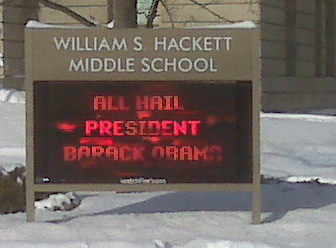
Neal notes the connection between Arne Duncan’s now-infamous embrace of Al Sharpton and the president’s continuing his new tradition of broadcasting a back-to-school message to America’s classrooms, coming up later this month.

Duncan didn’t just embrace Sharpton in his personal role as a citizen. He mobilized the U.S. Department of Education to support Sharpton by encouraging employees to attend Sharpton’s anti-Glenn-Beck rally.

Whatever you think of Glenn Beck, Sharpton cut his teeth as a professional purveyor of incitement to murder. During the Crown Heights race riots, with blood running in the streets, he said, “if the Jews want to get it on, tell them to pin their yarmulkes back and come over to my house.” He had to tone it back after the Freddy’s Fashion Mart murders, when people began making connections between Sharpton and the killings that kept following in his wake. But tone it back was all he did; he’s never repented.

Duncan spoke at Sharpton’s rally and urged his employees to attend.

A department spokesperson lamely tried to evade responsibility by saying “This was a back-to-school event.” Really? Here’s a sample of Al Sharpton’s back-to-school message for America’s youth, courtesy of the Washington Examiner:

[Conservatives] think we showed up [to vote for Barack Obama] in 2008 and that we won’t show up again. But we know how to sucker-punch, and we’re coming out again in 2010!

…and do your homework!

This is obviously intimately connected with the presdient’s decision to make it an annual tradition to use America’s government school monopoly to broadcast a message to the nation’s children. Other presidents have done so before, though none has made it an annual tradition. But it was equally wrong whoever did it, and this Duncan/Sharpton rally shows why.

Neal is trying too hard when he strains to describe Obama’s message to students as “politically charged material.” Joanne Jacobs rightly notes, “Last year’s speech raised a lot of fuss, culminating in a big fizzle as Obama told students to work hard in school.” No doubt this year the president will be equally anodyne.

[Update: Neal points out below that it was the accompanying materials sent to schools, not Obama’s message itself, that he described as “politically charged.” Fair enough! I read his post too quickly. Yet it’s worth noting that even those accompanying materials were focused on anointing Obama as a role model rather than pushing an overtly political agenda.]

The connection is rather that politics can’t be hermetically sealed. The president does have some role to play as the representative of the entire nation. But he is never just that; he is also a politician with an agenda. He will always stand for things that many Americans oppose; that’s just the nature of political life. And this president in particular seems to have more of a tendency than most presidents of associating himself with criminals and race-haters.

It doesn’t matter what Obama says. In fact, the less political his message, the worse it is. If Obama’s message really were “politically charged material,” many students would recognize it as such. The more anodyne he is, the more he gets what he really wants – to be anointed as a role model. With all that entails.

It’s wrong enough to have a government monopoly on schooling. To have the government monopoly anoint the president as a role model for our children is a hundred times more wrong. It would be wrong even if the president were relatively uncontroversial, because no president can avoid having many associations to which many parents will reasonably object. With this president – well, words just fail.