Rock star teacher pay for Rock Star teachers: Part 4

June 11, 2009

(Guest Post by Matthew Ladner)

How do you get rock star teachers? Offer rock star wages of course! I coauthored a study for the Goldwater Institute laying out a model of achieving $100,000 teacher salaries based on Arizona charter school funding. You can read the previous posts on this here, here and here.

The New York Times features a new charter school that apparently had a similar idea: they are offering teacher salaries of $125k and merit bonuses of up to $25k.

What do you get for that? Well for starters, Kobe Bryant’s former personal trainer as your gym teacher.  “Developed Kobe from 185 lbs. to 225 lbs. of pure muscle over eight years,” his resume says.

The school, named the Equity Project, is located in a rough part of town and will have class sizes of 30 to pay for those rock star teacher salaries.

I don’t know whether the school will be tracking value-added learning gains over time as we recommend in our study.  I hope they will. I for one will be watching with great interest to see how they do over time.


Do You Know What Else Rises to the Top?

June 10, 2009

If Arne Duncan did half of what he talks about, we’d be making huge progress toward education reform.  It would be great if  he actually followed the evidence regardless of ideology, only funded what works, made strides to end the lifetime-guaranteed employment of ineffective teachers, provided financial rewards to the most effective teachers, etc… 

We’d be lucky if Duncan manages to do one-tenth of what he talks about.  But I’m amazed at how many people confuse words with action.  Mike Petrilli is right that we should praise this new rhetoric and Greg has persuasively argued that rhetoric is politically important, but people really get carried away in their praise of a bunch of mostly empty words

Perhaps it is natural for people to suck up to whoever is in power.  Perhaps it is the triumph of hope over experience.  But I have to say that I am deeply skeptical of what Duncan will accomplish.

Let’s take as an example the Race to the Top money.  How does anyone really believe that a one-time expenditure of less than $5 billion is going to have any significant influence on the nature of $550 billion in annual expenditures?  This isn’t the tail wagging the dog.  This is the tail of the flea on the dog wagging the dog. 

What’s more, everyone except the most politically naive understands that there is enormous political pressure on Duncan to distribute the $5 billion roughly equally so that it provides absolutely no incentive to race to the top.  Andy Rotherham has dubbed this the peanut butter meme because people are guessing “how many states the Department of Education will have to include in the ‘Race to the Top’ funds to make the initiative politically palatable without spreading the money like ‘peanut butter’ across the states”

For those who still somehow believe that the Race to the Top money is going to have a big effect (and may also believe in the tooth fairy), I’d like to make a little wager.  I’m willing to bet that every state will receive at least some money from the Race to the Top fund and that the distribution of money will be roughly proportionate. If you think I’m wrong, would you be willing to bet that fewer than 30 states get the money? 

Like with much else that Duncan says, the Race to the Top fund is just a bunch of empty words.  You can’t have 30 and certainly not 50 states at the top.  Unfortunately, cream isn’t the only thing that rises to the top.

Edited to fix the link to Greg’s post; see also Matt’s post and to clarify Andy’s quotation.


Question for Sara Mead

June 9, 2009

(Guest Post by Matthew Ladner)

I saw a documentary on Napoleon’s Egyptian campaign a few years ago. After a completely nasty setback, Napoleon retreated in defeat back to Cairo, but then ordered a victory parade to be held before fleeing the country entirely.

Watching Fordham’s pre-school event online, I can’t help but think that pre-k advocates are trying to do the same thing with Oklahoma: pretend its a victory, when in fact it looks more like their Waterloo.

I watched the Fordham Foundation pre-school event online yesterday. I was especially taken by Sara Mead’s claim that universal preschool could lead to dynamic changes in K-12, and that disadvantaged kids in Oklahoma’s pre-k program made larger gains than other students.

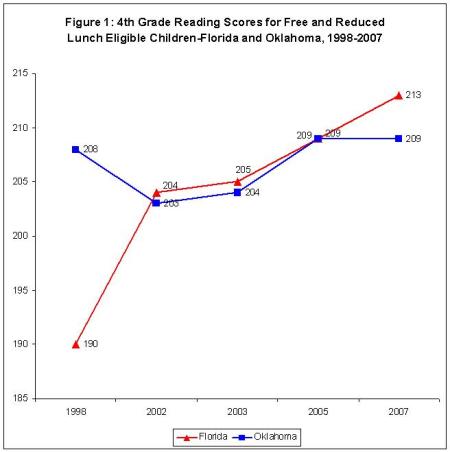
The biggest problem for universal pre-k advocates, in my view, is that the academic gains associated with Pre-K programs fade out. Consider the blue line in the chart below-4th grade NAEP scores from Oklahoma. In 1998, Oklahoma adopted a universal pre-k program.

FL vs. OkI assume that Ms. Mead has a basis to say that disadvantaged children make bigger gains under the Oklahoma pre-k program. The more important question is whether those gains are sustained over time.

Based upon the NAEP scores, Oklahoma’s program looks like a dud, increasing all of one point between 1998 and 2007.

The best one can try to spin out of the Oklahoma situation is scores might have actually dropped in the absence of the program, but now you are really grasping at straws. I seriously doubt that anyone who voted for this program in 1998 could be anything other than disappointed.

The red line, Florida, shows what can be done with a vigorous effort to improve K-12 schools. Florida’s low-income children improved by 23 points between 1998 and 2007.

Florida voters created a universal pre-k program, which was implemented as a voucher, but none of those students had reached the 4th grade by 2007.

Mead would likely argue, and I think she did at the event, that Pre-K and K-12 reform aren’t mutually exclusive, and I agree. It seems fair to ask however: is Pre-K a waste of time as an education improvement strategy? If not, why are the Oklahoma results so dreadfully unimpressive?


The National Standards Sausage-Making

June 9, 2009

Every decade or so we have to debate the desirability of adopting national standards for education.  People tend to be in favor of them when they imagine that they are the ones writing the standards.  But when everyone gets into the sausage-making that characterizes policy formulation, it generally becomes clear that no one is going to get what they want out of national standards.  What’s worse is that the resulting mess would be imposed on everyone.  There’d be no more laboratory of the states, just uniform banality.

Of course, some people always hope that they’ll somehow manage to sneak their preferred vision into place without having to go through the meat grinder.  That’s what is happening now with the National Governor’s Association effort at “voluntary” national standards.  In a process completely lacking in transparency and open-debate, some are rushing to announce a national standards fait accompli.

My colleague Sandra Stotsky tells us what’s what:

“If another country wanted other countries to respect its educational system and the reforms it was trying to make, who would it choose to lead such an important professional project as the development of its national standards in mathematics and in the language of its educational system itself?  In any other country in the world, one would expect a distinguished mathematician at the college level to be asked to chair the mathematics standards-writing committee–someone who commands the respect of the mathematics profession (and obviously is an expert on mathematics).   For the language standards-writing committee, one would likewise expect an eminent scholar in a college-level department–someone whose command of the language and understanding of the texts that inform the development of this language could not be questioned.   If the National Governors Association and the Council of Chief State School Officers had thought about national pride (and national need) as well as academic/educational expertise, then all of us would respect the Common Core Initiative and look forward with eagerness to the drafts the NGA and CCSSO have promised to make public in July.

 These two organizations could have followed, for example, the exemplary procedures followed by the National Mathematics Advisory Panel, on which I had the privilege to serve.  The Panel was chaired by the former president of one of the major universities in the country, all Panel members were identified at the outset, their qualifications were made known to the pubic, their procedures were open to the public and taped as well, and the final product was hammered out in public, after dozens of reviewers provided critical comments. 

 But instead of choosing nationally known scholars to chair and staff these committees–to assure us of the integrity and quality of the product–the NGA and the CCSSO have, for reasons best known to themselves,  treated the initiative as a private game of their own.  The NGA and the CCSSO haven’t even bothered to inform the public who is chairing these committees, who is on them, why they were chosen, what their credentials are, and why we should have any confidence whatsoever in what they come up with. 

 One person has announced on his own to the press and to a state department of education that he is chairing the mathematics standards-writing committee. He has not been contradicted by anyone at NGA or CCSSO, so we must assume he’s for real.  It turns out he is an English major with no academic degrees in mathematics whatsoever.  No one has yet announced on his/her own that he/she is chairing the English standards-writing committee.   One wag has already wondered whether this person might be a mathematics major with no academic degrees in English.  But it’s possible the sad joke in mathematics is not being repeated in English. 

 This country deserved better for a project of such national importance.”

Sandy Kress added these words of wisdom (pardon the capitalization since this was a comment on a post at Eduwonk):

“i suspect after the good feelings wear off, other governors and chiefs will begin to ask whether they can or should consider new standards at this time. once they learn about how hard it is to write new standards, they will ask even more questions. when we get to the controversies around whole language vs. phonics, they will ask more questions still. then comes computation vs. concepts. then comes all the many questions that arise once you get below the level of 30,000 feet. then – God forbid – you might even get to the place where you might possibly find the new standards under consideration to be no better than (or even possibly worse than) the standards you have! could it be that the tradeoffs that happen nationally will be the same as those that occur in the states? could the same interest groups intervene? could this nice dream be interrupted by the demons that bedevil state standard setting? could these interests be the problem as much as variation? oh no, could it be there’s no santa… no, i won’t go there.

and, oh yes, what about performance standards? if we ever get to detailed precise standards in each grade for reading and math, do the participants agree to common performance standards? if they don’t, who’s kidding whom? the real problem today is not so much that some states have vastly higher standards than other states; it’s more that their performance standards are greatly different. have the states, or will the states, commit to making those the same? if not, this will be utterly fruitless.

listen – DO NOT GET ME WRONG – i’m all for higher, fewer, clearer standards. i’ve spent a lot of time working on improving texas’ standards over the past 20 years. i’ve spent a lot of time with the hunt institute pushing more common standards. this is indeed the right thing to do.

but this process is going to be much more difficult than some think. it won’t happen overnight, nor should it. and there will remain great variation at the end of the day. it is utterly naiive and/or foolish to expect states to jump track from their current gameplans, particularly where they’re reasonably well thought out.

be prepared for states to recognize this “the morning after.” texas just recognized it before “the drinking began.”

also be prepared to realize that a better approach might be for one or more of these organizations to begin by recruiting the best and the brightest and actually doing the hard work of developing a few sets of model standards and then shopping them to the states, with the political support of those who rightly want high, common standards as well as perhaps some incentives from the feds to take these steps.” 

(edited for typos)


Synchronize Your Watches…

June 8, 2009

(Guest Post by Matthew Ladner)

James Sherk and Dan Lips point out that the Obama administration is lowering the amount of transparency for unions even as the Indiana swindle unfolds.

Meanwhile the NEA seems to have shifted its position from “we will take care of this” to “it sucks to be you disabled teachers” back to “we will take care of this.”

Synchronize your watches for 15 minutes and we will see what they say next.


Walmart Shareholder Meeting 2009

June 5, 2009

I just returned from another excellent Walmart shareholder meeting.  Ben Stiller was the mc.  Michael Jordan gave some inspirational words.  Miley Cyrus, Kris Allen,  and Smokey Robinson performed.  And earlier in the week I saw Sugarland, Brad Paisley, Foreigner, and Daughtry perform at free events leading up to the meeting.  It’s been another great week of entertainment in Fayetteville, Arkansas.

And of course, the meeting discussed Walmart’s business, including its financial results and values as an organization.  On that topic I’ll just repeat what I wrote after last year’s meeting: “They presented impressive evidence and compelling anecdotes of how Walmart saves money for families of modest means and, in doing so, improves people’s lives….  It struck me that if Walmart were a government program, designed to provide basic goods to low-income families at reduced prices, it would be lauded as a great success on the order of the New Deal or the Marshall Plan.  Books would be written about how it worked so well.  Conferences would be organized to sing its praises.  But because someone is actually making a profit while serving low-income families, somehow the whole thing is ruined.  It’s as if social progress can only be made if taxpayers lose money.”  If you want to see more along these lines, check this out.

At this year’s meeting my puzzlement about why people vilify Walmart only continues to grow.  This made me think about how the enemies one chooses says a lot about who one is.  Why do some people choose to focus their energies attacking Walmart while ignoring or even embracing others who more clearly violate their principles?

Let’s take as an example President Obama.  He has clearly chosen Walmart as an enemy.  Obama declared that he “won’t shop” at Walmart.  And during the campaign he participated in a conference call organized by the anti-Walmart advocates, WakeUpWalMart.  According to USA Today Obama said: “‘I think the battle to engage Wal-Mart and force them to examine their own corporate values and what their policies and approaches are to their workers and how they are going to be good corporate citizens, I think, is absolutely vital,’ Obama said, adding he was proud of WakeUpWalMart’s work.”

So how does Obama feel about Iran, whose values and policies must be much more objectionable to Obama than Walmart’s?  In his speech yesterday Obama said about Iran: “There will be many issues to discuss between our two countries, and we are willing to move forward without preconditions on the basis of mutual respect.”  And earlier in the week Obama said: “what I do believe is that Iran has legitimate energy concerns, legitimate aspirations.”  During the campaign, Obama stressed that he would “be willing as president to meet with the Iranian leader.”

Let’s see if I have this right.  Obama wouldn’t go to a Walmart and thinks the “battle” against Walmart is “vital.”  But he’s willing to meet with holocaust-denying Iranian leader,  Ahmadinejad, without preconditions on the basis of mutual respect keeping in mind their legitimate aspirations.

I fully believe that Obama strenuously opposes Iran’s illiberal policies.  The problem is not that he is ignorant of how Iran more clearly threatens his own principles than does Walmart.  The problem is that he approaches Walmart like an enemy while approaching Iran like a friend. 

Who you choose as an enemy says a lot about your own values and priorities.

(edited to add Kris Allen)


What Is Competition?

June 5, 2009

Monopoly - Pennybags

He’s done such a good job with your schools,
now he’s going to run your health care!

(Guest post by Greg Forster)

Mike Petrilli notes that Barack Obama and Paul Krugman are using the language of “competition” to mask Obama’s ambitions for a government takeover of the health care sector.

Krugman writes:

The “public option,” if it materializes, will be just that – an option Americans can choose. And the reason for providing this option was clearly laid out in Mr. Obama’s letter: It will give Americans “a better range of choices, make the health care market more competitive, and keep the insurance companies honest.

Mike responds:

You mean just like creating charter schools will give Americans “a better range of choices, make the education system more competitive, and keep the teachers unions honest”?

So in education, where the government is the major player, we’re trying to create competition via the private sector. But in health care, where the private sector is still a major player, we’re trying to create competition via the public sector?

Weird.

Mike, “weird” is not the word you’re looking for. Try “wrong.”

In health insurance, as in education, there’s no “market” deserving the name. But the way the government eliminates the market is slightly different. In education, government destroys the market by providing the service for “free” (of course you pay for it in your taxes, but it’s free at the point of service), making it impossible for anyone to compete; other providers are stuck serving niche markets. Whereas in health care government uses the tax code to force almost everyone to get insurance through their employers, which also eliminates the market, but more sneakily.

It’s as though government told you that from now on, your employer gets to pick one restaurant for you, and from now on you’re only allowed to eat out at that restaurant. They’d say that it’s a free market – because, hey, the restaurants are privately owned and there are multiple options available!

So it’s not surprising if the health sector and the education sector seem similar. Both are government-controlled command economies. The difference is, in the health sector you have these huge privately owned companies acting as rent-seekers, siphoning off tons of money and getting away with it because government has abolished the market forces that ordinarily weed out leeches – as Matt once explained to our Sith apprentice Leo. Whereas in the education sector, the rent-seeker siphoning off tons of money is the government itself.

The Obama/Krugman proposal isn’t about creating competition for private health insurers. That’s a smokescreen. It’s simply the first step toward making the command economy in the health sector more like the command economy in the education sector.


Fifteen Years of Pulp Fiction

June 5, 2009

(Guest Post by Matthew Ladner)

This year marks the 15th anniversary of Pulp Fiction. I can’t believe it either.

Pulp Fiction was a pop-culture phenomenon, not only resurrecting the career of John Travolta, but elevating the careers of several others, especially the brilliant Samuel L. Jackson.

I’ve met people who were repulsed by the grisly violence, foul language and drug use of the film. I’ve encountered others who claim that Resevoir Dogs is a better film (nonsense). Others like the film for the grisly violence, foul language and drug use, but I don’t believe they actually appreciate the film to the fullest.

You see, I believe that despite all of the hipster post-modern lingo, heart stabbing injections, Deliverance references, etc. that Pulp Fiction is actually a film about redemption.

Tarrantino used two main devices to tell this story: a fake Bible quote and non-linear storytelling.

Samuel L. Jackson’s hitman character Jules recites a manufactured version of Ezekiel 25:17 before killing people:

Along the way, Jules experiences what he regards as a miracle and decides to abandon the life of a hit man to “walk the earth” in a way that has echoes of the lillies of the field. Vincent Vega, Jules’ partner in crime ridicules him for choosing to become a bum.

The brilliance of the non-linear story telling is that the viewer knows that Vincent will soon be bleeding to death in a bathtub after being shot multiple times. We don’t know what happens to Jules, but we do know what happens to Vincent. The wages of sin, in other words, are death.

This becomes all the more clear when Ringo attempts to rob Jules in the diner:

Jules is trying real hard to be the shepard, and whatever happens to him, it’s better than what happens to Vincent.

This is how I interpreted Pulp Fiction, and I was relieved to see the Thomas Hibbs offer that the film can be interpreted in this way in his brilliant book Shows About Nothing: Nihlism in Popular Culture from the Exorcist to Seinfeld.

Tarrantino seems to be an unlikely source for a covert religious allegory, but there it is, hidden in plain sight.


Twin Editorials on Milwaukee Vouchers

June 4, 2009

Weasley Twins

(Guest post by Greg Forster)

This morning the Wall Street Journal and National Review Online both take on the covert effort to destroy Milwaukee vouchers by political subterfuge.

From the Journal:

Because the 20-year-old program polls above 60% with voters, and even higher among minorities, killing it outright would be unpopular. Instead, Democratic Governor Jim Doyle wants to reduce funding and pass “reforms” designed to regulate the program to death. The goal is to discourage private schools from enrolling voucher students and thus force kids to return to unionized public schools.

From NRO:

Last week, the legislature’s Joint Finance Committee approved a series of auditing, accrediting, and instructional requirements that will force successful voucher schools to shift resources away from classrooms and into administration. Several schools will have to comply with new bilingual-education mandates, even though many immigrant parents choose those schools precisely because they emphasize the rapid acquisition of English instead of native-language maintenance.

Both editorials also mention looming cuts in funding for vouchers, even though the program saves huge taxpayer dollars and the bloated government schools are getting increases in funding. Both editorials cite Robert Costrell’s calculation that the difference between private school efficiency and public school bloat has saved taxpayers $180 million – though only NRO mentions Costrell by name.

And NRO also gets a gold star for this:

Researchers say that the program is beginning to show systemic effects. In other words, it doesn’t merely help its participants. It also gives a lift to non-voucher students because the pressure of competition has forced public schools to improve.

C’mon, Wall Street Journal, get on the ball!


Barry Goldwater Jr. on Glen Beck

June 4, 2009

(Guest Post by Matthew Ladner)

Barry Goldwater Jr. is one of the most colorful people I’ve ever been lucky enough to get to know. Barry recently appeared on Glen Beck to discuss the awful state of the Republican Party:

At some point, I’ll have to rant at length about the Big Government Conservative project and the attempt to build a “permanent majority” with money out of your pocket. That was a great electoral strategy for FDR or LBJ, not so much for a right of center coalition.

By the way, how’s that permanent majority thing working out?