Socialism for Sports

October 2, 2008

George Carlin compares football and baseball.

The congressional bailout isn’t the only scheme that redistributes resources, punishing excellence and rewarding failure.  The National Football League’s revenue sharing scheme does the same.  All football teams, regardless of their performance or fan base, draw an equal share of the TV revenue, which is the lion’s share of all revenue in football.  Doing so rewards teams that flop and undermines the incentive to excel.

The arguments for revenue sharing are unpersuasive.  People say that revenue sharing produces parity, where all teams have an equal chance of winning, which makes it more exciting to watch.  But flipping a coin also has parity, with an equal chance of either side “winning.”  Who wants to watch a coin being flipped? 

I think what people really want — or at least should want — is excellence.  That is, sport offers fans the chance to see excellence in athletic achievement.  If all we wanted to see was parity, people would fill stadiums to see little league games where the players are randomly assigned to teams.  Instead, people fill stadiums to see the very best athletes doing the very best they can.

Now, it’s true that we wouldn’t see excellence if one team could beat the other without effort.  If teams could simply buy so much superiority that they didn’t have to try to win, we would be disappointed.  But the reality is that without revenue sharing teams still cannot be assured victory, especially over an entire season.

Just look at Major League Baseball, which has limited revenue sharing and historically had none.  The highest spending baseball teams cannot assure themselves a spot in the playoffs, so they must regularly try hard.  There is a relationship between how much a baseball team spends on its payroll and how many games it wins, but that relationship isn’t very strong.  In 2008 the correlation between team payroll and regular season games won was only .33.  Consider that the top three payroll teams (Yankees, Mets, and Tigers) aren’t in the post-season, while the Tampa Bay Rays, who spent 1/5 as much as the Yankees, are.

We shouldn’t want to see no correlation between team payroll and success because the revenue partially serves as a reward for winning, motivating excellence.  It’s also true that larger media market teams get more revenue without necessarily winning more games.  But we should want larger market teams to have a better chance of having the resources to win.  After all, those teams have more fans.  We wouldn’t want to shut large market teams out of the post-season and turn-off the bulk of the nation’s fans.  So, it is altogether fitting and proper (as A. Lincoln would say) that Los Angeles and Chicago each have two teams in the baseball playoffs even while NY has none.  And small market teams like Tampa Bay and Milwaukee clearly still have a fighting chance.

Obviously, it wouldn’t be any fun to have a team that never had a hope of winning because its market was too small to generate the revenue for a competitive team.  But if there were such a team the solution would be to move that team to larger market rather than to move revenue to the market that wasn’t viable.

So, this weekend I’ll be watching the baseball playoffs rather than the NFL.  I’d rather watch excellence than a coin being flipped.


Partnership Considers Casino Bailout

October 2, 2008


(Guest Post by Matthew Ladner)


Las Vegas (AP) Casino companies have entered into talks with the Ladner and Loftis LLP regarding a possible recapitalization of select Las Vegas Resorts.


Unable to resist economic gravity as in previous economic downturns, Las Vegas casinos have been laying off employees. “Las Vegas casinos are a great American institution,” noted James Loftis “the government got us into this mess, and the free market is going to have to get us out.”


“Vegas casinos face a short-term liquidity crunch. We will provide needed financial assistance,” noted Matthew Ladner. “We may even MAKE money on this deal!”


The precise assets to be purchased remain under negotiation, but are likely to include many hours at the tables, cigars, drinks out by the waterfall at the Wynn, multiple bets on college football games, and an umbrella drink or three by the pool.


L&L partners wouldn’t comment on ongoing negotiations, but rumors say that the bailout weekend may occur on the weekend of October 18th. The L&L partnership are raising funds from potential equity partners, or better yet, taxpayer funding.


“If we are going to subsidize real estate speculation, why not blackjack? It’s much more fun,” Ladner stated.


UPDATE: L&L officials confirmed the securing of a line credit from the newly formed Strategery Capital Management, LLC. An L&L official anonymously commented “Laissez Les Bon Temps Roulez!”


The One Florida Program

October 2, 2008

(Guest Post by Matthew Ladner)

Public school officials have come to resemble the kids at college football games holding up the sign “Hi Mom! Send More Money!” Public school officials constantly call for additional resources, a call that lawmakers have answered. Nationally, inflation adjusted spending per pupil nearly quadrupled between 1959 and 2004. Unfortunately, there was very little evidence of increased student learning during that period- NAEP scores have been largely flat since the late 1960s despite the increase in funding.


One state, however, has figured out how to utilize the insatiable appetite of schools for additional funding as a carrot to improving student performance.


Florida education reforms not only have improved early childhood literacy, but have also prepared a higher percentage of minority children for college work. Governor Jeb Bush pushed a One Florida Initiative, which sought to replace race based affirmative action with more effective instruction: better preparation rather than lower standards. The results have been impressive.


Working in partnership with the College Board beginning in the year 2000, the One Florida plan sought to increase the academic achievement of Florida’s students, particularly underrepresented in universities. The comprehensive plan included professional development for teachers and counselors and free PSAT exams for students. Florida officials created AP Potential – a web-based tool to identify promising students for AP coursework.


The program relied heavily on incentives, creating an AP Teacher Bonus – $50 for every passing score, up to $2,000. The program also created an incentive for the school, paying the school an additional bonus of $650 per student passing an Advanced Placement exam. Florida officials carefully wrote this bonus into the funding formula so that it went to the school, not to the school district.


The reformers didn’t stop there, however. Florida’s A-Plus reform plan assigns letter grades to schools based upon student performance. The One Florida plan provided an additional school bonus of $500 per student passing an AP exam for schools rated “D” or “F.” The idea was to set high expectations and to reward success.


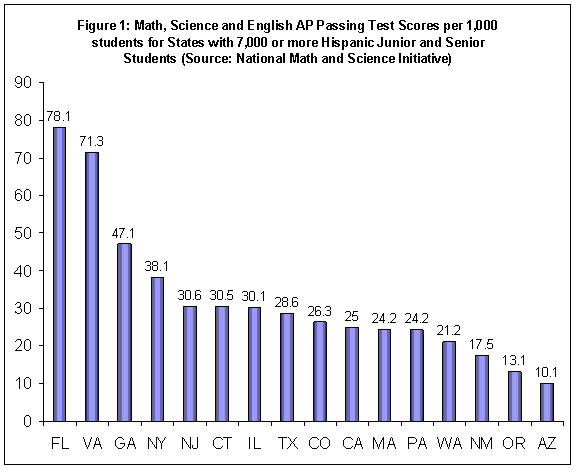
The National Math and Science Initiative recently collected data on the number of students passing AP exams, broken down by ethnicity. Figure 1 presents the number of Hispanic students having passed an AP exam per 1,000 junior and senior Hispanic students. Florida not only leads the nation in Hispanics passing AP exams, they do so at a rate nearly 8 times greater than that of my home state of Arizona.


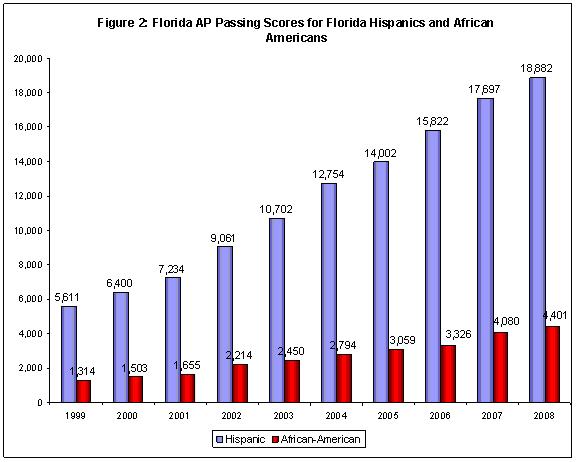
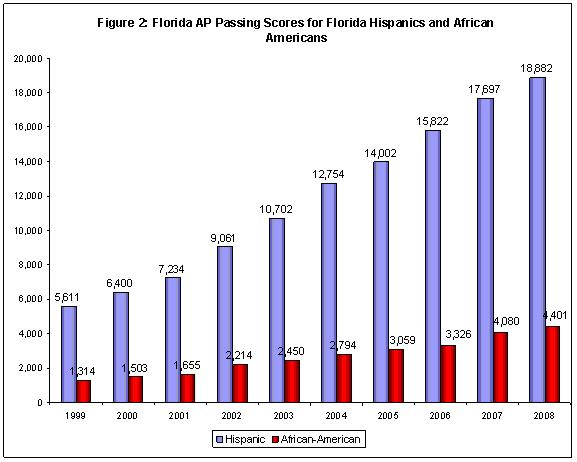
Do schools respond to incentives? Judge for yourself: between 1999 and 2007, the number of Florida students passing AP tests increased by 154%. Figure 3 below shows that the number of Florida Hispanic and African American students passing an AP exam more than tripled between 1999 and 2007.


Florida’s education reformers achieved these results for what ultimately amounts to a tiny portion of the Florida K-12 budget. Floridians should not be satisfied with these results, but should be proud of this level of progress- and work to extend it.


The next time the public school establishment calls for additional resources in your state, the question should not only be whether they should get them or not. The question should also be “in return for what?” Pay for performance is an excellent idea for education funding.


In Florida, high-schools get more money the old fashioned way- they earn it.


Stop Congress Before They “Help” Again

October 1, 2008

Greg and Matt had some excellent posts yesterday on the bailout.  Matt described how we got into this mess and Greg outlined the issues in dispute.  Today I want to talk about where we go from here.

I do not believe that a Congressional bailout is necessary to avert a catastrophe nor do I believe that it will effectively stop the economic damage that remains to be inflicted.  All that Congress is likely to do is shift the cost of the economic damage to a broader pool and hinder future growth with unwise regulations and new programs.

Despite scare-mongering to rush a bill through Congress, the reality is that the current turmoil is a normal popping of a speculative bubble fueled by Fannie and Freddie (government) guarantees on mortgages and artificially low Federal Reserve interest rates.  No matter what Congress does, a fair number of people are in homes they cannot afford and a number of banks own mortgages that will never be repaid. 

Shifting those bad mortgage securities from financial institutions to the government balance sheet changes nothing.  Someone is going to have to eat those losses.  If the bailout pays the banks above the market value for those securities, then the taxpayers will bear those losses, either in the form of raised taxes or higher inflation.  If the bailout pays market value, then the banks will not have any additional capital on their books and they will be no better off.  Either way, the economic damage of these bad mortgage securities on the economy will remain the same.

The only way that the government bailout could help is if the government pays above market value for the mortgages, strengthening bank balance sheets, but the amount that is paid turns out to be less than the intrinsic value of those securities, so the mortgages can later be resold without a loss to taxpayers.  But there is no reason to believe that the market value of those securities is less than their intrinsic value or that the government knows what the true intrinsic value of those securities is and will pay less than that amount.

To believe the case for the bailout you would have to believe that the government is the smartest hedge fund out there.  Keep in mind, there are potential buyers with capital willing to buy the bad mortgage securities, but not at a price that banks are currently willing to sell.  The banks don’t want to sell for the price that buyers would buy because they would have to write down the losses and be forced to raise capital themselves, which they are currently unable to do easily.  Instead, the banks are holding on, hoping that the government will pay them a higher price or that the market for these mortgages will somehow improve.

Instead of a bailout we should allow the market to work out these losses.  The government cannot stop the losses; it can only move them around.  And it can do some extra damage in the process, such as imposing new regulations and introducing moral hazard for future financial mistakes.

Despite elite opinion in the media and from many on Wall Street that a bailout is necessary, the passing of each day without a catastrophe demonstrates otherwise.  Sure, the markets have been volatile, but short-term market movements don’t indicate the long-term wisdom of policies. 

And let’s put things in perspective.  The economy grew last quarter.  Credit-worthy consumers can still get mortgages, car loans, and business loans.  The stock market is still higher than where it was a decade ago.  Things are painful but they are not catastrophic.

As Peter Robinson over at National Review’s The Corner says, “it has become impossible—simply impossible—to dismiss opponents of the bailout as mere hayseeds and (what to a lot of people amounts to the same thing) House Republicans.”  And a group of 200 academic economists from all ends of the political spectrum have come out against the bailout.

The hardest thing to do in a moment of crisis is to do nothing.  But in this case nothing is probably exactly what we need.

UpdateAlan Reynolds has a great piece at Forbes in which he documents that consumer lending has not declined.  He writes:

“On CNBC Monday, Democrat majority leader Steny Hoyer said the objective of the rescue package is to “unlock the credit” for consumers and business. And a Wall Street Journal editorial writer told CNBC, “Until we get the banks lending again, the economy will continue to contract.”

Such alarming comments never mention any facts. Why not? As Neil Cavuto recently noted on Fox Business News, the Fed reports bank loans every week.

U.S. Bank Loans (Billions of Dollars)

Week Ending Wednesday Business (Commercial & Industrial) Real Estate Consumer Interbank (Other Than Fed Funds)
Aug. 13 1,514.5 3,639.4 841.6 77.6
Aug. 20 1,509.1 3,653.3 845.6 75.3
Aug. 27 1,515.1 3,650.6 848.0 76.3
Sept. 3 1,514.8 3,631.3 846.8 77.2
Sept. 10 1,512.0 3,630.3 850.5 74.0
Sept. 17 1,531.2 3,625.2 847.1 72.3
         
Year Ago:        
Aug. 2007 1,311.1 3,498.4 774.0 82.7


Federal Reserve Board, “Asset and Liabilities of Commercial Banks in the United States” (H.8).

In August, bank loans to consumers were 9.5% higher than they were a year earlier–the fastest increase since 2004. The year-to-year increase in consumer and industrial loans was 15.5%, down only slightly from a recent record high of 21.6% in March. Real estate loans were up 4.1% for the 12-month period ending this August–flat lately, but not down…

Contrary to many comments, consumer and industrial loans actually increased in the latest week. Troubled giant banks have cut back on lending, but smaller banks have picked up the slack. Consumer and real estate loans dipped insignificantly through Sept. 17, remaining much higher than they were a year earlier. “


Just a Mint? One Mint?

October 1, 2008

(Guest post by Greg Forster)

Great news! Our schools are saved.

Billionaire Eli Broad is spending $44 million to start up a new Harvard center to figure out what’s wrong with public schools.

That’s right; the first $500 billion a year we spend on K-12 education didn’t do the job, but spending another $44 million (not per year but only once) will put us over the top.

Just like that after-dinner mint in the Monty Python sketch, I guess.

Larry Summers will head the center’s board. The Wall Street Journal reports that Summers was asked whether opening the new center was a rebuke to all the other education research centers which have been doing exactly the same thing for decades and have produced no tangible improvements in education to show for it.

Summers replied: “It’s not a rebuke to any individual.”

With respect to the fine people who work at these cushy “education laboratories,” the real education laboratories are the private and charter schools taking advantage of school choice programs to experiment with new approaches to education.

Milton Friedman always used to comment that education is the only thing we still do the same way we did it 100 years ago. Innovation in education has been stifled not because we lack comfortably endowed research centers but because education is controlled by a government monopoly. He would go on to comment that the real innovation in education won’t come until school choice programs are expanded to include all students – because only with universal choice will you get a more robust market that will produce bigger innovations. And once free-market schools begin discovering better educational techniques, others can copy them. Doctors improve care by copying other doctors who devise new and better treatments – and it’s not the doctors who work for the free, government-issue providers who devise new and better treatments, but the doctors who serve the middle and upper classes and have the opportunity to make more money if they provide better treatment.

The best thing we can do for the education of the poor, Milton would conclude, is to extend school choice to the middle class. Schools for the poor can’t improve service until the education sector as a whole figures out how to improve service, and that isn’t going to happen without a universal market.