In case anyone missed the release of this study this week, Rob Warren of the University of Minnesota has a new study comparing high school graduation rates in Milwaukee’s voucher program and public schools. The bottom line is that students graduate at much higher rates in the voucher program.
Warren is careful to emphasize that he cannot draw causal inferences from this work. That is, the voucher students graduate at higher rates than public students, but he can’t say whether the voucher program caused their higher graduation rate. That kind of conclusion can only be drawn from a study that compares apples to apples. With Pat Wolf I am involved in an evaluation that will be able to produce a graduation rate comparison of matched samples of voucher and public students, but results are still a few years down the road.
The season finale did not disappoint. I’ll sing its praises but first let me vent a complaint.
Jack’s decision to get the Oceanic six to lie about the island makes no sense. He justifies the decision by citing the strength of the conspiracy to create a false Oceanic crash site in which they are all supposed to be dead. But the first law of conspiracies is that you cease to be a threat once you tell as many people as possible as much as you know. If you’ve already spilled all of the beans, then the conspiracy gains nothing by killing you. Anyone trapped in a John Grisham novel would do well to keep this law in mind.
I hope they provide additional justification for this decision, but keeping the secrets of the island does nothing to protect them or the people on the island. Bad guys can and still do target them. And because they don’t know where the island is, keeping secrets is not needed to protect the people left there.
Now on to the good stuff. We now have some sense of why Jack wants to go back to the island — Locke has told him that his friends there are in trouble. And now that Locke is dead he feels responsible, both for Locke’s death (in all likelihood) and for those remaining on the island.
We also know why Kate does not want to go back. She’s having dreams of Claire warning her not to bring Aaron back. This is consistent with my earlier expressed theory that Aaron is supposed to be the next leader and there is a struggle about whether he should assume that role or not.
The struggle over whether they should return or not will likely be a main plot for next season. One other interesting angle on Ben’s declaration that they all need to return is that he may use that to find Desmond and then Penny so that he can take his revenge on Charles Widmore by killing his daughter. (hat tip to Greg for this observation)
The discovery that Charlotte was previously on the island and may have even been born there seems quite important, especially given the fact that pregnant women seem to die before they can give birth.
I’m assuming that Michael is dead and probably so is Jin (although he could have somehow been blown from the deck). Having Christian Shepherd appear to Michael telling him that he could go was meant, I think, to say that his purpose for the island was now done and he could die.
That vision strengthens the show’s reliance on mysticism, but the show also took steps to stay within the framework of sci-fi by revealing the negatively charged exotic material that moves the island (as well as bunnies). It’s like dilithium crystals on Star Trek. We don’t know how they work, but there is some physical substance that could account for a large chunk of the magic.
Now that the show is on hiatus for a few months, we’ll have to find some other distraction for Friday afternoons, but that shouldn’t be hard. We are chock-full of distractions.
Last week, I gave a commencement speech for the BASIS middle school. Newsweek recently named the BASIS Tucson the nation’s top high school. Charter schools took 10 out of the top 100 spots, which is far out of proportion with their numbers.
I had no idea of what to talk about, so I researched commencement speeches on the internet. There seemed to be two models: first you can quote a philosopher and give advice. Second, you can talk about whatever happens to be on your mind.
I chose model 1. For my philosopher quote, I used this nugget that I have seen attributed to Zen Buddhism:
The Master in the Art of Living makes little distinction between his work and his play, his labor and his leisure, his mind and his body, his education and his recreation, his love and his religion.
He hardly knows which is which.
He simply pursues his vision of excellence at whatever he does, leaving others to decide whether he is working or playing.
To him he’s always doing both.
When I first saw that quote, I said to myself “WOW- that’s what I want to be when I grow up!”
Let’s face it though, I’m not in much danger of growing up, so it remains only an aspiration for me.
The quote however perfectly describes my colleague at the Goldwater Institute Clint Bolick. The magazine Legal Times recently honored Clint in compiling “The 90 Greatest Washington Lawyers of the Last 30 Years” to mark the magazine’s 30th anniversary. The list honored attorneys for upholding the legal profession’s core values and “fighting to expand liberties and protect civil rights.”
Congratulations to Michael and Olga Block and their BASIS team, and the other charter schools making the list. Congratulations also to Clint, the only person I know getting lifetime achievement awards at the age of 39 (Ok, 39ish) and happily spending his time doing what he loves- suing bureaucrats.
Check out Michael Petrilli’s great article in the new Gadfly. If major media outlets are going to act like the sky is falling because of student obesity, why is nobody worried about teacher obesity – which imposes much more direct costs on the school system than student obesity?
Health insurance costs associated with treating overweight teachers and other school staff are taking a major bite out of public education budgets. I estimate that these costs come to at least $2.5 billion annually–more than Maine spends on its entire k-12 system in a year.
This calculation assumes that the obesity rate among people who work in k-12 education is the same as that for the population as a whole: about one-third of all adults. (I can’t think of any reason why it would be lower–and if you’ve been to many educator gatherings lately, you wouldn’t think so, either.)
Why is teacher obesity so expensive? Petrilli blames gold-plated health benefits thanks to “over-generous collective bargain agreements.”
It’s hard to tell just how far into his cheek Petrilli’s tongue is planted here, but the article’s worth a read.
So, true story, last year I turned 40 near the end of a Phoenix summer. My fantastic wife, who I don’t deserve, told me that she had bought me a mystery trip for my birthday. “You’re leaving Thursday, I’m not telling you where you are going, but the high temperature there is around 78 degrees. You will be staying in a nice hotel and meeting an old buddy. Your pal has all sorts of fun things on the agenda.”
I said, “You had me at 78 degrees!”
So that Thursday I got on a plane for Oregon. I met my old pal Kevin, my partner in crime from my hipster-doofus days in Austin. We hit the Northwest Music Fest and sampled the local cuisine. We rented a car in downtown, and the kid behind the desk informed us that they only had a Jaguar.
Kevin and I looked at each other, and said “Usually we hate Jaguars, but if it the only one you’ve got…”
Twenty minutes later we were going 100 miles per hour headed out of Portland to see the wine country. I told Kevin “You can hit on the Asian women, I’ll be neurotic about merlots…”
Anyway- I noticed two things about Oregon while I was out there. First- the kids all have tattoos. Second, the place is very Anglo.
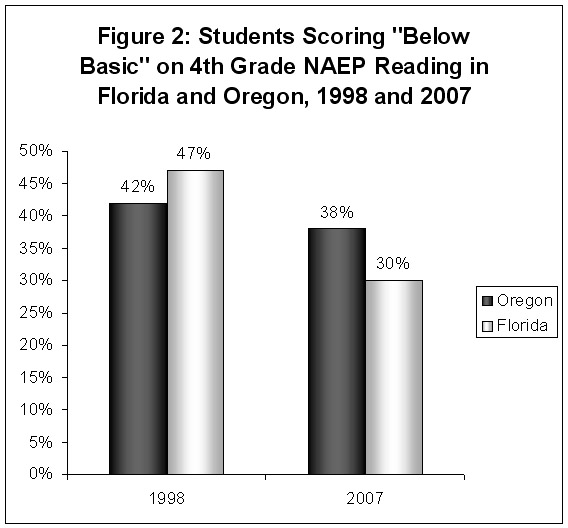
All of this is a prologue to wondering: why is a place as well to do as Oregon score so poorly on the NAEP?
One of these states is making substantial progress, and one of them is not. So, what’s going on Oregon? Where is the progress part of being progressive?
To follow-up on my post Monday on high school mascots, I have now assembled a fairly comprehensive national data set of high school mascot names. In total I have 19,786 high school mascot names from a school athletics site called MaxPreps. According the the US Dept of Ed’s Digest of Education Statistics there 23,800 secondary schools, not all of which have a mascot.
It will take me a little while to analyze it, but here are some things that stand out right away:
For good or bad, political correctness has not overtaken high school mascot names There are still 430 schools whose mascot is the “Indians,” 72 still called “Redskins,” and 209 still called “Crusaders.” There are 348 “Devil” mascots compared to only 18 “Angels.”
The national names, like those that I examined more closely in Texas, appear to be mostly animal mascots. Among those predator birds and big cats predominate. Among human mascots, the most common are Indian names (of some sort), Raiders, Pirates, Warriors, etc… Whether animal or human, mascots tends to have a fierce and intimidating quality.
One of the more frightening is the Marshall High School “Lawyers” from Cleveland, Ohio. Just imagine chants of “Go Lawyers” as the football team charges down the field.
The question that I have not yet been able to explore is whether newly selected mascots differ from ones selected many years ago. It may well be that new mascots are much more PC, while the non-PC names atrophy over time as those schools close.
With no Get Lost feature this week – the episode was postponed on account of soap opera – I figure this blog is a week shy on geekdom and it needs some ballast. So I’m going to pull on my flameproof shorts, put my affairs in order, kiss my wife and daughter good-bye, and tell the world what it needs to know:
Speed Racer is better than Iron Man.
(I don’t intend to spoil anything big here, but in deference to the prime directive of geekdom, I hereby warn you that if you want to be absolutely unspoiled for these movies, you’d be a moron to even start reading a post entitled “Speed Racer Is Better than Iron Man.”)
Don’t get me wrong; Iron Man is a good movie. But it’s missing something.
John Podhoretz (in the May 19 Weekly Standard) is right – Iron Man is not a superhero movie, it’s a 1930s screwball comedy about the wacky hijinks of a billionaire playboy. Flying around in a tin can is just another of his wacky hijinks.
Not that there’s anything wrong with that! I love “Cold Comfort Farm,” “Amelie” and “Down with Love,” so nobody can accuse me of screwball snobbery. And Iron Man works very well for what it is. (Which is a dignified way of saying that I laughed my pants off – and that’s saying a lot for a movie.)
It even manages to rise above the level of screwball in its evocation of the complex relationship between the male and female leads. Robert Downey Jr. and Gwyneth Paltrow earned every cent of the millions they’re going to make on this franchise. I went away thinking, “This is what that lousy Superman movie could have been like if they had hired an actor instead of a mannequin to play Lois Lane.”
But the tin man at the center of this movie has no heart – the psychology of the main character, which the structure of the movie intentionally draws our attention to, is never developed. The plot hinges on Tony Stark having a traumatic change of heart about his profession. But what exactly was this change? Does he repent of making weapons altogether? Some of the dialogue hints a little in this direction. But his first act of pennance is to make a big weapon and fly around using it to kill people.
So what then does he really repent of? I can see at least two other possibilities. He repents of making weapons for the US government, or perhaps making them for government (any government), or perhaps making them for anyone at all but himself. Again, a few lines of dialogue seem to point in this direction, but then the subject is dropped. Or, on the other hand, he repents of not keeping an eye on the weapons he makes and allowing them to fall into the wrong hands – but not of making weapons in itself. His actions after his repentance – making a big weapon and flying around killing people with it – seem to point toward this interpretation.
You can see why the movie never tells you which it is. If the first, then the movie is implicitly anti-war, and the conservative half of the audience is alienated. If the second, then the movie is implicitly pro-war, and the liberal half is alienated. You get bigger ticket sales by just letting each moviegoer mentally supply his or her own preferred interpretation of Stark’s psychology.
Trouble is, this turns Stark into a cipher. His motivation, his whole psychology, is truncated. That might not matter in a lot of superhero movies; Michael Keaton is a cipher in Tim Burton’s Batman, and it’s still a great movie. But the whole structure of this particular movie demands more psychology than the studio’s marketing suits are willing to permit. Iron Man could have been a tormented anti-war warrior, battling to undo the damage his life’s work has done to the world by enabling war. Or he could have been a warrior plain and simple, waging a just and noble personal war to put right the deadly consequences of his own arrogance. As it is, he falls between two stools and is . . . nothing in particular.
Winner of the 2008 Vaguest Midlife Crisis Award
OK, you might say, but do you really prefer a brainless light-show movie? Come on.
If you said, that, you’d clearly be in good company. The critics seem to agree that it’s a stupid movie. But I think the critics went into Speed Racer determined to dislike it, or at least not to like it unless it conformed to their preconcieved notion of what a “good” light-show movie is like, which it obviously doesn’t.
Critics don’t like what computer graphics have done to the movie business. And with the enormous number of lousy movies where the story is nothing but a lame excuse to show you a bunch of computer graphics, who can blame them?
To someone who sees things through that lens, if a movie has a lot of computer graphics, it had better also have a complicated plot, brilliant dialogue, gay cowboys eating pudding – something that could pass muster in an arthouse movie. If so, they get to look high-minded by praising the movie in spite of its having a lot of special effects. (“The effects serve the story” is the universal code phrase for “All of us snobs have permission to like this movie.”) Otherwise it goes in the “light show” trash bin.
Speed Racer doesn’t have anything you would ever see in a theater where the coffee at the concession stand is brewed fresh every hour. The plot is simple to the point of melodrama, and the dialogue does its job in advancing the plot, but no more.
But that doesn’t make it dumb! Simple is not the same as stupid. Melodramatic plot devices are cheap and tacky when they appear in narratives that are not otherwise melodramatic. But that’s not because melodrama itself is bad. It’s because melodramatic plot devices don’t belong in narratives that aren’t melodramas.
A well constructed melodrama satisfies a deeply rooted need in human nature. Anyone who denies this is kidding himself. Much of what passes as “serious” drama is really melodrama, but isn’t called that because the people who like it are too snobbish to think that anything they enjoy could be melodrama. And how else do we explain the near-universal popularity of melodrama? Why, for example, does practically every TV news outlet turn practically every story it covers into a melodrama?
And ultimately this same function – satisfying a universal human need – is the only claim that the allegedly more serious forms of drama have on our attention. Augustine, caught up in a violent overreaction against his own youthful obscession with “serious” drama, wrote that he understood the appeal of comedy but thought that tragedy was disgusting and perverse. Why go to the theater to intentionally make yourself miserable? In ethics and metaphysics I’ll take Augustine over Aristotle any day, but here, Aristotle knew better. We go because we must. Our spirits demand tragedy (and comedy) as our bodies demand food. That’s just how we’re built. And it’s the same with melodrama.
Speed Racer is the best melodrama I’ve seen in years. No doubt you already know the plot: Speed is a young racing prodigy who looks set to become the greatest racer of his time. But as soon as he wins his way into the big leagues, he discovers that the outcomes of the major races are fixed. He’s too clean to be bought and too good to be beaten, so the only way the fixers can ensure that their chosen racers win is by cheating – attaching hidden weapons to their cars. So Speed has to be twice as good to win. Cue fantastic racing-battle scenes.
Honestly, what more do you need? No doubt you could make a lousy movie out of that story. But you could also make a terrific movie out of it. And that’s what Speed Racer is.
If you want to know why it’s suddenly snowing horizontally, you’re missing the point.
Another reason people probably think Speed Racer is stupid when they shouldn’t is because it demands a full surrender to the narrative world. In the speedracerverse, everybody drives racecars, even to go shopping; monkeys are semi-intelligent; the hero’s actual, legal name is “Speed Racer” and his mother and father are named “Mom Racer” and “Pops Racer”; even the incorruptible Eliot Ness figure who helps Speed bring down the bad guys is named Inspector Detector. And no explanation is offered. The movie says, in effect: Here is the world where our story takes place; you can come in and join the party or you can go see some other movie.
Which is exactly as it should be. Every story must show you how its narrative universe differs from the real world, but trying to explain why its narrative universe differs from the real world is a fool’s errand.
And then there are the brazen plot devices. For instance, Speed is attacked while racing across a desert. Giant hammers and morningstars pop out of the cars. And just as you’re wondering how all this could be going on without the race officials noticing these giant honking weapons flying around, we cut to the TV announcer saying, “Wow, with all that sand being kicked up, it sure is hard to see what’s going on out there.”
Cheap? Stupid? It would be if it happened in an ordinary narrative, because it wouldn’t belong there. But in Speed Racer, that kind of thing is the narrative. “Stupid” stuff happens all the time in Monty Python, but nobody complains – because the stupid stuff is the whole point of Monty Python. And so, in that context, it’s not stupid at all; it’s brilliant comedy. Same here.
Or if Monty Python is too lowbrow for you, consider the point Dorothy Sayers makes, in another context, in The Mind of the Maker. If you’re writing a novel and you can’t figure out how to get your hero out of the jam he’s in, it would be stupid and wrong to end the novel by writing “Joe suddenly inherited a fortune from a wealthy relative he didn’t know he had, and he used the money to solve all his problems.” On the other hand, you could write a really great novel that opens with the same sentence – a novel about a man who suddenly inherits a fortune. If something brazen and outrageous is stuck on arbitrarily to resolve a problem because you’re too lazy to resolve it in a way that’s organic to the plot, that’s poor storytelling. But there’s nothing wrong with having something brazen and outrageous in your story if that’s what the story is about.
Finally, there is the innovation in the way the digital effects are used. The filmmakers decisively abandon visual realism to an extent that is probably unprescedented for a mainstream movie. During moments of intense conflict, the background fades away, leaving only the main characters surrounded by lights and colors. Things children imagine become momentarily real. A scene will suddenly become a visual montage (complete with people floating randomly across the screen, delivering dialogue) and then return to the scene. And in the final race, once Speed has dispatched the main villain, the rest of the race goes by in a chaotic blur. I think this last scene must be what the critics are thinking of when they complain that the effects are so heavy-handed you can’t tell what’s going on; at least it was the only scene where I couldn’t tell what was going on. But that’s clearly intentional. Once Speed has beaten the bad guy, it’s a given that he’ll win the race. So the fimmakers spare us the tedium of watching it.
To a critic worried about the negative effect of computer effects on filmmaking, all this must come across as reductive – effects intruding into scenes where they don’t belong. But the surreal visual style serves the melodramatic narrative very well. The whole point of melodrama is to clear away all the inevitable complexities of the real world in order to isolate and focus our attention on the stark, even painfully simple moral realities that always lie behind those complexities. People are always a complex blend of good and bad, but good and bad themselves are always simple. The point of melodrama is to tap into that simpler level of truth so that we can experience it, in narrative form, free of the complexities that always cloud it in the real world. What better way to visualize that experience than to have the background fade away as Speed struggles to overcome a thug sent to kill him?
Obviously all this explication is negative – an explanation of why Speed Racer is not dumb. None of that establishes that it is any good.
Fortunately, the producers have spared me a lot of effort by releasing the first seven minutes of the movie for free on the web:
If that doesn’t sell you on the movie, nothing I write will. Do yourself a favor and give it a chance.
The names we choose matter. When we name our children, or name a public school, or name a public park or courthouse — we are signaling what is important to us. Once names are given, there is an opportunity for people to learn about the values those names represent and promote those values in the world.
With Brian Kisida and Jonathan Butcher, I have already analyzed patterns and trends in what we name public schools. We found a trend away from naming schools after people, in general, and presidents, in particular. Instead, schools are increasingly receiving names that sounds more like herbal teas or day spas — Whispering Winds, Hawks Bluff, Desert Mesa, etc…
As you observe this Memorial Day remember that there are more public schools in Florida named after manatees than George Washington.
Now I am turning my attention to school mascots. I understand that mascot names aren’t taken very seriously and are often chosen without much deliberation or care. But even something trivial, like what we name our pets or the mascot names we adopt says something about us. Besides, this is a bit of fun.
I found a fairly complete list of mascot names for schools in Texas. The website has 1,363 mascots and there are about 2,000 secondary schools in Texas. If anyone knows of other databases of mascots, please let me know.
A quick analysis of the names reveals a few things. First, 71% of the mascots are animals, 25% are people, and the remainder are something else, like tornadoes or rockets.
Second, Indian mascots have not gone away. Almost 15% of the people mascots are related to Indians, including 36 actually named Indians, 5 Chiefs or Chieftains, 2 Apaches, 2 Braves, 2 Comanches, 2 Redskins, 1 Cherokee, and 1 Kiowas. There are only 14 Cowboys.
Third, a significant number of both people and animal mascots are fierce and bellicose. No pacifism here. There are 35 Pirates, 24 Warriors, 20 Raiders, 12 Rebels, 10 Vikings, 9 Crusaders, etc… Among animals 76 Tigers, 66 Panthers, 34 Hornets, 23 Bears, etc… Although we do have some pretty gentle sounding mascots, like 1 Unicorns, 1 Praying Hands, 1 Daisies, and 1 Doves.
Fourth, devils outnumber angels by 5 to 3. Alert the Praying Hands.
Others have collected funny mascot names from around the country. But I think there is something serious here beyond the funny names. From Texas mascots we see that people continue to find benefit in fierce competition. They believe the qualities of a fierce competitor can be found in animals, but also in Native American names, natural phenomena (such as Tornadoes, Cyclones and Blizzards), and in tools (such as Rockets, Javelins, and Hammers).
Periodically some of these mascot names provoke conflict over whether they promote the proper values. But there seems to be a broad consensus that the martial spirit of fierce mascot names is desirable. Just ask the Daisies when they have to play the Conquistadors.
Last year, Steven Colbert had a segment on college rankings. Colbert expressed disappointment that his alma mater, Dartmouth, did not rank well in the Washington Monthly rankings of college effectiveness. Washington Monthly focuses on the graduation rates of low-income students. Colbert protested that Dartmouth has plenty of social mobility, as you could enter a plutocrat and graduate an oligarch.
Despite the lighthearted treatment, a serious issue surrounds the issue of the perverse incentives created by the U.S. News and World Report (USNWR) rankings. Inputs dominate the USNWR rankings–how much money the universities have, and the SAT scores of incoming students, etc.
But a more appropriate ranking system would focus on outputs, not inputs. Student learning gains should be the focus of judging the effectiveness of colleges. The University of Texas System pioneered the use and publication of such gain scores on a broad test of cognitive skills. The results: the value added champions were UT-San Antonio, which sits at the bottom of the USNWR rankings. Strangely enough, the highest rated university according to USNWR, my alma mater of UT-Austin, does not do as well in the value added department.
Have-not universities have every incentive to adopt a similar system. Harvards by the Highway will never buy their way to the top of the heap, but they might be able to teach their way there, given the proper incentives.
The American Association of University Women released a report this week attempting to debunk concerns that have been raised about educational outcomes for boys. The AAUW report received significant press coverage, including articles in the WSJ and NYT.
But the AAUW report simply debunks a strawman — er, I mean — strawperson. The report defines its opponents in this way: “many people remain uncomfortable with the educational and professional advances of girls and women, especially when they threaten to outdistance their male peers.” Really? What experts or policymakers have articulated that view? The report never identifies or quotes its opponents, so we left with only the Scarecrow as our imaginary adversary.
Once this stawperson is built, it’s easy for the report to knock it down. The authors argue that there’s no “boy crisis” because boys have not declined or have made gradual gains in educational outcomes over the last few decades. And the gap between outcomes for girls and boys has not grown significantly larger.
This is all true, as far as it goes, but it does not address the actual claims that are made about problems with the education of boys. For example, Christina Hoff Sommers’ The War Against Boysclaims: “It’s a bad time to be a boy in America… Girls are outperforming boys academically, and girls’ self-esteem is no different from boys’. Boys lag behind girls in reading and writing ability, and they are less likely to go to college.” Sommers doesn’t say that boys are getting worse or that the gap with girls is growing. She only says that boys are under-performing and deserve greater attention.
Nothing in the new AAUW report refutes those claims. In fact, the evidence in the report clearly supports Sommers’ thesis. If we look at 17-year-olds, who are the end-product of our K-12 system, we find that boys trail girls by 14 points on the most recent administration of the Long-Term NAEP in 2004 (See Figure 1 in AAUW). In 1971 boys trailed by 12 points. And in 2004 boys were 1 point lower than they were in 1971.
In math the historic advantage that boys have had is disappearing. In 1978 17-year-old boys led girls by 7 points on the math NAEP, while in 2004 they led by 3 points. (See Figure 2 in AAUW) Both boys and girls made small improvements since 1978, but none since 1973.
Boys also clearly lag girls in high school graduation rates. According to a study I did with Marcus Winters, 65% of the boys in the class of 2003 graduated with a regular diploma versus 72% of girls. Boys also lag girls in the rate at which they attend and graduate from college. While boys exceed girls in going to prison, suicide, and violent deaths.
It takes extraordinary effort by the AAUW authors to spin all of this as refuting a boy crisis. They focus on how the gap is not always growing larger and that boys are sometimes making gains along with girls. They also try to divert attention by saying that the gaps by race/ethnicity and income are more severe. But no amount of spinning can obscure the basic fact that boys are doing quite poorly in our educational system and deserve some extra attention.


 Posted by Jay P. Greene







 Jay P. Greene's Blog


