Another Order of Florida Reforms, Please

July 3, 2008

(Guest Post by Matthew Ladner)

In 2007, a family of four needed to earn less than $20,650 to qualify for a free lunch. In Arizona, the median family income for a family of four is over $65,000.

Here’s the surprising news: Low-income students in Florida—namely, those who qualify for free lunches—outperform all students in Arizona. That’s the insight to be gleaned by sifting through the treasure trove of data generated by the National Assessment of Educational Progress (NAEP), known as the Nation’s Report Card.

Figure 1 shows fourth grade reading scores for Florida students whose family income qualifies them for free lunch compared to all students in Arizona.

Figure 2 shows the percentage of Florida’s low-income children scoring basic or above on fourth grade reading and all Arizona students scoring at the same level.
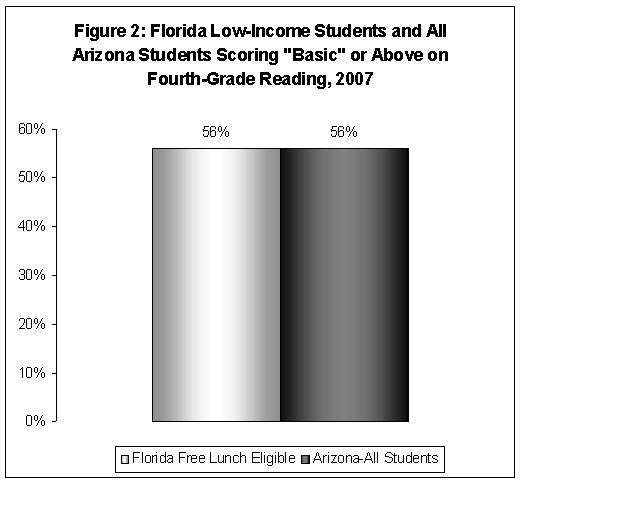
You don’t need to take my word on these scores. You can go to the National Center for Education Statistics website and see them for yourself.

The point here is not to bash the underperformance of Arizona schools. Sadly, they have plenty of company. Rather, these data point to the enormity of the opportunity for improvement which we can and must achieve. Florida has found a way to significantly boost the performance of low-income students. Others should examine how and borrow everything we can.


I’ll Have What Florida is Having

May 18, 2008

(Guest Post by Matthew Ladner)

In a recent article for the Goldwater Institute, I found that Florida’s Hispanic students outscore Arizona’s statewide average on fourth grade reading exams. Some readers emailed and wanted to know if this could be attributed to the fact that Florida’s Hispanic population is predominantly Cuban. The short answer is no, because the Hispanic population was also predominantly Cuban in the 1990s when scores were much, much lower.

Other inquiries involved questions about student poverty. Statewide averages for low-income students for Arizona and Florida are broadly similar, but I decided to investigate using the NAEP data. What I found was extraordinary.

Using the data analysis features on the NAEP website, you can get fourth grade reading scores broken down by both race and income. It is not only the case that Florida’s Hispanic students outscore the statewide average in Arizona, Florida’s low-income Hispanic students outscore the average Arizona student.

Arizona is not alone in this. Florida’s Free and Reduced lunch Hispanics also outscored the statewide average for all students on 4th grade reading of California, Hawaii, Louisiana, Mississippi, Nevada and New Mexico. They tied the statewide average for Alaska and South Carolina, and fell one scale point below Oregon and West Virginia.

In 2007, a family of four needed to earn $20,650 to qualify for a free lunch, $38,203 for a reduced price lunch. Nationwide, approximately 80 percent of free or reduced lunch children qualify for a free lunch.

Median family income in California, by comparison, is $64,563.

I appeared on a conference panel recently, and a fellow panelist noted the difference between a problem and a condition. A problem, she said, was something you tried to fix. A condition was something you had given up on and just grown to accept.

Low academic achievement for low-income and minority children is a problem not a condition. Florida under Jeb Bush put in testing and accountability with real consequences, implemented parental choice, reformed reading instruction, curtailed social promotion, liberalized teacher certification, and put in merit pay.

The results speak for themselves. To paraphrase that famous line from When Harry Met Sally: I’ll have what Florida is having.

UPDATE: The Wall Street Journal weighs in on the historic vote by Florida Democrats to expand the Step Up for Students tax-credit program.