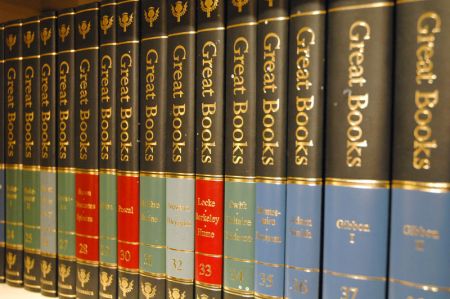
(Guest post by Greg Forster)
Yesterday’s Wall Street Journal carried a review of Alex Beam’s new history of the great books movement, A Great Idea at the Time. The reviewer, Robert Landers, approvingly quotes Beam’s statement that he wanted his history of the GB movement to be “brief, engaging, and undidactic . . . as different from the ponderous and forbidding Great Books as it could be.”
The GB movement has touched all levels of post-primary education – secondary, collegiate, and “continuing” – and it has come in for a lot of criticism, some of it justified, particularly as regards the pomposity and the (really surprising) intellectual vacuity of Mortimer Adler. Much that was written about the Great Books by some of their most prominent self-appointed champions was indeed prolix, unengaging, and didactic.
With some shame, I confess that in my excitement about great ideas during my intellectual youth, I was suckered into paying $50 for Adler’s useless cinder block of a book, the “syntopicon.” Adler’s ambition was to create a reference that would point you to everything that the great thinkers had ever thought about each of a hundred “great ideas.” Alas, the real content of the Great Books failed to line up with Adler’s preconcieved notions about what constitues a great idea, and Adler failed to realize this; consequently the book is as useless as it is long. Fortunately, thanks to the miracle of the Internet, I was able to find another sucker willing to pay me $50 to take the embarrassing thing off my hands.
But anyone who thinks the Great Books themselves are prolix, unengaging, and didactic has obviously never read one – or if he has, all the more shame on him that he didn’t pay attention to what he read.
Indeed, the greatness of Great Books consists precisely in the authors’ gift for communicating large ideas in a clear, easily understood, engaging, and undidactic way so that everyone – everyone – can benefit from them. People think that the greatness of Great Books consists in the greatness of the ideas, but this is false. Any fool can write a book about great ideas, as Mortimer Adler proved so conclusively. What takes greatness is to write a book about a great idea that makes those ideas accissible and exciting to all readers.
The issue here really goes to the heart of how we understand education when it comes to ideas as opposed to skills (like reading and math). What is the best way for people who are not themselves great philosophers to learn about great ideas? For a long time the nation’s educators have set themselves up as a parasitical priesthood class, arguing that the ordinary person lacks the capacity to recieve these things directly from the sources; they need priests to interpret for them. The GB movement argued that the great philosophers themselves were much better teachers of ordinary people than the educational priests – that is precisely what makes them so great.
C.S. Lewis – who wrote extensively about the purpose, methods, and philosophy of education – put it very concisely in an introductory essay he wrote to be included in a new edition of an old book (Athanasius’s On the Incarnation), which was subsequently published separately under the title “On the Reading of Old Books”:
I have found as a tutor in English Literature that if the average student wants to find out something about Platonism, the very last thing he thinks of doing is to take a translation of Plato off the library shelf and read the Symposium. He would rather read some dreary modern book ten times as long, all about “isms” and influences and only once in twelve pages telling him what Plato actually said. The error is rather an amiable one, for it springs from humility. The student is half afraid to meet one of the great philosophers face to face. He feels himself inadequate and thinks he will not understand him.
But if he only knew, the great man, just because of his greatness, is much more intelligible than his modern commentator. The simplest student will be able to understand, if not all, yet a very great deal of what Plato said; but hardly anyone can understand some modern books on Platonism.
It has always therefore been one of my main endeavours as a teacher to persuade the young that firsthand knowledge is not only more worth acquiring than secondhand knowledge, but is usually much easier and more delightful to acquire.
The whole essay is well worth reading for anyone who wants to think about how great ideas are communicated to ordinary people who want to know about them.
And for those of a more quantitative bent, I can’t resist examining the one quantitative claim implied by Beam’s comment – that his book, unlike the Great Books, is “brief.”
The Journal lists Beam’s book at 245 pages. I went to my office shelf and took down all the books that could be considered Great, and checked the page numbers – excluding introductions, interpretive essays, appendixes and the like (some of which occupy hundreds of pages in the volumes I have). Where I had multiple editions I picked the edition that I used regularly. I suspect the selection may be biased toward longer works because the books I keep at work as opposed to what I keep at home for regular reading are probably longer. One could argue that the selection is biased in the other direction because some books are so long that I don’t even bother to own a hard copy, and access them electronically (e.g. Aquinas’s Summa Theologica and Calvin’s Institutes). But I would argue that those longer works are not really Great Books at all, but reference works. Aquinas and Calvin never meant for anyone to sit down and read their works cover to cover; the idea was to provide a useful reference so that if you need help with some specific problem, you know where to look it up. (They’re kind of like Adler’s syntopicon that way, except they’re actually useful.)
Here’s what I came up with:
Plato, Apology of Socrates: 21 pages
Locke, A Letter Concerning Toleration: 49 pages
Rousseau, Discourse on the Origin of Inequality: 97 pages
Rousseau, The Social Contract: 144 pages
Locke, The Reasonableness of Christianity: 195 pages
Locke, Two Treatises of Government: 240 pages
Treatment case: Alex Beam, A Great Idea at the Time: 245 pages
Aristotle, Ethics: 276 pages
Niebuhr, Moral Man and Immoral Society: 285 pages
Burke, Reflections on the Revolution in France: 292 pages
Plato, Republic: 300 pages
Aristotle, Politics: 425 pages
Rousseau, Emile or On Education: 447 pages
Hobbes, Leviathan: 482 pages
Hamilton, Madison & Jay, The Federalist Papers: 494 pages
Locke, Essay Concerning Human Understanding: 678 pages
Tocqueville, Democracy in America: 705 pages
Montesquieu, The Spirit of the Laws: 722 pages
Augustine, The City of God: 1,086 pages
So it does seem fair to say that Beam’s book is on the shorter end of the distribution – but the generalization that Great Books are not “brief” is patently false. And that’s before we even get into the qualitative dimension; the Apology is more or less the Original Great Book (the educational equivalent of an OG, if you will) and in length it barely rises to the level of a pamphlet.
Bottom line: before you complain about the GB movement, try picking up a Great Book and reading it.
UPDATE: See additional data and discussion in my follow-up post.


 Posted by Greg Forster


 Jay P. Greene's Blog
