Weingarten/Ravitch v. Tooley/Dixon in Mexico

April 23, 2013

WSJ striking teachers in Mexico

Now THAT”S what I call an army of angry teachers!

(Guest post by Greg Forster)

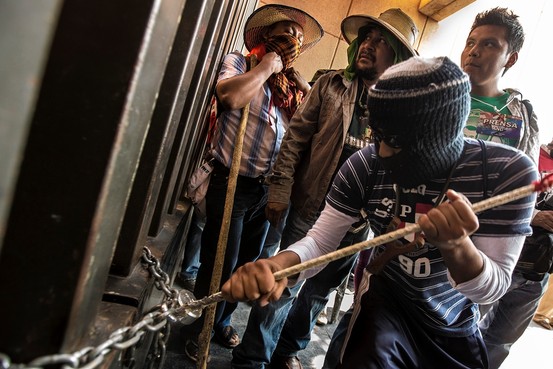
Today’s Wall Street Journal covers events in Guerrero, a state in southern Mexico, where the local version of the Weingarten/Ravitch army of angry teachers is now in head-to-head competition with James Tooley and Pauline Dixon’s army of black market schoolers.

In one corner:

Thousands of teachers protesting a revamp of the country’s education system have closed schools and taken to the streets, in the first significant challenge to overhauls undertaken by President Enrique Peña Nieto. Teachers in Guerrero, one of Mexico’s poorest states, are defying Mr. Peña Nieto’s administration by opposing the education measure signed into law in February, which for the first time requires teachers to be evaluated by an autonomous body. Those that fail the evaluation can be dismissed.

Last week, tens of thousands of teachers, some armed with metal bars and Molotov cocktails, marched in Guerrero’s capital, Chilpancingo. They again blocked for hours the highway that connects Mexico City with the Pacific port of Acapulco, hurting a key economic and tourist hub. The demonstrations have been held sporadically since the overhaul bill was signed.

In the other corner:

The action has left around 42,000 children without classes, and parents, exasperated after almost two months of protests, plan to start giving their own lessons in parks, public squares and even restaurants in the coming days….The lessons would be conducted like summer-school workshops, with hundreds of children expected to attend the first classes, Mr. Castro said. The idea is to teach grade-school students mathematics, Spanish and other basics, and the parents association is trying to get local education authorities to give credit for completed work.

The teachers’ unions of Guerrero have shown the same peaceful spirit we’ve seen so often from many labor unions here in the U.S.:

Initial plans to start the lessons Monday were put off for fear of reprisals from striking teachers, and the parents association is working with state authorities to guarantee safety for the classes, he added.

However, from the overall coverage I wouldn’t count the army of black market schoolers out yet. Conditions are bad enough that the parents are angrier than the teachers.

Also worth noting: it’s not clear how many of the teachers support what their unions are doing.

Photo by Zuma Press via WSJ


Pauline Dixon on Private Schools in Developing Countries

April 6, 2012

UK Tories Propose Vouchers for Developing Countries

July 6, 2009

This is great news forwarded from Pauline Dixon, who with James Tooley, have done amazing work on the breadth and quality of private schooling in developing countries.  Here is part of the article in the Guardian:

Aid vouchers will be given to millions of people in the poorest parts of the world so they can shop around for the best schools and services, under Tory plans to inject free-market thinking into development policy.

A Conservative government would also spend part of the £9.1bn overseas aid budget on funding for private schools across the developing world, which it believes would achieve better results than state schools and drive up standards overall. The controversial plans are in a draft Tory policy document leaked to the Observer before publication this week of the government’s white paper on development.

Andrew Mitchell, the shadow international development secretary, confirmed last night that the Tories were “investigating” using aid vouchers “to empower people in developing countries”. He also said his party had no objection to supporting the growth of the private education and health sectors in the developing world.

“Governments have a responsibility to guarantee access to health and education for everyone, particularly the poorest,” Mitchell said. “We stand ready to work with public, private and not-for-profit sectors to help make that happen. I don’t have any ideological hang-ups about whether it’s private provision or public provision: I’m interested in what works.”

In his bid to promote compassionate Conservatism, David Cameron pledges to match Labour’s plans to increase development spending to 0.7% of GDP by 2013. The budget in 2010-11 will be £9.1bn. But the policy has not proved universally popular in the party, particularly on the right, where many believe too much aid money is wasted. A survey of Tory candidates found only 4% thought international development should be the policy most protected from cuts.

Cameron’s critics believe he is promoting Thatcherite policies for aid to appease the right and reassure them the money will be well spent. The draft document suggests planning for a voucher scheme is well advanced.

“The vouchers would be redeemable for development services of any kind with an aid agency or supplier of their choice,” it states. The paper also says that a Conservative government would “embrace the potential of the private sector, not treat it with suspicion” when administering the aid budget.

As a result it makes clear the Tories would support private education in countries such as Nigeria, Ghana, Kenya, India and China, where it claims it has delivered better results than state-run schools “even adjusting for children’s backgrounds”.

The paper states: “We will stand ready to work with the public, not-for-profit and private sectors. We will consider funding insurance schemes, bursaries or targeted vouchers for the poorest children to attend a school of their choice.”


Black Market Private Schooling in the Third World

October 23, 2008


(Guest Post by Matthew Ladner)


Jay, Greg and I all had the chance to see a presentation by Pauline Dixon on private schooling in the third world at a recent conference sponsored by the Friedman Foundation and Clemson Institute for the Study of Capitalism. The information was very compelling.


Dixon and her co-author James Tooley explained their research in the 2005 Cato Institute report Private Education is Good for the Poor. Their two-year in-depth study in India, Ghana, Nigeria, and Kenya found amazing results.

The first component of our research consisted of a systematic census and survey of all primary and secondary schools, government and private, in selected low-income areas. The second component examined a stratified random sample of between 2,000 and 4,000 children from each of those areas. Tests in mathematics, English, and (in Africa) one other subject were administered. Children and teachers were also tested for their IQ, and questionnaires were administered to students, parents, teachers, and school managers or headteachers.

What did they learn? For starters, a large majority of students in each of the low-income areas studies in all four countries were attending private, not public schools. For instance, the census of the low-income area of Ghana found 779 schools total, only 25 percent were government schools. The census found that 64 percent of schoolchildren in the area attended private school. In the surveyed area of Nigeria, 75% of students attended private schools.

Interestingly, the majorities of these schools are unregistered, and in many cases illegal. They are neighborhood proprietary operations, run almost exclusively based upon student fees. The vast majority of these schools and students receive no public subsidy whatsoever. In fact, many of them must pay bribes just to stay in business. Many of these schools provide subsidized spaces for the poorest of the poor, and all of them are the precise opposite of the Dead Poet’s Society stereotype of private schooling.

As you can see from the photo above (taken by the research team), these schools are not housed in fancy facilities. In fact, as Dr. Dixon presented a power point presentation of these schools, it brought to mind the old story about Abraham Lincoln learning to read by writing on a shovel with coal.

The story here isn’t that there aren’t public schools to attend- it’s more that those schools are dysfunctional to an unimagined (by me anyway) scale. Parents told the researchers of rampant absenteeism by teachers, meaning that children simply run wild when their teachers decide not to report- which is frequent.

My impression: the public school system in these countries represent blatant jobs programs, rather than schools. This impression seems borne out by the test score results:

The raw scores from our student achievement tests show considerably higher achievement in the private than in government schools. In Hyderabad, for instance, mean scores in mathematics were about 22 percentage points and 23 percentage points higher in private unrecognized and recognized schools, respectively, than in government schools. The advantage was even more pronounced for English. In all cases, this achievement advantage was obtained at between half and a quarter of the teacher salary costs.

So there you have it- much better and much less expensive. Oh, and often illegal and great for the poor.