Fordham Splits the Baby

March 24, 2009

hemisphere

Extremist position #1: The earth is flat.

Extremist position #2: The earth is round.

Reasonable middle ground: The earth is a hemisphere.

HT Math Is Fun

(Guest post by Greg Forster)

Fordham has just released a new report on how voucher programs should be regulated. Their methodology seems to be that they don’t care about finding the truth, they only care about finding “middle ground.” It doesn’t matter whether a policy makes any sense, as long as falls 50% of the way between the policy on the right and the policy on the left, it must be the best policy.

They collect opinions from a bunch of education experts and then propose, as their preferred policy, something that falls roughly in the middle of the spectrum – they want to subject different voucher schools to different levels of regulation based on how many voucher students each school has. Naturally, since their proposal isn’t guided by any principle other than that of political triangulation, it accomplishes neither the goals held by one side nor the goals held by the other side, and will therefore please nobody. But no one can accuse Fordham of not seeking middle ground!

They’re just like Solomon splitting the baby – except that Solomon’s proposal was a ruse. Fordham really wants to actually take out their knives and split the baby.

Inspired by their example, I’ve decided to end the age-old debate over the shape of the earth. Some people hold the earth is round, which has the merit of providing a parsimonious explanation of the observed data. Other people hold that the earth is flat, which has the merit of being an ancient, time-tested view. But this tired old debate between two extremist positions is getting us nowhere.

First I convened a panel of experts, some from the National Astronomical Society and some from the Flat Earth Society. The experts achieved consensus on the following important points:

  • The shape of the earth is an important subject.
  • The earth is not cubical.
  • The earth is not made of green cheese.

Unfortunately, we were not able to achieve consensus on one issue: the earth’s actual shape.

To move beyond this tired old debate and find reasonable middle ground, I propose that the earth is hemispherical – flat on one side and round on the other. Since this position is 50% of the way between the two extremist positions, it must be true. QED.

Now we move on to the next great debate: which side do we live on, the flat side or the round side? I’m convening a conference in the Antipodes to begin exploring new research on this question.


Steyn Nails the Buildingpalooza

March 23, 2009

fancy-church

(Guest post by Greg Forster)

In the back of the new National Review, Mark Steyn’s column absolutely nails the giant new gusher of money for school buildings. Subscribers can read it online; for everyone else – well, for everyone else, online subscriptions to NR are cheap and you should have one. But here’s a taste, just in case you don’t believe everything I say implicitly:

Steyn follows up on the supposedly awful school bulding in Dillon, S.C. highlighted recently by the president and finds a number of holes in the story, such as:

Incidentally, you may have read multiple articles referring to the “113-year-old building.” Actually, that’s the building behind the main school — the original structure from 1896, where the school district has its offices. But if, like so many people, you assume an edifice dating from 1896 or 1912 must ipso facto be uninhabitable, bear in mind that the central portion of the main building was entirely rebuilt in 1983. That’s to say, this rotting, decrepit, mildewed Dotheboys Hall of a Gothic mausoleum dates all the way back to the Cyndi Lauper era.

He then moves on to the larger issues:

If a schoolhouse has peeling paint and leaking ceilings, what’s the best way to fix it? . . . Dillon, S.C., is a town of about 6,000 people. Is there really no way they can organize acceptable accommodation for a two-grade junior high school without petitioning the Sovereign in Barackingham Palace? . . . The issue is not the decrepitude of the building but the decrepitude of liberty. Maybe the president can spend enough of our money to halt the degradation of infrastructure. The degradation of citizenship will prove harder to reverse.


Obama Compares AIG to Suicide Bombers

March 20, 2009

obama

Photo from the LA Times

(Guest post by Greg Forster)

A while back, a certain secretary of education compared the teachers’ unions to terrorists and got in super-major hot water. Remember?

I just wanted to put that on the table so everybody bears in mind the standard for civil discourse that was established during that episode. Of course that standard would apply equally to both parties, right?

The LA Times is reporting that at a California town hall meeting, President Obama compared AIG to a suicide bomber:

Well, OK, that all made sense, but then he compared AIG to a suicide bomber, and at that, we really perked up.

“Same thing with AIG,” Obama said. “It was the right thing to do to step in. Like they’ve got a bomb strapped to them and they’ve got their hand on the trigger, you don’t want them to blow up, but you’ve got to ease them off the trigger.”

And the president held out his arm and pantomimed a hand on a trigger, and we were rapt, waiting for what would happen next.

But then he called for a final question from the crowd.

HT Campaign Spot.

When he’s off the teleprompter, he’s really off the teleprompter.

Steyn is telling Hugh Hewitt that now he’s recycling all the jokes Frank Sinatra used to do about Bob Hope’s reliance on cue cards as Obama teleprompter jokes, and they’re going over really well.


School Boards and the Media

March 18, 2009

mark-steyn

(Guest post by Greg Forster)

I’ve argued before, against federalism cops and state-level ed reformers alike, that the biggest monkey wrench in the government school system is the local school board. The union demands that do the biggest damage to children – the uniform, performance-blind pay scale and the extraordinary obstacles to firing bad teachers – are enforced at that level. And while higher levels of government set the broad budget outlines, it’s the school boards that manage the budgets at the detail level – making them the primary people to blame for the tremendous wastefulness and zero accountability of the system.

And (as I argued to the federalism cops) that’s what we should expect, because local power is structurally more susceptible to these problems than state or federal power. If you run a scam at a high level, the scam is big and that means the suckers (that’s you and me) are more likely to 1) notice and 2) be willing to pay the price to stop it. But if, like the unions, you have your tentacles in thousands of tiny little school districts across the country, you can steal a little here and a little there and end up with a much bigger pile of swag, all while flying under the radar.

Well, yesterday Mark Steyn posted on NRO’s Corner about his experience serving on a school board subcommittee. Two stories he told got me thinking about a new aspect of the school board problem.

Story #1:

After one somewhat difficult meeting, I got back to find a telephone message from the reporter at the local paper: “Hi, Mark. I couldn’t make School Board but I have to file my story this evening. Did anything happen that I need to know about?”

Happily, no. And her non-attendance proved no obstacle to filing a bland happy-face report on the event.

Story #2 (the subcommittee was negotiating with a nearby town to build a joint high school):

On another occasion, I absentmindedly forgot it was a public meeting and launched a blistering attack on a neighboring town. As the evening ended, the nice lady reporter said to me, “Don’t worry, Mark. I won’t put any of those controversial things you said in the paper.”

School boards get a free ride from the relevant media. The broadcast media don’t have time to cover them – they’re too busy with more important stories, like whoever is the new Brangelina this week. And the local papers are at best too lazy to do their jobs (note that in Story #1 it was a “difficult meeting” about which the reporter filed a “bland happy-face report”) and at worst too cozy with the board members – who are, after all, the reporters’ neighbors and pillars of their communities – to report a big story even when it bites them right in their assignments.


Symbols Matter

March 11, 2009

wingdings

(Guest post by Greg Forster)

Jay points out that the president’s speech on education yesterday doesn’t resemble his legislative agenda. But it’s worse than that. There are things Obama could do to promose these good reform ideas even without legislation or budget changes, but won’t.

He calls on states to lift their charter caps. But what does he plan to do about charter caps? Even without extending federal authority over the states on charter policy, there’s plenty he could do, as Jay Matthews points out:

Will the Obama Education Department prepare and publicize a list of all the charter school cap laws in the country? Will Duncan call the governors, and legislators and school boards responsible for them and ask them to remove those restrictions on new charters, and find a way to get rid of bad charters?

Is the pope Muslim?

So on pretty much all fronts, the president’s “plan” for education is just symbolism.

But you know what? Symbols matter! The president is using his position in the spotlight to endorse choice and competition (as he did during the campaign) and rewards for performance, the two indispensable principles of sound educational reform. Even if he’s only doing it because Democratic constituencies other than the education unions expect it, it matters that the president has chosen to align himself with those constituencies rather than the unions. He could easily have taken the old line and kowtowed to the unions. But he didn’t, and that counts for something. So let’s give the president his due.

Now if only he had stopped his pals in Congress (who look an awful lot like his bosses these days) from kowtowing to the unions on vouchers.


Get Lost – For the Defense

March 7, 2009

kate_on_trial

“On the charge of ruining a really cool show, how do you plead?”

(Guest post by . . .

Greg Forster for the defense, your honor.

Ladies and gentlemen of the jury, last week District Attorney Greene read you a very serious and sobering indictment. There is no denying that the charges, if proved, would justify a severe sentence against my client, the television program Lost. But during the forthcoming trial I intend to show you that the prosecutor cannot prove his charges.

The charge, in a nutshell, is this: that with the resurrection of John Locke, my client has 1) irreversably committed itself to containing “fantasy” elements as well as “sci-fi” elements, and 2) that this means the rules of the story’s narrative world are not stable but subject to arbitrary interference, which ruins the drama.

Ladies and gentlemen, there can be no denying the first element of the prosecutor’s theory of the crime. With Locke’s resurrection, my client is irreversably committed to having one foot in the fantasy genre as well as one foot in the sci-fi genre. The possibility that the show might end up with both feet on the sci-fi side of the divide is effectively foreclosed.

And it is also true that stable narrative rules are indispensable to good drama. Drama depends on moral agency, moral agency depends on choice, choice depends on actions having consequences, and actions having consequences depends on events obeying stable rules. In a universe where events were arbitrary, I couldn’t possibly make choices – I would have no way to connect my actions to any consequences. For all intents and purposes, there would be no alternatives to choose from.

But ladies and gentlemen, the prosecutor is wrong – “just plain wrong,” as he himself might put it – to assert that fantasy fiction, which is defined in the relevant statute as fiction containing supernatural elements, must necessarily have narrative rules that are unstable or subject to arbitrary interference.

Not only is this not true, ladies and gentlemen, I submit for your consideration that sci-fi fiction has historically been more guilty than fantasy fiction of presenting us with narrative worlds that have unstable or arbitrarily broken rules. Thus, I submit that when my client, having placed one foot firmly in the sci-fi camp, proceeds to place the other foot firmly in the fantasy camp, it increases rather than decreases the probability that we will ultimately get a narrative universe with stable rules.

No doubt there is much fantasy fiction that lacks stable narrative rules. You will all be familiar with the Harry Potter series, for instance.

But is there not also much fantasy fiction with admirably stable narrative rules? Whatever you may think of the Lord of the Rings, nobody accuses it of taking place in an insufficiently structured narrative universe.

As you will see when we introduce LOTR into evidence during the forthcoming trial, the text of the books is quite clear that Gandalf was not simply in a coma on the mountaintop, but died there, and “returned from death.” Did this leave anyone with the feeling that henceforward anything was possible and there were no rules in the LOTR universe? Was it not just the opposite, ladies and gentlemen – that the resurrection of Gandalf was the highest and most sublime manifestation of the story’s underlying narrative unity? It would be one thing if anyone, under any circumstances, could come back from the dead. But Gandalf’s return from the dead was not like that. It was a unique event, one that could only have happened to that particular character – and for a reason that was not arbitrary, but was clearly an integral part of the narrative universe. And his death and resurrection were connected to a series of consequences – connections which again were an organic part of the narrative.

One may summarzie the case by saying that Gandalf would not be Gandalf if he did not come back from the dead. The perfectly stable and uninterrupted narrative rules of the Tolkien universe demand that Gandalf come back from the dead.

Again, ladies and gentlemen, you may like the LOTR story or hate it. But will anyone really say that J.R.R. Tolkien was insufficiently concerned with the stability of his narrative universe?

One could cite other examples besides LOTR – the fantastic element in Star Wars comes to mind – but this is going to be a long trial with a full-dress media frenzy accompaniment, and I don’t want to make it any longer.

The question is not whether LOTR or Star Wars, or fantasy in general, is good fiction or bad. The question is whether the presence of supernatural powers, including resurrection, implies narrative rules that are unstable or subject to arbitrary interference. It does not.

The reason is simple: supernatural powers, even including power over death itself, may transcend the stable orderliness of nature, but that does not mean they transcend all orderliness. There can be a supernatural order that stands above the natural order. This supernatural order may take many forms, and need not imply anything religious. The only point is that supernature can be just as orderly as nature.

On the other hand, ladies and gentlemen, what has been more common than sci-fi fiction that lacks stable narrative rules? The arbitrariness of the rules of the Star Trek universe has been a running joke for decades. The defense will introduce into evidence several examples of people mocking Star Trek for the cavalier manner in which it disregards its own narrative rules.

For the purposes of narrative, ladies and gentlemen, there is no functional difference between highly advanced technology and supernatural powers. What are “dilithium crystals” if not the Star Trek equivalent of magic? Sci-fi and fantasy are both defined as genres by their reliance on powers – which is another way of saying “technologies” – that are inexplicable. The only thing that separates the two genres is why the powers are held to be inexplicable.

And surely, ladies and gentlemen, that distinction has no relevance for the charge that has been brought against my client. Both sci-fi and fantasy involve inexplicable powers that “do the impossible” from our perspective. Why should one method of doing the impossible still allow for a stable narrative, but not the other?

Here’s another way to put that point. Before Locke’s resurrection, the prosecutor did not bring charges in spite of all sorts of “magic” events that took place in my client. If the prosecutor thought that Locke’s getting up out of a wheelchair was at least potentially reconcilable with a stable narrative universe, why does he not think the same about Locke’s resurrection?

Even now, what is it that the prosecutor wants to see in lieu of resurrections? Time travel. Time travel, ladies and gentlemen! Apparently the prosecution thinks you can travel through time and still be subject to some sort of orderly rules. Well, why can’t resurrection be subject to some sort of orderly rules? Of course, any set of orderly rules governing resurrection would have to be different from the rules of nature that we now live under. But the same is true of time travel!

I would like you to ask yourselves a question during this trial, ladies and gentlemen: Has the prosecutor introduced any actual evidence of narrative arbitrariness on the part of my client? Does my client actually exhibit the breakdown of narrative structure that the prosecution attributes to it?

Surely not. The resurrection of John Locke fits the established narrative seamlessly and perfectly. Of course Locke was resurrected when he returned to the Island. He would not be Locke – and the Island would not be the Island – if it were not so.

The prosecutor also brought a charge of promise-breaking, but on this charge no serious defense is needed, since the prosecutor has failed to introduce any evidence that my client’s creators promised that dead characters would never come back to life. On the evidence so far introduced in this court, they promised only that 1) the characters on the island who appear to be alive are really alive, and 2) when those characters appear to die, they really die. None of this amounts to a promise that dead characters will not be resurrected, ladies and gentlemen. So on this charge we will be submitting a motion for summary judgment.

It is also worth noting, ladies and gentlemen, that the prosecutor confuses the question of genre (sci-fi or fantasy) with the role of faith in the narrative. “Faith” is not necessarily faith in something supernatural. That word means the same thing whether we’re talking about trusting God or trusting in another person, or even a machine. Indeed, the question of whether we should (with John) have faith in the Island, or (with Jack) doubt it was the central plot device on my client long before it was clear whether the Island was supernatural. The whole issue of faith is irrelevant to the prosecutor’s charge; the issue here is whether a narrative world can simultaneously allow for supernatural powers and have stable rules. And on that point I trust you will now see my client’s innocence.

And if all that doesn’t convince you, we have one more argument to offer.

Ladies and gentlemen of the supposed “jury” . . . this is Chewbacca.


Assassination for D.C. Vouchers?

February 25, 2009

the-assassin

(Guest post by Greg Forster)

In case you haven’t heard, it’s been discovered that the Democrats snuck a provision into the “stimulus” “omnibus”* bill that assassinates the D.C. voucher program.

Dan Lips and Robert Enlow have the story on NRO today; the link on the front page is broken as of this writing, but you can get the story here.

I’m not sure what’s most disgusting – that the Dems are putting union politics ahead of children’s lives, that they’re doing it in this cowardly way, or that the president broke his promise to make the text of the bill available to legislators and the public with plenty of time to review the contents and justified his decision by saying that we had to pass the bill immediately to avert a catastrophe.

What did the president know, and when did he know it? Seems like there’s no answer to that question that makes him look good.

*UPDATE: Thanks to the commenters for correcting my mistake. How could I possibly mix up the “stimulus” bill with the “omnibus” bill? I mean, other than the fact that they’re both nothing but special interest porkapaloozas, they’re so completely different! Even so, I’m leaving in my comment about the president having broken his word on making the text of the stimulus bill available, because he did break his word and it was wrong. And the question of what the president knew about the voucher assassination attempt and when he knew it still seems 1) relevant and 2) not to admit of answers that make him look good.


Evidence Shows Vouchers Are a Win-Win Solution

February 23, 2009

win-win-study-large

(Guest post by Greg Forster)

On Friday, the Friedman Foundation released my new report, “A Win-Win Solution: The Empirical Evidence on How Vouchers Affect Public Schools.” It goes over all the available empirical evidence on . . . well, on how vouchers affect public schools.

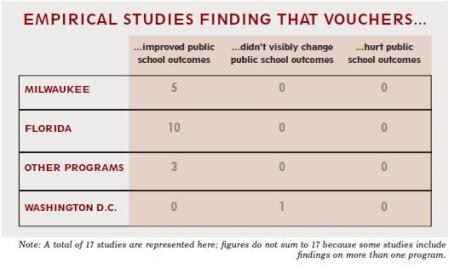
Here’s the supercool graphic:

win-win-study-chart1

Worth a thousand words, isn’t it? I mean, at what point are we allowed to say that people are either lying, or have been hoodwinked by other people’s lies, when they say that the research doesn’t support a positive impact from vouchers on public schools?

There’s always room for more research. What would we all do with our time if there weren’t? But on the question of what the research we now have says, the verdict is not in dispute.

Here’s the executive summary of the report:

This report collects the results of all available empirical studies on how vouchers affect academic achievement in public schools. Contrary to the widespread claim that vouchers hurt public schools, it finds that the empirical evidence consistently supports the conclusion that vouchers improve public schools. No empirical study has ever found that vouchers had a negative impact on public schools.

There are a variety of explanations for why vouchers might improve public schools, the most important being that competition from vouchers introduces healthy incentives for public schools to improve.

The report also considers several alternative explanations, besides the vouchers themselves, that might explain why public schools improve where vouchers are offered to their students. It concludes that none of these alternatives is consistent with the available evidence. Where these claims have been directly tested, the evidence has not borne them out. The only consistent explanation that accounts for all the data is that vouchers improve public schools.

Key findings include:

  • A total of 17 empirical studies have examined how vouchers affect academic achievement in public schools. Of these studies, 16 find that vouchers improved public schools and one finds no visible impact. No empirical studies find that vouchers harm public schools.
  • Vouchers can have a significant positive impact on public schools without necessarily producing visible changes in the overall performance of a large city’s schools. The overall performance of a large school system is subject to countless different influences, and only careful study using sound scientific methods can isolate the impact of vouchers from all other factors so it can be accurately measured. Thus, the absence of dramatic “miracle” results in cities with voucher programs has no bearing on the question of whether vouchers have improved public schools; only scientific analysis can answer that question.
  • Every empirical study ever conducted in Milwaukee, Florida, Ohio, Texas, Maine and Vermont finds that voucher programs in those places improved public schools.
  • The single study conducted in Washington D.C. is the only study that found no visible impact from vouchers. This is not surprising, since the D.C. voucher program is the only one designed to shield public schools from the impact of competition. Thus, the D.C. study does not detract from the research consensus in favor of a positive effect from voucher competition.
  • Alternative explanations such as “stigma effect” and “regression to the mean” do not account for the positive effects identified in these studies. When these alternative explanations have been evaluated empirically, the evidence has not supported them.

Get Lost 316

February 21, 2009

Last week Greg suggested that the Island has a will of its own that trumps the will of humans to direct its powers.  According to Greg’s analysis, the Island is essentially a super-natural being, like God, although he admits the possibility that it is a malevolent super-natural force.  And like God, Greg suggests that faith in the Island involves obeying even when the Island’s reasons are mysterious: “If we understood why the Island demands what it demands, there would be no question of faith (remember, John is the “man of faith”). In theology, “faith” doesn’t mean simply believing in certain facts about God, it means trusting and obeying God. And the supreme test of faith is to trust and obey when you don’t understand.”

Upon first seeing this week’s episode, 316, I thought Control-G (the hot-key for agreeing with Greg).  Greg is right so often that we had to develop a hot-key to make our agreement more efficient (in your heart you know he’s right).  It certainly would be novel to have a TV series entirely built around faith in a super-natural power.  Ben’s suggestion that Jack was similar to the Apostle Thomas, Locke’s note wishing that Jack had believed, Lapidus’ presence as the pilot of Ajira 316, and the allusion of the flight number to John 3:16 made me think — at first — that Greg was entirely right — Control G!  In the most recent episode Lost not only seemed like a story of vindicated faith but almost an explicit Christian allegory. 

That’s when I started doubting this interpretation.  Major TV producers would never make a series of a Christian allegory.  The religious references, whether Christian or Island as super-natural power,  have to be a false lead.  The argument between faith and science will be revived.  Faith has only temporarily prevailed.

The original faith/science debate revolved around pushing the button.  The alleged purpose of pushing the button was to save the world from destruction.  Locke had faith that the button must be pushed.  But what seemed like faith may have just been the prescience of time-loops.  The odd coincidences may just be the necessity of time course-correcting.  Is the purpose and direction of events determined simply by Fate, a power without an independent will or consciousness, or is there a super-natural entity choosing the course of events?  Greg’s theory seems to be the later, but I suspect it is the former.

I suspect that Fate has the world being destroyed.  Humans have detected this Fate through the Numbers and time-travel and are struggling to alter that Fate.  What seems like the will of the Island may just be the actions of humans in time loops attempting to steer Fate away from global destruction.  Whether they succeed or not will revolve around whether humans can change Fate, not the will of a super-natural entity.  I just can’t imagine a TV series emphasizing the will of a super-natural being over the primacy of human “agency.”  It would be gutsy and interesting if they did, but I just can’t see it in mainstream TV. 

The video embedded at the top of this post, suggests that human action to prevent destruction of the world is going to be central.  The video comes from Comicon and I found it on Lostpedia, where it is known as the Dharma Booth Video.  In it, Pierre Chang sends a message through time urging whoever sees it to continue the Dharma research to change time.  The different factions will struggle over who will control the potential power to change Fate, but we will discover that who controls it will be less important than using it to avoid total destruction.


Now She Tells Us

February 18, 2009

randi-weingarten-at-obama-rally

(Guest post by Greg Forster)

Randi Weingarten explained this week that, contrary to the outrageous slander that the unions are against education reform, she’s actually in favor of having the federal government create rigorous national academic standards for public schools, and will remain in favor of it as long as the Democrats are in power. (I’m paraphrasing.)

She writes: “Should fate, as determined by a student’s Zip code, dictate how much algebra he or she is taught?”

So the AFT now endorses the principle that a child’s education should not be determined by Zip code? When did that happen?

And if a child’s Zip code shouldn’t determine how much algebra he or she is taught, why should that determination be made in Washington instead? Apparently the amount of algebra you learn should be determined not by your Zip code, but by your international dialing code.

At least with Zip codes, some families can exercise school choice by moving to a different neighborhood. Yes, it’s an unfair system, since not all families are equally mobile; apparently Weingarten thinks the fair thing to do is to take away the freedom now enjoyed by some parents, so that there will be an equality of unfreedom.

Here we see the real modus operandi of the Left – achieve equality by leveling downward.