(Guest Post by Matthew Ladner)
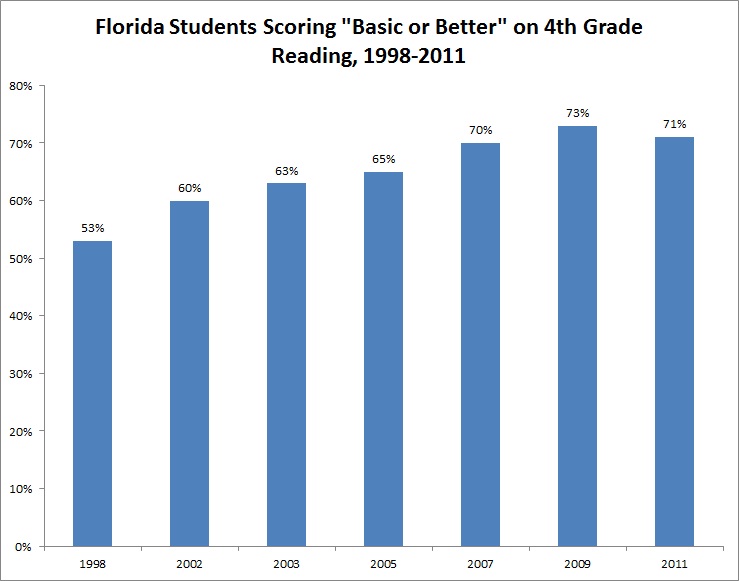
The Florida Age of Public School Improvement hit a wall in the 2011 NAEP. This should not be terribly surprising, as Florida’s improvement seemed certain to plateau in the absence of additional reforms.
Governor Jeb Bush relentlessly pursued a dual strategy- transparency with teeth from the top down, parental choice from the bottom up. Together these reforms drove improvement in the public schools for a number of years. Accountability measures included school grading (A-F) and earned promotion in the early grades. Parental choice measures included Opportunity Scholarships for children attending F rated schools, the nation’s first special needs voucher program (McKay Scholarships), the nation’s largest scholarship tax credit program (Step Up for Students), a decent charter school law and the nation’s most robust system of digital learning. Florida lawmakers also attempted to thoughtfully incentivize success.
Governor Bush took office in 1999 and left office in 2007. It would be nice if these efforts could indefinitely push progress forward, but there have been plenty of bumps and problems along the way. In 2006, the Florida Supreme Court rendered a logic-free ruling abolishing Opportunity Scholarships (failing school vouchers) for private schools, and followed that up by ruling against a state authorizer for charter schools. Tax-credits, McKay and digital learning continued to incrementally advance, but not at an earth-shattering rate.
The larger problem may have come in the top down measures. The chart below presents the distribution of district and charter school grades, with one line being the A/B grades and the other D/F grades. The dotted lines represent instances when the state board raised school grading standards.

The setting of these standards represents far more of an art than a science. Set them far too high and disaster follows (this happened in Arizona). Set them too low, and you remove the tension in the system needed to drive improvement. Even after the last increase in grading standards, more than 10 times as many Florida schools received A/B grades as D/F grades.
Florida’s policymakers raised standards four times, and last year (wisely) put in an automatic trigger to raise standards by a preset amount when a certain ratio of schools get A or B grades. In addition, a fresh set of reforms passed the Florida legislature in 2011, revamping teaching and increasing charter school and digital learning options.
Just as it is impossible to exactly pinpoint how much of what caused the gains, it is likewise impossible to say exactly what made them stall. Note however that one of the favorite explanations of the anti-reform crowd, the pre-school, finally saw the advent of children old enough to have participated in the program and age into the 4th grade NAEP sample. I hope that someone is carefully studying variation in participation and corresponding trends in FCAT data, but the results at the aggregate level thus far seem underwhelming.
Plenty of other things, however, have been going on- including the collapse of a housing bubble, cutbacks in public school funding (including of some of the incentive funding programs) and a variety of other very bad things. My advice to Florida policymakers: roll up your sleeves and get back at it. Despite the enormous amount of progress seen on NAEP (and no one loves celebrating it more than me) too great of a gulf lies between a state system awarding ten times as many top grades as low grades but still suffering from large minorities of students scoring below basic on the NAEP exams.
Governor Bush has consistently said for years that success is never final, and reform is never finished. The 2011 pause in progress demonstrates that he called it correctly. Moving the needle on student learning on a meaningful scale and at a sustained basis represents one of the greatest public policy challenges of our times. Governor Bush has passed the torch to a new generation of Florida reformers, and they must now find new ways, and fine-tune the old ways, to push academic progress forward.
Edited for typos


 Posted by matthewladner
 Jay P. Greene's Blog