Arne Duncan’s Doubleplusgood Doublespeak

September 30, 2009

(Guest Post by Matthew Ladner)

ABC quoted Arne Duncan yesterday on DC vouchers:

“The children who were in school, we fought hard to keep them in their schools. Congress has made it clear they are not accepting any additional students,” Duncan told ABC News last month. “So, kids that were in schools, we wanted them to go. Kids who weren’t yet in when the program ended, according to Congress, it didn’t make sense. … I encourage them to come in and look at what’s going on with the public schools here in D.C. It’s pretty exciting.”

Duncan strongly opposes vouchers and has made clear his belief that the money is better spent investing in lasting reforms.

“Vouchers usually serve 1 to 2 percent of the children in the community. And I think we, as the federal government, we as local governments or we as school districts, we have to be more ambitious than that,” Duncan said in a speech before the National Press club last May.

“I don’t want to save 1 or 2 percent of children and let 98 to 99 percent drown. We have to be much more ambitious than that. And we have to expect more,” he added. “This is why I would argue … rather than taking three kids out of there and putting them in a better school and feeling good and sleeping well at night, I want to turn that school around now and do that for those 400, 500, 800, 1,200 kids in that school, and give every child in that school, in that community, something better and do it with a real sense of urgency.”

Oi vey…

Duncan’s logical flaws smell so overwhelming that there isn’t really any need for me to point them out.  Duncan’s absurd claptrap does however remind me of a joke:

So one day a great flood came, and the sheriff went to the house of a man to tell him that he needed to evacuate to higher ground. “No, God will save me” replied the man.

So the storm raged on. The man’s house flooded, forcing him to flee to his roof. Rescue workers came in a canoe to save him, but the man again refused, saying “No, God will save me.”

Finally, the man stood desperately atop of his chimney. A rescue helicopter flew by and threw him a rope ladder, which he refused. “God will save me!” he screamed to the helicopter crew.

So the water rose and the man drowned.

After entering the Pearly Gates, the man asked “God why didn’t you save me from the flood?”

God replied “What do you mean? I sent you a police car, a canoe and a helicopter.”

If Duncan thinks DC schools are “exciting” then why doesn’t he enroll his own children in them? Strangely enough, they are off in the suburban Virginia schools. Admittedly, checkbook school choice does serve way more than “1 or 2 percent” of students.

“I don’t want to save 1 or 2 percent of children and let 98 to 99 percent drown. I am however willing to let 30-40 percent buy their way out and let the other 60 to 70 percent drown, so long as my kids are among those safely sequestered in the leafy suburbs.”

What’s that?  He didn’t say that?

You forget: actions speak louder than words.


Pat Wolf In Ed Next

August 20, 2009

Pat Wolf has an article summarizing and clarifying the latest evidence from the official evaluation of the D.C. voucher program newly posted at Education Next.

The part that struck me the most was how strong the DC voucher results are compared to the results of all of the other rigorous evaluations sponsored by the U.S. Department of Education:

The achievement results from the D.C. voucher evaluation are also striking when compared to the results from other experimental evaluations of education policies. The National Center for Education Evaluation and Regional Assistance (NCEE) at the IES has sponsored and overseen 11 studies that are RCTs, including the OSP evaluation. Only 3 of the 11 education interventions tested, when subjected to such a rigorous evaluation, have demonstrated statistically significant achievement impacts overall in either reading or math. The reading impact of the D.C. voucher program is the largest achievement impact yet reported in an RCT evaluation overseen by the NCEE. A second program was found to increase reading outcomes by about 40 percent less than the reading gain from the DC OSP. The third intervention was reported to have boosted math achievement by less than half the amount of the reading gain from the D.C. voucher program. Of the remaining eight NCEE-sponsored RCTs, six of them found no statistically significant achievement impacts overall and the other two showed a mix of no impacts and actual achievement losses from their programs.


Local Control Only When You Agree with Me

July 28, 2009

Where are the advocates of DC local control now? 

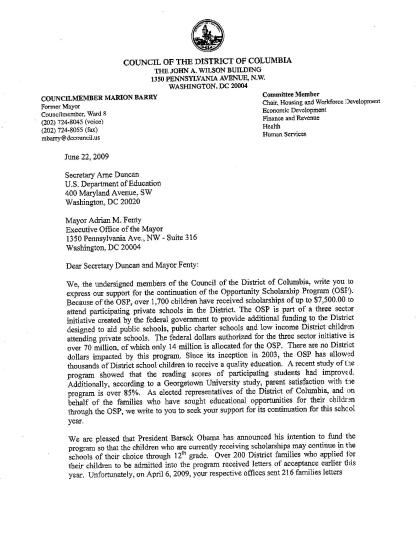
Earlier this month a majority of DC City Council members wrote a letter to Arne Duncan urging the continuation and expansion of the DC voucher program.

And today a new poll of DC voters is being released showing that “74% have a favorable view of the D.C. Opportunity Scholarship Program; and 79% of parents of schoolage children oppose ending the D.C. Opportunity Scholarship Program.” (I’ll add a link to the entire survey as soon as I can find one.  UPDATE:  Here it is.)

Is the same program that Kevin “Too Cool for Private School” Carey called “the voucher program that was imposed on D.C. by Congress“?  Did he mean “imposed” like how Congress imposes millions and millions of dollars on the DC public schools that the new survey finds “76% [of DC voters] rate … as ‘fair’ or ‘poor.”?


DC Vouchers: One Step Up, Two Steps Back

July 13, 2009

Durbin

As Matt wrote on Friday, a majority of the DC City Council Members wrote a letter to Arne Duncan expressing their strong support of the DC voucher program, including expansion of the program beyond those currently using scholarships.  The WSJ has yet another great editorial on the topic.  It says, in part:

Earlier this year Illinois Senator Dick Durbin added language to a spending bill that phases out the D.C. Opportunity Scholarship Program after next year. The program provides 1,700 kids $7,500 per year to use toward tuition at a private school of their parents’ choosing. Mr. Durbin’s amendment says no federal money can be spent on the program beyond 2010 unless Congress reauthorizes it and the D.C. Council approves.

The D.C. Council’s letter shows that support for these vouchers is real at the local level and that the opposition exists mainly at the level of the national Democratic Party. Mr. Durbin has suggested that he included the D.C. Council provision in deference to local control. “The government of Washington, D.C., should decide whether they want it in their school district,” he said in March. Well now we know where D.C. stands. We will now see if the national party stands for putting union power and money above the future of poor children.

Will others who’ve offered DC local control as a reason for opposing the voucher program now come out in support of it?  (I’m looking at you, Kevin Carey.)

Unfortunately, even as vouchers benefited from the support of the DC City Council, Senator Durbin was busy introducing new, onerous regulations on the program in an appropriations bill last week.  In particular, his measures would require participating private schools to take the DC public school test rather than a nationally-normed standardized test, even though they may not have the same curriculum as DCPS.  His measures would also require the Secretary of Education to prohibit voucher students from attending any private school that was not deemed “superior” to DC public schools.  The language is unclear as to whether that means the average DC public schools, the best, the worst, or what. 

You know, this may not be such a bad idea.  Maybe no DC public school students should be forced to attend a public school that is worse than average.  How about if we offer them vouchers?

Wait, I’m sure that was not the intent of the new Durbin measures.  The clear purpose is to strangle the program with reasonable-sounding but truly crippling regulation while the entire program is eventually eliminated. 

Senator Feinstein attempted to remove the Durbin measures in the full committee and Senators Landreau and Byrd joined her in that effort.  But they failed on a tie vote.  It was particularly disappointing to see Senator Mark Pryor vote with Durbin.  Pryor has to be careful not to move further left than his Arkansas constituents as he follows the national leadership or he could finally face a serious challenger for re-election.


DC Council: Continue Opportunity Scholarships

July 10, 2009


(Guest Post by Matthew Ladner)

Yet another BOOOOOM! Now a majority of the DC City Council weighs in for DC Opportunity Scholarships!

Read the letter at the DC Children First website here.

Or read it below:DC letter 1 


DC letter 2 


WaPo: A Plea to Mr. Duncan

July 10, 2009

(Guest Post by Matthew Ladner)

The Washington Post brings it again on behalf of the victims of Department of Education’s slavish decision to deny over 200 children access to the DC Opportunity Scholarship Program.

Seven council members — including those who represent the poorest sections of the city — wrote to Mr. Duncan on June 22 challenging his decision not to admit new students to the D.C. Opportunity Scholarship Program. The federally funded program provides vouchers of up to $7,500 so that low-income students can attend schools of their choice. Because the program’s future is uncertain, Mr. Duncan decided — disappointingly to our mind — to rescind scholarships awarded to 216 families for this upcoming school year.

Ooops, there goes the local control argument. Perhaps Mr. Duncan and company would like to stand up and confess “We’d like to help these kids, but sadly, we toil as the servile minions of teacher union thugs. Please don’t pay attention to what we do, but rather to what we say. Move along, nothing to see here…”


Lieberman in WashPo

June 22, 2009

Sen. Lieberman has another great piece in the Washington Post on DC vouchers.  The issue just won’t go away as much as the cool crowd wishes it would.


For Those Keeping Score

May 20, 2009

For those who are keeping score, 3 of the top 5 circulating newspapers in the United States have recently written editorials supporting the D.C. voucher program:  USA Today, Wall Street Journal, and Washington Post

The New York Times along with their teacher union readership have remained quiet on the issue, hoping the dirty deed can be done as silently as possible. 

And the Chicago Tribune, which is a top 10 circulating newspaper as well as the hometown paper for voucher-killers Obama, Duncan, and Durbin, also endorsed DC vouchers.

Somebody needs to reach Kevin Carey in his hermetically-sealed DC bubble to let him know that at least some people who “are serious about education policy” seem to care about vouchers — that is, unless we want to believe that the editorial boards of the country’s largest newspapers with total circulation in excess of 5 million readers shouldn’t be considered as serious as policy analysts at tiny DC think tanks.


Would You Want This Man As Your Chief Advocate?

May 19, 2009

Rocket scientist and wholly-owned subsidiary of the teacher union, Sen. Dick Durbin, makes his best attempt to write a negative op-ed on D.C. vouchers in USA Today this morning.  The unsigned main editorial in the paper endorses D.C. vouchers and Durbin was given the opportunity to articulate the opposing view.

Durbin writes:

“Now, after three years of study, the results of that evaluation are in, and the U.S. Department of Education found: no statistically significant improvement in math scores for any voucher students (boys or girls); no statistically significant improvement in scores for male voucher students; no statistically significant improvement in scores for students transferring from failing schools (the targets of the voucher program), and only a slight improvement in reading scores for female voucher students (equivalent to three months of additional reading proficiency).”

The program also did not produce statistically significant gains for space aliens and did not make voucher students more handsome or grant them super-powers (HT to Matt).  There are many things that the D.C. voucher program did not do or that the rigorous study could not detect with high confidence for small sub-groups of students.

But one thing that the program did do that Durbin somehow fails to mention is raise reading scores significantly in the analysis of all students offered vouchers.  That is, he mentioned almost every tiny sub-group analysis lacking the statistical power to detect significant effects but leaves out the overall effect of the program. 

This selective and misleading reporting of results is obviously disingenuous.  I’m beginning to lean toward the lying end of stupid or lying.

Why would the union’s water-boy make such an obviously misleading and weak argument?  Can’t they find anyone better to do their bidding? 

Unfortunately, the teacher unions may feel like they don’t have to do any better than this.  As long as they offer their supporters some fig leaf for killing a program proven to work, they are going to press forward.  They don’t have to defend their ideas; they just have to have enough brute force to win.  And unfortunately it seems that they believe they have enough brute force.  That’s why they didn’t even bother to show up to the Senate hearings to defend their position.  They don’t care about being right — only about getting what they want.


I Want A New Civics Teacher

May 18, 2009

Kevin Carey offers a Civics 101 lesson on his blog.  All I can say is that I want a new civics teacher because this one doesn’t even have basic facts right. 

For example, Kevin writes that DC is “the one place in America without representation in Congress.”  The people of Guam, Samoa, the Marshall Islands, U.S. Virgin Islands, and Puerto Rico will be thrilled to learn that they’re not part of America or that Kevin has decided to give them representatives. 

But this is a bit of a distraction from the main issue, which is whether charters are good because they are allegedly accountable while vouchers are bad because they allegedly are not.  And here Kevin makes yet another bold, false assertion saying that vouchers schools are “currently unaccountable.” 

In what meaningful sense are DC charters more accountable than vouchers?  Both are subject to market accountability so that if they fail to perform to parental satisfaction they can lose students and the revenue those students generate.  In this sense both charters and vouchers are far more accountable than D.C. district public schools, which receive ever more revenue even as they perform miserably and lose students.  The only “currently unaccountable” schools are the district public schools, not the voucher schools.

But I imagine that Kevin only understands accountability to mean directly accountable to a public authority.  Even with that narrow meaning of accountability vouchers are accountable because they are subject to Congressional regulation and oversight.  Just watch the excellent hearings on DC vouchers held last week if you want to see what accountability looks like.

Perhaps Kevin has an even more narrow understanding of accountability, meaningful compliance with a particular set of rules regarding testing and reporting of results.  But even then DC vouchers are truly more accountable.  DC voucher students are required to take a standardized test and an independent evaluator is assessing whether students are benefiting from having access to the voucher program.  It’s true that DC charters must report test results by school, but that doesn’t make them any more accountable.  Knowing raw test results does not tell parents or public authorities whether those students would have done better had they not gone to that school or had access to the charter program.  The only way to know that with high confidence would be with a random-assignment evaluation, which many voucher programs have had and charter programs almost never have.

By accountability maybe Kevin means checking boxes on some regulatory check-list regardless of benefit to parents or the public.  Kevin would be right about that one.  Charters do have more meaningless and even counter-productive regulation with which they have to comply in the false pursuit of accountability.  The net effect of those mindless regulations is to undermine charter effectiveness and help preserve the unionized traditional district stranglehold.  That’s the kind of false accountability that I’m glad vouchers don’t have.

(edited for typos)