I have a review of Marc Tucker’s book, Surpassing Shanghai, in the new issue of Education Next. It’s a general critique of “best practices” in education as well as a particular critique of Tucker’s ability to sell band instruments — er, I mean, sell Common Core — based on picking and choosing among the practices of high-achieving countries, like Finland, China, Canada, and Singapore.
Oh we got trouble. Right here in the US. And that starts with “T,” whose solution rhymes with “C,” and that stands for Common Core.
I don’t know how I could have been so foolish for so long. It just struck me today that I really should support Common Core national standards. Here are the reasons I’ve changed my mind:
1) I learned from Diane Ravitch and Sol Stern that dramatic reversals in views generate a lot of attention. For some reason my new support for Common Core will have credibility and influence no matter how weak my reasoning for switching is.
2) If I play my cards right, there may be big money to be made with my new support for Common Core. In addition to book royalties and lecture fees, I see a big grant from the Gates Foundation in my future. Evil pays better than good.
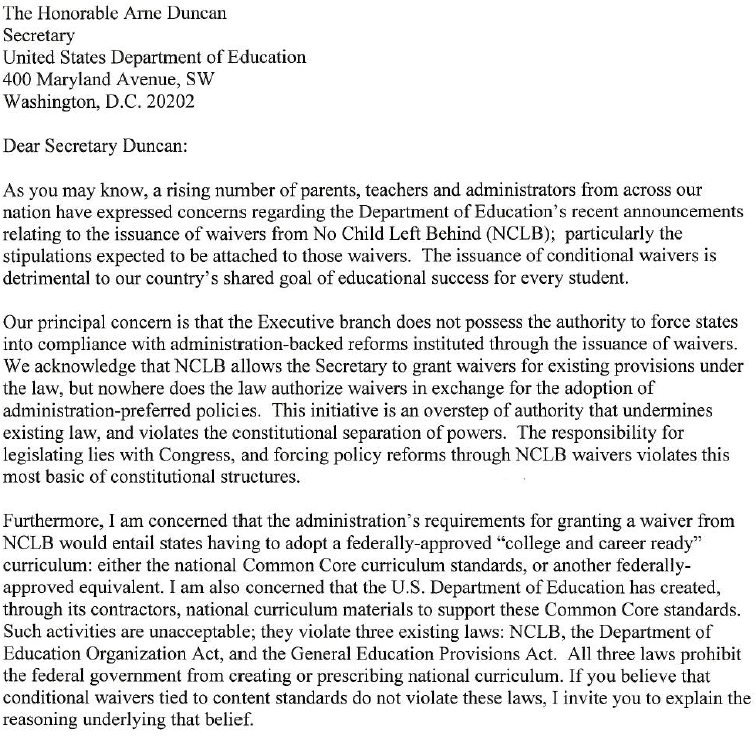
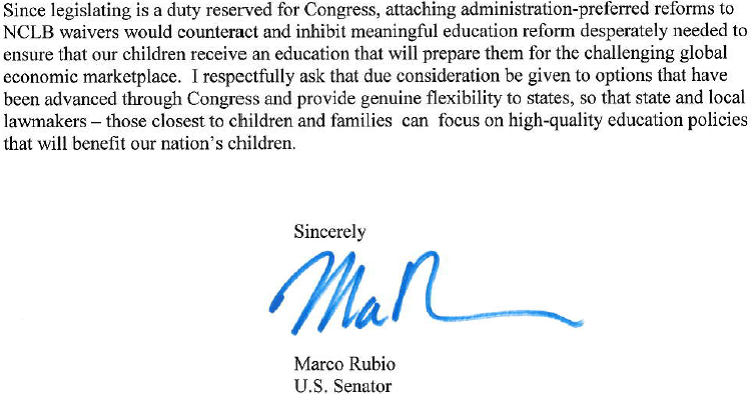
Education Secretary Arne Duncan’s press statement on South Carolina was a bizarre display of the opposite of what it intended. As Greg pointed out, the statement’s harsh and threatening tone did nothing to support the claim that Common Core national standards and assessments are a purely voluntary consortium of the states. Instead, the statement was a not so veiled threat that South Carolina would lose out on the opportunity for federal grants like Race to the Top and lose the opportunity to receive waivers from impossible to satisfy NCLB requirements if it followed through with a proposal to withdraw from Common Core. If it is purely voluntary, why the need for threats and intimidation from the Education Secretary?
[Prominent Republicans] have supported the Common Core standards because they realize states must stop dummying down academic standards and lying about the performance of children and schools. In fact, South Carolina lowered the bar for proficiency in English and mathematics faster than any state in the country from 2005 to 2009, according to research by the National Center for Education Statistics.
South Carolina did significantly lower its performance standards between 2005 and 2009. But they did so because they had earlier raised those performance standards to well-above the national average. In the end, South Carolina had math and reading performance standards that were close to the national average and close to the NAEP standard for Basic.
One of the potential benefit of state control over performance standards is that they can raise or lower them so that they are not too easy so that everyone passes or so hard that everyone fails. You have to hit the sweet spot between these points to motivate students and educators to improve without crushing them. Each state may have a different sweet spot and needs the flexibility to adjust in case they miss the mark (as SC initially did) or in case achievement improves (as has occurred in FL).
We actually had Jack Buckley, the Commissioner of NCES, out to give a lecture in Arkansas during which he presented this analysis. You can see a summary and the slides here.
Compared to what we could have had as an education secretary, Duncan has been pretty good. He’s shown some independence from the teachers unions and supported some promising reforms, like charter schools. But he’s ignored his own department’s research in seeking (multiple times) to kill the DC voucher program. And he seems oblivious to the limits of power that he and the federal government have over education policy. When people abuse their power they may also be more likely to abuse research.
Shorter Arne Duncan: The U.S. Department of Education is not pressuring states to adopt Common Core. However, any state that takes action to resist Common Core will be immediately singled out by the Education Secretary for an extremely harsh public denunciation of its education system – which will obviously make it effectively impossible for the Department to look favorably upon that state when doling out grants and waivers for the foreseeable future.
Lance Izumi has a new mini-book coming out as part of the Encounter Broadsides series arguing against the effort to build a nationalized education system through centrally imposed Common Core standards, assessments, and curriculum. Be sure to check out the cool video Encounter has made to promote the mini-book.
Wilson did praise the fact that “Common Core is vastly superior—not just a little bit better, but vastly superior—to the standards in more than 30 states.” But he also acknowledged “There is much to criticize about them, and there are several sets of standards, including those in California, the District of Columbia, Florida, Indiana, and Washington, that are clearly better.” He also acknowledged that Common Core math standards are “certainly not up there with the best of countries…”
I thought Wilson was trying to argue that being better than 30 states represented a good first step and that Common Core would be improved over time. That was me inferring something that he did not actually say and that he explicitly objected to having attributed to him.
So, let’s just pretend for a moment that Common Core is just as good as the very best. Who, in education circles, will agree with that enough to put it all in practice? The standard algorithm deniers will teach multiple ways to multiply numbers and mention the standard algorithm one day in passing. Korea will say “no calculators” in K–12, a little extreme perhaps, but some in the U.S. will say “appropriate tools” means calculators in 4th grade. We, in this country, are still not on the same page about what content is most important, even if everyone says they’ll take Common Core. Without a unified, concerted effort to teach real mathematics, there isn’t much chance of catching up.
In other countries, if you say “learn to multiply whole numbers,” no one questions how this should be done; students should learn and understand the standard algorithm. In the U.S., even if you say “learn to multiply whole numbers with the standard algorithm,” some people will declare wiggle room and try to avoid the standard algorithm.
The Common Core will have little to no effect on student achievement. The quality or rigor of state standards has been unrelated to state NAEP scores, Loveless finds. Moreover, most of the variation in NAEP scores lies within states, not between them. Whatever impact standards alone can have on reducing within-state differences should have already been felt by the standards that all states have had since 2003.
So, let’s review where things stand. Despite a withering public scolding from Rick Hess, Common Core still can’t produce anyone to strongly defend national adoption of those standards based on their quality. Common Core supporters are either too chicken to engage in the debate over the quality of the standards or too arrogant to think they have to defend the standards intellectually before they cram them down all of our throats.
In the current issue of the Education Gadfly and on the Education Next blog Checker Finn offers an unusual argument for adoption of K-12 national standards. He likens opposition to national standards to rooting for the Euro to fail:
If you hope the Euro crashes, that this week’s Brussels summit fails, and that European commerce returns to francs, marks, lira, drachma, and pesetas, you may be one of those rare Americans who also seeks the demise of the Common Core State Standards Initiative in U.S. education.
It’s odd that Checker should pick the Euro as a way to make the case for national standards since the Euro’s difficulties wonderfully illustrate the problems with national standards. The Euro is in trouble because it was an attempt to impose a common currency on countries that were too diverse in their economic needs and political traditions. The Euro is too strong of a currency for countries with un-competitive labor forces and undisciplined budget deficits, like Greece, Italy, and Spain. But if the European Central Bank significantly loosens the currency to bail out these countries, it will create serious inflation problems in countries like Germany and others with more skilled labor forces and reasonable deficits.
The Euro is not in trouble because some people “hope the Euro crashes.” It’s in trouble because it is a centralized institution that does not fit the diversity of its members.
Similarly, national standards will fail because it is not possible to have a centrally determined set of meaningful standards that can accommodate the legitimate diversity of needs, goals, and values of all of our nation’s school children. To have an effect national standards inevitably drive the assessments that are used to measure student achievement as well as the methods of instruction that are used to produce that achievement. “Tight-loose” is just an empty slogan (or part of a drinking game). In reality standards, assessments, and instruction are closely connected unless they are just irrelevant things.
In a country as large and diverse as ours there is no single, right set of knowledge for all students to possess, no single, best way to assess that knowledge, and no single, best method for teaching it. The attempt to impose a nationalized system onto this diversity is doomed to fail just as the Euro is doomed to fail in imposing a common currency on such diverse economies and political systems.
The fact that the Euro is in such trouble and creating such political and economic turmoil ought to scare us away from trying to impose a centralized solution on too much diversity. The Euro crisis is an argument against national standards, unless we are eager to have similar difficulties here.
No one is rooting for those failures, per se. Some of us just recognize that reality is not created by repeating slogans to each other over catered lunches at DC think tank conferences. Reality actually exists out there in the world and no matter how many chardonnays I’ve had while listening to the keynote speaker and no matter how many grants the Gates Foundation sprinkles on me and my friends, centrally imposing institutions on too much diversity is doomed to fail.
Of course, there is a way to overcome that diversity and improve the chances for centrally imposed institutions to succeed — force. If European countries relinquish power to make their own budgets to a central authority, the Euro might work. Similarly, if individual schools, school districts, and states relinquish power over daily operations to a central authority, the nationalized education movement might succeed.
But achieving that type of centralization in the face of diversity requires an enormous amount of coercion. People who disagree have to be suppressed, or at least denied the ability to do anything about their dissent. Local folks no longer get to make the meaningful decisions. They can just implement the decisions that are centrally made.
This could work but it would be awful. Some people say they would favor a World Government if only it were possible to do it. I’m not one of those people. World Government would be awful because it would require an enormous amount of coercion to overcome local diversity. To a much lesser degree, a nationalized education system in the US could be done but it would run roughshod over the needs and legitimate interests of many individuals.
But some people are nevertheless attracted to centralized solutions. I think Tears for Fears has a song that might explain why.
Last week the education task force of the American Legislative Exchange Council (ALEC) endorsed measures urging states to oppose adoption and implementation of the federally “incentivized” Common Core standards. According to Catherine Gewertz at Ed Week:
The organization’s education task force approved the package, we learned from a couple of folks who attended those sessions of ALEC’s meeting this week in Scottsdale, Ariz.
Gewertz added that the measures do not become official ALEC policy until they are approved by the board of directors. A similar proposal was proposed last summer by members of the education task force but was tabled until the recent meeting. Allies of Jeb Bush and the long, gilded arm of the Gates Foundation pulled out the stops to block the measure and may yet succeed at the board level.
I fear that even if the measure is approved by ALEC’s board, the battle over adoption may effectively be finished. An effort to repeal Common Core standards in Alabama failed despite the fact that the governor proposed the repeal and votes on the state board of education. If you can’t repeal national standards in Alabama under such favorable conditions, it may be very hard to repeal it in any of the other 40-some states that have signed on.
But just because the adoption debate is winding down doesn’t mean the national standards war is over. Far from it. So far states have done the costless and non-constraining step of adopting a set of standards. Once the nationalizers try to make the standards concrete and binding by incorporating them into newly designed high-stakes testing, we are likely to see a lot more resistance. And adopting those new tests, revising teacher training, professional development, and textbooks to fit the national standards and testing will require considerable effort and expense — causing more states to rethink their initial support for Common Core.
The ALEC anti-Common Core measure will be important for mobilizing opposition as those next hurdles have to be jumped. Even if the nationalization effort successfully runs this gauntlet, which they may do, the probability that national standards and assessments will actually produce the end goal — significantly improved student achievement over the long term — is near zero. If nationally setting goals and ordering progress toward those goals were the path to success, the Soviet Gosplans would have produced their economic triumph over the West. We all know how well that turned out.


 Posted by Jay P. Greene





 Jay P. Greene's Blog