The Lives of Others

January 12, 2018

Image result for behavioral economics

In education reform, like other policy areas, analysts are busy trying to identify how to channel people’s behavior in directions that we believe will improve their lives.  If we think people should eat less, we devise interventions to encourage them to cut back.  If we think too few students go to college, we nudge them to enroll.  If we think people save too little, we arrange systems to increase retirement contributions.  In what is imagined to be a kinder, gentler approach to these problems, we “nudge” people toward desired outcomes rather than mandating them.  Mandating can seem too harsh and produce backlash, but nudges allow social scientists to influence behavior without feeling like they are infringing on the autonomy and liberty of the people whose behavior they are shaping.  Most people behave irrationally and lack impulse control, but the priestly class of social scientists can detect and correct these problems for other people.

A central problem with this approach is that we know too little about the lives of others to know with confidence what is good for them or how our nudges will affect their entire lives.  We may think we are helping people, but absent the same contextual information that individuals possess about themselves we are liable to push (excuse me, nudge) people in ways that actually harm them.

A recent NBER study on a plan to increase retirement savings helps illustrate the challenges associated with managing other people’s lives.  That study examined a natural experiment in which civilian employees of the military were automatically enrolled in contributing 3% of their income toward a retirement plan that would be matched by employer contributions.  Previously, employees had to opt-into this retirement plan, but the policy changed so that employees would have to opt-out if they did not wish to contribute.  Already employed workers were exempted from the change, so researchers could compare those hired just before the policy was implemented to those hired just after to identify the causal effect of the switch toward automatic contributions.

As intended, the plan increases retirement savings: “At 43-48 months of tenure, automatic enrollment increases cumulative employer plus employee contributions since hire by 5.8% of first-year annualized salary.”  While the plan succeeded in increasing retirement savings, employees did not appear to decrease their consumption.  Instead, they increased their borrowing, particularly for cars and homes, by an amount that exceeded the amount by which their retirement savings increased.  Even if we exclude the mortgage borrowing, which has a more ambiguous affect on long-term wealth given that house prices may appreciate by more than interest and depreciation, even just the auto loan increases exceeded the amount by which employees increased their savings.  If we include the employer match, increased retirement wealth was close to the increase in auto loan amount.  Overall, it is unclear if the policy increases the total wealth of the employees.  Excluding the employer match, employee wealth is likely decreased. So the only clear effect of the automatic savings policy is a transfer of wealth from whoever pays for the employer match to employees, but no overall benefit to society.

As this study reveals, shaping other people’s behavior is complicated.  People may not contribute to retirement plans because they want to consume things now.  Pushing (er, I mean, nudging) them to save anyway may just cause them to increase their borrowing in a way that has no net benefit or even a net harm.  We don’t know enough about other people’s lives to manage them optimally.

But retirement savings is usually considered one of the clear success stories for nudges.  I suspect that is because people typically judge those interventions by the extent to which they change the narrow behavior on which we are focused rather than overall well-being. That is, we nudge people to contribute more to retirement savings and sure enough they do.  Mission accomplished.  But we really need to look at their total consumption and borrowing behavior to see how this policy affects folks.  When we step back to see the bigger picture, the benefits disappear or even become harms.

The same is true for educational nudges.  We have a number of studies that look at short-term and narrow effects of nudges to get students into college.  Sure enough, if we push (I mean, nudge) people to enroll in college, they tend to do that.  All that shows is that people believe we are experts and are willing to substitute our expert advice for them (even though we know almost nothing about them) for their own, better informed judgement about what they should do.  The real proof of college-going nudges is not whether people listen to us, but whether that helps them long-term.  Those long-term results have not yet been published, but those results exist and I believe based on leaked drafts that the short-term benefits go away or even turn into harms after a few more years.   That is, students who didn’t think they were ready for college but were pushed into attending may have difficulty finishing and other students who enroll later may be better prepared at that point to succeed, causing the overall effect of these nudges to be null or even negative.  One has to wonder about the ethics of researchers touting short -term positive results if they know that longer-term effects tend to go away or turn negative.  Are they nudging us to accept the idea of nudge interventions, so it is really for our own good to only hear about positive short-term results?

(H/T Bob Costrell for alerting me to the retirement study.)


Time to Bet on Black in 2017

January 11, 2018

(Guest Post by Matthew Ladner)

I am going to be on a panel at the Arizona Townhall tomorrow about racial achievement gaps, so this had me taking a look at data. Arizona’s Black students had the highest NAEP 8th grade math scores in the country in 2015, so this got me curious to how close this would get them to the lowest average statewide scores for White students (not that this bar is high enough but better to pass it than not and sooner rather than later or never).

Put me down for $20 on the 2017 NAEP- I’m betting on Arizona Black baby!


Will Arizona school funding volunteer to serve as electoral cannon fodder?

January 10, 2018

(Guest Post by Matthew Ladner)

Back in 2016 word reached my ears that Arizona Democrats planned to nominate a particular candidate for Governor and to put a replacement for Proposition for 301 on the 2018 ballot with or without Governor Ducey’s support. Prop. 301 was a voter approved six tenths of a cent sales tax passed by voters in the early aughts and set to expire in 2021. The sales tax raises a significant amount of funding. Like clockwork, sure enough the candidate is running and efforts are apparently underway on the tax front as well.

So…where to start?

The history of ballot tax proposals for education is very consistent: without the active support of the Governor, they fail. With the support of the incumbent Governor they pass, often by narrow margins. Prop. 301 narrowly passed with the support of Governor Hull, First Things First narrowly passed with the support of Governor Napolitano, a temporary sales tax increase passed with the support of Governor Brewer, Prop. 204 failed almost 2-1 with Governor Brewer staying neutral in 2012, Prop. 123 narrowly passed with Governor Ducey’s support in 2015 (no tax increase involved).

An interesting divide emerged during the Prop. 123 campaign. While the Arizona School Boards Association and the Arizona Education Association agreed to the settlement, deciding that getting an additional $3.5 billion today and seeking more tomorrow constituted a reasonable decision. Much of the Arizona left however resisted the settlement. Stated motives involved misgivings about wanting more money, but the risk of getting zero dollars from the suit were substantial. They therefore decided to settle the case, which required a vote of the public to increase the state land trust payout.

The South Carolina legislature has apparently ignored a SCSC school funding order for decades. Something about separation of powers and legislative authority to appropriate money I take it. If you can’t imagine the Arizona legislature seeing things in a similar fashion, you might want to exercise your imagination a bit more often. Prop. 123 was a reasonable compromise in my book and personally I decided my yes vote was a no-brainer- why pile up additional money into a trust with a payout set at a fraction of that required by public charities?

Much of Arizona’s left however seemed to see this primarily through the lens of electoral politics. While public statements focused on a (highly speculative) case for more money, privately the left fumed that the settlement had foiled what they saw as a golden political opportunity. I never heard anyone say that they yearned for the constitutional crisis described above, but let’s just put it on the table that there were people yearning for a constitutional crisis. The Arizona Republic’s Bernie-Bro columnist brigade gave every appearance of falling into this category. Education interests divided between those who actually cared about funding and those who are happy to use school funding as a sacrificial pawn to their partisan ambitions imo.

In any case, rumor around town is that the ASBA and AEA were effectively paralyzed by the divide in their bases, leaving Governor Ducey in the position of getting the proposition over the finish line. It has probably never been harder to give away $3.5 billion.

Which leads us up to the present day. Governor Ducey has stated publicly that he is open to renewing Prop. 301 before expiration, but apparently some think it is better to go in 2018 without his support. The risk of this to school funding is considerable. Imagine Governor Ducey wins reelection and a son of 204 fails goes on the 2018 ballot. The prospects for 301 renewal would appear to fall somewhere on the grim to implausible spectrum. This is of course is a risk worth taking if you don’t actually care about school funding a la those who claimed to support public schools but wanted a political issue more than $3.5 billion in school funding.

I’m not sure whether this strategy represents the best available for the Arizona Democratic Party or not. Whether it is or isn’t it is obviously very risky for school funding. As the folks who actually care about school funding grapple with the polarized nature of their tribe it is worth considering the following: even if the wildest dreams of the left came true there is no giant pot of money here in Arizona to put into K-12- regardless of the outcomes of the 2018 elections.

Imagine for a moment that a Democrat takes office as Governor in 2019 and for the first time since who knows when Democrat majorities in the legislature. Even in this wildest dream scenario, the same competing demands for funds, and the same 2/3 requirement in each chamber needed to raise taxes. In other words, the only avenue would be the ballot just as it is now.

The question therefore boils down to whether a bipartisan vote in 2019 have a better chance of prevailing, or a blatantly partisan 2018 effort that will not have the support of the Governor? This boils down to a debate on the left between those who actually care about school funding, and those who mostly prize it as a political issue.


Winners and Losers in the John Rawls Reading Challenge 2003 to 2015

January 8, 2018

(Guest Post by Matthew Ladner)

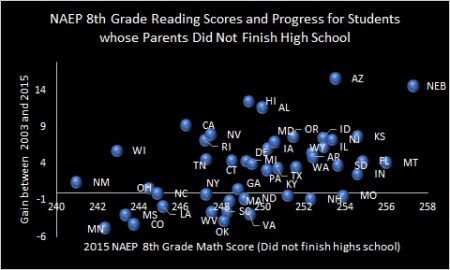
So I’m just going to leave this chart here:

Feel free to blubber in the comment section about how somehow the kids with parents that did not finish high school are the hardest to educate in the planet in state X. On second thought feel free to skip it. Every state has their excuse. That sound you hear is us laughing them off here in our pleasant patch of cactus (our state’s excuse used to be kids crossing the border not being able to read English or Spanish).

Scores unavailable in Alaska, Maine, Utah and Vermont. Rawls background here.

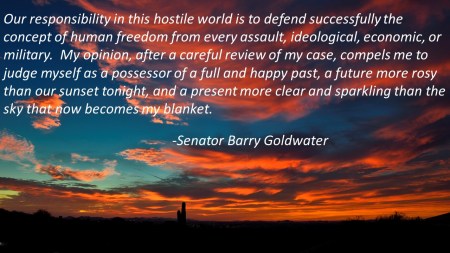
The 2017 NAEP results will arrive in March or April. I hope your state does better next time. I’ll update this chart when the new data comes out, but in the meantime, I am reminded of the below quote:


Studies: Teachers Unions Hurt Students’ Future Earnings, Employment (Minorities Hardest Hit)

January 7, 2018

(Guest Post by Jason Bedrick)

At this week’s annual meeting of the prestigious American Economic Association, Stanford economist Caroline Hoxby chaired a paper session titled, “New Evidence on the Effects of Teachers’ Unions on Student Outcomes, Teacher Labor Markets, and the Allocation of School Resources.”

I haven’t read these studies yet, so I won’t provide any commentary on them, but I figured JayBlog readers would be interested to see these two papers in particular:

“The Long-run Effects of Teacher Collective Bargaining” by Michael Lovenheim (Cornell University) and Alexander Willen (Cornell University)

This paper presents the first analysis of the effect of teacher collective bargaining on long-run labor market and educational attainment outcomes. Our analysis exploits the different timing across states in the passage of duty-to-bargain laws in a difference-in-difference framework to identify how exposure to teacher collective bargaining affects the long-run outcomes of students. Using American Community Survey (ACS) data linked to each respondent’s state of birth, we examine labor market outcomes and educational attainment for 35-49 year olds. Our estimates suggest that teacher collective bargaining worsens the future labor market outcomes of students: living in a state that has a duty-to-bargain law for all 12 grade-school years reduces earnings by $800 (or 2%) per year and decreases hours worked by 0.50 hours per week. The earnings estimate indicates that teacher collective bargaining reduces earnings by $199.6 billion in the US annually. We also find evidence of lower employment rates, which is driven by lower labor force participation, as well as reductions in the skill levels of the occupations into which workers sort. The effects are driven by men and nonwhites, who experience larger relative declines in long-run outcomes. Using data from the 1979 National Longitudinal Survey of Youth, we demonstrate that collective bargaining leads to sizable reductions in measured cognitive and non-cognitive skills among young adults. Taken together, our results suggest laws that support collective bargaining for teachers have adverse long-term labor market consequences for students. [emphasis added]

In short, the paper finds evidence that teachers unions’ collective bargaining reduce the future level of employment and earnings of students, especially minorities.

But wait, there’s more!

“Unions, Salaries, and the Market for Teachers: Evidence From Wisconsin” by Barbara Biasi (Princeton University)

A careful study of teachers’ labor demand and supply, while extremely relevant for policy, is challenging due to a lack of variation in pay, as teacher salaries are usually set using steps-and-lanes schedules based entirely on seniority and academic credentials. This paper exploits the passage of Act 10 in Wisconsin in 2011, which changed the scope of collective bargaining on teacher salaries, to study the effects of changes in pay on teachers’ labor market, and on the composition of the teaching workforce. As a result of this law some districts started to individually negotiate salaries with each teacher, whereas other districts continued setting salaries using seniority-based schedules. I first document an increase in salary dispersion in individual-salaries districts, and show that it is correlated with teacher value-added. Teachers responded to changes in pay by sorting across districts or by exiting: I find a 34 percent increase in quality of teachers moving from salary-schedule to individual-salary districts, and a 17 percent decrease in quality of teachers exiting individual-salary districts. Building from this reduced-form evidence, I estimate the parameters of teachers’ labor supply and demand using a two-sided choice model. Simulating the model on different salary schemes shows that an increase in the quality component of salaries in one district is associated with an improvement in average quality of the teaching workforce, driven by both in-movements of higher-quality teachers and out-movements and exits of lower-quality teachers. An increase in all districts is, however, associated with a smaller improvement, entirely attributable to exits of lower-quality teachers. [emphasis added]

In other words, the study finds that, after enacting Act 10, high-quality teachers in Wisconsin tended to move to districts that paid them based on their individual performance, whereas low-quality teachers gravitated to districts that paid for them staying alive an additional year.

Whether these findings are robust or generalizable is an open question that I’ll leave it to others to debate. But I do hope that these studies receive the consideration that they deserve.


EDRE Alumnus, Lynn Woodworth, Named to Lead NCES

January 5, 2018

Woodworth

James Lynn Woodworth, who goes by Lynn, has been picked to lead the National Center for Education Statistics in the US Department of Education.  Lynn enrolled in the Department of Education Reform‘s PhD program as part of its inaugural class in 2009. He completed his doctorate in 2013 and began work as a researcher with CREDO at Stanford University.  Before coming to the University of Arkansas, Lynn was a teacher and band instructor at Mansfield High School for 11 years.  Before that he was a Marine, where he worked in Intelligence and developed a proficiency in Arabic.

We are extremely proud of Lynn as we are of the successes of all of our Alumni.  If you would like to see a list of our graduates and their impressive accomplishments, visit this web site.  And if you are interested in joining the ranks of these amazing people, you still have until January 10 to apply to our doctoral program for next academic year.  You can read more about the program and how to apply here.


Education Freedom is…a Millennial

January 4, 2018

(Guest Post by Matthew Ladner)

So the recent closing of BAEO has me reflecting a bit. The Milwaukee Parental Choice Program passed in 1990, followed by the first charter school statute in 1991 in Minnesota. This makes the choice movement a millennial. Like many millennials, the education choice movement is still a little rough around the edges, still a little up in the air about whether she’s going to pull it all together. She does show promise, but just might be holding herself back despite some lessons learned the hard way that she does not quite, really want to confront and accept. Lessons like:

  1. It’s counter-intuitive but if you want to help poor kids with choice it is best to include everyone.
  2. Central planning efforts can and do backfire, even when your intentions are good.
  3. When you go outside and talk to normal people you learn important things away from the reformosphere bubble.
  4. Politics has some basic rules-know them.

Needless to say, there are more, which you can add in the comments. I for one am optimistic that our sometimes out of sorts millennial is going to make it after all.


The Need for BAEO’s Struggle Continues

January 2, 2018

(Guest Post by Matthew Ladner)

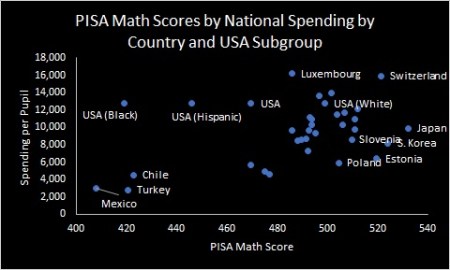
New Year’s Eve was the end of an era with the closing of the Black Alliance for Educational Options (BAEO). The PISA data show just how vital BAEO’s mission remains. Developing countries like Chile and Estonia outscore American Black students despite spending a fraction of what American schools spend per pupil. It staggers the imagination to believe that the structure of our incredibly generously funded K-12 system plays no role in this appalling state of affairs imo.


Pass the Popcorn: The Past Jedi

December 31, 2017

ED3E5D48-903D-4E5F-A622-D8E1009E12C0

(Guest post by Greg Forster)

Start 2018 off right with my review of The Last Jedi over on Hang Together:

Where TFA was about the family, TLJ is about the past. We need the wisdom of the past, but the corruption of the past threatens to destroy us.

Looking forward to hearing what y’all think!

PS Coming soon, Darkest Hour. Go see it while it’s still in theaters, it benefits from the big screen!


2017 in review

December 29, 2017

(Guest Post by Matthew Ladner)

So…let’s start with the good news: despite dire predictions of apocalypse, human civilization is still alive and kicking. No global trade wars broke out, the economy shows signs of life. If you google around a bit you can learn things like that the Trump administration is running at about half of the pace for deportations from the Obama administration peak.

That’s all I have to say about that. Ok I take it back-you should also read this. Keep your fingers crossed.

The early days of 2017 looked like the year might be a complete K-12 dumpster fire as (too) much of ed reform world went into a Patty Hearst level of Stockholm Syndrome. The response to the K-12 version of the polarization trap went in the direction of “Gaghghghghgh!!!! The sky is falling!!!!! Quick make something up about Detroit charter schools!”

It should be obvious now that this was overwrought. As it happens 2017 goes into the books as a mixed year on the choice front, contra the fears of DeVosaphobes. Advances in Illinois, North Carolina and Wisconsin were offset by a setback in Nevada and a cliffhanger in Arizona. The initial drama surrounding the prospect for federal legislation eventually simmered towards an incremental approach sans apocalypse. Kentucky passed a charter school law, but not one likely to produce many charter schools. There are people getting excited for and against the 529 provision, but color me mostly meh. Other provisions of the tax bill may wind up being more significant.

There was a lot of discussion of ESSA plans. I’m not sure why. Perhaps 2018 will see more of the ESSA cottage industry think through the implications of NGO school rating systems. What’s that? Okay I’ll mark my calendar for 2084. Later?!? Fine. Meanwhile approximately 3,650,000 additional Baby Boomers reached the age of 65 in 2017. No one on either side of the aisle in DC seemed to notice. Arguments over inaugural crowd sizes and Russian conspiracy theories took precedence. Excuse me 2018? I’ll have another 3.65m please! Oh and send the check over to the kiddie table.

Perhaps the most encouraging news I heard this year came from the Modern States Project. MSP developed MOOCs and free online textbooks designed to allow students to pass AP/CLEP courses for only the cost of the exam (~$85.) This looks like a straightforward solution to the credit problem, at least in lower level courses and inches the ball closer to free.

The 2017 NAEP will be released in a few months. Election years don’t usually serve as the setting for broad K-12 reforms, but my money is on Greg beating Mathews yet again.

Let’s see what happens next.