Question for Leo — How Long Will It Take For an NEA Correction?

January 29, 2010

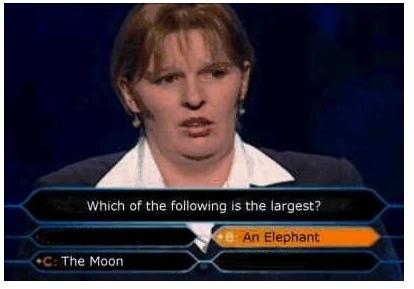
Since the teacher union flacks have a hard time changing the cue cards from which they read, we have a question for Leo:  How long will it take until the NEA issues a correction for the obvious error committed in the video above and in the press release here?

In case you need to catch up, the NEA issued a press release claiming “Inflation over the past decade has outpaced teachers’ salaries in every single state across the country…”  The only problem is that their own report shows that teacher salaries actually rose at a real rate of 3.4% nationwide over the last decade and at faster than the rate of inflation in 36 states.  Read more about it here.

We’ll start our new series, NEA Correction Watch, tomorrow to count the days until they admit the error.

UPDATE — I’ve been corresponding by email with Celeste F. Busser, the NEA’s Senior Public Relations Specialist, about this error.  I have to say she has been very responsive.  In fact, she just emailed me to say that the NEA’s research department has “confirmed their mistake.”  She has altered the web site of the press release to say that inflation has outpaced salary increases in 15 states (rather than every state) over the past decade.  And she says that she will send a corrected press release to everyone who received the original one. 

Yes, the NEA is still putting their heavy spin on these facts, but at least they are getting the facts right.  I feel a little guilty about expecting the worst with regard to their issuing a correction.  But my guilt is reduced somewhat by the fact that they do not appear to acknowledge any error and are just replacing the erroneous information as if it never happened.  That’s not quite what they should be doing.


The Ministry of Truth Speaks

January 29, 2010

A press release from the National Education Association landed in my inbox this morning with the alarming headline: “Teachers Take ‘Pay Cut’ as Inflation Outpaces Salaries.  Average teachers’ salaries declined over the past decade” 

The release goes on to say: “Inflation over the past decade has outpaced teachers’ salaries in every single state across the country, according to the National Education Association’s update to the annual report Rankings and Estimates: Rankings of the States 2009 and Estimates of School Statistics 2010. ‘Public schoolteachers across the nation are continuing to lose spending power for themselves and their families in an already struggling economy,’ said NEA President Dennis Van Roekel.”

The only problem is that this is not what the data in the NEA report actually show.  In Table C-14 “Percentage Change in Average Salaries of Public School Teachers 1998-99 to 2008-09 (Constant $)” we see that salaries increased by 3.4% nationwide over the last decade after adjusting for inflation.  The increase in average salary outpaced inflation in 36 states, which is very different from the claim that  “Inflation over the past decade has outpaced teachers’ salaries in every single state across the country…”  Check for yourself, the table is on p. 20 of the report, which is p. 38 of the pdf.

I can’t find a single table or figure in the report that would justify the headline and claims in the press release.  But when the Ministry of Truth speaks who are you supposed to believe — them or your lying eyes?

I should add that total compensation for public school teachers has risen much more rapidly than just salary because of the rising value of benefits.  In addition, the numbers the NEA provides are the increase in the average salary, not the increase for the average teacher.  The huge increase in new teachers over the last decade who begin with lower starting salaries makes the rise in average salary smaller than the average raise that each individual teacher has received.

Even with these distortions, the report is a treasure trove of interesting information.  We learn that the average teacher in 2008-09 was paid $54,319, excluding the value of health benefits, generous (and guaranteed) pensions, and exceptionally high job security (See Table C-11).  We also learn that the average school revenue per pupil was $11,681 in 2008-09, up from $11,432 the year before  (See Tables F-1 and F-2).  And total instructional staff has increased by 13.6% over the last decade to 3,716,541, with increases in educators employed every year — no recession here.  (See Table 3.2 on p. 75 of text and p. 93 of pdf.)

UPDATE:  Here is the NEA press release with a video from NEA president, Dennis Van Roekel, repeating the erroneous claim.  It is obvious from the video and an email exchange I’ve been having with the NEA press representative that they compared the constant dollar percentage increase to the increase in the rate of inflation and found that no state had a real increase that was higher than the 29.6% rate of inflation over the past decade.  The problem with this is that the constant dollar percentage increase adjusts for inflation.  The claim of the press release is based on an obvious error.


Coming Soon to a Theatre Near You: The Lottery

January 28, 2010


(Guest Post by Matthew Ladner)

We’ve discussed John Rawls and the veil of ignorance a few times here on JPGB. What if you lost the cosmic lottery and were born a poor inner city child? What would you want the school system to work? If you said “anything other than a zip code based system which pervasively matches the most disadvantaged students with the least effective teachers” give yourself a gold star.

In any case, the Rawls lottery is only a thought exercise, but back here in reality, there are real lotteries held every year with thousands of children attempting to escape the system described above by applying for a charter school. There are winners and losers, families who celebrate in joy and families who weep bitterly. 

Someone made a movie about it. Check out the preview– I’m looking forward to it.

Question for Leo: have you figured out why you lost Barack Obama on charter schools yet? Buy a ticket and some popcorn and you may figure it out.


Write Your Own Caption Contest

January 26, 2010

President Barack Obama, accompanied by Education Secretary Arne ...

(Guest Post by Matthew Ladner)

So that is Arne Duncan in the background, and yes, the President is using a teleprompter for a speech at an elementary school. Funniest caption wins a JPGB No-Prize!


Pro-Choice Doesn’t Mean No Taste

January 25, 2010

Amy Gutmann and Suicide Bomber.jpg

Amy Gutmann poses with a student dressed as a suicide bomber at her Halloween party in 2006.  Talk about having no taste.

A regular indictment leveled against advocates of school choice is that they have no taste when it comes to the quality and purpose of education.  As Amy Gutmann, the president of the University of Pennsylvania and author of Democratic Education, put it: “advocates of parental choice and market control downplay the public purposes of schooling, and this is not accidental. It coincides with the idea of consumer sovereignty: the market should deliver whatever the consumers of its goods want.”  If schools should do whatever the consumer wants, according to this way of characterizing choice supporters, then those choiceniks can’t favor particular educational standards or approaches.  Choice supporters wouldn’t be able to denounce a Jihad school, for example, because consumer preference is the only issue that matters.

This caricature of choice supporters is mistaken on many levels.  First, just because choice supporters want to empower parents to select their school doesn’t mean that the choice advocates are unable to have their own preferences about what schools would be better for people.  Similarly, I might believe that smoking is bad for one’s health, even as I am willing to recognize other people’s liberty to choose to smoke or not.  Or perhaps an easier example — I may think a movie is awful and contains harmful messages and still believe that people have a right to see it.  Believing in liberty doesn’t mean being indifferent to what other people like or do.  It just means not wanting to coerce them into doing or liking what I prefer.

Favoring choice does not require abdicating all taste.  Advocating choice requires believing that people have a right to have their own bad taste.  Favoring choice can also be supported by a belief that people are less likely to make bad choices for themselves than someone else would on their behalf.

Second, most choice supporters recognize some need for public regulation of the schools that are chosen.  These regulations could be as minimal as the public health and safety regulations that affect restaurants or could be more extensive to include instructional issues.  The point is that almost no school choice supporters are anarchists, so there is no need for the Amy Gutmann’s of the world to act as if they all are.

Choice supporters can have personal taste and standards and most also favor public standards that place limits on choice.  At least most choice supporters would have better personal taste and standards than to pose for a photo with a Halloween party guest dressed as a suicide bomber, even though almost all of us would recognize someone’s right to have such awful taste.


“Just Call Me Mister Butterfingers!”

January 22, 2010

(Guest post by Greg Forster)

President Obama says health care socialization has “run into a bit of a buzz saw.”

Jim Geraghty asks: What’s the survival rate for people who run into buzz saws?


The Silence of the Lame

January 22, 2010

(Guest Post by Matthew Ladner)

Dan Lips on the mainstream media and the head start evaluation. Money quote:

When a Congressionally-mandated study released in 2008 found that President Bush’s favorite reading program was a failure, it was national news.  An article by Greg Toppo in the USA Today blared the headline “Study: Bush’s Reading First Program Ineffective” and reported that the results could be a “knockout punch” for the program.  Similar articles appeared in the New York Times (by Sam Dillon) and Washington Post (by Maria Glod).

But when a similarly devastating report was published last week that undercuts a pillar of President Obama’s education plans, none of these papers has bothered to report it.   As we have reported, the Department of Health and Human Services finally released the results of a national evaluation of the Head Start program that Congress mandated in the late 1990s.


Pass the Popcorn: Up in the Air

January 22, 2010

 (Guest Post by Matthew Ladner)

Up in the Air is a must see flick.

Clooney plays a man purposely devoid of attachments, a middle-aged guy with a Peter Pan syndrome. He travels 300+ days a year for his job, rarely speaks to his siblings, and has no interest in owning a home or having a serious romantic relationship. Not only has Clooney’s character made these choices for himself, he evangelizes this lifestyle in public speaking. His spiel involves using a backpack as a prop. Wives, mortgages, kids, pets- these are all heavy burdens in your backpack, he essentially argues, and you want to travel light.

His job? Flying around the country firing people in corporate  down-sizings.

Clooney’s character reminds me of an older, grizzled manifestation of the flawed young men of Kay Hymowitz’s brilliant and biting social commentary. Hymowitz, a colleague of Jay’s at the Manhattan Institute, has written a series of articles lamenting the young men of today. While once it was expected that a man would actually make something of himself before seeking a wife, today sex is widely available outside of marriage. So, thinks today’s bachelor, why get married? Although I can’t find a link, I recall seeing Hymowitz describe the young men of today as “addicted to video games and masturbation.” 

I remember it because I spit my “tea, Earl Grey, hot” onto my computer screen when I read it. Anyhoo, Clooney’s character, a bit more mature, is addicted to the accumulation frequent flyer miles, staying in five-star hotels,  hanging out at the Admiral’s Club at the airport and one night stands.  It’s all going swell, or is it (?), until a young whippersnapper figures out that it is cheaper to fire people by text message and he hooks up with a female version of himself out on the road…

Up in the Air is a great movie that deserves the buzz it is receiving. Drop what you are doing and go see it.


Federal Judge Strikes Down Campaign Matching Funds in AZ

January 21, 2010


(Guest Post by Matthew Ladner)

A federal judge has overturned Arizona’s misguided “Clean Elections” system, once touted as a national model, on First Amendment grounds.

The system was a terrible idea from the start.

Clean Elections gathered involuntary contributions from sources such as surcharges on parking tickets, and created a funding source for political campaigns. A candidate could run “clean” by gathering a proscribed number of $5 donations, and then would receive state funding.

Worse still, when facing an opponent raising funds the old fashioned way, the “clean” candidate would receive matching funds from Clean Elections. It is this matching provision which has been found unconstitutional in case brought by the Goldwater Institute.

So what was so bad about “Clean Elections” after all? Plenty. For starters, it represents involves compelled political speech. Second, it is subject to all sorts of gaming, some of which we have seen unfold, and some of which has yet to come.  The Phoenix New Times did a great job of laying out the gaming going on, including Republicans apparently recruiting Green Party candidates for legislative races that the real Green Party people had never met.

Greg Patterson, a former state lawmaker and Republican Arizona blogger, has delighted in noting that although Clean Elections was a project of Progressives, that one of the main results have been a more conservative state legislature. The centrist O’Connor House Project sums it up nicely:

Kill Clean Elections: Voters approved this system of publicly financed campaigns in 1998, hoping to reduce the influence of private donors and give less-wealthy candidates a better shot. Over the ensuing decade, though, Clean Elections has proved adept at helping extremists of both parties get elected. In a traditional campaign setting, the political views of these folks would prevent them from raising enough money to mount a legitimate campaign. But with Clean Elections, they need only collect a minimum number of $5 contributions to qualify for public funding. Talk of dissolving the system may be the nearest to bipartisan consensus of any of the government reforms being discussed.

Finally, the system works as an incumbency protection racket. If you are an incumbent with strong name recognition, you can run “clean” and the battlefield tilts decidedly in your favor and against any relatively unknown challengers. An unknown often needs the opportunity to purchase their name recognition, but the paltry base amounts provided by Clean Elections don’t allow for this. A traditionally financed candidate faces the disadvantage of having matching funds provided to their opponent, begging the question as to why anyone would make a donation to their campaign simply to watch it get matched by Clean Elections.

There are more problems still, more than I have time to write about.

The Goldwater Institute has received some grumbling about why it is we don’t like a system that helped produce a more conservative legislature. Note however that that same system ensured Janet Napolitano’s initial election as Governor (she ran clean, a Republican Congressman ran traditional, JNap won by 12,000 votes) and, oh yeah, IT’S JUST WRONG.  Political free speech ought to be protected as a sacred right. Speaking only for myself (GI hasn’t developed a position on this) the only requirement I believe is appropriate for campaign contributions is transparency- campaigns should take money from whomever they want, with the proviso that they report everything they take in a timely fashion.

Congratulations to GI’s Nick Dranias and the entire litigation team for a job well done.


Edsall Plays the Race Card

January 21, 2010

(Guest post by Greg Forster)

Well, that didn’t take long.

Just one day after the election, Thomas Edsall argues that Scott Brown won – and Americans generally are rejecting health care socializiation – because white people are just so darn racist.

No! It’s true! Because he read a book that says ethnically diverse neighborhoods have more social tension than ethnically homogeneous neighborhoods! The book had numbers in it and everything! That proves it!

Update: Edsall’s not alone. Howard Fineman, editor of Newsweek, thinks pickup trucks are racist.

Apparently not everyone’s ideological blinders have been loosened by this experience.

What do you suppose it will take to get through to these people?