Florida Crushes the Ball on 2009 NAEP Reading

March 24, 2010

(Guest Post by Matthew Ladner)

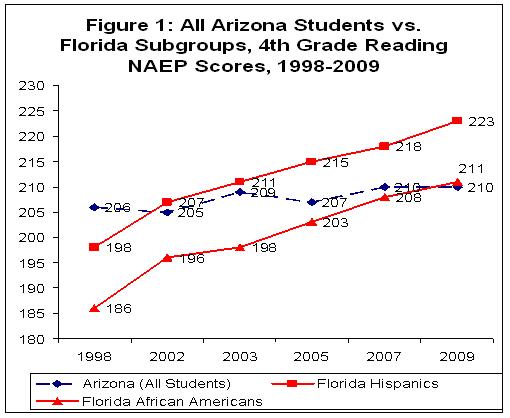
The NAEP released reading scores for the 2009 Reading exams for both 4th and 8th grade. Florida once again crushed the ball in improving student performance. While the nation’s  4th grade reading scores remained flat, Florida’s scores surged ahead.

In 2007, Florida’s Hispanic students outscored 15 statewide averages for all students on 4th grade reading. Two years later, Florida Hispanics tied or outscored 30 statewide averages. Florida’s Hispanics scored 13 points higher than the statewide average for all students in Arizona in 2009, over a grade level worth of learning (10 points roughly equaling a grade level’s worth of learning).

Arizona had company. Florida’s Hispanic students also outscored or tied the statewide averages for all students in Alabama, Alaska, Arkansas, California, Georgia, Hawaii, Idaho, Illinois, Indiana, Iowa, Louisiana, Michigan, Minnesota, Mississippi, Nebraska, Nevada, New Mexico, North Carolina, Oklahoma, Oregon, Rhode Island, South Carolina, South Dakota, Tennessee, Texas, Utah, Washington, Wisconsin and Wyoming.

Florida’s African American students also beat the statewide average for all students in Arizona by a nose. Statistically speaking, this is a tie, but extraordinary nevertheless. In 1998, the average Arizona student scored two grade levels higher than the average Florida African American. Florida’s African American students outscored or tied the statewide scores for eight states: Alaska, Arizona, California, Hawaii, Louisiana, Mississippi, Nevada and New Mexico.

Florida’s success in improving academic achievement for disadvantaged students should inspire the rest of the nation to action.  Importantly, Florida’s reading scores also improved markedly for 8th graders, including very large gains among all the disadvantaged student subgroups, including Hispanics, African Americans, students with disabilities and ELL students. More on that later.

Congratulations to Florida students, teachers, school leaders and policymakers. Florida serves as a beacon to the rest of the nation, and should inspire us all to even greater reform efforts. I’ve said it before, and I’ll say it again now. When it comes to education reform…I’LL HAVE WHAT FLORIDA IS HAVING!

UPDATE: I left West Virginia off of the list of states which Florida’s Hispanic students outscore. West Virginia’s score for all students was 215, Florida’s Hispanics scored 223. So, make that 31 states for Florida Hispanic students!


The Mirage

March 24, 2010

(Guest post by Greg Forster)

It’s fitting that Matt and Jay are posting this morning about their experiences in Vegas, because I was already planning to post about a really big Mirage.

Over the weekend, a lot of conservatives in the blogosphere were consoling themselves with the thought that “now they own the system.”

Jim Geraghty: Direct All Future Health-Care Complaints to 1600 Pennsylvania Avenue

K-Lo: Every hiccup. Every complaint. Every long line. All yours.

I’d love to believe this line, but it’s obviously not true. Dozens of other countries have gone down this road, to their manifest ruin. Did any of them produce this kind of backlash against the party that led the socialization process?

They want to own the system. That’s the whole point. I don’t just mean that they want the wealth and power that comes with actually owning it, although that’s a nontrivial factor. (Just look at how they’re already using the nationalization of student loans to coercively redistribute wealth from grads who choose private-sector jobs to grads who choose public-sector jobs.) They also – even more importantly – want to own it in perception, want to be seen as owning it.

Why? Because in a socialized system, the presumption is that the party that owns the system wants to make it (and hence your health care) bigger and better, while the party that doesn’t own the system wants to redirect resoucres away from it (and hence hurt your health care).

They own the system, therefore they own the issue. If everybody gets their health care from “the system,” then when people want better health care, they’ll always vote for the party that owns “the system.” And, of course, socialized medicine does a lot of damage to health care, and thus generates a lot of desire for better health care. It’s a self-reinforcing dynamic.

Game over, man! Game over!

We do have a limited window in which the law could be repealed before “the system” takes over. But the Journal is right to sound a hard note of caution about the realistic prospects for that. You can’t get repeal until you get a new president. And Obama has three full years to live down the damage he took in this fight. If he gets smart, which it’s very likely he will, he’ll take his licks in 2010 and come roaring back (or at least drag himself over the finish line) in 2012.

Plus, will the GOP commit to repeal? Would they even be smart to commit to repeal given the unlikelihood they’ll get it?


Vegas, Baby

March 23, 2010

I recently returned from an excellent conference organized by the Nevada Policy Research Institute in Las Vegas.  As you can see in the above photo, we had a good time (I’m the one in the middle — the Jewish guy).

At the conference it dawned on me that health care is likely to have a huge, unintended effect on education policy.  By placing significant new health care costs on states, the bill will almost certainly strain state finances.  Since education is the only other really big expenditure in state budgets, look for states to become much more open to ways to economize on education than they have been.  State may become much more interested in virtual education, choice, and other lower cost ways of delivering education.  The days of regular annual increases in education spending are over.  Once that happens the political landscape will almost certainly change. 

Patrick Gibbons, the smart and energetic organizer of the conference, has already blogged on my health care/education trade-off ideas on the NRPI blog.

This was my first time in Vegas, so I should make a quick observation about the place.  I think Las Vegas could best be described as a giant vacuum cleaner that sucks money out of people’s wallets.  The people are glad to have the money vacuumed; they aren’t being robbed.  It’s just that everything about the place has been carefully designed to extract as much money as people will willingly part with.  If you don’t like gambling, they have shows.  If you don’t have shows, they have shopping.  They have food, they have prostitution, they have booze, they have spas, they have luxurious accommodations.  Whatever you want to spend money on, they will provide the service and take your money.  It is the Platonic form of commerce.

I know a lot of people have negative judgements about Vegas, saying that people are exploited or manipulated to give up their money.  That wasn’t my experience.  People were thrilled to have their money taken and seemed to enjoy the process knowing full well what was happening. 

My sense is that it is no more exploitative than the local shopping mall in every city.  It is only far more efficient and on a larger scale.


2009 NAEP Reading Scores Released Tomorrow

March 23, 2010

(Guest Post by Matthew Ladner)

Tune in here tomorrow for news and analysis.


Teacher Union Smackdown

March 23, 2010


Intelligence Squared sponsored a debate in NYC on March 16 on whether teacher unions were to blame for our failing schools.  On the union side was Randi Weingarten and two union bosses whose names are not worth remembering.  On the other side was a dream team of Terry Moe, Rod Paige, and Larry Sand. 

Let’s just say that the debate wasn’t close.  Before the debate the audience was polled and 24% believed teacher unions were not to blame, 43% believed they were to blame, and 33% were undecided.  By the end of the evening 25% believed the teacher unions were not to be blamed, 68% believed they were, and 7% remained undecided. Given the quality of the arguments made by Moe, Paige, and Sand and the lame responses from Weingarten, et al, it’s easy to see how the union side gained virtually no supporters while the union-critics won over an additional 25% of the audience. 

 Here is Terry Moe’s opening salvo: 

What we are saying is that the unions are and have long been major obstacles to real reform in the system. And we’re hardly alone in saying this. If you read “Newsweek,” “Time Magazine,” the “Washington Post,” lots of other well respected publications, they’re all saying the same thing: that the teachers unions are standing in the way of progress. So look. Let me start with an obvious example. The teachers unions have fought for all sorts of protections in labor contracts and in state laws that make it virtually impossible to get bad teachers out of the classroom. On average, it takes two years, $200,000, and 15% of the principal’s total time to get one bad teacher out of the classroom. As a result, principals don’t even try. They give 99% of teachers — no joke — satisfactory evaluations. The bad teachers just stay in the classroom. Well, if we figure that maybe 5% of the teachers, that’s a conservative estimate, are bad teachers nationwide, that means that 2.5 million kids are stuck in classrooms with teachers who aren’t teaching them anything. This is devastating. And the unions are largely responsible for that. They’re also responsible for seniority provisions in these labor contracts that among other things often allow senior teachers to stake a claim to desirable jobs, even if they’re not good teachers and even if they’re a bad fit for that school. The seniority rules often require districts to lay off junior people before senior people. It’s happening all around the country now. And some of these junior people are some of the best teachers in the district. And some of the senior people that are being saved are the worst. Okay. So just ask yourself, would anyone in his right mind organize schools in this way, if all they cared about was what’s best for kids? And the answer is no. But this is the way our schools are actually organized. And it’s due largely to the power of the unions. Now, these organizational issues are really important, but they’re just part of a larger set of problems. Our nation has been trying to reform the schools since the early 1980s. And the whole time the teachers’ unions have used their extraordinary power in the political process to try to block reform and make sure that real reform just never happens. Consider charter schools. There are many kids around this country who are stuck in schools that just aren’t teaching them. They need new options. Well, charter schools can provide them with those options. But charter schools are a threat to teachers’ unions. If you give kids choice and they can leave regular public schools, then they take money and they take jobs with them. And that’s what the teachers’ unions want to stop. So what they’ve done is they’ve used their power in the political process to put a ceiling on the numbers of charter schools. As a result in this country today, we have 4,600 charter schools. There are like well over 90,000 public schools. So this is a drop in the bucket. And mean time charter schools have huge waiting lists of people who are desperate to get in. In Harlem, for example, the charter schools there got 11,000 applications for 2,000 slots recently. So just to give you an idea of about how the politics of this works out, in Detroit a few years ago, a benefactor came forth and said he was willing to donate $200 million to set up additional charter schools for the kids in Detroit who obviously need it. What did the union do? The union went ballistic. They shut down the schools, went to Lansing, demonstrated in the state capitol and got the politicians to turn down the $200 million for those kids. This is good for kids? I don’t think so. This is about protecting jobs. The same kind of logic applies with accountability. Accountability is just common sense. We obviously need to hold schools and teachers accountability for teaching kids what they’re supposed to know. But the teachers’ unions find this threatening. They say they support accountability but they don’t want teachers held accountable. Any sensible effort to hold teachers accountable, they brand as scapegoating teachers. They don’t even want teachers performance to be measured. Right here in New York City, Joel Klein indicated a while ago that he was going to use student test scores as one factor in evaluating teachers  or tenure. What did the union do? Now, this is something that Obama supports, that Arne Duncan supports. It’s unbelievable. What the union did is they went to Albany and they got their friends in the legislature to pass a law making it illegal to use student test scores in evaluating teachers for tenure anywhere in the state of New York. It’s just outrageous. And makes no sense from the standpoint of what’s best for kids. The “New York Times” called it absurd. This is how the unions approach accountability. Okay, well, I don’t have a whole lot of time left here. So let me just quickly say our opponents are going to say tonight, and Randi has already said, there is really no conflict between standing up for the jobs of teachers and doing what’s best for kids. But the thing is there is a conflict. And that’s why we can’t get bad teachers out of the classroom, because they protect them. That’s why the schools have totally perverse organizations imposed on them, and that’s why totally sensible reforms are seriously resisted in the political process. Now, what you’re going to hear, I’m sure, throughout the evening is that union leaders and unions around the country, they’re actually reformers too. They want to get bad teachers out of the classroom. They say they’re for charter schools; they’re all in favor of accountability. Well, not really. Talk is cheap. What counts is what they actually do. And what they do is to oppose reform. This is the reality. 
 
A union boss from Lowell, MA responded: 
 
 I’m from the commonwealth of Massachusetts. Which I’m very proud to say is number one in the country. Our students perform higher than anybody else in this country academically. Yet we have the strongest collective bargaining rights in the country. So do me it just doesn’t add up. And then I started thinking I’m also a doctoral student so I’m trying to learn as much as I can about research and so the next thing I did is I went straight to the literature. Even Professor Moe said publications are all saying the same thing. There is no research to support what he is saying. There is no research out there that correlates student achievement to collective bargaining rights to teach unionism, either for or against. 
 
And check out this exchange: 
 
[Moderator]: And I want to begin with a couple of specifics — specific charges that were laid out there without responded to. Terry Moe specifically saying that teachers unions operate against the whole notion of charter schools, that they try to stop them wherever they find them. I want to hear from the other side, true or not true. Let’s start with Randi Weingarten. 
  
 Randi Weingarten: Well, given that the United Federation of Teachers under my watch, started two charter schools in Eastern York, it’s totally and completely untrue. What we want to do is we want charters to be held to the same accountability standards including the ones that we started, as any other school and what the evidence has been in New York, like the evidence around the country, is that charter schools instead of, as Diane Ravitch said, should take more of the most at-risk kids are actually taking fewer special needs kids and fewer kids with limited English proficiency. So we’ve open to, we think charters could be a great incubator for instructional practice and could be a great incubator for labor relations practice. But Terry, I don’t want New York to be as much as an evidentiary zone as Washington D.C. seems to be, which means let’s look at the Credo story which were done with a pro-charter advocate. What they said was, where 17 percent of the charters are better than public schools, 34 percent are worse, and the rest are the same. The idea is to actually find what works, make it sustainable and make it replicable. That’s what we’re trying to do and that’s what I’m trying to do.  
 
[Moderator]: Terry Moe, Randi Weingarten is saying no, it’s not true that they are against all charter schools. 
Terry Moe: Well let me first point out that New York State has a cap on the number of charter schools. It has a cap because this union put it there. 
[applause] 

Terry Moe: And even under the pressure of race to the top, they wouldn’t lift the cap. Right, so this is not an organization that’s in favor of charter schools. They’ve done everything they can to keep charter schools down. What they’re doing now in New York City is they’re running three charter schools to show if they can, that unionized charter schools can work, because what they want to do, is to unionize all the charter schools. That’s the only reason they’re doing it….  

[applause] 

Randi Weingarten: I mean, what’s interesting Terry is that I didn’t know you were in my head so much. We are not running charter schools to unionize all charter schools. 
 
Terry Moe: Where’d the cap come from? 
 
Eventually the debate is opened to questions from the audience and someone asks how many teachers had been fired for poor performance in New York state.  Rather than answering Randi Weingarten begins to question whether the audience was packed with opponents,  She says: 


Well, but I think that the tone — what I have experienced in terms of New York City is that in a — most teachers right now, as we are speaking, are at home actually grading papers and marking lessons. And frankly, from my perspective when I was the teachers union president here, I never actually asked people to come or pack an audience or do these things, from my perspective. 
 
When someone dodges a question and says she doesn’t have enough allies in the audience because they are busy working at home, you know it’s over.  Put a fork in her, she’s done. 
 
There are too many great arguments from Rod Paige and Larry Sand that I’ve left out, so I urge you to read the whole thing.  

The Wheels Are Coming Off the National Standards Train

March 21, 2010

Less than two weeks ago Andy Rotherham was declaring victory for a national standards consensus:

If the only person WaPo’s Nick Anderson can find to critique the push for common standards on the record is Susan Ohanian, does that mean it’s close to a done deal?   That pierced my skepticism more than anything else in this process so far!

But not everyone jumped onto the national standards train.  In fact, the wheels seem to be coming off.  Strong resistance to adopting these national standards has developed in Minnesota, Virginia, Massachusetts, and California — joining Texas and Alaska who already declared their opposition. 

Now the Wall Street Journal has joined the rising chorus of nat stand skeptics.  Here’s the meat of their argument:

The biggest challenge may be reaching agreement on what a national curriculum should include. In the 1990s, the Bush and Clinton Administrations advocated national history standards. But the process became dominated by educators with a multicultural agenda preoccupied with political correctness and America’s failings. The Senate censured the history standards by a vote of 99 to 1. The recent brawl over the Texas social sciences curriculum suggests that what works in Nacogdoches isn’t going to fly in Marin County, and vice versa.

Under the 2002 No Child Left Behind Act, states are free to set their own standards, and it’s certainly true that some have dumbed-down their exams to meet the law’s requirements. The latest national standards effort is intended to correct this practice and ensure high-quality standards across all 50 states.

However, national standards won’t tell us anything we don’t already know about underperforming states. The U.S. already has a mandatory federal test in place—the National Assessment of Educational Progress exam (NAEP)—to expose states with weak standards. Mississippi may claim that 89% of its fourth graders are proficient in reading, according to the state test. But when NAEP scores show this is true of only 18% of fourth graders, Mississippi education officials aren’t fooling anyone.

It’s true that some countries with uniform standards (Singapore, Japan) outperform the U.S., though other countries with such standards (Sweden, Israel) do worse. On the 2007 eighth-grade TIMSS test, an international math exam, all eight countries that scored higher than the U.S. had national standards. But so did 33 of the 39 countries that scored lower. The U.S. is also commonly regarded as having the best higher education system in the world, though we lack national standards for colleges and universities.

National standards won’t magically boost learning in the U.S., and if this debate distracts attention from more effective reforms, then public education will be worse off. State and local educators don’t need more top-down control from Washington. They need the freedom and authority to close bad schools, recruit better teachers and pay them based on effectiveness rather than tenure.

Most important, families need more educational choices. Some 2,000 high schools are responsible for half of all drop-outs in America, and forcing those schools to compete for students and shape up or shut down is the main chance. Higher standards will be the fruit of such reforms, not the driver.


Who’s Fickle?

March 19, 2010

(Guest post by Greg Forster)

The new Gadfly opens with Mike Petrilli’s article “Fickle on Federalism.” At the head of the article he juxtaposes these two quotes:

“[This plan] will fundamentally change the federal role in education. We will move from being a compliance monitor to being an engine for innovation.”

–Secretary of Education Arne Duncan, March 17, 2010, before the House Education and Labor Committee


“In coming weeks and months…we will be announcing a number of compliance reviews to ensure that all students have equal access to educational opportunities.”

–Secretary of Education Arne Duncan, March 8, 2010, at the Edmund Pettis Bridge in Selma, Alabama

Good one!

But I’ve got a better one. Scroll down to the next article in the Gadfly and you’ll find Checker’s NRO piece, in which he twists himself into even tighter pretzel knots on the new national standards train wreck. Here’s what he was writing about that on Feb. 23:

This is enormously risky and, frankly, hubristic, since nobody yet has any idea whether these standards will be solid, whether the tests supposed to be aligned with them will be up to the challenge, or whether the “passing scores” on those tests will be high or low, much less how this entire apparatus will be sustained over the long haul.

But in the March 10 New York Times, he was singing a different tune:

I’d say this is one of the most important events of the last several years in American education… Now we have the possibility that, for the first time, states could come together around new standards and high school graduation requirements that are ambitious and coherent. This is a big deal.

Now, in the new Gadfly, he’s careful to weasel around without actually taking a clear position. He opens by saying “conservatives should take seriously the potential” of the standards. “Take seriously the potential”? What does that even mean? Should we support or oppose?

And at the end he concludes that the standards are “light years better than we had any right to expect.” So’s the health care monstrosity currently winding its tortuous way through the House; compared to what I thought they’d get, I’m shocked at how little they’ve ended up with. But that doesn’t mean passing it wouldn’t be a huge disaster; it just means it wouldn’t be as huge a disaster as I had feared (or, more likely, that the huge disaster will be longer in coming to fruition).

In between, he lists five surprisingly weak reasons to support the standards – and then four even weaker warnings about “risks” involved in the enterprise. Check out this howler:

Third, they emerged not from the federal government but from a voluntary coming together of (most) states, and the states’ decision whether or not to adopt them will remain voluntary. Each state will determine whether the new standards represent an improvement over what it’s now using.

Riiiiiiiiiight.

Or take the example of hijacking. The Dr. Jekyll Checker from February sounded warnings that the standards, once imposed, could subsequently be hijacked by the Dark Side. The Mr. Hyde Checker in the Times seems to have forgotten all about this. Here’s the new, pretzel Checker in the Gadfly:

Third, the long-term governance of these standards–and of the assessments to follow–is unknown. Something more durable will need to be found or created than the consortium of states that produced the present draft. (Fordham is developing ideas and options for this, and others will surely weigh in as well.)

So yes, hijacking is a danger. But don’t worry, Checker’s clarion call for somebody to do some sort of something that will do something about this problem will no doubt be heeded and acted upon with dispatch!

What really galled me was the closing line:

Remember, it’s liberals who believe that people should be held to different standards.

Right. Because if Johnny learns long division in fourth grade and Suzy learns it in third grade, that’s the moral equivalent of a racial quota.

Let’s be clear. Conservatives believe that everybody should play by the same rules. That’s different from saying everybody should be forced to conform to the same model of life. It’s liberals who believe that – as Jonah Goldberg has shown so clearly in Liberal Fascism.

Personally, I agree with Checker that too many children have not had access to a solid academic education. The solution to that is not to impose the One Right Way on every child, but to smash the oppressive power structure that has stood in the schoolhouse door for a hundred and fifty years, preventing those children from getting the education they need. Checker wants to make the oppressor even bigger and more powerful, in the hope that he can bend it to his will. Good luck.


Jay Interviewed on National Standards

March 17, 2010

(Guest Post by Matthew Ladner)

Jay was interviewed on EducationNews today on National Standards. Strangely enough, the talk quickly turned to movies and awesomely bad pop culture! I can’t imagine how that happened…we take ourselves very seriously around here at JPGB, and indulge in such frivolity with only the most profound reluctance.

Btw Jay- where is this week’s LOST post?


The Democrats’ War on Education Science

March 17, 2010

“I keep my brain in this pickle jar for safe-keeping.”

It was perfectly predictable but still sad to watch.  The U.S. Senate voted 55-42 yesterday against continuing the DC voucher program.  Among Republicans only Olympia Snowe voted against the program.  Among Democrats (or Independents), Feinstein, Lieberman, Nelson, and Warner voted for the program.

Normally we hear that Republicans are engaging in a war on science — opposing stem cell research, questioning global warming claims, etc…  But judging from the arguments that opponents made in yesterday’s debate, Democrats are also engaged in a war on science, at least a war on education science.  They couldn’t be bothered to fully or accurately reference the U.S. Department of Education’s evaluation of the program that found significant benefits for voucher recipients after 3 years.

Instead, the quality of the opponents’ scientific reasoning was exemplified by Sen. Byron Dorgan of South Dakota.  As you can see in this link to CSPAN coverage (starting around minute 21), he argues that there is no need for vouchers because our public school system is doing a great job.  And we know this because graduates of American public schools were the people who put a man on the moon.  I’m not sure what public school Wernher von Braun attended.

Dorgan goes on to reference the U.S. Department of Ed evaluation, but he leaves out the positive main finding and focuses only on a sub-group analysis of students who came from very low performing public schools.  The point estimate for that sub-group analysis is positive but the sample is small and so the effect is not statistically significant.

I know I’m using big words that may be a little hard for the likes of Sen. Dorgan to grasp, but the blatant disregard for scientific evaluations of government programs demonstrated by Dorgan, Durbin and the rest of the program opponents shows that they are the ones engaging in a war on science.

UPDATE — Maybe my brain has been picked because Dorgan is from ND, not SD.  Oops.

(corrected for typos)


National Standards, Welfare Reform and the Dream of the One True Way

March 16, 2010

(Guest Post by Matthew Ladner)

So why not national academic standards?  Many states, after all, have awful standards. Some with decent standards have nevertheless dropped their cut scores to the point of undermining those standards. Surely the states have proven that they cannot be trusted with this responsibility.  A set of high quality national standards could replace this balkanized mess and improve the sorry state of American education.

Actually, not so much.  First however we should consider the scale of the problem with state accountability tests.

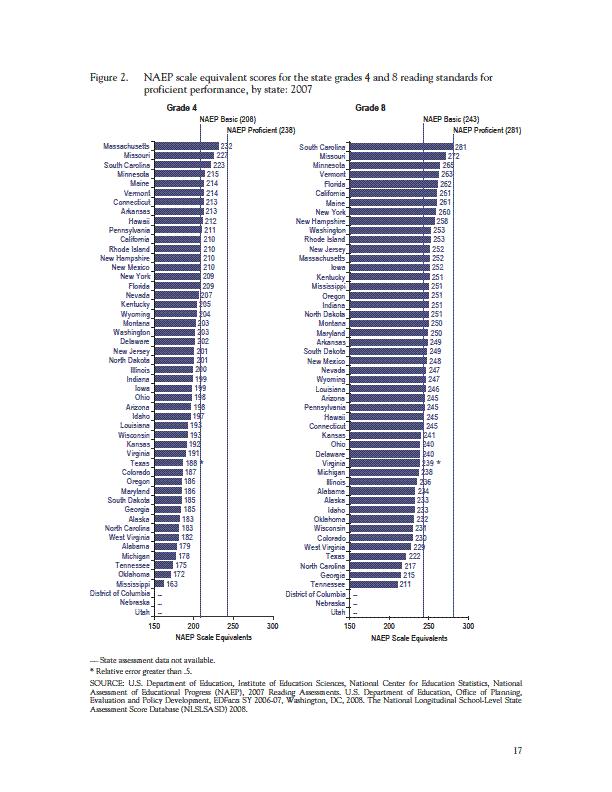
Above is a table from a NAEP study which used an equating procedure to determine where the “proficiency threshold” for each state’s exam would compare to the NAEP 4th and 8th grade reading exam. As you see, many states have proficiency cut scores which would merit a child a “below basic” score on NAEP. No state makes the equivalent of proficient on a 4th grade reading test equivalent to the 4th grade NAEP, and only one state does so on the 8th grade exam.

In Mississippi, one can “pass” the 4th grade reading test with a score which is 25% lower than “Basic” on NAEP, never mind proficient. This is a c*r*u*e*l j*o*k*e to play on children.

American welfare policy provides an insight into why it is not however a good idea to have the federal government take this over. Political scientists have established a strong relationship between shifts in public opinion and trends in federal spending. When the public decides they want more of something, like defense spending, they get it. Two exceptions had been foreign aid and welfare (AFDC). This spending endured despite widespread public hostility as a result of a Burkean elite consensus that this spending had to go on despite the fact that the people providing the funds, by large margins, didn’t want the money spent.

Much ink was spilled back in the late 20th century regarding whether the American public ought to have hated welfare as much as they did. Welfare queens- myth or reality…etc. etc. etc. Ultimately, this didn’t matter other than as a justifying myth to those who wanted elites to continue to ignore public opinion on the subject. America had a welfare program run out of Washington, and lacked a consensus about what to do about it, even after it was widely viewed as a failure.

Eventually an elite consensus formed around the notion that in the long run, welfare was cruel to the recipients, creating a powerful disincentive to work and develop job skills. This new consensus could be seen as early as the late 1980s, but for the most part, the national welfare Gosplan went on as usual, with minor tinkering at the edges.

Given the lack of a national consensus on what to do about AFDC, the Republican Congress and President Clinton eventually agreed to devolve welfare to the states. Different states tried different approaches, but by and large in did not prove terribly difficult for states to reach a consensus about how to deal with the issue. Nor did it prove difficult for the states to (mostly) do a better job than the federal government. The Personal Responsibility Act of 1996 is widely viewed as having been a rare social policy success.

In K-12, the long-term increase in the role of the federal government has coincided with a long-term collapse in the productivity of American K-12 spending. Federal involvement did not drive this collapse, but did contribute to it, and certainly did not prevent it. Secretary of Education Rod Paige lamented the billions spent on Title I with next to nothing to show for in terms of improved academic performance at the start of the George W. Bush administration. Sadly, not much has changed in terms of performance, but spending continued to rise.

Why not national testing? Given that there is no national consensus on what constitutes a high quality education, there is no prospect for an enduring national consensus on high quality standards. In fact, it seems fairly obvious to me from the figure above that there is a national consensus for LOW QUALITY ACADEMIC STANDARDS AND TESTS.

The danger in creating “common core standards” and then forcing states to adopt them through NCLB is that when they get dummied down, and they will, they drag the entire nation with them. Despite the fact that the status-quo is awful, it could be worse: we could have the entire country saddled with bad standards and tests.

Federalism has not been a cure for K-12 because all states have essentially the same problem: large politically powerful special interest groups in every state who prefer the status-quo. In recent years, however, we have not lacked for “labs of reform” out in the states. Jeb Bush’s reforms in Florida have significantly improved academic outcomes for disadvantaged children. The NAEP needle seems to be moving in the right direction in Washington DC. Massachusetts is proud of its standards led reforms and highest overall NAEP scores. Indiana has a reform-minded governor and schools chief determined to learn the lessons from these examples, and to take the next steps.

To be sure, these examples are few and far between, but they do exist. Just as Tommy Thompson led the way on welfare reform by seeking federal waivers from a federal “one true way” on AFDC, those few states that have departed from the “throw more money at schools and wring our hands” consensus fostered by the teachers union have shown progress as well.

It is however NOT likely to be the case that there will be any sort of sustainable national consensus on using high quality standards or tests in Washington DC. The same political forces which dummied down most of the state tests will eventually, if not from the start, dummy down a national effort. The genius of federalism is that a state consensus can be developed much easier in a state than in the nation as a whole. As more states enjoy success, we can expect other states to copy their practices through the normal process of policy diffusion. This process is already under way.

We could however suspend the laws of political dynamics. We could skillfully impose strong tests and standards on states against their wills, and resist their efforts indefinitely to undermine such tests until such time as the public grew to accept, love and defend them from special interest attack. Riiiight. It is also worth noting that while a DC elite consensus fended off AFDC from the public will for decades, they *ahem* got it WRONG…

Sorry kids, but the road to K-12 reform is a long, hard slog that primarily leads through 50 state capitols. We already have a national test for gauging the effectiveness of  state K-12: NAEP. The only reason that NAEP wasn’t dummied down is because no one’s school label or job performance hangs on the results. It is hard enough to maintain a consensus for decent standards in a handful of states. The chance that it will happen at the national level is vanishingly small and the danger of such an attempt very real.