Reaction To SC Decision on Special Ed

June 29, 2009

Reactions are beginning to pour in on the Forest Grove School District v. T.A. Supreme Court decision, which Greg and I wrote about last week.  Predictably and unfortunately, those reactions are informed by concerns for the financial burdens of the decision that are lacking in both facts and perspective. 

Even the dissenting opinion, written by Souter and joined by Scalia and Thomas, made a point of worrying about the costs:

The majority’s suggestion overlooks the terms of the IDEA process, the substantial procedures protecting a child’s substantive rights under the IDEA, and the significant costs of its rule. To start with the costs, special education can be immensely expensive, amounting to tens of billions of dollars annually and as much as 20% of public schools’ general operating budgets. See Brief for Council of the Great City Schools as Amicus Curiae 22–23. The more private placement there is, the higher the special education bill, a fact that lends urgency to the IDEA’s mandate of a collaborative process in which an IEP is “developed jointly by a school official qualified in special education, the child’s teacher, the parents or guardian, and, where appropriate,the child.”Burlington, supra, at 368.

Just how much private placement is there?  How much does it really cost?  How big is this relative to total enrollment and expenditure in public schools?

As of 2007 there were 67,729 disabled students in private school at public expense who were there at the initiative of their parents.  That is 1.1% of the 5,978,081 students in special education and 0.14% of the 49,610,000 students in public education.  Theses percentages were not significantly different before 1997 when Congress amended the special education law in a way that the dissent believed would constrain burdensome private placements.  And Marcus Winters and I estimated that the total financial cost of private placement is less than a billion dollars and amounts to less than one-quarter of one percent of total public school spending

I understand that a billion dollars is a lot of money, but in a public education system spending more than $500 billion it is almost rounding error.  Souter, Scalia, and Thomas violate the Denominator Law, where it is required that all claims of “big” problems have to be put in perspective by including a denominator to show how large the problem really is given the full context.  As officers of the Court they should know that ignorance of the law is no excuse!

It’s also strange that Scalia and Thomas would join in a dissent that is based at least partially on concerns for the financial implications of their decisions.  I thought Scalia and Thomas believed in finding the original intent of the law.  A court ruling based on (false) fears of financial burdens of the law sounds like policymaking from the bench.

However, Debra Saunders, in a column on the decision at the San Francisco Chronicle, seems confused about what constitutes policymaking from the bench.  She writes: “the court arguably engages in policy-making when it tells districts how they must spend valuable education dollars.”  There is a federal law, IDEA, that tells schools how they must spend their money (along with the money they receive from the feds).  It says that all disabled students are entitled to a free appropriate public education.  It isn’t policymaking from the bench to say that students unreasonably denied appropriate services shouldn’t have to wait 2-3 years for the Courts to order the schools to provide those services.  The Courts can’t also provide a time machine, so we have to have a mechanism that handles what happens to kids while their parents fight with schools in the courts. 

In Forest Grove the Supreme Court said that parents should be able to take the risk of placing their children in private school and seeking reimbursement.  If the courts agree that the schools unreasonably denied services, then they can get reimbursed for their costs while they were waiting.  If the public schools were reasonable, then the parents are out the money. 

I agree with Debra Saunders that the facts in this specific case make it hard to understand how a lower court found that the public schools behaved unreasonably.  But the law isn’t about one set of facts; it applies to all instances.  If we pretend that the lower courts find that public schools denied a special education classification unreasonably, then obviously students would be denied their rights under IDEA if they had to wait 2-3 years for those services.

Debra goes on to violate the Denominator Law, writing: “It’s one of those nice people things. The government has expanded the notion of disability to the point of absurdity. But nice people refuse to look at the impending drain on public school budgets, or how one child’s boarding school tuition can mean that much less funding for all the other students’ educational needs.”  This was especially frustrating because I pleaded with her to report claims of financial burdens in context.  Besides quoting me, she chose to ignore my point and repeat her claims of burden with no basis to support it.

My colleague, Walter Olson, also has a post on Forest Groveon his blog, Overlawyerd.com.  While I disagree with Wally on this issue, I am sympathetic with his concerns.  Specifically, he notes that private placement is a remedy much more available to wealthy families than poor ones.  And he doubts the justice of disabled students having federally protected rights to an appropriate education while no one else does. 

I agree that rich kids have better access to this remedy than poor kids. That’s why I favor vouchers for special education, both to democratize this remedy and to better control costs. Vouchers control costs because the voucher is worth no more than would have been spent in public schools or private school tuition, whichever is less. Special ed vouchers also discourage over-identification of disabilities because schools would risk losing students when they classify students as disabled.

And I also agree that it is unclear why non-disabled students should have to wait in schools that fail to serve them appropriately while disabled students are entitled to find an appropriate education. But the solution is not to strip disabled students of that right.  The solution is to extend it to all students. Give vouchers to all students worth the amount that would be spent on them in public school (the amount would vary based on the cost of educating different kinds of students). If any student is unable to find what his family believes is an appropriate education, give them the resources to find it somewhere else.


Choice Victory in Special Ed SC Case

June 22, 2009
The Supreme Court ruled 6-3 today in Forest Grove School District v. T.A. that disabled students that the public schools unreasonably failed to identify as disabled don’t have to wait to seek placement in a private school and reimbursement for those costs. 
This ruling seems to give families with disabled children unilateral access to vouchers for private school if they can later prove that the public schools failed to provide adequate services or unreasonably failed to identify the disability.  The families assume the financial risk if they act unilaterally, but they can be fully reimbursed for their expenses if they are proven right.  The majority reasoned that delays were so long in adjudicating these disputes, that children would be denied their right to a free appropriate public education (FAPE) if they had to wait:
 
“Our decision rested in part on the fact that administrative and judicial reviewof a parent’s complaint often takes years. We concluded that, having mandated that participating States provide a FAPE for every student, Congress could not have intended to require parents to either accept an inadequate public-school education pending adjudication of their claim or bear the cost of a private education if the court ultimately determined that the private placement was proper under the Act.” (see p. 7 )
 
Now all we need to do is to grant to all children what we have given to disabled children.  Why should any child, disabled or not, be made to wait for an appropriate education?  Why can’t all parents seek a unilateral private placement and sue to be reimbursed if they can demonstrate that the public schools were failing to provide an appropriate education? 
 
Even better, why should we make parents prove to a court that the education in the public schools was not appropriate?  Why not let the parents be the judge of the appropriateness of the education being offered?
Updated:  I just noticed that Matt made a similar argument a while back.

Lieberman in WashPo

June 22, 2009

Sen. Lieberman has another great piece in the Washington Post on DC vouchers.  The issue just won’t go away as much as the cool crowd wishes it would.


No News — NEA Lies

June 20, 2009

You read it here on JPGB first.  The NEA sent a letter to members of Congress containing bald-faced lies about the DC voucher program.  Now the WSJ has picked up the story.  The WSJ wrote:

Public school teachers are supposed to teach kids to read, so it would be nice if their unions could master the same skill. In a recent letter to Senators, the National Education Association claims Washington, D.C.’s Opportunity Scholarships aren’t working, ignoring a recent evaluation showing the opposite.

“The DC voucher pilot program, which is set to expire this year, has been a failure,” the NEA’s letter fibs. “Over its five year span, the pilot program has yielded no evidence of positive impact on student achievement.”

That must be news to the voucher students who are reading almost a half-grade level ahead of their peers. Or to the study’s earliest participants, who are 19 months ahead after three years. Parents were also more satisfied with their children’s schools and more confident about their safety. Those were among the findings of the Department of Education’s own Institute of Education Sciences, which used rigorous standards to measure statistically significant improvement.

It should be no news that the NEA lies.  They do not have a commitment to the truth; their only commitment is to the interests of their members and leadership.  If that requires lying, they show no restraint.

The only news is that people, including the news media, public intellectuals, and policymakers, continue to treat the teacher unions as if they were credible actors in education policy discussions.  It is a mystery to me why they are ever contacted for comment by reporters or invited to serve on panels.  People who feel obliged to lie should be shunned and their opinions should never be solicited because their opinion can never be trusted as serving the truth.

I understand that the teacher unions have a right to exist, to represent their members in negotiations, and to attempt to influence policy.  But I don’t know why anyone should help them influence policy since they have shown such a callous disregard for truth and obsessive concern with self-interest.

Now I know that Leo Casey or one of his sock puppets might accuse me of being untrustworthy.  Here’s the difference:  While I might be mistaken, I am unlike the union folks in that my continued employment is not dependent on my holding particular opinions.  If I woke up tomorrow and decided that vouchers made no sense, I would be perfectly free to do so without penalty.  My position as a tenured professor does not depend at all on my believing that something  is true.

The same cannot be said for Leo Casey or other unions flacks.  If they woke up one morning and decided that vouchers were the key to improving the education system, they could not say so and expect to continue to be employed.  If they cannot change their mind without severe penalty, why would we believe that they are telling us their honest opinion now?  And if we can’t be sure that they are telling us their honest opinions, why would we ever ask them for their opinions?

I also know that some might accuse Matt or Greg of lacking the freedom to change their minds since they don’t have tenure like I do.  Actually, there is a remarkable amount of latitude at think tanks for people to say what they really think.  If you don’t believe that, think about Sol Stern or Diane Ravtich.  Besides, if Matt or Greg suddenly changed their minds they could pretty easily find work at another think tank that held a different view.  Where would all of the union people work if they changed their minds?

I say what I say because I believe it is the truth.  The teacher unions say what they say because they want something.


The Lie Seems to Be Spreading

June 15, 2009

Pinnochio

(Guest post by Greg Forster)

Here on JPGB we’ve been tracking the progress of Dick Durbin’s lie that the DC voucher program didn’t show academic gains – which is all true except for the part where it says that the program didn’t show academic gains. (We’ve also had some fun passing along the AP’s reprot that Durbin tried to help Rod Blagojevich make a deal for Barack Obama’s vacant Senate seat.) Now it would appear that we’ve made our way back upstream to the source.

A little bird told me the NEA has mailed out the following letter to all U.S. Senators. Note the line I’ve highlighted.

June 11, 2009

Dear Senator:

On behalf of the National Education Association’s (NEA) 3.2 million members, we would like to express our strong opposition to proposals reportedly under consideration in the Armed Services Committee to provide private school vouchers for military families.

Vouchers are not real education reform.  Pulling children out of the public school system doesn’t solve problems – it ignores them.  Real reform will put a qualified teacher in every classroom, keep their skills up to date with continuing education, and raise pay to attract and retain the best teachers.

Proponents of a military family voucher program have cited the District of Columbia voucher program as a model.  However, the DC voucher pilot program, which is set to expire this year, has been a failure.  In fact, over its five year span, the pilot program has yielded no evidence of positive impact on student achievement.

Vouchers are clearly not the right solution to ensure every student the highest quality education.  Voucher schools are permitted to maintain their admissions standards and can reject any public school student they choose.  They can reject students based on prior academic achievement and on the basis of gender.  Students with special needs often cannot find a private school that can serve them.  In contrast, public schools serve all students who come through their doors.

Providing vouchers for 750,000 students in military families stationed in the United States would be a huge expense.  These resources would be much better spent on to ensure ALL children the highest quality education.  The U.S. Department of Education has created the What Works Clearinghouse (WWC) clearinghouse to help school districts, educators, parents, and other stakeholders choose programs that have been proven effective.  A brief review of their database revealed dozens of programs that have been scientifically proven effective at improving student achievement in reading and math, at increasing the likelihood of students staying in school and completing their education, and at improving the language and achievement of English language learners.  We have attached examples of these programs for your information.

Again, we urge your opposition to any proposals to create a private school voucher program for military families.

Sincerely,

Diane Shust
Director of Government Relations

Randall Moody
Manager of Federal Advocacy

Of course, the whole letter is shot through with dishonesty – but it’s the sort of dishonesty that’s routine in politics. (E.g. The empirical evidence consistently shows that vouchers do in fact “solve problems,” not only by helping the students who use them but by improving public schools.)

The highlighted sentence, on the other hand, represents the kind of thing you normally can’t get away with. No matter how many Senators you buy.

Hey, here’s a question (and not just for Leo): If vouchers are really so bad, why do their opponents have to lie about them all the time?


Twin Editorials on Milwaukee Vouchers

June 4, 2009

Weasley Twins

(Guest post by Greg Forster)

This morning the Wall Street Journal and National Review Online both take on the covert effort to destroy Milwaukee vouchers by political subterfuge.

From the Journal:

Because the 20-year-old program polls above 60% with voters, and even higher among minorities, killing it outright would be unpopular. Instead, Democratic Governor Jim Doyle wants to reduce funding and pass “reforms” designed to regulate the program to death. The goal is to discourage private schools from enrolling voucher students and thus force kids to return to unionized public schools.

From NRO:

Last week, the legislature’s Joint Finance Committee approved a series of auditing, accrediting, and instructional requirements that will force successful voucher schools to shift resources away from classrooms and into administration. Several schools will have to comply with new bilingual-education mandates, even though many immigrant parents choose those schools precisely because they emphasize the rapid acquisition of English instead of native-language maintenance.

Both editorials also mention looming cuts in funding for vouchers, even though the program saves huge taxpayer dollars and the bloated government schools are getting increases in funding. Both editorials cite Robert Costrell’s calculation that the difference between private school efficiency and public school bloat has saved taxpayers $180 million – though only NRO mentions Costrell by name.

And NRO also gets a gold star for this:

Researchers say that the program is beginning to show systemic effects. In other words, it doesn’t merely help its participants. It also gives a lift to non-voucher students because the pressure of competition has forced public schools to improve.

C’mon, Wall Street Journal, get on the ball!


Was He Stupid or Lying? Durbin-Blagojevich Edition

June 3, 2009

Durbin

(Guest post by Greg Forster)

A while back, noting Sen. Dick Durbin’s flagrantly false statements about the DC voucher study – he said the study didn’t show voucher students outperformed the control group, which is entirely true except for the fact that it did show voucher students outperforming the control group – Jay asked “is he stupid or lying?”

“Of course,” he added, “when it comes to an Illinois pol, one doesn’t have to choose. He could be both.”

Not long ago, when Sen. Durbin made similarly misleading (though now more carefully weaseled) statements in USA Today, Jay remarked, “I’m beginning to lean toward the lying end.”

The first sign of a good scientist is that he adjusts his theory in response to new data!

Well here’s another new datum to factor into our “stupid or lying” calculus. The AP reports that Durbin offered to help Rod Blagojevich make a deal for Barack Obama’s Senate seat. Take it away, AP (emphasis added):

CHICAGO (AP) – Just two weeks before his arrest on corruption charges, then-Gov. Rod Blagojevich floated a plan to nominate to the U.S. Senate the daughter of his biggest political rival in return for concessions on his pet projects, people familiar with the plan told The Associated Press.
 
Blagojevich told fellow Democratic Sen. Dick Durbin he was thinking of naming Illinois Attorney General Lisa Madigan to the seat vacated when Barack Obama won the presidential election, according to two Durbin aides who spoke on condition of anonymity…
 
The aides said the concessions Blagojevich wanted in return were progress on capital spending projects and a health care bill that were stalled in the Legislature…
 
According to the Senate aides, Durbin was delighted to hear that Blagojevich was thinking of naming Madigan to the seat. He believed she would be a popular figure in Illinois and stood perhaps the best chance of holding the seat against a Republican.
 
Durbin volunteered to call the attorney general or the speaker to get the ball rolling and possibly broker an agreement, the aides said.

When the AP came calling about the story, Durbin’s office offered no comment.

Moe Lane of Red State comments: “This would only be a bombshell if it had been unexpected…Senator Dick Durbin has had since November some very significant corroborating evidence that Governor Rod Blagojevich really was corruptly auctioning off a Senate seat.  This is information that would have been very helpful when it came to the timing of Blagojevich’s impeachment, seating Burris, and/or fixing the entire problem with a special election.  And yet, Durbin did or said nothing. I don’t wonder why.  Then again, I know enough about this story to know that the Senator hadn’t realized that his talks with Blagojevich were being recorded.”

Lane highlights the implication that Durbin knew about Blago’s corruption all along, and kept vital information under his hat during the crisis. And Illinois-based politicians betraying the public trust by keeping vital information out of public circulation during a crisis does seem to be emerging as a meme in the DC voucher story.

But doesn’t it seem more important that AP is reporting Durbin offered to help broker the deal?

Yes, what Durbin offered to help arrange was not a bribe to be paid directly to Blago. It was conessions on Blago’s pet projects, including “capital spending projects.” Yet that’s bad enough, isn’t it? I’m aware that people take alliances and rivalries into account when they make these kinds of appointments. But isn’t it something else entirely to arrange a quid-pro-quo transaction of legislative votes for nominations?

And if you insist that there must be a personal bribe involved before we can say it’s wrong, let me ask you: given what we know about Blago, what kind of odds would you give that he wasn’t going to wet his beak on any of those “capital spending projects”? And doesn’t that make Durbin complicit? Or just how dumb are you willing to say Durbin is?

HT Moe Lane, via Jim Geraghty


Did a “Massachusetts Miracle” actually happen?

June 2, 2009

(Guest Post by Matthew Ladner)

There was fierce posting last week here and at Flypaper on the Massachusetts Miracle and what role the unions did or did not do in thwarting said miracle. The question I’ll raise: does MA’s improvement deserve the title of miracle?

MA has the highest NAEP scores in the country, and they’ve improved in recent years, so they don’t have anything to be ashamed of when it comes to education reform. Superficially, they outshine everyone.

However, MA is also a very wealthy and fairly homogenous state.  NAEP lists their free and reduced lunch eligible students at 28.9% (which is low) and their percentage of Anglo children at 72.9% which is pretty high. Spending per pupil is listed at over $12,000 per pupil.

My favorite education reform state, Florida, spends less and has a far more demographically challenging K-12 demographic profile. And…they’ve made much more progress with difficult to educate students.

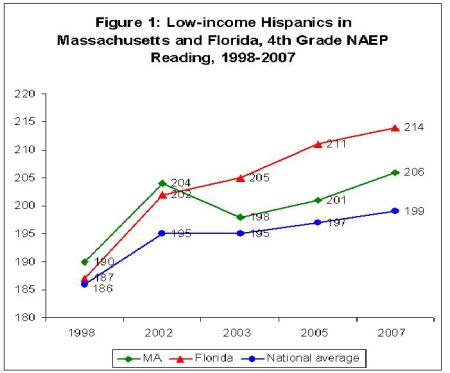
FL MA 1

Looking at progress among the most difficult to educate students gives us a good view of which state has made the most progress. This effectively controls for MA being wealthy and pale. Figures 1 and 2 present data from the 4th grade reading exam.

Among free and reduced lunch eligible Hispanics, Florida has made a great deal more progress than MA- 16 point improvement in MA, a 27 point improvement in Florida. 

MA outperforms the national average, but by a mere three points. Florida doubled the improvement of the national average.

The same is true among free and reduced lunch eligible African American students. MA improved by nine points, the national average improved by ten points, and Florida improved by twenty four points.


FL MA 2Again, MA doesn’t have anything to be ashamed of given their highest scores. There are other wealthy and homogenous states that spend a great deal on their public schools- and MA clobbers them. For me, however, when it comes to education reform


Duncan Endorses Universal Vouchers (without knowing it)

June 1, 2009

Below is a portion of the transcript from a National Press Club event last week featuring Secretary of Ed, Arne Duncan.

If I am reading Duncan right, the problem with vouchers is that they only serve 1 to 2 percent of the population.  So, the obvious solution he endorses must be universal vouchers.  Right?

MODERATOR:  OK.  What is your position on a potential national education voucher program?   

DUNCAN:  I’ve been very, very clear that I don’t think vouchers work.  They’re not the answer.  Let me explain why.      

Vouchers usually serve 1 to 2 percent of the children in a community.  And I think we as the federal government, we as local governments, or we as school districts, we have to be more ambitious than that.  That’s an absolutely worthy or noble goal.  If a nonprofit or philanthropy wants to provide scholarship money to children, that’s a great, great use of the resources.       

But I don’t want to save 1 or 2 percent of children and let 98, 99 percent drown.  We have to be much more ambitious than that.  We have to expect more.       

And this is why I would argue rather than taking one of these struggling schools, these thousands (inaudible) — rather than taking three kids out of there and putting them in a better school and feeling good and sleeping well at night, I want to turn that school around now and do that for those 400, 500, 800, 1,200 kids in that school and give every child in that school and that community something better, and do it with a real sense of urgency. 


Liberating Learning

June 1, 2009

Liberating Learning by Terry M. Moe: Book Cover

Two decades after writing Politics, Markets, and America’s Schools, Terry Moe and John Chubb have done it again.  With Liberating Learning they’ve written a a compelling account of what is blocking significant improvement in public education and provided strategies for overcoming those obstacles. 

The main obstacle has remained the same across the two books: teachers unions.  Organized special interests in education as in other sectors of public policy shape the policies that are made.  In the case of education the special interests are so large, well-organized, and well-funded that their influence has distorted policy significantly to the benefit of the adults working in schools and against the interests of students and their families.

In their earlier book the solution to union dominance was choice and competition.  Interest groups can control policy but they can’t easily control markets.  But in the new book Moe and Chubb (they flipped the order of the names) acknowledge that unions have been generally successful at using politics to block the creation of effective markets.  Something has to loosen the union stranglehold to allow the markets to develop and prosper.

In Liberating Learning they’ve found what they think will break that logjam: technology.  The increasing use of technology in education will transform the operation of schools and the role of teachers in education.  In general, it will reduce the need for teachers by replacing (at least to some extent) labor with capital.  It will generate tons of data, improving the transparency of schools to the public and policymakers.  And it will decentralize the education workplace, making it harder for unions to organize and control the workforce.

There are clear echoes of Clayton Christensen’s work on disruptive technologies in this new book.  But unlike Christensen, Moe and Chubb focus on the politics of public organizations rather than technology per se.  In fact, if you are looking for detailed descriptions of how technology should be used in education or hard proof of its effectiveness, you won’t find it in Moe and Chubb’s new book.  They are not trying to prove that these technologies are educationally effective or describe best practices, although it is clear that they have some ideas on these topics.  They are trying to describe the political logic of the current stagnation in education and how it might be altered.

The clear writing and tight argument will make Liberating Learning a pleasure to read for education reformers.  We might still wonder whether unions will be able to use politics to block the transformative effect of technology, but the book is sure to provoke a lot of productive discussion and thinking.

(edited for typos)